

III. Pisces-10. Ichthyofauna of Kharkiv Oblast
A component of the vertebrate zoology practicum is an examination of the ichthyofauna of Kharkiv Oblast
Ichthyofauna of Kharkiv Oblast
European bitterling (Rhodeus amarus)
A small (TL 4–7 cm) shoaling, sedentary fish. The body is deep, the lateral line is short (4–7 scales), and the dorsal and anal fins lack serrated spinous rays. In the posterior half of the body a greenish-blue stripe is visible, reaching the end of the scale cover and widening somewhat on the caudal peduncle. The mouth is small, slightly oblique, subterminal. Pharyngeal teeth uniserial, laterally compressed, unserrated; dental formula predominantly 5–5.
The species inhabits both riffle areas and sites with slow current or standing, often heavily vegetated waters with rocky or sandy-silty substrates. The bitterling spends much of its time in the benthic layer among aquatic vegetation; it is rarely encountered in open areas. It feeds chiefly on phytoplankton, as well as algae and small insect larvae. Spawning is fractional, occurring during spring and summer. By the onset of spawning, in late April–May, the female develops a long ovipositor, while the normally bluish-silver colouration of the male flanks changes to crimson-pink, making the bitterling one of the most brilliantly coloured of our fishes, comparable in beauty with exotic aquarium species. By its spawning strategy the bitterling is classified as an ostracocophil: using the ovipositor, the large eggs (diameter 1.7–2.1 mm) are deposited by the female in small successive batches into the mantle cavity of bivalve molluscs, where further development takes place under reliable protection. Absolute fecundity ranges from several tens to nearly 300 eggs.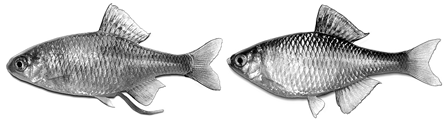
European bitterling — female with ovipositor and male in breeding dress
Goldfish (Carassius auratus)
Crucian carp (Carassius carassius)
Prussian carp (Carassius gibelio)
The carps of the genus Carassius are characterised by a short, deep body, tightly adherent large scales, and a large, serrated along the posterior margin, unbranched ray in the dorsal and anal fins. The mouth is small, terminal, obliquely directed. Barbels are absent. The crucian carp has a predominantly yellowish-bronze overall colouration, a deep rounded body, and a pale abdomen. The Prussian and goldfish are usually grey, sometimes blackish, bronzed, or silvery-white, with a dark abdomen and a higher number of gill rakers (39–50 versus 23–25 in the crucian carp). Their body is generally less deep and less rounded than in the crucian carp (Fig. 2.4). Pharyngeal teeth uniserial, 4—4.
All Carassius species prefer slowly flowing or standing waters of floodplain lakes, oxbows, and ponds densely overgrown with aquatic vegetation, often marshy; they are frequently found in sun-warmed, silted zones of low oxygen content. They remain almost continuously in immediate contact with the bottom, feeding on benthos. The Prussian carp, somewhat smaller in size, avoids currents and small streams. In some water bodies they are the sole representatives of the ichthyofauna. Medium-sized fishes, maximum total length (TL) may reach 40 cm, but on average much less; a dwarf stunted form is frequently encountered.
Spawning is fractional; in the crucian carp from mid-May to mid-June, in the others possibly from April to July. In terms of spawning strategy the carasses are classified as phytophils: eggs are deposited in shallow water on aquatic vegetation or on plants of flooded floodplain meadows.
Absolute fecundity in the carasses depends on age and size and may reach 600,000 eggs.
The first record of the Prussian carp in the basin dates to the beginning of scientific ichthyological surveys in the region, and the first published record of the goldfish dates to 2009. 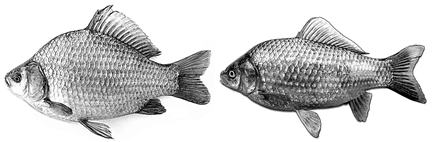
Carasses: crucian carp (left) and Prussian carp (right)
Common carp (Cyprinus carpio)
The common carp, or its domesticated form, prefers cleaner and better-oxygenated water than the carasses and tench, but likewise avoids river reaches with swift current. The scales of the common carp are fairly large and golden-yellow; the dorsal fin is long and dark grey; the posterior edge of the last unbranched ray of both the dorsal and anal fins bears fine dentations in the form of a saw. The caudal fin is reddish-grey, the paired fins and anal fin are yellowish. On the upper lip is a pair of short barbels. The mouth is terminal; pharyngeal teeth trisinuate, 1.1.3—3.1.1. A fairly large fish, maximum total length may reach 1 m at a body mass exceeding 20 kg.
The species remains almost continuously near the bottom, feeding on benthos. Spawning is fractional and phytophilous, lasting from late April to early June in the littoral zone of the water body among soft aquatic and flooded floodplain vegetation. Absolute fecundity ranges from 96,000 to 1.5 million eggs.
The common carp is one of the most widespread and popular objects of aquaculture. 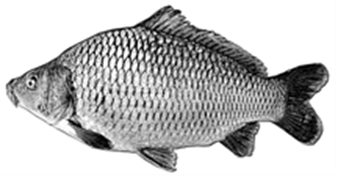
Common carp
Grass carp (Ctenopharyngodon idella)
A herbivorous introduced species. The only member of our ichthyofauna that feeds primarily on higher aquatic vegetation. The body is elongate, low, fairly thick, and only slightly compressed laterally. The forehead is broad, the eyes are small, and the mouth is subterminal. The predominant body colouration is yellowish-grey. Pharyngeal teeth bisinuate, 2.5—5.2 or 2.4—4.2, sharply serrated, with a groove on the masticatory surface.
An aquaculture species that reproduces only under artificial conditions; it enters natural water bodies from ponds and reservoirs used for fishery operations. May reach 120 cm in length at body mass up to 30 kg. Near the biological station it is rare, encountered only occasionally in the catches of recreational anglers in the main channel of the Siverskyi Donets and its backwaters. 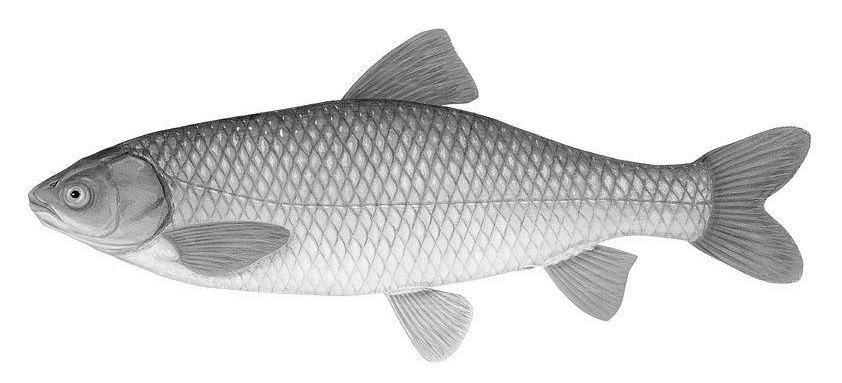
Grass carp
Don gudgeon (Gobio brevicirris)
Don white-fin gudgeon (Romanogobio tanaiticus)
Gudgeons have a sub-cylindrical body, more cylindrical anteriorly, covered with large scales; at the mouth there is 1 pair of barbels. Along the lateral line on the flanks are 7–11 rounded dark spots of varying distinctness. Pharyngeal teeth bisinuate, elongated into a distinct hook, most often 3.5–5.3. The body length of these small shoaling fish usually does not exceed 13 cm. The Don gudgeon inhabits rivers, remaining on the bottom in shallow areas with weak to moderate current, or in lakes and ponds on sandy or gravelly shoals. The Don white-fin gudgeon (long-barbelled gudgeon) is endemic to the Don and Siverskyi Donets basins; it lives primarily in the main river channel and is thus encountered in catches considerably less often than the preceding species. It is distinguished from the Don gudgeon by its pale, unbarred or unspotted dorsal and caudal fins (the Don gudgeon has barred fins), a shorter snout, and a longer barbel that extends beyond the posterior orbit margin. The mouth is inferior.
Gudgeons are typical benthophages; their diet consists of aquatic benthic insect larvae, worms, small molluscs and crustaceans, as well as plant detritus. Spawning is fractional, with eggs deposited on sand or hard substrate. Spawning begins in May when water warms to 13–20°C and continues until July. Absolute fecundity of the Don gudgeon averages approximately 4–7 thousand eggs, up to 12,000 maximum; that of the white-fin gudgeon is somewhat lower.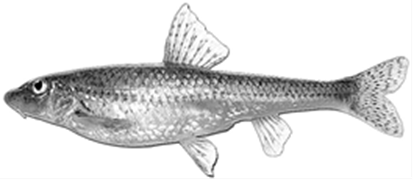
Don gudgeon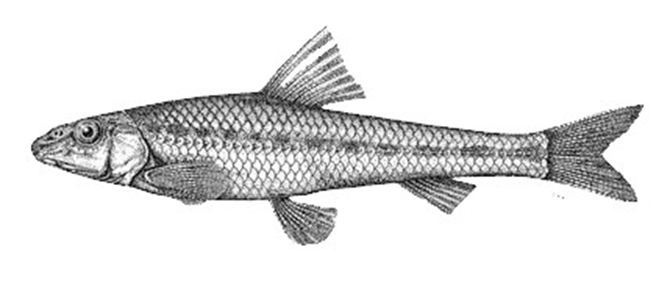
Don white-fin gudgeon (right)
Topmouth gudgeon (Pseudorasbora parva)
Body length up to 12 cm, mass up to 15 g, lifespan up to 5 years. Pharyngeal teeth uniserial, smooth, laterally compressed, with a small hook at the apex; dental formula most often 5–5. The body is elongate, low, only slightly compressed laterally. The scales are large; the head is somewhat flattened dorso-ventrally and relatively small. On the posterior part of each scale is a crescent-shaped dark spot with its convexity directed posteriorly. A dark longitudinal stripe extends along the entire body. The mouth is small, crescent-shaped, oriented as a transverse slit in its upper part.
The species is found mainly in schools among vegetation on sandy-silty substrates. Spawning is fractional, in late spring to the first half of summer; fecundity up to 4,000 eggs.
The first confirmed records of this species in the Donets basin occurred in the area of the biological station in the 2000s. Today it is a widespread but sporadic species, found primarily in ponds and less frequently in natural watercourses. Population outbreaks occur periodically in individual water bodies.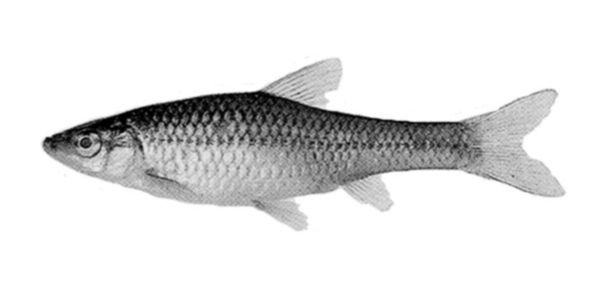
Topmouth gudgeon
Common bream (Abramis brama)
Silver bream (Blicca bjoerkna)
Blue bream (Ballerus ballerus)
White-eye bream (Ballerus sapa)
These four species are morphologically similar, although they belong to different genera. A young, sexually immature common bream and an adult silver bream are so alike in their rhomboidal body shape and overall silvery-white colouration that they are frequently confused even by experienced anglers. The bream is distinguished from the silver bream by its light-grey (or dark in large individuals) fins, whereas in the silver bream the paired fins are reddish. The scales above the lateral line are markedly smaller in the bream than in the silver bream, and in adults the eye diameter is noticeably less than the snout length. In addition, the bream has uniserial pharyngeal teeth (5–5, rarely 6–5), while the silver bream has bisinuate teeth (2.5—5.2, or rarely 3.5—5.3). In length the bream usually reaches no more than 45 cm (maximum 75 cm), and the silver bream up to 25, rarely 30 cm.
During feeding they remain close to the bottom, and at other times they inhabit the near-bottom layers at moderate to great depth. These shoaling, sedentary fishes live predominantly in standing water bodies and in slow-current river reaches. Their strongly protrusible mouths, which can be extended into a fairly long downward-directed tube, are capable of sucking benthic organisms deeply embedded in the sediment, chiefly chironomid larvae and other insects; small crustaceans, worms, and molluscs are also present in the diet.
Absolute fecundity of the bream is approximately 750,000 eggs. Spawning is phytophilous and single-batch, beginning in late April and continuing to mid-May. It takes place in floodplain water bodies or among stands of littoral aquatic vegetation. The bream migrates to spawning grounds in mixed-age cohorts in three waves. The silver bream, like the bream, deposits eggs on vegetation, but spawns fractionally from late April or early May to June or late June; absolute fecundity up to 150,000 eggs.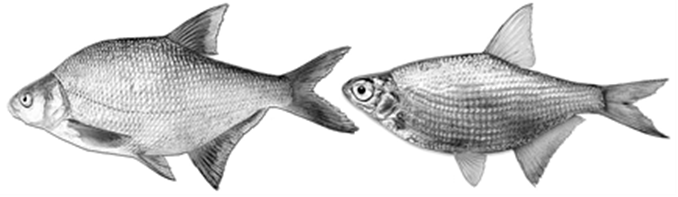
Common bream (right) and silver bream (left)
The white-eye bream has a more slender body than the bream and silver bream. Unlike them, it is a typical riverine species, but is generally rather rare in the Siverskyi Donets basin. It is also morphologically distinguished from the bream by a longer anal fin (A III 35–42 versus A III 25–30 in the bream). It reaches a standard length (SL) of 25 cm, rarely 33 cm. It prefers deep parts of water bodies, where it congregates in schools. It feeds on chironomid and caddisfly larvae and other insects, small bivalve molluscs, and plants. Spawning is single-batch, occurring on rocky or other hard substrates in river channels in the second half of April to early May at water temperatures of 14–15°C. Absolute fecundity up to approximately 100,000 eggs.
The blue bream is a lake-river fish of intermediate size (SL usually up to 35 cm, rarely up to 45 cm). It is distinguished by its very slender, silver-coloured body, a long anal fin (A III 36–43), and small scales. Its name derives from the bluish iridescence of the dorsal surface. It inhabits slowly flowing sections of large and medium rivers, channelised floodplain lakes, and reservoirs. The oblique, upward-directed mouth of the blue bream is well adapted for feeding on zooplankton in the water column. Egg deposition is single-batch, occurring in shallow water or on flooded meadows on vegetation or its remains, in late April to early May at water temperatures of 13–14°C. Absolute fecundity up to 80,000 eggs.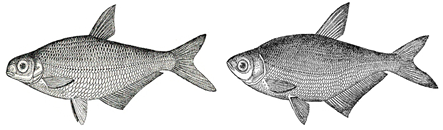
White-eye bream (left) and blue bream (right)
Bleak (Alburnus alburnus)
A relatively small fish reaching a standard length (SL) of 17 cm, but usually less. The back and flanks are strongly compressed, and the ventral profile and the complete lateral line are more or less arched downward. The body is elongate; the mouth is small, subterminal, directed upward. Dental formula 2.5–5.2. Scales shed readily. The bleak generally does not avoid swift current but also inhabits open, slowly flowing river reaches or backwaters with low current, and is often encountered in schools near riffles in the slack zone; it frequently leaps from the water. It is almost absent from marshy and heavily vegetated areas.
It feeds on zooplankton — crustaceans, chironomid pupae, and aerial insects. Adults also prey on juvenile fish. Spawning occurs in May–June at water temperatures above 14–16°C; eggs, up to 35,000 in number, are deposited in 2–6 batches in sheltered localities onto the substrate — stones, gravel, sand, submerged wood, and subaquatic vegetation — over a wide depth range from 20 cm to 4–5 m.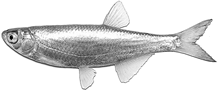
Bleak
Sunbleak (Leucaspius delineatus)
A very small fish, body length up to 8 cm, with a rounded dorsal profile and a very short (incomplete) lateral line that terminates within the anterior third of the body length. The lateral colouration is mirror-silver; the ventral surface bears a sharp keel; the mouth is small, terminal, obliquely truncated; the scales are thin. The body is elongate and low, almost fusiform. Pharyngeal teeth bisinuate (1.5—4.1, 1.5—5.1, 2.5—4.2) or uniserial (5—4, 5—5), or bisinuate on one side and uniserial on the other.
Together with the bleak it is the most typical shoaling inhabitant of surface horizons, but in rivers it prefers areas and backwaters with low or slow current; it is common in ponds and small lakes. It is diurnal in habits, feeding primarily on zooplankton and aerial insects. It consumes large quantities of fish eggs and fry, as well as mosquito larvae. Eggs are deposited in several batches, chiefly on vegetation, at water temperatures above 15°C in May–June; clutches take the form of long narrow ribbons.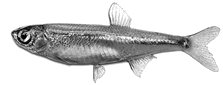
Sunbleak
Bighead carp (Aristichthys nobilis)
Silver carp (Hypophthalmichthys molitrix)
Both species of tolstolobik are large shoaling fishes weighing up to several tens of kilograms at body lengths sometimes exceeding 1 m, currently occurring in Ukraine in ponds, lakes, and reservoirs, and rarely in lowland rivers. Population numbers are sustained only through artificial propagation. Both species are externally very similar (Fig. 2.8). The silver carp has an overall light, silvery body colouration, with pink or red anal and ventral fins, and gill rakers fused by a continuous mucous membrane. The bighead carp generally has a darker body colouration, often with dark spots, a larger head and longer pectoral fins extending to the base of the ventral fins; its gill rakers are also connected by mucous membrane. The eyes are positioned well below the medial body axis, extending below the corner of the mouth. The mouth is obliquely truncated, directed upward; gill rakers are numerous, very long, exceeding the length of the gill lamellae. Scales are very small. Dental formula 4—4.
Both species are planktophages that filter plankton suspended in the water using their numerous fine-meshed, elongate rakers. The silver carp feeds almost exclusively on phytoplankton, while the bighead carp feeds predominantly on zooplankton. Reproduction of these Far Eastern species, introduced into our water bodies, occurs only under artificial conditions, after which the raised juveniles are released into ponds and reservoirs, from which they subsequently enter river channels.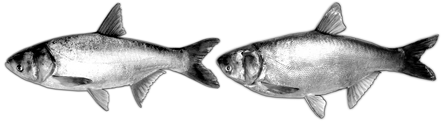
Bighead carp (left) and silver carp (right)
Volga nase (Chondrostoma variabile)
The Volga nase is a medium-sized species (body length up to 40 cm) that is a true riverine species. The body is elongate, low, and slightly compressed laterally. The nase is also characterised by an inferior mouth in the form of a transverse slit and a lower jaw covered by a horny sheath. The snout is long and cartilaginous. Pharyngeal teeth uniserial, knife-shaped, 6—5, 6—6.
It inhabits deep river reaches with moderate or weak current. It is not found in small swift-running rivers, floodplain lakes, or other standing water habitats. It is shoaling and remains chiefly in benthic horizons in close proximity to the bottom. The Volga nase may be characterised as a phytophage and detritivore, and principally as a periphytophage that scrapes algal growths from stones, snags, and submerged parts of plants with its mouth. Single-batch spawning occurs on hard substrate at water temperatures of approximately 7–9°C in April–May. Egg deposition takes place in swift current and at considerable depth. Absolute fecundity up to 40,000 eggs.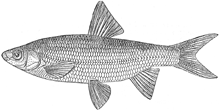
Volga nase
Asp (Leuciscus aspius)
The only truly active stenophagous predator among the local cyprinid fishes, it pursues other fish with a comparatively narrow prey spectrum. By virtue of its very slender, strongly laterally compressed body and the presence of a sharp keel posterior to the ventral fins, this fish actively hunts in the water column and near the surface, pursuing its prey. Maximum body length up to 95 cm, commonly 40–50 cm; mass up to 8 kg. Unlike most predatory fishes, the asp, like all cypriniform fishes, lacks teeth on the jaws and in the oral cavity. However, its large, upward-directed mouth, with the lower jaw projecting forward, is equipped with a peculiar locking mechanism at the jaw tips: a tubercle on the lower jaw that fits into a notch on the upper jaw. This jaw structure allows the asp to firmly seize small prey, and the hook-shaped bisinuate pharyngeal teeth (3.5—5.3) assist in retaining the quarry.
It inhabits open reaches with gentle river current or in clear, slow-flowing reservoirs; large individuals are solitary. It prefers shallows and riffles — areas where its principal prey, the bleak and small roach, are found in sufficient numbers.
The asp, like most predatory fishes, spawns early, in April, at water temperatures of approximately 4–6°C. Spawning is single-batch; eggs are deposited on rocky or other hard substrate in the river channel in swift current. Absolute fecundity up to 480,000 eggs.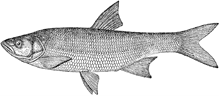
Asp
Chub (Leuciscus cephalus)
A large, very attractive fish with an elongate body and a broad head bearing a large terminal mouth. Body length up to 80 cm, commonly about 35 cm. Pharyngeal teeth robust, bisinuate, slightly ridged, with a small hook at the apex, 2.5—5.2. The flanks are silvery-white or slightly yellowish; pectoral fins are yellowish-orange; ventral and anal fins are red; dorsal and caudal fins are dark grey; in juveniles the caudal fin is paler with an almost black outer margin. Scales are large with a dark border. Usually a solitary fish, but sometimes encountered in small schools, particularly in autumn before entering overwintering pits and during the spring run. Normally found in rivers with perceptible current and cool or cold water; virtually absent from lakes. Prefers sandy, rocky, or clay substrates, avoiding overgrown and floodplain habitats. Inhabits the main channel at depth, as well as riffles and shallows; more frequently than other demersal-pelagic fishes, it appears at the surface. Reaches a standard length (SL) of 60–80 cm.
It feeds on a varied diet at the surface, in the water column, and also near the bottom. A significant proportion of the diet consists of aerial insects falling onto the water surface, and in larger individuals also small fishes. In some water bodies the diet base may be benthic epifauna. Spawning is extended and fractional (3–4 batches), beginning in May at water temperatures of approximately 11°C and continuing until mid-June. Eggs, totalling up to 100,000, are deposited on rocky or other hard substrate.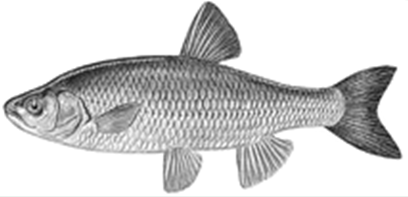
Chub
Danilevsky’s dace (Leuciscus danilewskii)
A small fish, body length up to 20 cm, mass up to 80 g. The body is elongate, low, sub-cylindrical, slightly compressed laterally. Dental formula 2.5—5.2. The mouth is subterminal, almost terminal. Distinguished from most sympatrically distributed dace-like species by the absence of coloured fins, and from juvenile asps of similar size by the absence of the jaw locking mechanism.
Endemic to the Don basin. A shoaling, benthic rheophile. Spawning on hard substrate from late March to early May; maximum fecundity up to approximately 10,000 eggs. Feeds predominantly on benthic organisms. In the first half of the twentieth century it was considered by researchers of that period to be "very common" in the Siverskyi Donets; since the late 1980s it has been regarded as very rare throughout the basin. Near the biological station it is most often observed in small schools on sandy shallows. 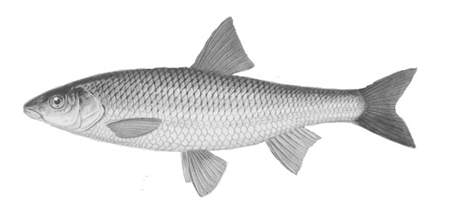
Danilevsky’s dace (left) and topmouth gudgeon (right)
Ide (Leuciscus idus)
The body is moderately deep, somewhat elongate, and laterally compressed; the mouth is small, terminal, and protrusible with an oblique gape; the caudal fin has a pronounced fork; scales are of medium size, with 52–65 scales in the lateral line. Reaches a length of 85 cm and a mass of 6–8 kg; length usually does not exceed 45 cm, mass 2 kg. Pharyngeal teeth 3.5—5.3, robust, cylindrical, hooked at the tip. Overall colouration is silvery-white or silvery-yellowish, darker above the lateral line; the dorsal and caudal fins are dark, sometimes with a reddish tinge; remaining fins are orange-red; the iris is usually yellowish or reddish. Distinguished from the roach and rudd principally by noticeably smaller scales. Distinguished from the chub by its deeper body, more intensely crimson-red ventral and anal fins, and the shape of the anal fin margin. In addition, the ide is more bottom-oriented and inhabits slowly flowing lowland rivers and lakes, occurring in the floodplain and among macrophyte stands.
It feeds on benthic insects and crustaceans, aerial insects falling into the water, and small fish. Spawning is single-batch, beginning very early, in March–April, at water temperatures of 5–6°C. Egg deposition occurs on rocky or other hard substrate at considerable depth. Absolute fecundity up to 170,000 eggs.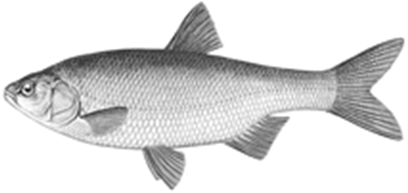
Ide
Roach (Rutilus rutilus)
One of the most abundant freshwater fishes. It has a small, subterminal mouth and orange-coloured fins and eye irides — features that readily distinguish it from the rudd. The body is relatively short, deep, and laterally compressed (Fig. 2.12). Pharyngeal teeth robust, uniserial, 6—5, 5—5. Body length reaches 30–35 cm, on average considerably less. It inhabits lakes and slowly flowing rivers, often among vegetation stands. The dietary spectrum is very broad. During the growth phase it is typically pelagic in habits, feeding on algae, insect larvae, and small molluscs. With age it shifts more to benthic layers, feeding on bottom epifauna, particularly molluscs.
Spawning usually takes place in large schools in 2 waves (large fish first, then first-time spawners) in late April at water temperatures of approximately 8–10°C. Spawning is single-batch; eggs are deposited in shallows or in floodplain water bodies on hard aquatic or last year’s flooded terrestrial vegetation. Absolute fecundity up to 170,000 eggs.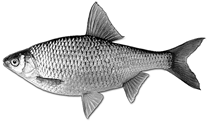
Roach
Rudd (Scardinius erythrophthalmus)
Inhabits slowly flowing or standing water bodies with clear water and stands of submerged macrophytes, among which it remains constantly. Externally resembles the roach, but with bright red rather than orange fins. The rudd has an obliquely upward-directed mouth and a scaled keel posterior to the ventral fins, while the iris of the rudd is silvery or greenish-yellowish and is never entirely orange. Reaches a standard length (SL) of 20–30 cm (Fig. 2.12).
The mouth is well adapted for feeding on aerial insects falling into the water, on zooplankton in the water column, and also on macrophyte plants, which constitute the main dietary component in warm seasons.
Spawning is fractional (up to 3 batches), occurring later than in most native cyprinid fishes, in May–June when water warms to 18–20°C. Eggs are deposited on littoral aquatic vegetation. Absolute fecundity up to 300,000 eggs.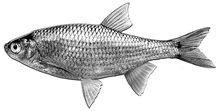
Rudd
Tench (Tinca tinca)
A sedentary, usually solitary fish, typically reaching no more than 30 cm in body length. The body is relatively short, fairly deep, and thick. Colouration is greenish-gold or brown; scales are small, deeply embedded in thick skin; the body is covered with a thick layer of mucus. At the corners of the mouth there is one short barbel on each side. Dental formula 4—5, 5—4, 4—4.
The tench is a typical benthophage, feeding principally on chironomid larvae and other insect larvae. It feeds intensively only in summer; in winter it usually burrows into mud and enters torpor. Spawning begins in late May–June at water temperatures of approximately 20°C. Spawning extends over approximately 1.5–2 months. Egg deposition is fractional, with a new batch deposited approximately every 2 weeks on aquatic vegetation. Absolute fecundity is usually approximately 300–400 (up to 950) thousand eggs.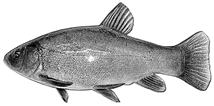
Tench
Siberian spined loach (Cobitis melanoleuca)
Common spined loach (Cobitis taenia)
Azov spined loach (Cobitis tanaitica)
Spined loaches have an elongate, eel-like, low-set body with 3 pairs of barbels around the mouth. Along the dorsal midline runs a row of dark spots; below, on the flanks, four longitudinal pigmentation zones are present: a zone of fine dots, then a zone of enlarged oval-elongate spots, below that again a zone of fine dots, and yet below that a zone of the largest, more or less irregularly shaped spots. In the Siberian spined loach, most abundant in the vicinity of the biological station, the body is low and strongly compressed laterally throughout its entire length, including the head. Beneath the eyes are small bifurcate spines embedded in the skin. It is distinguished from other spined loach species by a longer and lower caudal peduncle (height-to-length ratio approximately 1:2, whereas in the Azov spined loach this ratio is approximately 1:1.2), more closely set anterior (rostral) barbels, a greater number of large lateral spots (16–20 versus 12–16), and a higher vertebral count (48–50 versus 41–43).
Spined loaches are distributed in rivers, backwaters, lakes, and small enclosed water bodies on sandy and silted substrates. Sympatric species are capable of forming interspecific polyploid hybrids and persisting in this form for many generations. They lead a sluggish lifestyle in shallow water, hiding under stones or burrowing into the substrate. They feed on benthos and small benthic crustaceans. Spawning is fractional, beginning in May at water temperatures above 16°C and extending for more than a month. Large eggs with a diameter of approximately 2–3 mm are deposited among filamentous algae. Fecundity up to 3,000 eggs.
Spined loach of the genus Cobitis
Baltic golden loach (Sabanejewia baltica)
The body is loach-like, low, strongly laterally compressed, covered with very fine scales and an abundant mucous layer; around the inferior mouth are three pairs of short barbels; concealed in the musculature below the orbit is a small, sharp spine. The overall body colouration is pale grey or yellowish, against which 11–12 large oval dark spots are arranged along the dorsal crest and the mid-lateral zone; between the dorsal and lateral spot series, irregular small dark blotches occur. Distinguished from loaches of the genus Cobitis by the absence of the 4 characteristic longitudinal dot zones on the flanks, and by the presence in sexually mature males (when viewed from above) of symmetrical Φ-shaped swellings on the flanks in the mid-body region anterior to the dorsal fin. Total length up to 102 mm, standard length up to 90 mm, mass up to 5.2 g.
Feeds on detritus and benthic organisms. Spawning is fractional in April–June. Fecundity up to 4,000 eggs. 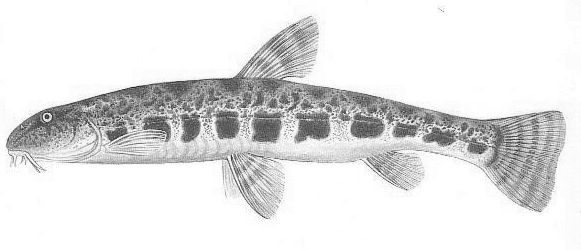
Loach of the genus Sabanejewia
Weatherfish (Misgurnus fossilis)
The weatherfish is considerably larger than the spined loaches, usually reaching 25 cm in length; the known maximum absolute length is 32 cm. Colouration is yellowish-brown, with dark longitudinal stripes along the flanks; the eyes are very small; around the mouth are 5 pairs of barbels. The body of the weatherfish is capable of serpentine flexion along virtually its entire length — hence the specific undulatory swimming or bottom-crawling movement.
The weatherfish inhabits primarily enclosed, non-flowing lakes or overgrown oxbows. The skin of the weatherfish, covered with very fine scales and a copious mucus layer that facilitates burrowing into mud or dense aquatic vegetation, makes it well adapted to its environment. It shows low sensitivity to oxygen deficiency because, like all members of the family (including the spined loaches), it can assimilate oxygen directly from air through an accessory respiratory organ in the intestine. When dissolved oxygen in the water is insufficient, fish rise to the surface and gulp air at the mouth. It feeds on benthic invertebrates and detritus.
Spawning begins in May at water temperatures above 16°C and continues until mid-summer. The large eggs, up to 1.9 mm in diameter, are deposited on subaquatic vegetation; fecundity up to 50,000 eggs.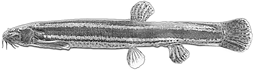
Weatherfish
Stone loach (Barbatula barbatula)
A small fish, up to 12 cm in length. It can be distinguished from spined loaches of similar body size and barbel number by its more cylindrical body form, a head that is not compressed laterally, the absence of suborbital spines, and a more variegated colouration below the lateral line. Fins are yellowish or brownish. The overall background colouration is brownish.
It feeds on benthos, consuming chiefly small chironomid larvae. Spawning is fractional (approximately 3 batches) and extended — from April to June — at water temperatures above 9–10°C. Eggs are deposited in shallow water on sand and aquatic vegetation; fecundity up to 23,000 eggs.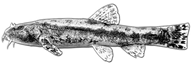
Stone loach
European catfish (Silurus glanis)
The catfish prefers deep pools and only occasionally enters shallow littoral areas. Its external appearance is distinctive: a very large, dorsoventrally flattened head with an enormous oral gape and 3 pairs of barbels, of which 2 pairs of short barbels are situated on the chin and one pair of very long, thick barbels on the snout. The body of the catfish is elongate, scaleless, covered with mucus, with a small dorsal fin and a very long anal fin. Colouration is highly variable: the colour of the dorsum and flanks ranges from dark, almost black, to yellowish-green, with numerous indistinct small spots of yellowish and dark colouration on the flanks; the venter is pale. The catfish is the largest representative of the local ichthyofauna.
Its maximum absolute length may reach 5 m and mass 200 kg, but specimens of such size are now extremely rare. The catfish is one of the most predatory of fishes, feeding principally on fish but also on other prey — frogs, birds, and small mammals. In winter it retreats to deep pools and does not feed at all.
Spawning is single-batch, taking place in late spring when water temperature reaches 18–20°C. Only 1 breeding pair participates in spawning. The catfish exhibits parental care. The male constructs a nest — a cleared, muck- and debris-free platform arranged in shallow water among vegetation or reed roots, bordered by a rampart of old plant material. Absolute fecundity exceeds 500,000 eggs. After egg deposition, the male guards the clutch and aerates it with his pectoral fins until the hatched larvae begin to feed independently.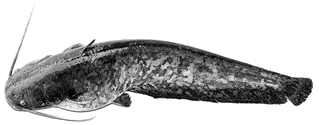
European catfish
Northern pike (Esox lucius)
The northern pike is one of the most significant predators in our waters. It leads a solitary, predominantly benthic existence. Pike congregate only during spawning and to overwinter. In enclosed or slow-flowing water bodies it often occupies shallow, vegetated areas; in rivers it avoids reaches with moderate to swift current.
Characteristic features of the pike include its elongate, only slightly laterally compressed body, a long snout, dorsal and anal fins displaced far posteriorly toward the caudal peduncle, ventral fins positioned at mid-body, and pectoral fins at the same level as the ventral fins. Total length (TL) reaches 1.5 m. Fish exceeding 1 m are now a great rarity.
The yellowish-green, highly variable spotted or barred colouration enables the pike to remain concealed in aquatic vegetation stands or to be inconspicuous on open substrate. It feeds on fish, including smaller conspecifics. The torpedo-shaped body form allows this predator to develop great speed in sudden strikes on prey from ambush among vegetation. The large teeth serve the pike to seize prey, and the gill membrane, not attached to the isthmus, permits extreme distension of the pharynx during swallowing; a prey fish may sometimes be half the pike’s own length.
The pike spawns among the earliest of our fishes (disregarding the winter-spawning burbot). Single-batch spawning begins in March when ice begins to break up and continues into April. Eggs are deposited on last year’s vegetation in shallow (0.5–1 m depth), sheltered localities. Absolute fecundity in fish up to 1 m long reaches 400,000 eggs; in larger specimens considerably more.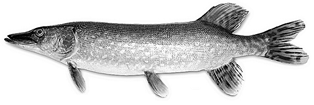
Northern pike
Burbot (Lota lota)
The burbot is the only freshwater representative of the order Gadiformes; it is found in sites with clean water over rocky or sandy substrates. Total length usually does not exceed 50 cm, although the maximum known size is 112 cm. The characteristic external feature of the burbot is the presence of a single chin barbel. Its body is covered with very fine, almost imperceptible cycloid scales deeply embedded in the skin, which secretes copious mucus. The overall colour is dark brown with indistinct yellowish-ochre spots, extending to the unpaired fins. This cold-adapted species spends much of the summer hiding in burrows and is thus rarely encountered in catches.
The burbot is the only one of our fish that spawns in winter, from December to February. Spawning is single-batch and always occurs on sandy or gravel-cobble substrates. However, the non-adhesive, bathypelagic eggs of the burbot do not develop on the substrate but remain suspended near the bottom. Absolute fecundity is very high — approximately one million very small eggs. In large specimens up to 1 m in length, the number of deposited eggs may reach 3 million.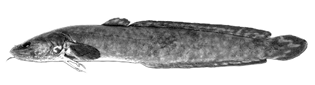
Burbot
Southern ninespine stickleback (Pungitius platygaster)
A small fish; total length of the stickleback does not exceed 5–6 cm. It is distinguished by 8–11 dorsal spines, the absence of a keel on the caudal peduncle, and practically inconspicuous thin bony lateral plates, often developed only in the anterior part of the body. The body is moderately elongate, low, fusiform, and laterally compressed.
It feeds predominantly on benthos, as well as on eggs and juveniles of other fish.
At the onset of spawning the male’s background colouration is grey, barely distinguishable from the female, and then becomes coal-black with a bluish iridescence. Spawning in sticklebacks is fractional, occurring from late April through May–June at water temperatures above 10–17°C. Parental care is highly developed: the male skillfully weaves a spherical nest with 2 openings from small plant fragments, suspended on the stems of aquatic vegetation in the water column. After larvae hatch, male sticklebacks dismantle the upper part of the nest and continue guarding the offspring in the resulting cradle structure. Absolute fecundity ranges from several tens to 300–600 eggs.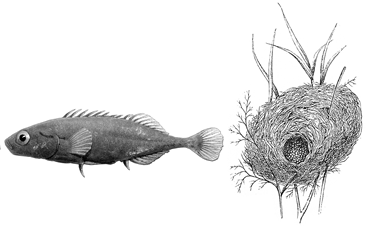
Southern ninespine stickleback and its nest
Black-striped pipefish (Syngnathus abaster)
The length of this morphologically unusual fish in our waters may reach 15–16 cm. It inhabits the full water column at shallow depths in slow-flowing, macrophyte-rich waters of backwaters and reservoirs. Its dark-green colouration and very long, slender body provide effective camouflage among dense aquatic vegetation. Being a poor swimmer, and with its body encased in a rigid armour of bony plates, the pipefish normally moves extremely slowly by undulation of the small dorsal fin; the very small, rounded caudal fin takes almost no part in locomotion.
It is a typical zooplanktophage, feeding chiefly on nectobenthic crustaceans and to some extent on juvenile fish. Its toothless, pipette-like superior mouth, situated at the apex of a tube-shaped snout, has great suction power, enabling it to aspirate small zooplankton.
Spawning is fractional, occurring from May to August, predominantly in June–July. In male pipefishes a brood pouch develops on the ventral surface of the caudal region prior to spawning, clearly visible as a long longitudinal fold. Fertilised eggs deposited by several females are placed into this pouch, where their development proceeds during brooding. After hatching, the juveniles continue for some time to shelter in the brood pouch of the male before becoming independent.
Black-striped pipefish
Ruffe (Gymnocephalus cernuus)
A typical demersal fish, spending virtually its entire time on the bottom, remaining in schools and only occasionally rising into the near-bottom or middle water layers. Largely crepuscular and nocturnal in habits. Body length of the ruffe does not exceed 20 cm, usually no more than 10–13 cm.
The ruffe is distinguished from other perciform fishes in our region by its united dorsal fins bearing only unbranched spinous rays anteriorly, and by the very large pores in the seismosensory canals of the head. The overall colouration is ashy-grey with a greenish tinge. The skin secretes copious mucus.
The ruffe prefers quiet waters with slow current; it is frequently found in lakes with cold spring water, hence its alternative name of lake ruffe. It feeds on zooplankton, benthic organisms, and also consumes large quantities of eggs and juveniles of other fish. Spawning is fractional and extended in time, from April to May. Egg deposition occurs on sand or gravel-cobble substrates. Absolute fecundity of the ruffe up to 100,000 eggs.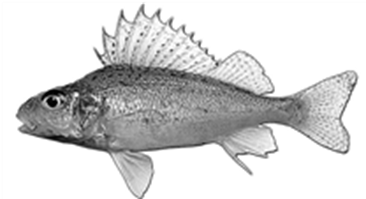
Ruffe
European perch (Perca fluviatilis)
The European perch is readily identified by the arched dorsal profile of the body, the high, spinous first dorsal fin with a black spot in its distal portion, and the absence of canine teeth. It is coloured in greenish hues with 5–6 dark transverse bars and bright orange pectoral, anal, and caudal fins.
It inhabits large and small rivers, reservoirs, lakes, and ponds. The large predatory perch typically grows to 30 cm in length and weighs 1.2–4.8 kg; it keeps to the bottom in vegetated areas or in deep holes, where it awaits prey. The small form of perch inhabits shallow vegetated areas and feeds predominantly on zooplankton.
It spawns early, in late March–April, after ice break-up, at water temperatures of 5–8°C. Absolute fecundity reaches 200–300,000 eggs or more. Single clutches of eggs, in the form of long mucous ribbons, are deposited in shallow water among aquatic vegetation. Juvenile perch (like those of another predator — the pike) grow large enough by the time the larvae of late-spawning cyprinids hatch, which they then begin to prey upon.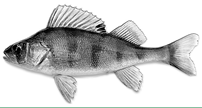
European perch
Zander (Sander lucioperca)
The zander is a large predatory fish reaching 130 cm in length and 10 kg in mass, inhabiting rivers, large clear reservoirs, and lakes, more often flowing ones. It is predominantly solitary in habit, but in youth or during winter — while remaining active — it forms small schools. It prefers sandy substrates and considerable depths, favouring deep pools and eddies. It is distinguished from the perch by a more slender body with a gently sloping dorsal profile, the presence of large canine teeth on the jaws and palatine bones, 10–12 dark transverse stripes on the flanks, and pale ventral and anal fins (Fig. 2.22). Spawning is single-batch, in May–June at water temperatures of 15–16°C, generally in pairs. Absolute fecundity is very high — from 200,000 to 1 million eggs. Eggs are deposited in nests built by the male from last year’s plant material on cleared substrate, and are guarded by him until juvenile hatching.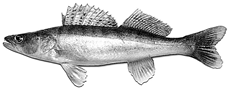
Zander
Caucasian dwarf goby (Knipowitschia caucasica)
This species was first recorded in the Siverskyi Donets basin precisely in the main channel near the university biological station in 2009.
Maximum body length 4–5 cm, lifespan up to 2 years. The body is low, relatively thick, and sub-cylindrical. The caudal fin is rounded. Along the mid-flank there is a series of fairly large dark spots.
It feeds predominantly on zooplankton and small insect larvae, as it possesses a swim bladder and can easily manoeuvre in the water column.
Spawning is fractional, occurring at water temperatures of 12–25°C. Both male and female display breeding colouration. The male prepares a nest by clearing an area beneath shells, stones, or snags; after one or several females deposit eggs on the “ceiling” of the nest, he fertilises and guards them, and aerates the clutch until larvae hatch. Fecundity up to 1,500 eggs.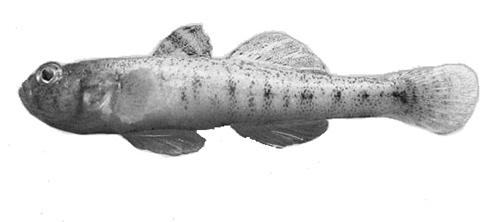
Caucasian dwarf goby
River goby (Neogobius fluviatilis)
Maximum body length up to 20 cm; in rivers and small water bodies considerably less. The body is elongate, relatively low, and slightly laterally compressed. The ventral disc usually does not extend beyond the anal aperture. The overall body colouration is light brown with small dark spots on the flanks, with an oblique dark stripe anterior to the eye; in individuals inhabiting sandy substrates the body is often almost entirely unpigmented. The second dorsal fin tapers posteriorly.
It inhabits near-shore areas in shallow, slow-flowing backwaters on sandy and sandy-silty substrates with abundant detritus and vegetation, although it avoids dense stands; it is also frequently found in shallow current zones, though not in strong ones.
It feeds on worms, crustaceans, insect larvae, and small molluscs. Spawning is extended and fractional; eggs are deposited by females into nests guarded by males. Fecundity up to 1,500 eggs.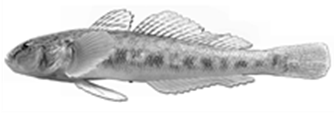
River goby
Western tubenose goby (Proterorhinus semilunaris)
Maximum body length 9 cm, usually considerably less. The mouth is relatively small; on the flanks there are irregularly shaped stripes, dots, and blotches. It prefers shallow, slow-flowing backwaters rich in detritus and densely overgrown with submerged higher aquatic vegetation, but is occasionally found in vegetation stands in areas of fairly swift current. It is the only goby strongly associated with macrophyte stands. Its characteristic feature is the comparatively large head of males and the anterior nostrils elongated into narrow tubes, which sometimes overhang the anterior margin of the snout.
It feeds on small benthic invertebrates. Eggs are deposited under stones, mollusc shells, and other bottom objects and are actively guarded by the male. Spawning is extended and fractional; fecundity up to 800 eggs.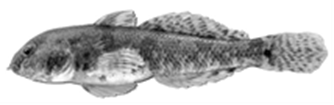
Western tubenose goby
General characteristics of fishes in relation to their mode of life
According to their spatial distribution, which is expressed both in their association with particular biotopes and in the predominant activity of fishes in different water layers — a greater or lesser tendency toward the water surface, mid-water column, near-bottom layer, or the bottom itself — species may be grouped into several complexes. Let us review the fishes of the vicinity of the biological station by their pelagic, demersal-pelagic, demersal, and benthic complexes, as well as fishes that inhabit vegetation stands. Some species may be assigned to more than one complex.
Pelagic species occur across a wide depth range of the water column — near the surface, in mid-water layers, and near the bottom. Species in this category include the bleak, sunbleak, silver and bighead carps, rudd, asp, and blue bream. These fairly active-swimming fishes characteristically have a laterally compressed, slender or moderately deep body, sometimes with a developed ventral keel and a strongly forked caudal fin, as well as an overall pale or silvery colouration with a darker dorsum. Such morphological features promote greater mobility in fishes that spend much of their time in the water column or near the surface, and render them less conspicuous to predators both from below and from above.
Demersal-pelagic species are more closely associated with the substrate or macrophyte stands than typical pelagic fishes. At the same time, the deeply forked posterior margin of the caudal fin and the laterally compressed body indicate that they are fairly active swimmers that spend much time in motion. The demersal-pelagic complex includes the bitterling, common bream, white-eye bream, silver bream, roach, chub, ide, and dace. Like pelagic fishes, they largely exhibit silvery-white flank colouration, sometimes turning yellowish (as in the ide) or darkening with age (as in the bream).
Demersal species. Darker body colouration in yellow, green, and grey tones, often spotted or transversely barred, is characteristic of demersal fishes. They live primarily near the bottom but are also encountered in the water column and even near the surface. For these species it is important to be inconspicuous against the colouration of the substrate or aquatic vegetation, remaining undetected by fish above or alongside them. Demersal fishes include the perch, zander, pike, grass carp, Volga nase, common carp, carasses, tench, and Caucasian dwarf goby.
Benthic species are represented by such typical, externally and largely sluggish species as gudgeons, weatherfish, spined loaches, stone loach, catfish, burbot, river goby, and western tubenose goby. These species spend much of their lives in direct contact with the bottom surface, where they usually lie motionless, and some species burrow into the substrate. Most of them lack a swim bladder entirely. Their movements are usually confined to short distances. The posterior margin of their caudal fin is truncate or slightly rounded, and in the colouration of their lateral surface the mirror-like silvery sheen is generally absent, with dark tones usually predominant.
A rather specific body form is found in such benthic species as the European catfish, burbot, western tubenose goby, and river goby: with a large, dorsoventrally flattened head and a caudal region that is compressed laterally.
Fishes of vegetation stands. The complex of species associated with macrophyte stands includes the relatively slow-moving black-striped pipefish, which can easily be caught by hand, as well as the southern ninespine stickleback, rudd, bitterling, western tubenose goby, and the small form of perch. In addition, juvenile roach and pike prefer to remain in vegetation stands.
Native species and introduced species. Biological invasions
The great majority of species in the local ichthyofauna are autochthonous or native, i.e., inhabiting within the limits of their historical (ancestral) range. Remains of the ancestors of these fish can be found in bottom sediments of water bodies in the Siverskyi Donets basin. At the same time, over the past half-century the species composition of fishes in the Siverskyi Donets basin near the biological station has changed quite markedly. These changes proceeded especially rapidly from the 1970s of the twentieth century, associated with the regulation of river flow by dams and reservoirs, the construction of artificial canals that mechanically eliminated natural barriers between river systems, and the introduction of several new aquaculture species. Thirteen such species can now be encountered in water bodies near the university biological station.
In the Siverskyi Donets river basin within Ukraine as a whole, 18 alien fish species have been recorded over the past 150 years (27% of the ichthyofauna). In the current ichthyofauna of this basin section they are represented by 15 species (26% of the present fish fauna), of which 9 species (16%): the paddlefish Polyodon spathula, grass carp Ctenopharyngodon idella, goldfish Carassius auratus and Prussian carp Carassius gibelio, bighead carp Aristichthys nobilis and silver carp Hypophthalmichthys molitrix, topmouth gudgeon Pseudorasbora parva, channel catfish Ictalurus punctatus, and pumpkinseed Lepomis gibbosus are alien to the Ukrainian fauna as a whole. Six species (10%) — the European eel Anguilla anguilla, Black Sea sprat Clupeonella cultriventris, southern ninespine stickleback Pungitius platygaster, black-striped pipefish Syngnathus abaster, Caucasian dwarf goby Knipowitschia caucasica, and Kessler’s goby Ponticola kessleri are colonisers within the basin but belong to the native ichthyofauna of Ukraine.
Three species alien to the Ukrainian fauna are artificial introductions: the bigmouth buffalo Ictiobus cyprinellus, peled Coregonus peled, and mosquitofish Gambusia holbrooki. They were unable to naturalise in the Siverskyi Donets basin and have disappeared from the ichthyofauna in the absence of artificial stocking support.
The Black Sea sprat, southern small stickleback, black-striped pipefish, and Kessler’s goby entered the basin through natural dispersal driven by human activity; the topmouth gudgeon, pumpkinseed, and Caucasian dwarf goby arrived as a result of unintentional introduction, most probably via fish-stocking material. The remaining 8 species appeared as a result of deliberate translocation by humans. Of these, the population size and distribution of 6 species (over 10% of the current ichthyofauna) are today sustained only through artificial stocking.
Fish species of the biological station vicinity with conservation status
Alongside intensive invasion by new fish species, a decline — and sometimes total disappearance — is observed not only in anadromous species that fattened at sea but ascended to river headwaters to reproduce, but also in some resident (sedentary) species. The Red Data Book of Ukraine (2009) includes 6 species that are occasionally encountered near the biological station — the Ukrainian brook lamprey, crucian carp, Danilevsky’s dace, Volga nase, Siberian spined loach, and burbot — as well as three species that formerly occurred in water bodies near the biological station but are now gone: the Bitterling Alburnoides bipunctatus, lake minnow, and the Danube ruffe.
18 species: the Ukrainian brook lamprey, European bitterling (within the species Rhodeus sericeus), crucian carp, Don white-fin gudgeon (within the species Romanogobio albipinnatus), asp (as Aspius aspius), blue bream, white-eye bream, Volga nase (within the species Chondrostoma nasus), sunbleak, common spined loach, weatherfish, Baltic golden loach (within the species Sabanejewia aurata), European stone loach, European catfish, southern ninespine stickleback, black-striped pipefish, river goby, and western tubenose goby (within the species Proterorhinus marmoratus) are listed in Appendix III of the Convention on the Conservation of European Wildlife and Natural Habitats (the "Bern Convention"), ratified by Ukraine.
In the list of animals requiring special protection in Kharkiv Oblast (the regional "Red List", 2018), a further 5 fish species occurring in the vicinity of the biological station are included — blue bream, white-eye bream, ide, northern golden loach, and European stone loach.