
Karazin University · Biology & Ecology
Materials
Lectures, peer-reviewed articles, field protocols and reference works.
StatOracle–15 Фенетичні дистанції
Для зоологічних досліджень дуже часто є корисним розрахунок фенетичних дистанцій — міри подібності між особинами або їх групами
Ecology: the biology of interaction. VII-06. Approximation of data on global human population growth using various models
Яка математична закономірність найкраще описує зростання кількості представників нашого виду на Землі? Для цього можна використати оцінки чисельності людства на різних етапах своєї історії. Звісно, ці оцінки не є абсолютно точними, але це — найкраще, що у нас є, і на їх підставі можна зроби...
Biology. Introduction to the Profession. Task IV (field practice): Data Analysis Using R Script Templates
Although the statistics course is yet to come, the first-year field practice becomes an opportunity to gain initial experience in data analysis...
StatOracle–11 Analysis of Variance in R
Dispersion analysis — a powerful method (more precisely — an entire “bouquet” of methods) created by Ronald Fisher. This method is based on the possibility of decomposing the dispersion (English: variance) of a random variable into components caused by different factors.
 Lecture
StatOracle–12 Cluster Analysis in R
Cluster analysis — a method very frequently employed in zoological research. Unfortunately, in many instances its application is not the optimal choice, which is precisely why one must understand the distinctive characteristics of this method.
Ecology: The Biology of Interactions. Appendix VII. Semi-finished Components for Building R Models
The idea behind this page is simple: to collect fragments of R scripts that may be useful when creating new models. What should these fragments be called? Examples? Samples? Templates? "Blanks"? Recipes? Let them be called "semi-finished components", semifinished. The content of this page is ongoing; many things in this work remain unclear (for example, it is not easy to decide in what order to arrange these semi-finished components). Nevertheless, we hope that the result of this work will be us
Ecology: biology of interactions. IV-19. (supplement) Sex must be impossible! Why does it exist?
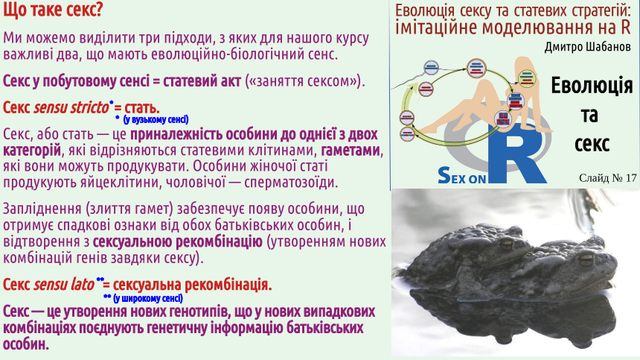
«The core» of the complex of phenomena, which includes the presence of sexes, the difference between them, and sexual acts, is precisely sexual recombination, the formation of new gene combinations that ensures the probabilistic combination of hereditary traits of parental individuals as a result of fertilization — their fusion...
EcoLectures#06_Population Growth Models
{ "title": "", "summary": "", "body": "Discussion of population growth models provides an opportunity to understand both the threat of a Malthusian catastrophe and descriptions of species strategies, and even the basics of classification of relationships between populations BATRIMG<N>BATR" }
Ecology: Biology of Interactions. VII-05. The Preconditions-and-Consequences Model: Simpson's Paradox and the Evolution of Altruism
The "Simpson's Paradox" model is an example of a "preconditions-and-consequences model" that tests the assumption of whether certain preconditions are sufficient for the emergence of a given property in the system under study. This model seeks an answer to the question: "Can group selection, in which groups with a higher proportion of altruists gain an advantage, truly overcome the action of individual selection, in which altruists lose to selfish individuals?"
Ecology: the biology of interaction. IV-19. (supplement) Evolution of altruism
Thus, according to the presented views, altruistic behavior can be maintained by selection at three different levels. Altruistic behavior toward relatives is a consequence of kin selection acting at the gene level; selection for the ability to engage in reciprocal altruism should most likely be considered...