
Six old news items about our relationships with other animals
Become the way I want. The toy must be harmless. And it is clear that the best toy is a living one. War with the toad. Humanity is ready to start a genetic war with one of the animal species. Do not go, children, to Africa for a walk! «In Africa there are sharks, in Africa gorillas, in Africa big, angry crocodiles...
Become what I want
A toy must be safe. What justified indignation we feel at reports of toxic paints being used in the manufacture of children's toys. And it is clear that the best toy is a living one.
The biotech firm Allerca of San Diego, California, offers customers hypoallergenic domestic cats for a price of four thousand dollars. Contrary to the widespread belief, the allergy is caused not by cat fur but by a protein contained in saliva and the secretions of the skin glands. By licking their fur, cats transfer this protein onto it. The mechanisms that ensure the animals' hypoallergenicity are kept secret. Supposedly it is a matter of ordinary selective breeding, although it seems strange that such a complex task could be solved in a relatively short time. Allerca's competitors do not hide the fact that they are trying to breed similar animals using genetic engineering.
Have all the shortcomings of cats been corrected in the new breed? No. Cats scratch, soil, feel sexual arousal, bring forth kittens, run away from home and, finally, die. A systematic offensive against all of these shortcomings has begun, using appropriate methods. Hormonal pills will save us from sexuality and its undesirable consequences. Against death, cloning is supposedly the remedy — you need only convince yourself that the new kitten is the old cat. The fact that the old favourite has nonetheless died (as well as the multitude of failed attempts to grow a clone that must accompany every kitten brought to saleable condition) should be forgotten, consoling oneself by reading advertising brochures. Oh, how soon all the living creatures around us will become the obedient realization of our designs and whims! And if we don't rebuild the living, we'll replace them with robots.
Unfortunately, for now it usually turns out otherwise: animals do not want to submit to our intentions. In its time "CT" reported on plans for a genetic war against the poisonous cane toads that have triumphantly spread across Australia (#570). A hundred million Australian cane toads have done serious damage to the local fauna. The problem brooks no delay, and because of the immaturity of high-tech control measures the Australian government decided to use proven methods. The spread of the toad will be contained by the regular army. After all, the cane toads did not appear in Australia out of nowhere: they were deliberately distributed around the world from their historical homeland, South America, to fight pests of sugar cane.
Defending the homeland, the troops will fight the cane toad. How to destroy it? We live in a civilized world, and the army must use the most humane (that is, human? strange… perhaps bufonic — froggy?) method. For example, they can be shot with rubber bullets or clubbed with bats. Professional nature defenders insist on freezing the toads to death in freezers — that way they suffer least. Compared with dousing live birds, possibly or possibly not sick with bird flu, in napalm, this is great progress.
We live in a complex, often cruel world. Leaving this world through illness or in the teeth of predators, its inhabitants experience suffering that is not regulated by any animal-protection societies. We are the part of this world that has begun to remake everything else according to its own understanding. Unfortunately, the unworthy animals do not always live up to our expectations. We will make them what we need, using the whole arsenal of methods — from napalm and freezer chambers to genetic engineering. But why do our actions resemble the chaotic games of an unbalanced child rather than the calculated steps of a far-sighted manager?
War with the toad
Humanity is ready to begin a genetic war against one of the animal species. Which species, do you think, has been granted the dubious honour of becoming the target of our attack? It is the cane toad living in Australia, Bufo marinus (in the photo), one of the largest frog species (individuals over 20 cm long are found). The cane toad is a native of South America, but has been spread by humans across almost all tropical countries to fight pests. In the 19th century it was also brought to Australia, to the sugar-cane plantations of northern Queensland. Having spread across the continent (at a speed that can exceed 20 km a year), these toads provide a vivid example of evolution in action. Studying their geographical variability, specialists have recorded an accumulation of differences from the original, American type.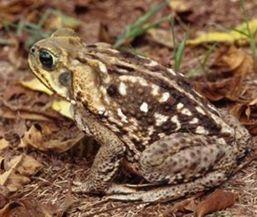
In Australia the spread of the cane toad causes much trouble. It eats rare species of invertebrates and small vertebrates. The toad deprives native species of food. Finally, when local species (from dingoes to crocodiles) eat the cane toads, they die from the poison of its parotoid glands. Global warming only aids the spread of the cane toad, recognized as a serious threat to Australian fauna.
The cane toad is extraordinarily plastic. An anecdotal example of its adaptability: at apiaries the toads climb onto one another's backs to reach the hive entrance, where bees can be caught one after another. Finally, the toad's poisonous secretion has begun to be used by drug addicts. The active principle of the "smoke" that Don Juan gave Carlos Castaneda to smoke is bufotenins — a group of amines first discovered in the poison of the genus Bufo, to which the cane toad belongs. However, in the cane toad's poison the bufotenins are contained within a bouquet of other toxins (for example, the cardioactive steroids bufadienolides), so that only utterly reckless connoisseurs would go on such a "hunt" for a high.
How to fight the advancing billions of toads? At one time they tried to use a virus dangerous to the cane toad, found in Venezuela, in its homeland. Unfortunately, it also affected local anuran species. Now they have managed to find a gene whose expression triggers an immune response in cane-toad tadpoles that prevents their metamorphosis. To transfer this gene to the toads, ranaviruses can be used — a group of relatively large viruses that parasitize tailless amphibians.
The decision to use the genetic weapon has not yet been made: work on it is not complete, and it has not passed safety testing for other species. The use of a new kind of biological weapon can still be prevented. Maybe it is better, after all, to put up with the toad?
Don't go, children, to walk in Africa!
Remember, when the information about AIDS had only just appeared, how many regarded it as a secret weapon created in military laboratories? Now it is clear that the situation is far more complex. HIV is one of many retroviruses found in African monkeys, and not only in them. Right now in Africa a spread of lion immunodeficiency is being observed, transmitted, among other ways, during fights between males. Accordingly, the HIV pathogen was probably transmitted from monkeys to humans more than once, but only under the conditions of today's erasing of tribal and national borders was it able to spread across the whole planet. Everyone understands how acute this problem is: according to UN experts' estimates, in twenty years HIV will infect 10% of Africa's population. And are we threatened by new dangers similar to AIDS?
Specialists at the Johns Hopkins Medical Institute in Baltimore studied the blood of 930 hunters of monkeys (including gorillas) from Cameroon. In the blood of thirteen of them six different retroviruses were found, belonging to the same group as HIV, two of which were registered in humans for the first time. The hunters were probably infected with them by consuming the killed monkeys. Although these viruses "do not reach" the HIV pathogen, they are capable of causing oncological and neurological diseases as well as inflammation. Another danger is connected with the fact that if several viral infections develop in one person's body, their pathogens can exchange functional blocks, potentially creating new, more dangerous combinations. It is not clear how widely the viruses newly acquired by the hunters may spread; nevertheless, it is probably worth refraining from consuming monkeys.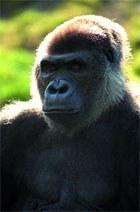
"In Africa there are sharks, in Africa gorillas, in Africa big, fierce crocodiles…" Who would have thought that the greatest danger in this list is gorillas?
Unto the seventh generation
Researchers from Washington State University recorded a phenomenon that calls for serious reflection. The consequences of the effect of pesticides on rats persisted over several generations, even though the younger generations were not exposed to the toxic substances. The pathological consequences of the poisoning are not connected with genetic changes (mutations): they are transmitted at the epigenetic level, affecting the regulation of gene activity.
Pregnant rats were exposed to pesticides that disrupt the endocrine system. The exposure fell on the period of pregnancy when sexual characteristics form in the embryos. Not surprisingly, the newborn individuals had impaired reproductive-system functions: a reduced sperm count, a reduced capacity for fertilization. Nevertheless, offspring were still obtained from them.
What is remarkable about the described result? Yet another class of acquired traits that can be inherited has been discovered. In essence, these are far from the first data of this kind. Unfortunately, one can hardly hope that the majority of geneticists will stop regarding the concept of the non-inheritance of acquired traits as a cornerstone of their science.
Theory is theory, but important practical conclusions also follow from the discovered phenomenon: perhaps the danger of pesticides is greatly underestimated. Current assessments of the long-term effect of the toxins we have released into the environment speak only of their ability to cause mutations, but do not at all consider epigenetic phenomena. The existence of this class of phenomena is well proven, although the molecular mechanisms that ensure its realization are clearly insufficiently studied.
Now compare the results obtained by the Americans with the decline in fertility recorded in men all over the globe. This fact in itself speaks of serious anomalies, probably caused by chemical pollution of the environment. Add to this the prospect of such disturbances persisting over several generations even in the case of success in the fight for a clean environment. Is this not sufficient reason, rolling up our sleeves, to set about studying epigenetic mechanisms?
The long life of roundworms
Erasmus Darwin, the eccentric grandfather of Charles Darwin, believed that one should periodically carry out completely crazy experiments. Realizing this idea, he, among other things, played the trumpet in front of the tulips in his garden. An experiment conducted by staff of the Washington University School of Medicine in St. Louis, Missouri, is from the same opera. They studied how various drugs affect the lifespan of roundworms. Chosen as the test subject was Caenorhabditis elegans, a model organism in many studies in the field of developmental biology (these worms live a very short time and are well studied).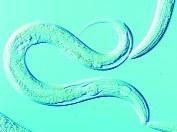
Unexpectedly, it turned out that anticonvulsant drugs used for epilepsy extend the worms' life by almost one and a half times! Of course, roundworms do not suffer from epilepsy even without any drugs. One may assume that the recorded result reflects the key role of the nervous system in all processes, including aging. Although to this day no effect of anticonvulsant drugs on the lifespan of epilepsy patients has been recorded, such a possibility cannot be ruled out. It will be studied in the near future, in parallel with experiments on flies and mice.
The undercover agent
A new word has been spoken in the dialogue with the animal world that has begun. Until now, people communicated with animals directly. Of course, history knows some examples of using models of living creatures. Gardeners set up a scarecrow knocked together from sticks in the field, dressing it in their own coats and hats. Hunters put inflatable ducks out on lakes. Jacques-Yves Cousteau showed hippos a collapsible model of their kin. But genuine communication between models and animals did not yet exist. And now — a breakthrough.
A Franco-Belgian-Swiss collective of scientists has created a robot that penetrates into gatherings of cockroaches, establishes contact with them, and then, like the Pied Piper of Hamelin, leads them out into pre-prepared places. What happens to the cockroaches next is not reported.
The main function of the robot, named InsBot, is to be a provocateur. It is impregnated with cockroach smells, moves in a way they understand, and altogether seems to the cockroaches almost a relative. Cockroaches are collectivists deprived of leaders. When they sense a similar creature nearby that firmly knows where to go, they obediently follow it.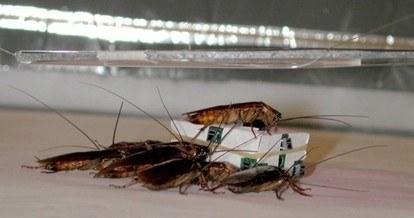
The robot is quite well equipped: it has two 16-megahertz processors, its own operating system (InsBotOs), a camera and ten infrared sensors. The wheels are driven by a pair of electric motors. Work on InsBot is not yet finished: the next modification will have to find cockroaches itself over the "rough terrain" of our apartments.
Judging by the photograph, InsBot communicates with the American cockroach — a large and aggressive species. A German cockroach next to an American one is like a dachshund next to a crocodile. What a pity that the apartments of our compatriots are populated mostly by German cockroaches! Perhaps, in order not to lag behind the scientific and technological revolution, we should already now see to settling our homes with a more progressive species?
By the way, robot-builders are not for the first time using cockroaches as bionic models for their constructions (either their biological horizons are narrow, or they don't want to go far afield). Cockroaches are interesting both from the standpoint of the mechanism of their orientation in space and with respect to the control of their legs. But through the respectful attitude toward the cockroach as a biomechanical marvel of nature, its perception as an unwanted housemate cannot help but break through. And so, alongside the many-legged concept-rovers, the cockroach-provocateur InsBot appears.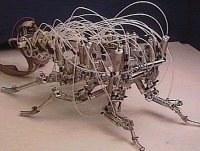
Will we live to see the times when the tendencies laid down by the robot-cockroach gain force? Across the sky will fly flocks of migratory birds led by electronic guides. In the oceans, schools of fish will follow robot-leaders straight into the sluices of fish factories. Even earthworms will take up soil formation not singly but as part of teams headed by worm-bots. And household robots will become as perfect and numerous as cockroaches, taking over their ecological niche. Beautiful!
D. Shabanov. Become what I want // Computerra, Moscow, 2006. — No. 24 (644)
D. Shabanov. War with the toad // Computerra, Moscow, 2004. — No. 46 (570). — pp. 19–20
D. Shabanov. Don't go, children, to walk in Africa! // Computerra, Moscow, 2005. — No. 12 (584)
D. Shabanov. Unto the seventh generation // Computerra, Moscow, 2005. — No. 24 (596)
D. Shabanov. The long life of roundworms // Computerra, Moscow, 2005. — No. 5 (577). — p. 13
D. Shabanov. The undercover agent // Computerra, Moscow, 2004. — No. 44 (568). — p. 20