
Ecology: The Biology of Interaction. 1.12. (Supplement) Models: Their Limitations and Dangers
Some objects cannot be studied directly, or are extremely difficult to investigate in situ. In this and in many other cases, models are employed. A model is a system constructed for the purpose of studying an original system; it must exhibit a similar character of interaction among its parts and, by virtue of this, possess analogous emergent properties...
Ukrainian Language (latest version) / Russian Language (update stopped)
1.11. (supplement) Scientific Method
D. Shabanov, M. Kravchenko. Ecology: Biology of Interaction Chapter 1. Ecology and the Biosystems it Studies
1.13. (supplement) Universal Properties of Biosystems
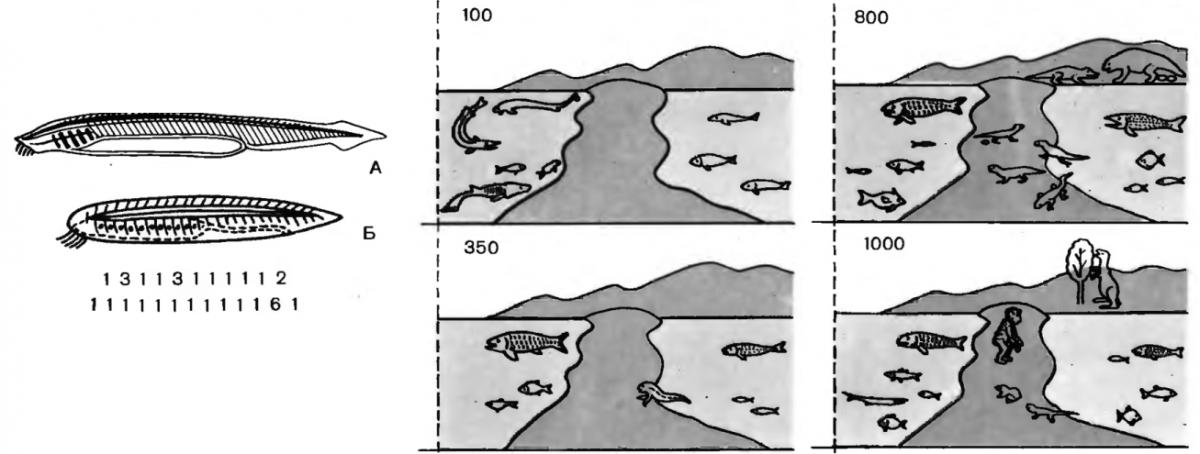
1.12. (Supplement) Models: Their Limitations and Dangers Some objects cannot be studied directly, or are extremely difficult to investigate in situ. What would happen if all fish exceeding a certain size were removed from a fish-breeding pond? How would the biosphere respond to nuclear war? Conducting a corresponding experiment is frequently impractical or impossible, yet obtaining an answer to such a question is of considerable importance. In these and in numerous other cases, models are employed. A model is a system constructed for the purpose of studying an original system; it must exhibit a similar character of interaction among its parts and, by virtue of this, possess analogous emergent properties. A model may be of highly varied nature. A physical model consists of physical objects that simulate the parts of a system; a conceptual model is composed of certain abstractions; an analytical model consists of interrelated mathematical functions; and a simulation model consists of programmatic processes running within a computational environment. For example, to study the biosphere one may construct its mathematical model. To do so, it is necessary to determine what components constitute the biosphere and to hypothesize how they influence one another. One then constructs a system of equations in which the variables describe the interactions among the parts of the biosphere. By introducing specified changes into this model, one may predict how the original system would respond to them. However, when employing models, it is essential never to forget that they are approximations, adequate only for estimating a certain range of phenomena. Let us divide the set of states of the original system and its describing model into two domains: that in which the original has actually been observed, and that about which we can judge only through the model. If the model fails to correspond to the original in the studied domain, it must be abandoned or, at minimum, substantially revised. In the unstudied domain, however, the adequacy of the model cannot be proven. All the more valuable, therefore, are those situations in which the domain of states of the original system where its behaviour has been studied is expanded. Let us consider an example pertaining to the response of organisms and ecosystems to changes in environmental factors. Relatively recently it was discovered that the majority of climate models incorrectly predict the response of forests to moisture deficit. Let us first consider the logic upon which any reasonable model would be constructed. How does one determine the response of a forest to drought? Subject experimental plants to water deficit in a climatic chamber. The answer seems straightforward: seeking to limit water evaporation, such plants will close their stomata, reduce gas exchange with the surrounding environment, and decrease the intensity of photosynthesis. By analogy, the humid tropical rainforest would be expected to respond in the same manner. From July to September 2005, an unprecedented drought was observed in Amazonia. The region was monitored from space. The intensity of photosynthesis was assessed by measuring the degree to which the frequencies of chlorophyll absorption were extracted from the light reflected by the forests. Upon processing the resulting data, a paradoxical phenomenon was recorded. Over the overwhelming majority of the territory, the drought caused an increase in photosynthesis; it decreased only in areas altered by human activity. How could ecologists have failed to detect the mechanism by which drought enhances photosynthesis? Probably because climatic chambers do not produce clouds. The reduction in atmospheric humidity above the forests led to decreased cloud cover, increased leaf illumination, and a rise in the intensity of photosynthesis. And water? The trees obtained water from somewhere. The soil in a humid tropical rainforest is exceedingly poor, yet, as it turns out, it retains some minimum of moisture necessary for the forest's survival during drought. But what if the drought were prolonged? Unfortunately, the answer to this question lies in that domain of states of the original system for which sufficiently reliable experimental data are lacking. Thus, models are an important research tool, but they are by no means a panacea. Moreover, the use of models sometimes becomes a means of self-deception for researchers. To substantiate this claim, numerous examples could be cited; here, however, one will be examined that paradoxically involves Charles Darwin himself. The case concerns an edition of Darwin's "On the Origin of Species" published in 1987 with commentary by two prominent Soviet and Russian evolutionists: A.V. Yablokov and B.M. Mednikov. Those passages in which Darwin expressed doubt or cautiously groped toward an idea were excised without hesitation by the commentator-editors. The retained Darwinian text was substantially embellished with commentary and insertions by the publishers. "In order to demonstrate the connection between Darwin's ideas and the modern achievements of biology, we decided to supplement the text of the author of 'On the Origin of Species' with contemporary illustrations confirming or developing his thoughts. <...> For greater accessibility of Darwin's work, we have removed certain sections that, in our view, are secondary or excessively complex for the teacher" (A.V. Yablokov, B.M. Mednikov, 1987; in: Ch. Darwin. On the Origin of Species by Means of Natural Selection: A Book for the Teacher. Moscow: Prosveshchenie, 1987) Among other additions, a description of a computer experiment performed by V.V. Menshutkın in collaboration with Mednikov himself was inserted into "On the Origin of Species" (Fig. 1.12.1). [IMG_1] Fig. 1.12.1. Illustrations explaining the Menshutkın-Mednikov experiment (source: Darwin (!), 1987) "The machine memory was loaded with a description of the prototype of chordate animals, analogous to the lancelet (Amphioxus) that has survived to the present day (A); the numbers below represent the 'genotype,' the machine description of 24 characteristics of the 'species.' This initial species could be transformed into others, with variation being indeterminate, in the Darwinian sense. Progressive (increasing complexity) and regressive (decreasing complexity) changes were equiprobable. Major saltations were excluded — for example, the sudden emergence of a well-developed organ (the brain, etc.). After each time step, approximately corresponding to 1 million years of the palaeontological record, the computer sorted through the resulting variants, evaluating them according to degree of fitness. The least fit were erased from computer memory ('became extinct'), and their memory cells were occupied by new, 'adapted' variants. In this manner, the struggle for existence and natural selection were modelled" (A.V. Yablokov, B.M. Mednikov, 1987) The outcome of this experiment purportedly "demonstrated" that the course of evolution is predetermined and inevitably leads to the emergence of intelligence. In the Menshutkın-Mednikov experiment, the "lancelets" gave rise to diverse "fishes" possessing three pairs of paired fins, which subsequently emerged onto land in the form of six-legged creatures. As a result of the evolution of terrestrial life, animals resembling centaurs arose — organisms that moved on four limbs with forelimbs freed for labour. They possessed a large brain and a social life conducive to the development of intelligence. Having reached this stage, the experimenters "rewound" the machine time and repopulated the land with four-limbed creatures. Remarkably, the intelligence that emerged in the course of evolution was now bipedal. Thus, it was "demonstrated" that evolution possesses a certain degree of freedom, yet its overall course is predetermined. The authors of the present textbook consider that evolution is substantially directional, but hold this view not because of the Menshutkın-Mednikov experiment, but in spite of it. The issue is not that vertebrates could not have been six-limbed. The issue lies in how the fitness of "organisms" was assessed in this experiment. The book by Nobel Laureate Friedrich von Hayek, devoted to attempts to manage an economy from a single centre, is titled "The Fatal Conceit." No plan can anticipate what is determined by the multitude of individuals in their concrete market interactions. Yet more fatal is the conceited belief that one can know in advance what natural selection will favour and what it will reject. A model biosphere capable of making such predictions would necessarily be as complex as the real biosphere itself. In the Menshutkın-Mednikov model, there existed only one method for distinguishing successes from failures — the introduction of an a priori evaluation in which that which triumphed in the course of actual terrestrial evolution was deemed fit. The programme was instructed that the most adapted organism is an intelligent one. Intelligence requires free limbs, a large brain, and social life. In other words, the model was assigned a terminal state and a means of achieving it (using random errors that approximated the goal). Should it surprise anyone that the model arrived at the destination toward which it had been directed from the very beginning? It is noteworthy that the experimenters "switched off" evolution once an intelligent organism had emerged. Did they understand that further development of the model would result in mere stagnation? The answer to this question would allow one to assess the proportion of deception to self-deception in the motivation behind the experiment in question. Menshutkın and Mednikov might perhaps have justified such a decision by arguing that after the emergence of intelligence, biological evolution is supplanted by social evolution. But did they not wish to observe what would happen next? Their failure to do so permits the inference that a certain measure of deliberate deception was admixed with the self-deception. In any case, this mixture proved sufficiently successful; many readers of "On the Origin of Species" were persuaded that the predetermination of evolution had been demonstrated. Darwinism is accused of logical circularity: fitness is explained as the capacity to survive, and survival is considered a consequence of fitness. Nevertheless, it may be supposed that Darwin — inclined as he was to cautious and comprehensive reflection — would not have fallen into the trap into which Menshutkın and Mednikov led themselves and their readers. Incidentally, in the authors' view, the cause of a certain crisis in evolutionary biology observable today is connected not with deficiencies in Darwin's work (which in any case belonged to its own era, the century before last), but with the dogmatism of contemporary "Darwinists." Additional materials: Course outline "Simulation Modelling in Ecology (Based on Microsoft Excel)". Basic concepts Educational models in ecology Ukrainian / Russian
1.11. (supplement) Scientific Method
D. Shabanov, M. Kravchenko. Ecology: Biology of Interaction Chapter 1. Ecology and the Biosystems it Studies
1.13. (supplement) Universal Properties of Biosystems