
Shabanov et al (2015) Sustainable coexistence
{"authors": "Shabanov D., Usova O., Kravchenko M., Biriuk O., Leonov A., Korshunov O., Mair Q., Meleshko O., Newman J., Vladymyrova M., Zholtkevych G.", "title": "Sustainable coexistence of the parental species and hemiclonal interspecific hybrids is provided by the variety of ontogenetic strategies", "source": "Herpetological Fac..."}
Shabanov D., Usova O., Kravchenko M., Biriuk O., Leonov A., Korshunov O., Mair Q., Meleshko O., Newman J., Vladymyrova M., Zholtkevych G. Sustainable coexistence of the parental species and hemiclonal interspecific hybrids is provided by the variety of ontogenetic strategies // Herpetological Facts Journal. 2015, 2. — P. 35–43.
SUSTAINABLE COEXISTENCE OF THE PARENTAL SPECIES AND HEMICLONAL INTERSPECIFIC HYBRIDS IS PROVIDED BY THE VARIETY OF ONTOGENETIC STRATEGIES
Dmytro Shabanov1,3, Olena Usova1, Marina Kravchenko1, Olha Biriuk1, Anton Leonov1, Olexiy Korshunov1, Quentin Mair2, Olena Meleshko1, Julian Newman2, Marina Vladymyrova1, Grygoriy Zholtkevych1
1 V.N. Karazin Kharkiv National University, Ukraine;
2 Glasgow Caledonian University, Scotland, UK
ABSTRACT
Factors determining the sustainability of Hemiclonal Population Systems in which the interspecies hybrids Pelophylax esculentus complex coexist with members of parental species were studied using a combination of empirical data and computer simulation modeling. The empirical data demonstrates the existence of different intrapopulation strategies by partitioning a sample of individuals into two groups on the basis of their body size at a given age and comparing selected groups in terms of factors such as growth rate, life span, females’ fecundity and the age at which breeding commences. Then by using simulation modeling, we study the probable importance of intrapopulation ontogenetic strategies for the stability of Pelophylax esculentus complex HPS.
Key words: Pelophylax esculentus complex, skeletochronology, strategy, undersize, oversize, simulation, hemiclonal population systems.
INTRODUCTION
The hybribogenetic complex of water frogs, Pelophylax esculentus complex (=Rana esculenta complex), consists of two parental species: the pool frog, Pelophylax lessonae (Camerano, 1882) and the marsh frog, Pelophylax ridibundus (Pallas, 1771), and their interspecies hybrids with varying ploidy levels (Plötner, 2005). It is common to refer to these hybrids by using the species name Pelophylax esculentus (Linnaeus, 1758) — the edible frog. Hemiclonal inheritance is characteristic of P. esculentus. In this case they produce gametes transmitting either P. ridibundus genome, or P. lessonae genome, or both.
P. esculentus tends to cohabit with parental species representatives in hemiclonal population systems, HPSs (Shabanov, Litvinchuk, 2010). HPS consisting only of P. esculentus are also known.
One way of designating types of HPS is associated with counting of frogs' forms, composing the system, wherein the letter L represents P. lessonae, the letter R — P. ridibundus, and the letter E — P. esculentus. The presence of polyploid P. esculentus in the HPS is represented as Ep. A particular center of diversity, named The Siverskyi Donets Center of Water Frog Diversity, has been identified in the basin of Siverskyi Donets River in the territory of Kharkiv region. It is characterized by R-E-HPSs, R-E-Ep-HPSs, as well as the complete absence of mature P. lessonae representatives (Shabanov, Litvinchuk, 2010).
Previously, the authors formed the hypothesis that diversity of individuals within one population or HPS (in the case of water frogs) can be described by the effect of intrapopulation ontogenetic strategies, IOS. Ontogenetic strategy is a hierarchy of priorities exhibited in organism development. An intrapopulation strategy is one discrete realization of a species-specific strategy occurring in representatives from one population or HPS. IOS is characterized by a certain syndrome (complex of related traits) reflecting a specific environmental adaptation.
The study consists of two parts. The first is the description of the diversity of water frogs as the effect of different intrapopulation strategies. For this purpose, we divide individuals into two groups on the basis of their body size at a certain age. Then selected groups are compared according to strategic characteristics of their representatives, such as growth rate, life span, females’ fecundity and the age at which they begin to participate in spawning. In the second part, by using simulation modeling, we study the probable importance, for the stability of Pelophylax esculentus complex HPS, of frogs’ diversity with respect to their IOS.
MATERIALS AND METHODS
We studied 575 water frogs, captured in Kharkivska Oblast. These frogs were of three forms: 193 were P. ridibundus, 348 were diploid P. esculentus, and 34 were triploid P. esculentus. The frog’s age was determined via the method of skeletochronology by analysing gluing lines, which are forming in bone during wintering, and are visible on the phalangeal bone cross sections (Usova, 2014). Based on the size of gluing lines visible in the bone, one can determine the dynamics of its growth, and calculate the past sizes of a given individual during its several previous winterings. The fecundity of 59 females was determined by counting eggs in their clutches.
The study of the stability of HPS of Pelophylax esculentus complex was carried out by means of a simulation model. This model simulates the changes of composition of water frogs’ HPS. Based on defined initial parameters which can be varied by the investigator, the model conducts step-by-step recalculation of the structure of the model HPS (Figure 1).
The initial parameters defined during modeling were as follows:
— Initial composition (number of individuals of different forms and ages) in the model HPS;
— Population-biological parameters of all frog groups considered in the model HPS (which differ by genotype and age), that include its viability (probability of survival in uncompetitive environment), competitiveness (probability of survival during competitive exclusion), probability of pairing with a partner during breeding, age at first reproduction, maximum life expectancy, fecundity and resource requirements;
— Variants of all possible crossings, indicating the probability of penetrance of different genotypes in the offspring;
— Environmental capacity (quantity of available resources);
— Immigration and emigration scenarios (if necessary).
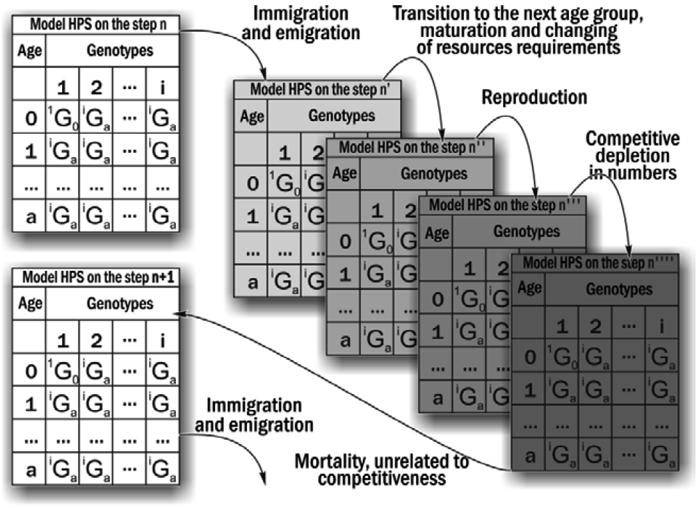
Figure 1. The calculations in each cycle of the simulation model
At each simulation time-step, the fate of each individual (its survival and reproduction) in the model HPS was determined by random process and was described by probabilities, defined in the initial model parameters. 10 simulations were run on each initial condition. Simulation outcomes were classified depending on the composition of the frog forms present in the model HPS after 500 cycles (corresponding to 500 years). Then the probability distributions of different simulation outcomes were determined depending on the initial composition of the HPS, and on the given viability parameters.
RESULTS AND DISCUSSION
Description of water frogs’ intrapopulation ontogenetic strategies (IOS)
The observed empirical distribution of individuals by age and size can be described using different models. We have chosen to model our sample using two regression lines, one of which corresponds to relatively smaller, and the other to relatively bigger individuals of the same age (Figure 2). The regression lines were fitted by the least squares method. Both selected size groups included individuals of both sexes, well as all three studied forms.
In order to compare the relative sizes of individuals of different ages, a measure independent of age is required. We used the “dimensional index” S, calculated by the formula
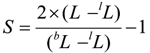
where L — individuals’ body length, lL— expected value of body length for an individual of such age, corresponding to a position on the regression line for relatively smaller individuals (Figure 2), bL — expected value of body length for an individual of such age, corresponding to the regression line for relatively bigger individuals.
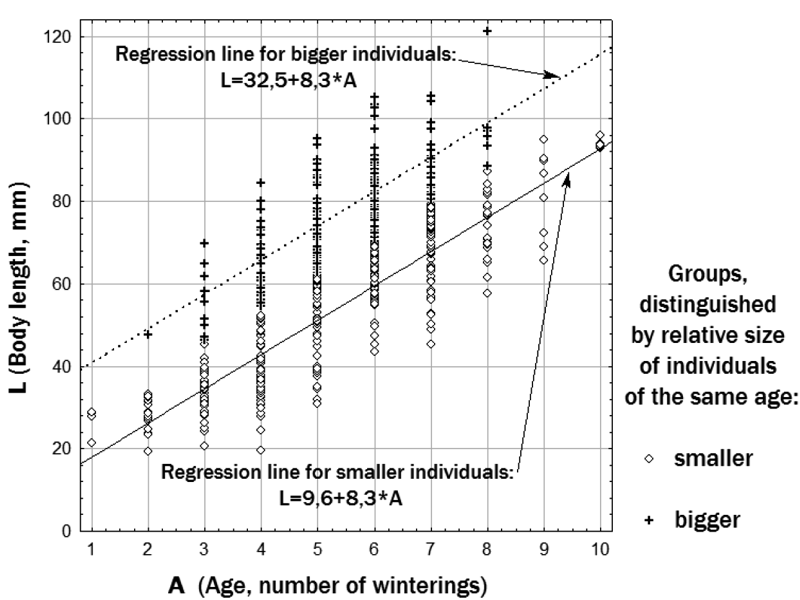
Figure 2. Approximation of the empirical age-dimensional diversity of water frogs by two linear dependences
The dimensional index has the value S= -1 for frogs with a body size corresponding to a position on the regression line for relatively smaller individuals; S= +1 for those, which are on the regression line for bigger individuals; S=0 for those centrally positioned between the two regression lines.
Using the Kruskal-Wallis test, we determined the effect of the following three factors on the dimensional index: frog form, sex and sampling site locality. The only factor whose influence on the growth rate turned out to be significant was the form of representatives of Pelophylax esculentus complex (Figure 3).
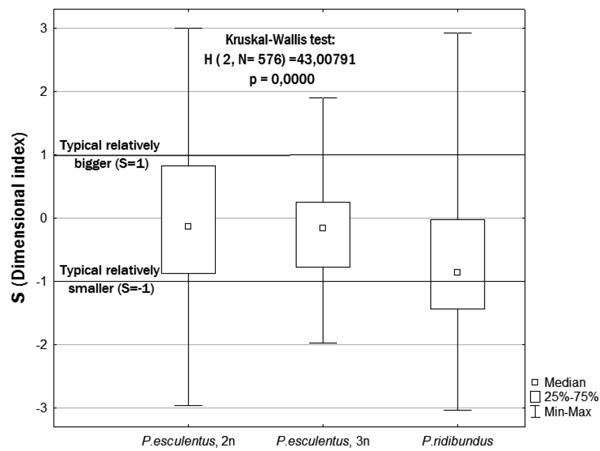
Figure 3. Comparison of the dimensional index value (S) for three studied forms of water frogs
Comparing the representatives of two selected size groups of frogs, we found significant differences in their growth rate at the 3rd and 4th years of life. As expected, the relatively bigger individuals grow much faster than the relatively smaller. The dimensional index (S) was notably associated with female fecundity: Spearman's rho was 0.34 (p = 0.009). Both the mean and the median of the clutch egg number were two to three times higher in relatively larger females than in relatively smaller females of the same age.
The oldest individuals in the studied sample belong to the smaller size group (Figure 2). Among individuals older than 6 years, the age of relatively smaller individuals is significantly greater (p=0.045 when compared by Mann-Whitney test) than that of relatively bigger ones.
In the study region, all frogs reach physiological puberty by the age of 3-4 years. However, most frogs progress significantly later to full participation in spawning (which involves presence on the spawning grounds as well as a substantial energy cost for reproduction). The age at which this happens is shown in Table 1.
Table 1. Comparison of the intrapopulation ontogenetic strategies (IOS) of undersize and oversize individuals
|
IOS Characteristics |
Undersize |
Oversize |
||
|
Females |
Males |
Females |
Males |
|
|
Size |
Relatively smaller: lL = 9,7 + 8,3×A |
Relatively bigger: bL = 32,5 + 8,3×A |
||
|
Growth rate in the age of 3-4 years |
Relatively low: lgme3 = 0,170; lgme4 =0,176 |
Relatively high: bgme3 =0,450; bgme4 =0,288 |
||
|
Full participation in spawning |
Relatively early: since 4 years |
Relatively late: since 6 years |
Relatively late: since 6 years |
Relatively early: since 5 years |
|
Life span |
Relatively high: up to 10 years |
Relatively low: up to 8 years |
||
|
Females fecundity |
Relatively low: F = ‑1325 + 335×A |
‒ |
Relatively high: F = 179 + 316×A |
‒ |
|
Number of breeding seasons |
Relatively large: up to 7 years |
Relatively large: up to 5 years |
Relatively small: up to 3 years |
Relatively small: up to 4 years |
The probable significance of intraspecific ontogenetic strategies (IOS), as observed in water frogs belonging to the *Pelophylax esculentus* complex within a single habitat patch system (HPS), is being investigated. The presence of both oversized and undersized individuals within the same water frog population suggests that this variation might be an adaptation to interactions among individuals within that population. Simulation modeling is a valuable tool for exploring the importance of such adaptive strategies. This phenomenon was first observed during experiments using a simulation model of water frog HPS developed in Microsoft Excel (Kravchenko et al., 2011). Later, it was studied in more detail using a refined model developed by A.O. Leonov, with additional contributions from Q. Mair (Shabanov et al., 2015). The models simulated R-E-HPSs, which consist of *P. ridibundus* and diploid *P. esculentus*. In these systems, the gametes of *P. esculentus* carry the genome of the female *P. lessonae*. For clarity, the genome of *P. lessonae* is represented by 'L', and the genome of *P. ridibundus* by 'R'. Male genomes are denoted by the superscript 'Y', and female genomes by 'X', as males are the heterogametic sex in water frogs (Plötner, 2005). Clonality of a genome is indicated by enclosing its symbol in parentheses. Using this notation, the possible types of reproduction within the described HPS are: * **Parental species reproduction:** * Female (X R X R) crossed with Male (X R Y R) results in Female (X R X R) and Male (X R Y R). * **Crossing of parental species with hybrids, producing only hybrid offspring:** * Female (X R X R) crossed with Male (Y R (X L)) results in Female (X R (X L)). * Female (X R (X L)) crossed with Male (X R Y R) results in Female (X R (X L)) and Male (Y R (X L)). * **Crossing between hybrids, producing inviable individuals of parental species not present in the HPS:** * Female (X R (X L)) crossed with Male (Y R (X L)) results in Female ((X L) (X L)), which are non-viable (indicated by †) (Plötner, 2005; Shabanov, Litvinchuk, 2010). Transformations of these R-E-HPSs can lead to one of three outcomes: 1. The HPS transforms into a population of *P. ridibundus* due to the disappearance of *P. esculentus*. 2. The R-E-HPS is maintained through the continued coexistence of *P. ridibundus* and *P. esculentus*. 3. The HPS becomes extinct as a result of the disappearance of *P. ridibundus*. If the population-biological parameters for *P. ridibundus* and *P. esculentus* are identical in the simulation, the proportion of *P. esculentus* within the HPS increases continuously due to their more efficient reproduction. In such scenarios, the R-E-HPS transformations lead to outcome (3). This suggests that in reality, the viability parameters of *P. ridibundus* and *P. esculentus* are not identical, because if they were, R-E-HPSs would be relatively short-lived and would naturally disappear. However, such systems are known to be widespread in the river basins of the Mozh and Udy Rivers (tributaries of the Siverskyi Donets River). The researchers hypothesized that the stable coexistence of *P. ridibundus* and *P. esculentus* could be explained by lower viability of *P. esculentus*. This hypothesis suggests that reduced hybrid viability would compensate for their reproductive advantage. However, as shown in Figure 4, this assumption proved incorrect. Depending on the mortality rates of *P. ridibundus* and *P. esculentus*, the simulated HPS reached either outcome (1) or (3). **Figure 4.** Results of R-E-HPS transformation simulations, assuming *P. ridibundus* and *P. esculentus* differ only in their probability of death. A different outcome was observed when *P. ridibundus* and *P. esculentus* exhibited different intraspecific ontogenetic strategies (IOS) (Figure 5). In this case, the system entered a zone of correlated viability between the two forms, allowing for their sustainable coexistence. **Figure 5.** Results of R-E-HPS transformation simulations, assuming *P. ridibundus* and *P. esculentus* differ in their IOS. The researchers propose that the phenomenon observed in their simulations represents a specific instance of a broader mechanism. Future research aims to test the hypothesis that differences in ontogenetic strategies can facilitate the coexistence of competing species.