
Natural Sciences. The Past, Present and Possible Future of Humanity and the Biosphere (Programme + Lesson Planning for Grade 10)
The integrated natural sciences curriculum by D.A. Shabanov and O.H. Kozlenko (+ calendar lesson planning for Grade 10). The programme received the official endorsement "Approved by the Ministry of Education and Science of Ukraine" (Order of the Minister of Education and Science of Ukraine No. 1407 of 23.10.2017). Piloting of the programme commenced on 1 September...
Natural Sciences. The Past, Present and Possible Future of Humanity and the Biosphere
The programme received the official endorsement "Approved by the Ministry of Education and Science of Ukraine" (Order of the Minister of Education and Science of Ukraine No. 1407 of 23.10.2017)
Piloting of the programme commenced on 1 September 2018 under the nationwide experimental initiative "Development and Implementation of Educational and Methodological Support for the Integrated Course 'Natural Sciences' for Grades 10-11 of General Secondary Education" in accordance with Order of the Minister of Education and Science of Ukraine No. 863 of 03.08.2018
The programme in PDF format for download
Calendar lesson planning (working version, subject to revision) for Grade 10 in PDF format for download
The course is intended for students of Grades 10-11 at general secondary schools who are not enrolled in a natural-sciences specialisation. The course will foster the growth of individual and collective adaptive capacity of students in the rapidly changing present and in an insufficiently predictable future. The course will form a coherent natural-scientific worldview, develop an understanding of cause-and-effect relationships in natural processes and their impact on society, and promote the development of future citizens' capacity to make responsible decisions regarding their own lives and the future of Ukraine. Special attention is devoted to current and contentious problems of the modern era. The subject matter of the natural sciences is examined in an order determined by the general structural principle of the course: cause-and-effect relationships that are the reason for the current state of the biosphere and humanity; characterisation of the current state and trends shaping the future; various scenarios for the future and the course of action for the individual, a nation and a state, as well as for humanity as a whole, that bring the desired future closer.
The structure of the course is shown in the diagram provided. In it, the arrangement of the panels denoting the sections of the course corresponds to the temporal axis "past - future"; the height of the panels is proportional to the approximate projected number of hours.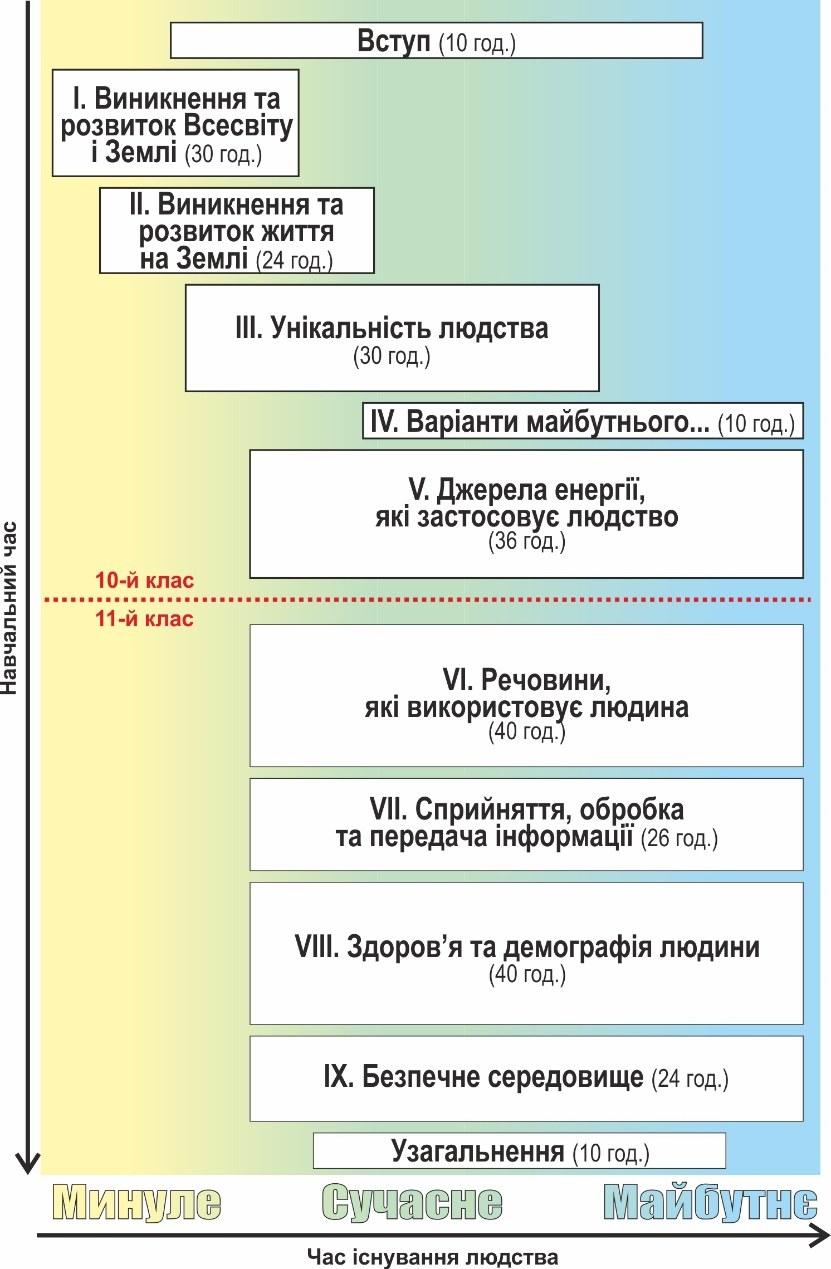
Mastery of the programme should develop in students the ability to consciously apply acquired theoretical knowledge and practical skills in everyday life. The outcome of studying the course should be the assimilation of the leading ideas, concepts and laws of the natural sciences, familiarity with methods of scientific inquiry, and the promotion of intellectual development. The programme includes, among other things, questions on which no societal consensus has been reached. However, it is precisely the discussion of such issues that will foster the development and civic formation of students. For this reason, the course materials, including the textbook, must not contain categorical answers to the listed issues but should set out the range of aspects of the problem that require consideration and discussion. The teacher delivering this course should be granted the right to devote deeper attention to those questions that he or she considers more relevant for the students, and to save time by treating other topics in less depth.
In the course of working through the curriculum, the following key competencies are envisaged to be formed, as laid down in the concept of the "New Ukrainian School":
|
In studying the course it is advisable to use the various types of models set out in the programme. In particular, a series of simulation models are planned, created using Microsoft Excel or other software tools, which students and the teacher will be able to modify, edit or even create independently. These models or their templates should be available on the course support website. |
Course Sections |
Content elements of education according to the State Standard:
|
|||||||
|---|---|---|---|---|---|---|---|---|---|
|
For the overwhelming majority of sexually reproducing organisms, species populations are formed, which constitute biotic communities. Individuals within a population share a common gene pool and jointly participate in population reproduction. Populations in a community interact in various ways, from competition to exploitation and mutualism. A portion of the community that unites competing populations using the same resource can form guilds. The listed levels of organization of biosystems (population, guild, community) can be considered typical. However, for some groups of organisms other, unusual levels of organization occur. Among them are the European green frogs, Pelophylax esculentus complex. |
The general natural-science part: The methods of scientific cognition of nature. The fundamentals of the general methodology of scientific research. The natural-science picture of the world. Astronomy: The methods and means of astronomical research Physics: Physics as a fundamental science. The methods of cognition. Chemistry: The methods of scientific cognition in chemistry. Biology: Biology is the science of the cognition of living nature. The methods of scientific cognition of living nature Geography: Geography is a system of sciences about nature, population and economy. The place and role of geography in the system of the natural and social sciences |
Resistance to manipulation, the scientific picture of the world |
Critical thinking, the ability to make well-grounded decisions |
||||||
|
I. The origin and development of the Universe and the Earth |
Astronomy: The structure and development of the Universe. Galaxies. The Sun and the stars, the 'Milky Way' galaxy. The motion of the celestial bodies. The motion of the Solar System in the Galaxy. The motion of the planets of the Solar System Physics: Matter and field. The physical properties of matter and field. Quanta. Elementary particles. Wave-particle duality. The fundamental interactions. Chemistry: Chemical elements in nature. The cycle of elements. Metallic and non-metallic elements. |
The examination of the cause-and-effect relationships that underlie the competences connected with the content lines |
|||||||
|
II. The origin and development of life on Earth |
Chemistry: Organic compounds. The levels of organization of matter. The chemical reaction. The classification of chemical reactions Biology: The cell. The features of the chemical composition of living systems. The main biochemical processes. The modern cell theory. Non-cellular forms of life. The organism as an open self-regulating system. The general properties of organisms. Supra-organismal systems: the levels of organization of supra-organismal systems. The systematics and evolution of organisms. Geography: geographical space. |
The examination of the cause-and-effect relationships that underlie the competences connected with the content lines |
|||||||
|
III. The uniqueness of humanity |
Biology: The human and the biosphere. Geography: The spatial organization of the life and activity of people. Political, social, economic systems |
The examination of the cause-and-effect relationships that underlie the competences connected with the content lines |
|||||||
|
IV. Variants of the future and non-depleting development |
The general natural-science part: to assess the prospects and limitations of the relationships in the system 'nature - human - science - society - production'. Astronomy: Astronomy in human life Geography: The geographical aspects of the interaction of humans and nature. The geographical environment as a sphere of interaction of society and nature. |
The main attention in the section is given to the material of this content line |
Planning the future, understanding the trends in the development of society and its relationships with nature |
||||||
|
V. The energy sources that humanity uses |
Physics: Motion and interactions. The physical essence of physical phenomena and processes of various natures. The role of physical knowledge in the life of society, the development of technology and technologies, the solving of ecological problems. Nanophysics and nanotechnologies Geography: The geography of natural resources. Nature management and its consequences. |
The influence of the energy industry on the environment and human life |
The responsible choice of an energy-use strategy |
The influence of the energy industry on human health |
An understanding of the advantages of modern technologies as a basis for effective business |
||||
|
VI. The substances that humans use |
Chemistry: Matter. Inorganic compounds of metallic and non-metallic elements. Chemistry in the life of society. The role of chemistry in solving the global problems of humanity. Geography: The geography of natural resources. Nature management and its consequences. Ukraine in the world, the economy, territorial differences, external economic relations. |
The responsible choice of an energy-use strategy |
The influence of the use of certain substances on human health |
An understanding of the advantages of modern technologies as a basis for effective business |
|||||
|
VII. The perception, processing and transmission of information |
Biology: The organism as an open self-regulating system. The general properties of organisms. The main regularities of heredity and variability. Reproduction and ontogeny. Biotechnologies |
Resistance to manipulation |
An understanding of the advantages of modern technologies as a basis for effective business |
||||||
|
VIII. Human health and demography |
Biology: The organism as an open self-regulating system. The general properties of organisms. The main regularities of heredity and variability. Reproduction and ontogeny. Biotechnologies Geography: Regional geographical systems. The regions and countries of the world, their natural and socio-economic features, international relations. |
The main attention in the section is given to the material of this content line |
An understanding of the advantages of modern technologies as a basis for effective business |
||||||
|
IX. A safe environment |
Biology: Supra-organismal systems: the levels of organization of supra-organismal systems. The human and the biosphere. Geography: Geographical space. The general regularities of the development of society. Nature management and its consequences. |
The main attention in the section is given to the material of this content line |
The main attention in the section is given to the material of this content line |
Accounting for the environmental component in the balance of economic accounts |
|||||
|
Incorporation of the conservation component into the balance of economic accounts. |
The general natural-science part: The fundamental ideas of the natural sciences. The main concepts of modern natural science. The significance of natural-science knowledge in human life and the development of society. |
Conclusions from the material considered, their influence on life and civic responsibility |
Planning the future, understanding the trends in the development of society and its relationships with nature |
||||||
Communication in the state language (and in the native language if different) - by actively engaging students in discussions and debates using various information sources;
|
Kozlenko Oleksandr Hryhorovych, Research Associate, Department of Biological, Chemical and Physical Education, Institute of Pedagogy of the National Academy of Educational Sciences of Ukraine.
|
The approximate content of the educational material |
The practical component of the studies |
|||||
|---|---|---|---|---|---|---|---|
Grade 10 (140 hours, 4 hours per week) |
|||||||
Introduction (approximate time - 10 hours) |
|||||||
|
distinguishes: - information sources by reliability; - scientific, non-scientific and pseudo-scientific theories; describes: - the differences of the scientific cognition of the world from the religious and the aesthetic; composes: - a research plan for a certain problem; classifies: - information sources; characterizes: - the stages of scientific research; establishes cause-and-effect relationships between: - the results of scientific research and the confirmation of hypotheses. |
names: - the criteria of scientificity; - the main stages of the development of the natural sciences; explains the concept of: - the falsifiability of scientific knowledge; - feedback; - the double-blind study - evidence-based medicine; gives examples: - different approaches to the cognition of the world. |
is aware of: - the significance of the natural, humanitarian and technical sciences for achieving the desired future; expresses a judgement: - regarding the influence of different approaches to the cognition of the world on scientific cognition; substantiates: - the pseudo-scientific character of certain theories; assesses : - the significance of evidence-based medicine for the health-care system and the activity of humanity as a whole; draws a conclusion: - about the significance of modelling in the structure of scientific research. |
The scientific method. The relationship between the scientific explanation of the world, the religious worldview and art, as fundamentally different approaches. The criteria of scientificity; the falsifiability of scientific knowledge according to K. Popper. The structure of scientific research (observation, hypotheses, models, experiments, statistical processing; the testing of hypotheses and their refutation or confirmation). Evidence-based medicine as a result of applying the scientific method in health care. The double-blind study. The comparison and analysis of information sources. Scientific, popular-science, educational, entertainment, pseudo-scientific sources. The significance of science for modern humanity. An algorithm for achieving a desired state: to determine the causes of the existing state (the cause-and-effect chains that formed it); to determine the desired future and the ways of achieving it; to model the transition from the existing to the desired state; to implement what is planned. The significance of the natural, humanitarian and technical sciences for such a transition. |
Demonstration: - examples of works of fine art based on the features of the physiology of human visual perception. Practical works: — the study of the electrification of a ball by friction and the experimental testing of hypotheses; - the 'blind spot' in the human eye and the algorithms of the modelling of reality by the brain that can be revealed with its help; — a double-blind study (an organoleptic analysis of water or similar); - working with a synchronistic table of the development of the natural sciences. Models: - cause-and-effect relationships. Projects: - an analysis of the scientificity/non-scientificity of certain concepts. |
|||
I. The origin and development of the Universe and the Earth (approximate time - 30 hours) |
|||||||
|
describes: - the stages of the life cycle of stars; composes: - diagrams of the movement of the lithospheric plates of the Earth; classifies: - the atoms of chemical elements; compares: - the features of the structure of the Earth compared with the other planets of the Solar System; - the processes that take place inside celestial bodies; characterizes: - the Sun as a star; establishes cause-and-effect relationships between: - the presence of a large satellite (the Moon) and the features of the processes on Earth. |
names: - the main stages of the formation of the Solar System; - the methods of modern cosmological research; — main-sequence stars; explains: - the essence of the 'Big Bang' hypothesis, the concept of entropy; - the origin of chemical elements in different processes in stars; - the conditioning of the 'arrow of time' by thermodynamic processes; gives examples: - elementary particles. |
is aware of: - the worldview significance of scientific cosmogonic theories; expresses and substantiates a judgement regarding: - the connection between life on Earth and processes in space; assesses: - the significance of the geophysical features of the Earth as a planet for the origin of life; draws a conclusion: - about the significance of modelling in understanding the physical picture of the world. |
Pokhodzhennia Vsesvitu. The 'Big Bang', the appearance of space and time. Matter and field, their physical properties. Quanta. Elementary particles. Wave-particle duality. The interrelationship of energy and matter; E=mc2. The principle of equivalence of gravitational and inertial mass. The axis of time and the directionality of processes. The mechanical and thermodynamic models of time; entropy. The appearance of elementary particles and atoms. The appearance of the stars. Thermonuclear reactions. The emergence of light elements as a result of thermonuclear reactions. The life cycle of stars, supernova explosions; the appearance of heavy elements. The radiation of stars; the quantum nature of light. The expansion of the Universe. The Doppler effect. Modern cosmological research. The problem of studying dark matter and dark energy. The formation and development of the Earth. The appearance of the Solar System. The mechanics of the rotation of physical bodies. The formation of the Earth, its structure; gravitational differentiation. The appearance of the Moon; its influence on processes on Earth. The slowing of the Earth's rotation about its axis. Tidal phenomena, the magnetic field of the planet. The cooling of the planet, the appearance of the ocean. Plate tectonics. The mountain cycle, sedimentary, metamorphic and igneous rocks, volcanism. The active lithosphere of the Earth as a cause of the elemental diversity of its surface. |
Demonstration: - the deviation of the Earth from a spherical shape as a result of its rotation; - the centrifugal force; — the motion of balls with different fillers; — modelling the expanding Universe using a balloon. Practical works: — determining the speed of electromagnetic radiation using a microwave oven and a bar of chocolate; - the observation of the Doppler effect; - the gravitational differentiation of mixtures. Models: — the physical modelling of gravitational systems, black holes (an elastic fabric); — the balance between the gravitational compression and the thermal expansion of a star. - plate tectonics; modelling the movement of the continents and the formation of the modern distribution of land and sea. Projects: - what fate awaits the Sun (with an analysis of the reliability of the information sources)? |
|||
II. The origin and development of life on Earth (approximate time - 24 hours) |
|||||||
|
describes: - the role of living organisms in the creation of mineral resources; composes: - models of the phylogeny of individual groups of organisms (and other objects); classifies: - different explanations of the origin of life on Earth (creationism, spontaneous generation, biochemical evolution, panspermia) by the criteria of scientificity; compares: - the energy sources for the life activity of organisms; characterizes: - the stages of the establishment and development of life on Earth; establishes cause-and-effect relationships between: - the increasing complexity of the structure of cells and multicellular organisms and the complexity of the processes in them; - the activity of living organisms and the transformation of the land; - the processes in living organisms and the composition of the shells of the Earth; adheres to the rules: - the construction of tables and diagrams demonstrating the evolutionary development of the plant and animal world of the Earth. |
names: - the scientific methods of studying the history of the Earth; - the main features of living systems; explains: - the essence of the processes of chemosynthesis, photosynthesis, fermentation, respiration; recognizes: - examples of different fossil organisms; gives examples: - catastrophic events in the history of the Earth. |
is aware of: - why the appearance of life on Earth has a regular character; expresses and substantiates a judgement regarding: - the influence of astronomical and geological factors on the origin and development of life on Earth; - the significance of chemosynthesis, photosynthesis, fermentation, respiration for living organisms and the Earth as a whole; draws a conclusion: - about the integrity and self-regulation of living systems; - about the significance of natural communities for maintaining the balance in the biosphere; - about the significance of modelling in understanding the evolution of life on Earth. |
The origin of life on Earth. The regular character of the appearance of life on Earth. Autocatalytic reactions. Chemical selection. Approaches to defining life, the main features of living systems. The geochronological scale. The methods of studying the history of the Earth and the phylogeny of living systems. Non-cellular systems capable of replication. The origin of cells. The history of the biosphere. The bacterial stage of the evolution of life. Stromatolites. The formation of mineral resources. The 'Oxygen Revolution'. Sexual reproduction and its significance. Energy sources for life activity. Chemosynthesis, photosynthesis, fermentation, respiration. The appearance of the eukaryotic cell. Symbiogenesis. The emergence of plants and animals, the main stages of their evolution. The mastering and transformation of the land by life. Catastrophic events in the history of the Earth and their significance. Biogeocoenotic crises and the renewal of flora and fauna. The dynamics of the climate throughout the geological history of the Earth. The ecological strategies of different species. |
Demonstration: - modelling the stability of systems capable of replication (Conway's game of 'Life' or similar). Practical works: — the reconstruction of phylogeny and the construction of phylogenetic trees; - reconstructions of the composition of the ancient supercontinents from the data of historical biogeography; — modelling the emergence of complex molecules (blocks in a washing machine); — the dissolution of the pigment layer of M&M's sweets in a layer of water as a model of the compartmentalization of space by lipid membranes; - the chromatography of pigments. Models: - tornadoes; - timelines; — 'Daisyworld' according to J. Lovelock. Projects: - experiments on the creation of artificial life; - the search for planets suitable for life, and for extraterrestrial life; - examples of symbiogenesis in the modern living world. |
|||
III. The uniqueness of humanity (approximate time - 30 hours) |
|||||||
|
describes: - the features of biological, cultural and technological evolution; composes: - diagrams of the phylogeny of the human and the dispersal across the world; classifies: - tools by their energy sources and resource consumption, compares: - the genetic and cultural transmission of information; adheres to the rules: - the construction of tables and diagrams demonstrating the evolutionary development of the human. |
names: - the biological features of the human compared with other mammals, primates, hominids; - the biological and social factors of anthropogenesis; - the stages of anthropogenesis; explains: - changes in the reproductive biology and life cycle of the human during its evolution; gives examples: - the emergence and development of certain tools, instruments; - fossil humans attributed to different stages of anthropogenesis. |
is aware of: - the instability of the way of life of modern humanity owing to its critical dependence on non-renewable and exhaustible resources; expresses a judgement regarding: - the influence of the use of tools on the biological and social features of the human; substantiates: - the uniqueness of the population structure of humanity; assesses : - the role of global processes for modern humanity; draws a conclusion: - about the significance of modelling in understanding the mechanisms of anthropogenesis. |
Anthropogenesis. The phylogeny of the human. The biological features of the human compared with other representatives of the family Hominidae (including chimpanzees, gorillas, orangutans and extinct representatives). The social features of the human and their preconditions. Changes in reproductive biology and the life cycle during anthropogenesis. The evolution of social behaviour and altruism in the human. The dispersal of people across the Earth. A comparison of the genetic and cultural transmission of information. The features of cultural and technological evolution compared with biological evolution. Tools and 'organ projection'. The mechanics of the movement of human limbs and of mechanisms. Adaptation to changes in the way of life thanks to cultural inheritance and the joint maintenance of cultural models based on complex sign systems. The dispersal of the modern-type human across the Earth. Changes in the human way of life during its dispersal across different continents and in different natural-climatic zones. The biological changes of the human during dispersal and their causes. The globality of modern humanity. The use of tools through which a flow of energy passes and which require the consumption of resources. The use of energy stored in sources from the past (fossil fuel - nuclear energy - thermonuclear energy). The ability of people to transfer resources between populations as a precondition for the globality of humanity. The forms of resource transfer between the parts of global humanity. Renewable and non-renewable, exhaustible and inexhaustible resources. The instability of the way of life of modern humanity, which depends critically on non-renewable and exhaustible resources. |
Demonstration: - reconstructions of different hominids; a virtual tour of museums. Practical works: — an analysis of the 'organ projections' of tools; - the construction of the simplest dwelling from a limited set of materials. Models: — the iterated 'prisoner's dilemma'; — modelling the 'mitochondrial Eve' effect using dice. Projects: - the interrelationship of the factors of anthropogenesis. |
|||
IV. Variants of the future and non-depleting development (approximate time - 10 hours) |
|||||||
|
describes: - the main features of the concept of sustainable development; classifies: - the possible risks of the future by selected features; compares: - different scenarios of the predicted future; — anthropocentrism and naturocentrism; establishes cause-and-effect relationships between: - the shortage of resources and the emergence of socio-political conflicts; adheres to the rules: - the construction of diagrams of cause-and-effect relationships and mind maps. |
names: - scenarios of the predicted future; - the risks of the future; gives examples: - the deficit of necessary elements and substances; - the energy shortages that humanity has faced in our time. |
expresses a judgement regarding: - the influence of human actions on the probability of the realization of future scenarios; assesses: - the prospects of the mastering of space by humanity; draws a conclusion: - about the significance of modelling the processes of the future. |
The variability of the future. Modelling the future and its limitations. Versions of the future: predicted, desired, projected. Different scenarios of the predicted future - from catastrophic to unlimited progress. Determining the desired and achieving the projected future. Anthropocentrism, naturocentrism. The concept of sustainable (= non-depleting) development. The significance of human actions that will favour the desired scenarios. The necessity of the development of the sciences, including the natural sciences, as a basis for the adaptation of humanity to the changing environment and the change of its relationships with it. The risks and opportunities of the future: a deficit of necessary elements and substances; a shortage of energy and limitations in its use; technological dangers and risky changes to human nature; the risks of overpopulation, depopulation and epidemics; changes to the environment as a result of pollution, and so on. The mastering of space and the possible cosmic prospects of humanity. |
Demonstration: - the dynamics of the models of the future built at different times, and the assessment of the correspondence of the forecasts to reality. Models: - the study of the stability of ecosystems (for example, on a virtual aquarium model). Projects: - futurological forecasts; will humanity reach the singularity point within the lifetime of today's senior pupils? - * the design of a colony on Mars/the Moon, the calculation of resources; - the colonization of other planets by humanity: pure fantasy or a potential possibility? |
|||
V. The energy sources that humanity uses (approximate time - 36 hours) |
|||||||
|
describes: - ways of transforming energy in different processes; composes: - diagrams of the transformation of energy in different processes; classifies: - the energy sources that modern humans use; compares: - the forms of energy consumption; the causes of the dominance of certain forms of energy consumption at different times; characterizes: - the possibilities and limitations of alternative energy; establishes cause-and-effect relationships between: - the energy sources that humanity uses, and the possible ecological consequences. |
names: - ways of saving energy in everyday life; - the energy needs of the human organism; explains: - the transformation of energy on the basis of the conservation laws; recognizes: - the energy sources of natural phenomena and processes; gives examples: - the use of different energy sources (solar energy, the energy of the movement of air and water, combustible minerals, biomass, nuclear energy, and so on). |
is aware of: - the significance of the rational use of different forms of energy in everyday life; expresses and substantiates a judgement regarding: - the influence of the availability and accessibility of energy sources on the character of the economy of certain countries of the world; assesses: - the ratio of different directions of energy use by modern humanity; draws a conclusion: - about the significance of modelling in understanding the processes of energy transformation. |
Sources and transformation of energy. The energy sources that modern humans use. The ways of transforming energy, measuring its quantity and changes in its quality. The thermodynamic limitations of the use of energy by humanity. The Carnot cycle. The energy sources that humanity uses, and the further prospects for their use: - the energy of biomass, which is solar energy bound during photosynthesis; - the energy of the movement of air and water, which is solar energy transformed by the shells of the Earth; - the direct use of solar energy; - the energy of combustible minerals, fossil solar energy bound as a result of photosynthesis in past geological epochs; - geothermal energy, tidal energy (the energy of the Earth - Moon system); - nuclear and thermonuclear energy. The causes of the growth of the diversity of energy sources that humanity uses throughout its history. Going beyond the limitation of the number of renewable energy sources in the habitats of human populations, the use of energy stored in past geological epochs and at past stages of the development of the Universe. Energy losses during its use and the means of reducing them. Magnetic levitation. Ways of using and accumulating energy. Physiological energy consumption; energy expenditure on maintaining the state of the local environment; the energy used by technical tools (which 'feed' on energy). The electric power industry, the consumption of electrical energy. Direct and alternating current. Energy carriers, batteries. Hydrogen fuel cells. The use and saving of energy in everyday life. The energy needs of industry. The future of the energy industry. The newest and most promising energy technologies. Alternative energy, its possibilities and limitations. Changes in human life connected with alternative energy and modern technologies for storing it. |
Practical works: - the transformations of energy (light into heat, mechanical; mechanical into electrical, and so on); - the construction of the simplest electric motor and electric generator; - a comparison of different types of lamps by their spectral characteristics; — the magnetic levitation of a spinning top. Models: — modelling a chain reaction (dominoes). Projects: - the physical properties of direct and alternating current as a basis for their use in everyday life, production and transport; - ways of reducing energy losses in transport; - an expensive toy or an alternative: can a modern electric car completely replace a car with an internal combustion engine; - alternative fuel for petrol and diesel engines: advantages and disadvantages; - * the calculation of the energy efficiency of different ways of saving electricity and heat. |
|||
Grade 11 (140 hours, 4 hours per week) |
|||||||
VI. The substances that humans use (approximate time - 40 hours) |
|||||||
|
describes: - the components of soil fertility; classifies: - the elements and substances that the human needs; - the energy subsidies necessary for obtaining agricultural products; compares: - different ways of preparing food; - the methods of genetic engineering versus the classical methods of selection; characterizes: - methods of obtaining hydrocarbons, establishes cause-and-effect relationships between: - the composition, properties, methods of storage, transportation and use of hydrocarbons and their influence on the environment; adheres to the rules: - the safe handling of organic and inorganic substances in everyday life; - the construction of diagrams of the cycle of elements and substances. |
names: - the components of food, the criteria of complete (balanced) nutrition; - the factors that influence the productivity of agriculture; - the fields of application of hydrocarbons; explains: - the significance of the cycle of substances in maintaining the stability of ecosystems; gives examples: - food additives (colourings, emulsifiers, flavour enhancers, flavourings, and so on); - the contamination of food with the elements of the mineral nutrition of plants. |
is aware of: - the necessity of protecting the environment from industrial waste; expresses and substantiates a judgement regarding: - the influence of the products of organic synthesis on the ecological state of the environment; - the significance of plant-protection products and their influence on the health of people and the environment when used incorrectly; assesses: - the biological significance of proteins, fats and carbohydrates; their role in human nutrition; - the advantages and disadvantages of consuming plant and animal food and of clothing made from natural and artificial fabrics; - the safety of organic substances and the possibility of their use; - the ecological consequences of violating the technologies of obtaining and using hydrocarbons and their derivatives; recognizes: - elements of manipulative technologies in advertising, in particular, 'organic production'; solves the problem: - one's own rational nutrition based on knowledge about the components of food; draws a conclusion: - about the significance of modelling in understanding the processes of the transformation of substances, in particular in the human organism. |
Human nutrition. The human need for elements and substances. Food as a resource; plant and animal food. The storage of food and its preservation. The preparation of food. Food additives: colourings, emulsifiers, flavour enhancers, flavourings, and so on. The problem of the quality of drinking water. The problems of agriculture. The problems of agriculture. The energy sources for it. Energy subsidies in obtaining agricultural products, energy expenditure on the processing, storage and transportation of food. The factors that influence the productivity of agriculture. Soil fertility. The 'Green Revolution' and its consequences. Fertilizers. The removal of organogenic elements from agroecosystems and the ways of compensating for it. The contamination of food with the elements of the mineral nutrition of plants. Protection from 'pests' - herbivorous animals that compete with humanity for primary production, and 'weeds' - plants that compete with agricultural plants. Pesticides and pesticide pollution. The marketing campaign of 'organic production' and its scientific (un)soundness. Means of selection. Genetic engineering. GMOs and the myths connected with them. The safety testing of agricultural products. The use of mineral resources by humanity. The mineral resources that humanity uses. The physical and chemical properties of substances connected with their use. The dynamics of the use of mineral resources. The extraction of metals, the history of the development of metallurgy. The extraction and processing of oil, gas and coal. The Hubbert curve. 52the chain 'revolution'. Local problems connected with the extraction of combustible minerals. Land reclamation. The possible consequences of the exhaustion of mineral resources. The recycling of resources. Synthetic substances. New materials and the change in the importance of natural resources. Composites. Nanomaterials. The resource provision of Ukraine. The main resources on the territory of Ukraine and the prospects for their use. Ukrainian chernozems and the problem of preserving soil fertility. The water supply of Ukraine. |
Demonstration: - the representation of the amount of sugar and fats in drinks and products; — the effect of a microwave oven on a compact disc. Practical works: - the division of colourings into water-soluble and fat-soluble; - obtaining and studying household indicators; — the creation of a map of the tongue's sensitivity to the meaty taste ('umami'); - the study of the swelling of gels (gummy sweets) in solutions of different concentrations; - the Mohs scale and its application in everyday life. Models: - the cycle of organogenic elements; - the influence of ecological factors on the productivity of a plant. Projects: - modern technologies for obtaining drinking water and the instrumental assessment of its quality; - energy subsidies into agriculture, or why we 'feed' mainly on oil; - * an assessment of the ratio of the cost price of food products to the costs of their logistics and distribution; - chemical elements in modern technical devices (using the example of a smartphone, and so on). |
|||
VII. The perception, processing and transmission of information (approximate time - 26 hours) |
|||||||
|
describes: - the processes of storing and transmitting information; - the influence of information technologies on the structure of production, on the use of resources; composes: - schemes of the construction of statements according to formal logic; classifies: - means of communication by the principles and technologies of information transmission; compares: - the origin and circulation of matter, energy and information; - the sensory systems of the human; characterizes: - the process of modelling the world by the human psyche; establishes cause-and-effect relationships between: - the features of the environment and the development of certain sensory systems; adheres to the rules: - the construction of diagrams of the control of processes with feedback, in particular the regulation of the activity of certain systems of the human organism, regulation in technical systems. |
names: - the principles of operation of the sense organs; - technical means that extend the natural range of human sensitivity; explains: - the concepts of information, homeostasis; - the essence of the information 'revolution'; - the principles of functioning of the virtual environment, augmented reality, brain-computer interfaces; recognizes: - logic elements; gives examples: - the possible information technologies of the future. |
is aware of: - the significance of the processes of storing and transmitting information for the functioning of civilization; expresses a judgement regarding: - the influence of artificial intelligence on the social structure of humanity in the future; assesses : - the influence of communication and information-processing technologies on various fields of human activity; draws a conclusion: - about the significance of modelling in understanding the processes of the transmission and processing of information. |
Information exchange. General ideas about information. A comparison of matter, energy and information. The storage and transmission of information. Regulation and homeostasis in biological systems. Feedback. Regulation in technical systems, cybernetics. The perception of information. The evolution of the sense organs of animals. Vision and the optical features of the environment. The optical characteristics of the eye. A comparison of the eye and a camera. Hearing and the acoustic features of the environment. Smell, tactile perception, and so on. Technical means that extend the perceptual capabilities of the human. The perception of the world by the human. The modelling of the world by the psyche. Formal logic. The transmission and processing of information. Sign systems. Communication, its means. Information-transmission technologies. The information 'revolution', its influence on technology and the use of resources. The virtual environment. Augmented reality. Information technologies and the future. The problem of artificial intelligence. Brain-computer interfaces. |
Demonstration: - the camera obscura, the camera; - night-vision devices and thermal imagers. Practical works: - the sensors with which a smartphone is equipped; which parameters they measure and what they can be used for; — measuring physical parameters using the built-in sensors of a smartphone; — the effect of the main parameters (exposure, f-number, sensitivity) of a camera on the quality of a photograph; - a comparison of the appearance of objects in visible and ultraviolet light; optical brighteners; - optical illusions; - tactile illusions; - performing exercises on the application of formal logic; — the determination of paternity from conditional data. Models: - the spatial correspondence of the molecules of odorous substances to receptors; - the varieties of codes; — mechanical models of logic elements ('YES', 'NOT', 'OR'). Projects: - is the Internet a noosphere? - the polymerase chain reaction and its use in solving practical problems. |
|||
VIII. Human health and demography (approximate time - 40 hours) |
|||||||
|
describes: - the influence of advertising and fashion on the spread of the use of certain medical and preventive procedures and means; composes: - a personal diet; classifies: - means of treating human diseases; - ways and means of compensating for the special needs of sick people; compares: - different technologies for changing or correcting appearance; characterizes: - the possibilities of different tests and technical means for diagnosing certain diseases; establishes cause-and-effect relationships between: - individual dangerous factors and their influence on the state of human health; adheres to the rules: - the rules of behaviour in the event of the occurrence of diseases; - the assembly and maintenance of home first-aid kits. |
names: - the features of human health according to the WHO definition; - the largest-scale epidemics in the history of humanity; - the advantages and possible risks of using genetically modified organisms; explains: - the possible consequences of gene therapy; - the essence of evidence-based medicine; - the causes and consequences of the antibiotic-therapy-directed evolution of the bacteria that cause infectious diseases; gives examples: - cellular technologies for ensuring health; - the recreational potential of different regions of Ukraine. |
is aware of: - the significance of vaccination in the formation of herd immunity to dangerous infectious diseases; expresses a judgement regarding: - the possibilities of using genetically modified organisms; - the moral and social aspects of biological research; substantiates: - the economic expediency of a healthy way of life; assesses: - the influence of various factors on the dynamics of the size of humanity, in particular those that ensured the rapid growth of the size of humanity over the last two centuries; draws a conclusion: - about the significance of modelling in the study of demographic processes and the spread of epidemics. |
Human health. The concept of human health; the influence of various factors on the state of health. The diagnosis of health disorders. Tests and devices for diagnosis. Means of treatment: surgery and therapy, including with medicines. Evidence-based medicine. Personalized medicine Advertising and fashion in the use of medical procedures and means. Dietary supplements. Infectious and parasitic diseases, their influence on the size of humanity in the past and their possible significance in the future. The evolution of bacteria directed by antibiotic therapy. Resistant forms of disease agents. Vaccination. Herd immunity. A healthy and an unhealthy way of life. Diets, technologies for changing appearance. Recreation. The mutational load in human populations. Cellular technologies for ensuring health (in vitro fertilization, the use of stem cells, cloning, and so on). The compensation of special needs. The biomedical technologies of the future, gene therapy. Ageing, its possible causes. The factors that influence life expectancy. Human demography. The dynamics of the size of humanity and various mathematical models for describing it. The hyperbolic growth of the size of humanity. The demographic transition. The features of the demographic composition of different types of countries. The demography of Ukraine. The problem of the 'carrying capacity' of the Earth and its dependence on the way of life of humanity. The limitation of the growth of the size of humanity. |
Demonstration: - anamorphoses of the world map depending on data on diseases and demography. Models: - the spread of infections and herd immunity; - the spread of epidemics and pandemics; - the dynamics of the size of humanity. Projects: - the placebo effect; - the composition of a home first-aid kit or a traveller's first-aid kit; - the significance of data visualization in the development of the health-care system (the work of Florence Nightingale, and so on). |
|||
IX. A safe environment (approximate time - 24 hours) |
|||||||
|
describes: - the influence of climate change on certain regions of the world; - the dynamics of the change of aggressiveness at different levels of the organization of society throughout the history of humanity; composes: - the list of necessary sensors for registering possible dangers of the home, of production; classifies: - the categories of pollution; compares: - the effects of environmental pollution by different categories of pollutants; characterizes: - ways of protecting personal data from loss/theft; establishes cause-and-effect relationships between: - global climate change and its influence on certain regions and ecosystems in Ukraine. |
names: - modern methods of human identification; - the features of the favourable state of the local environment; - the climatic zones of Ukraine; explains: - the essence of the 'nuclear winter' model and other dangers of military actions for the stability of humanity; - the influence of various factors on the stability of ecosystems; gives examples: - technogenic accidents and catastrophes that are significant in their impact on the environment. |
is aware of: - the necessity of ensuring ecological safety during the obtaining and use of different energy sources and resources; expresses a judgement regarding: - directions for reducing the risk of technogenic accidents and catastrophes; substantiates: - the relationship of the roles of the individual and the state in ensuring the personal safety of citizens; assesses: - the significance and conditions of use of means of individual self-defence; draws a conclusion: - about the risk of the self-destruction of human civilization and its possible causes; - about the significance of modelling in the design of a safe environment. |
Personal Safety. Personal safety and the safety of the home. Sensors that register dangers. The 'smart home'. Methods of human identification. Personal data and protection against its loss. The quality and safety of the environment. The stability of ecosystems and the factors that influence it. The protection of biodiversity. The categories of pollution and their effects. The 'ecological footprint' of human activity. Technogenic accidents and catastrophes. Radiation contamination and its sources, the Chernobyl accident and its consequences. The decay chains of radioactive elements; the elements connected with the contamination after the Chernobyl accident. Natural sources of radioactive radiation. Pollution and the favourable state of the local environment. Climate change and its possible causes. International cooperation in the control of climate change. The features of the climate of Ukraine, the possible consequences of its change. The stability of human civilization. Conflicts within humanity. The military threat. The 'nuclear winter' model. The concept of mutually assured destruction. The dynamics of aggression in the history of humanity. The problem of the possible self-destruction of civilization and possible safeguards against it. |
Demonstration: - means of human identification. Practical works: - the identification of people by certain features (by a general description of features, by a fingerprint, a photograph of the iris, and so on). Models: - the 'nuclear winter'; - the consequences of climate change. Projects: - means of individual self-defence; - * the development of a regime for conserving a certain element of an ecosystem; - the active and passive safety systems of a car; the kinetics of the airbag and the seat belt. |
|||
Summary (approximate time - 10 hours) |
|||||||
|
composes: - an action plan for solving a certain problem at the level of one's home, neighbourhood, street, and so on; participates: - in environmental-protection and other socially significant activity; adheres to: - the requirements of ecological ethics in everyday life. |
names: - the main directions of volunteer activity; gives examples: - volunteer activity and its influence on social processes. |
is aware of: - the significance of the scientific picture of the world for making correct decisions about the optimal course of action; expresses and substantiates a judgement regarding: - one's own course of action for the coming years in the context of the course; forms a civic stance: - in the field of environmental protection. |
What to do? The search for the optimal course of action by each individual person, family, Ukraine as a whole and humanity in general. Civic stance. Volunteering. The concept of small deeds. The change of the priorities of values in modern humans. |
||||
Communication in foreign languages - by actively using foreign-language resources in preparing projects of various types, preparing for discussions and debates, etc.;
Mathematical competence - through the creation, analysis and application of mathematical models to substantiate certain theoretical propositions;
Core competencies in natural sciences and technology - the primary key competency towards whose formation this course is entirely directed;
Information and digital competence - through the creation, analysis and application of computer models, and through the use and evaluation of the reliability of various digital information sources;
Ability to learn throughout life - by developing critical thinking and the ability to apply methods of scientific cognition to everyday problem-solving;
Initiative and entrepreneurship - by forming the capacity to make well-reasoned decisions regarding the economic efficiency of certain choices, treating risks associated with possible negative environmental impact as financial risks;
Social and civic competencies - by forming the capacity to make well-reasoned decisions regarding the appropriateness and specific forms of civic engagement in addressing problems of economic and political development, environmental protection, and the formation of civil society;
Cultural awareness and self-expression - by drawing on material from various cultural domains (literature and the arts, mass media, etc.);
Environmental literacy and healthy living - another primary key competency towards whose formation this course is directed.
The principal expected outcome of mastering the course will be an increase in the readiness of future citizens to make well-reasoned decisions regarding pressing issues facing the individual, the state and humanity. Among these issues are the following:
- conservation of natural biosystems;
- rational use of resources;
- possible courses of action upon depletion of mineral deposits;
- causes of climate change; possibilities for adaptation to changed conditions;
- optimal strategies for vaccination and maintenance of herd immunity;
- application of genetically modified organisms and adequate safety measures;
- prospects for cloning of agricultural animals and humans;
- healthy and safe nutrition;
- rational approach to the promotion of "organic" food, "natural" substances and products, etc.;
- causes and consequences of overpopulation and, conversely, population ageing in the case of population decline;
- the problem of genetic load in human populations;
- potential of regenerative medicine and other biomedical technologies; associated ethical and nature-conservation issues;
- development of antibiotic resistance in pathogenic bacteria; the possibility of emergence of new pathogens causing global epidemics;
- significance and development of alternative energy;
- transition of the state and of humanity to sustainable (non-depleting) development;
- effective resistance to manipulative media technologies and brainwashing based on an oversimplified worldview;
- search for optimal directions of future development of Ukraine and its prospective place in the global division of labour, etc.;
- possibilities and limitations of humanity's space expansion.
The text of the programme does not separately include the fundamental scientific generalisations that should have been formed in students during previous years of study (such as the law of conservation of energy, the principle of natural selection, etc.). These generalisations are inevitably employed when examining questions explicitly included in the programme, since without relying on them it is impossible to construct a coherent causal-explanatory account. As a result, this stage of studying fundamental natural-scientific generalisations will be linked to their application in addressing current issues.
The issues examined in the course correspond to the cross-cutting content lines of school education.
Certain elements of the content, practical component of the programme, and expected outcomes of students' educational and cognitive activity may be treated as optional (at the teacher's discretion). Such elements are marked in italics.
Practical assignments are carried out with the aim of acquiring or consolidating practical skills and abilities, primarily those that are useful in everyday life. The list of practical assignments included in the programme is indicative. The teacher may propose alternative topics for practical assignments, taking into account the school's technical resources and his or her own vision of the course.
In studying the course it is advisable to use the various types of models set out in the programme. In particular, a series of simulation models are planned, created using Microsoft Excel or other software tools, which students and the teacher will be able to modify, edit or even create independently. These models or their templates should be available on the course support website.
General Natural Science Component: Methods of scientific cognition of nature. Fundamentals of general methodology of scientific research. The natural-scientific picture of the world.
Astronomy: Methods and tools of astronomical research.
Physics: Physics as a fundamental science. Methods of cognition.
Chemistry: Methods of scientific cognition in chemistry.
Biology: Biology - the science of cognising living nature. Methods of scientific cognition of living nature.
Geography: Geography - a system of sciences about nature, population and economy. The place and role of geography in the system of natural and social sciences.
Astronomy: Structure and development of the Universe. Galaxies. The Sun and stars; the Milky Way galaxy. Motion of celestial bodies. Motion of the Solar System within the Galaxy. Motion of the planets of the Solar System.
Physics: Matter and field. Physical properties of matter and field. Quanta. Elementary particles. Wave-particle duality. Fundamental interactions.
Chemistry: Chemical elements in nature. Elemental cycles. Metallic and non-metallic elements.
Examination of cause-and-effect relationships that underlie competencies linked to the content lines.
Chemistry: Organic compounds. Levels of organisation of matter. Chemical reaction. Classification of chemical reactions.
Biology: The cell. Characteristics of the chemical composition of living systems. Principal biochemical processes. Modern cell theory. Non-cellular forms of life. The organism as an open self-regulating system. General properties of organisms. Supra-organismal systems: levels of organisation of supra-organismal systems. Systematics and evolution of organisms.
Geography: Geographical space.
Examination of cause-and-effect relationships that underlie competencies linked to the content lines.
Biology: Humanity and the biosphere.
Geography: Spatial organisation of human life and activity. Political, social, economic systems.
Examination of cause-and-effect relationships that underlie competencies linked to the content lines.
General Natural Science Component: evaluating the prospects and limitations of relationships within the "nature - humanity - science - society - production" system.
Astronomy: Astronomy in human life.
Geography: Geographical aspects of the interaction between humanity and nature. The geographical environment as a sphere of interaction between society and nature.
Primary focus of the section is on the material of this content line.
Planning for the future; understanding trends in societal development and its relationship with nature.
Physics: Motion and interactions. The physical nature of physical phenomena and processes of various kinds. The role of physical knowledge in the life of society, the development of technology, and the resolution of ecological problems. Nanophysics and nanotechnologies.
Geography: Geography of natural resources. Nature management and its consequences.
Impact of the energy sector on the environment and human life.
Responsible choice of energy use strategy.
Impact of the energy sector on human health.
Understanding the advantages of modern technologies as a basis for effective business.
Chemistry: Matter. Inorganic compounds of metallic and non-metallic elements. Chemistry in the life of society. The role of chemistry in solving global problems of humanity.
Geography: Geography of natural resources. Nature management and its consequences. Ukraine in the world, the economy, territorial differences, external economic relations.
Responsible choice of energy use strategy.
Impact of the use of specific substances on human health.
Understanding the advantages of modern technologies as a basis for effective business.
Biology: The organism as an open self-regulating system. General properties of organisms. Principal regularities of heredity and variability. Reproduction and ontogenesis. Biotechnologies.
Resistance to manipulation.
Understanding the advantages of modern technologies as a basis for effective business.
Biology: The organism as an open self-regulating system. General properties of organisms. Principal regularities of heredity and variability. Reproduction and ontogenesis. Biotechnologies.
Geography: Regional geographical systems. Regions and countries of the world, their natural and socio-economic characteristics, international relations.
Primary focus of the section is on the material of this content line.
Understanding the advantages of modern technologies as a basis for effective business.
Biology: Supra-organismal systems: levels of organisation of supra-organismal systems. Humanity and the biosphere.
Geography: Geographical space. General regularities of societal development. Nature management and its consequences.
Primary focus of the section is on the material of this content line.
Primary focus of the section is on the material of this content line.
Incorporation of the conservation component into the balance of economic accounts.
General Natural Science Component: Fundamental ideas of the natural sciences. Principal concepts of modern natural science.
The significance of natural-scientific knowledge in human life and societal development.
Conclusions from the material examined; their impact on life and civic responsibility.
Planning for the future; understanding trends in societal development and its relationship with nature.
The number of hours allocated for the study of each topic is indicative. The distribution of hours devoted to the study of individual topics is determined by the teacher.
The course educational projects are designed to achieve the following pedagogical objectives:
Forming skills of intellectual work, developing the ability to analyse, identify the most important elements, and draw conclusions;
Improving written and oral communication skills.
The following types of projects are distinguished: research, creative, informational, practical (practice-oriented) and role-play (game-based) projects. The two principal project types within the scope of this course are:
Research projects, which involve the conduct of an independent scientific investigation and have a corresponding structure: definition of the research methodology, i.e. the research topic, argumentation of its relevance, subject and object, tasks and methods of investigation, formulation of hypotheses, resolution of the problem and selection of pathways to its solution. Topics of such projects are marked with an asterisk (*) in the programme.
Informational projects, aimed at gathering information about a given object or phenomenon, processing information sources, verifying, analysing and summarising them, as well as presenting information in the form of a presentation, poster, etc.
Projects of other types (creative, role-play, practical, etc.) may be introduced by the teacher additionally at his or her discretion.
The authors express sincere gratitude to the critics of this programme and to the participants in its discussion.
Compilers of the programme:
Shabanov Dmytro Andriiovych, Professor at V. N. Karazin Kharkiv National University, Doctor of Biological Sciences;
Kozlenko Oleksandr Hryhorovych, Research Associate, Department of Biological, Chemical and Physical Education, Institute of Pedagogy of the National Academy of Educational Sciences of Ukraine.
The scientific method. The relationship between the scientific explanation of the world, the religious worldview and art as fundamentally different approaches.
Criteria of scientific validity; falsifiability of scientific knowledge according to K. Popper. The structure of scientific investigation (observation, hypotheses, models, experiments, statistical processing; testing of hypotheses and their refutation or confirmation).
Evidence-based medicine as the result of applying the scientific method in healthcare. Double-blind study.
Comparison and analysis of information sources. Scientific, popular-science, educational, recreational and pseudo-scientific sources.
The significance of science for modern humanity. The algorithm for achieving a desired state: identify the causes of the present state (the causal chains that produced it); define the desired future and the pathways to its achievement; model the transition from the present to the desired state; implement the plan. The significance of the natural sciences, humanities and engineering sciences for such a transition.
Demonstrations:
- examples of visual art works based on the physiological features of human visual perception.
Practical assignments:
- study of the electrification of a ball by friction and experimental testing of hypotheses;
- the blind spot in the human eye and the algorithms by which the brain models reality, which can be revealed through it;
- double-blind study (organoleptic analysis of water or analogous);
- work with a synchronistic table of the development of the natural sciences.
Models:
- cause-and-effect relationships.
Projects:
- analysis of the scientific or pseudo-scientific nature of certain concepts.
Origin of the Universe. The Big Bang; the emergence of space and time.
Matter and field; their physical properties. Quanta. Elementary particles. Wave-particle duality. The relationship between energy and matter; E=mc2.
The principle of equivalence of gravitational and inertial mass.
The temporal axis and the directionality of processes. Mechanical and thermodynamic models of time; entropy.
The emergence of elementary particles and atoms.
The emergence of stars. Thermonuclear reactions. Formation of light elements through thermonuclear reactions. The stellar life cycle; supernova explosions; formation of heavy elements. Stellar radiation; the quantum nature of light.
The expansion of the Universe. The Doppler effect. Modern cosmological research. The problem of studying dark matter and dark energy.
Formation and development of the Earth. The origin of the Solar System. Mechanics of rotation of physical bodies. Formation of the Earth; its structure; gravitational differentiation. Formation of the Moon; its influence on processes on Earth. Deceleration of the Earth's rotation about its own axis. Tidal phenomena; the planet's magnetic field.
Cooling of the planet; formation of the ocean. Plate tectonics. The orogenic cycle; sedimentary, metamorphic and igneous rocks; volcanism. The active lithosphere of the Earth as the cause of the elemental diversity of its surface.
describes:
- the role of living organisms in the formation of mineral deposits;
compiles:
- models of the phylogenesis of individual groups of organisms (and other objects);
classifies:
- various explanations for the origin of life on Earth (creationism, spontaneous generation, biochemical evolution, panspermia) according to criteria of scientific validity;
compares:
- energy sources for the vital activity of organisms;
characterises:
- the stages of the establishment and development of life on Earth;
establishes cause-and-effect relationships between:
- the increasing complexity of cell structure and multicellular organisms and the complexity of processes within them;
- the activity of living organisms and the transformation of the land surface;
- processes in living organisms and the composition of Earth's envelopes;
observes the rules for:
- compiling tables and diagrams demonstrating the evolutionary development of the plant and animal kingdoms of the Earth.
recognises:
- why the emergence of life on Earth has a regular, law-governed character;
expresses and substantiates judgements regarding:
- the influence of astronomical and geological factors on the origin and development of life on Earth;
- the significance of chemosynthesis, photosynthesis, fermentation and respiration for living organisms and for the Earth as a whole;
draws conclusions:
- about the integrity and self-regulation of living systems;
- about the significance of natural communities for maintaining equilibrium in the biosphere;
- about the significance of modelling in understanding the evolution of life on Earth.
The origin of life on Earth. The law-governed character of the emergence of life on Earth. Autocatalytic reactions. Chemical selection. Approaches to defining life; principal characteristics of living systems.
The geochronological scale. Methods for studying the history of the Earth and the phylogenesis of living systems.
Non-cellular systems capable of replication. The origin of cells.
The history of the biosphere. The bacterial phase of the evolution of life. Stromatolites. Formation of mineral deposits. The oxygen revolution.
Sexual reproduction and its significance.
Energy sources for vital activity. Chemosynthesis, photosynthesis, fermentation, respiration.
The emergence of the eukaryotic cell. Symbiogenesis. The origin of plants and animals; the principal stages of their evolution. The conquest and transformation of the land surface by life.
Catastrophic events in the history of the Earth and their significance. Biogeocoenotic crises and the renewal of flora and fauna. Dynamics of climate throughout the geological history of the Earth.
Ecological strategies of different species.
Demonstrations:
- modelling the stability of systems capable of replication (Conway's Game of Life or similar).
Practical assignments:
- reconstruction of phylogenesis and construction of phylogenetic trees;
- reconstruction of the composition of ancient continents from historical biogeographical data;
- modelling the origin of complex molecules (bricks in a tumble dryer);
- dissolution of the pigment coating of M&M's confectionery in a layer of water as a model of spatial compartmentalisation by lipid membranes;
- chromatography of pigments.
Models:
- a tornado;
- timelines;
- the Daisyworld model after J. Lovelock.
Projects:
- experiments on the creation of artificial life;
- the search for habitable planets and extraterrestrial life;
- examples of symbiogenesis in the modern living world.
recognises:
- the instability of the modern human way of life due to its critical dependence on non-renewable and depletable resources;
expresses judgements regarding:
- the influence of tool use on the biological and social characteristics of humans;
substantiates:
- the uniqueness of the population structure of humanity;
assesses:
- the role of global processes for modern humanity;
draws a conclusion:
- about the significance of modelling in understanding the mechanisms of anthropogenesis.
Anthropogenesis. Human phylogenesis. The biological characteristics of humans in comparison with other representatives of the family Hominidae (including chimpanzees, gorillas, orangutans and extinct representatives).
The social characteristics of humans and their preconditions. Changes in reproductive biology and the life cycle during anthropogenesis.
Evolution of social behaviour and altruism in humans.
The dispersal of humans across the Earth. Comparison of genetic and cultural transmission of information. Features of cultural and technological evolution in comparison with biological evolution. Tools and organoprojection. The mechanics of movement of human limbs and mechanisms.
Adaptation to changes in lifestyle through cultural inheritance and collective maintenance of cultural models based on complex sign systems.
The dispersal of anatomically modern humans across the Earth. Changes in human lifestyle during dispersal across various continents and in different natural and climatic zones. Biological changes in humans during dispersal and their causes.
The globality of modern humanity. The use of tools through which flows of energy pass and which require resource consumption. The use of energy stored in sources from the past (fossil fuels - nuclear energy - thermonuclear energy).
The human capacity for inter-population resource transfer as a precondition for the globality of humanity. Forms of resource transfer between parts of global humanity.
Renewable and non-renewable, depletable and non-depletable resources. The instability of the modern human way of life, which is critically dependent on non-renewable and depletable resources.
The variability of the future. Modelling of the future and its limitations. Versions of the future: the projected, the desired, the designed.
Various scenarios for the projected future - from catastrophic to unlimited progress.
Determining the desired and achieving the designed future. Anthropocentrism; naturocentrism. The concept of sustainable (non-depleting) development.
The significance of human actions that will promote desired scenarios. The necessity of developing science, including the natural sciences, as the foundation for humanity's adaptation to a changing environment and the transformation of its relationship with that environment.
Risks and opportunities of the future: deficits of necessary elements and substances; energy shortages and limitations on energy use; technological hazards and risky transformations of human nature; risks of overpopulation, depopulation and epidemics; environmental change due to pollution, etc.
Space exploration and possible cosmic prospects for humanity.
Demonstrations:
- the dynamics of future models constructed at different periods, and an assessment of the correspondence of forecasts to reality.
Models:
- study of ecosystem stability (for example, using a virtual aquarium model).
Projects:
- futurological forecasts: will humanity reach the singularity point within the lifetime of current upper-secondary students?
- * designing a colony on Mars or the Moon; calculation of resources;
- human colonisation of other planets: pure science fiction or a potential possibility?
recognises:
- the significance of the rational use of various forms of energy in everyday life;
expresses and substantiates judgements regarding:
- the influence of the availability and accessibility of energy sources on the character of the economy of specific countries;
assesses:
- the ratio of different directions of energy use by modern humanity;
draws a conclusion:
- about the significance of modelling in understanding energy transformation processes.
Energy sources and transformations. Energy sources used by modern humans. Pathways of energy transformation; measurement of energy quantity and changes in energy quality. Thermodynamic limitations on humanity's use of energy. The Carnot cycle.
Energy sources used by humanity and the further prospects for their utilisation:
- biomass energy, which is solar energy bound during photosynthesis;
- wind and water energy, which is solar energy transformed by Earth's envelopes;
- direct use of solar energy;
- energy of fossil fuels - fossil solar energy bound through photosynthesis in past geological eras;
- geothermal energy; tidal energy (energy of the Earth-Moon system);
- nuclear and thermonuclear energy.
Causes of the growing diversity of energy sources used by humanity throughout its history. Transcending the limits imposed by the quantity of renewable energy sources in the habitats of human populations; the use of energy stored in past geological eras and in earlier stages of the Universe's development.
Energy losses during use and means of reducing them. Magnetic levitation.
Pathways for the use and accumulation of energy. Physiological energy consumption; energy expenditure for maintaining the state of the local environment; energy used by technical tools (which are fed by energy).
Electric power engineering; consumption of electrical energy. Direct and alternating current. Energy carriers; accumulators. Hydrogen fuel cells.
Use and conservation of energy in everyday life. Industrial energy requirements.
The future of the energy sector. Novel and prospective energy technologies. Alternative energy - its possibilities and limitations. Changes in human life associated with alternative energy and modern technologies for its storage.
Practical assignments:
- energy transformations (light into heat, mechanical; mechanical into electrical, etc.);
- construction of a simple electric motor and electric generator;
- comparison of different types of lamps by spectral characteristics;
- magnetic levitation of a gyroscope.
Models:
- modelling a chain reaction (dominoes).
Projects:
- physical properties of direct and alternating current as the basis for their use in everyday life, industry and transport;
- ways of reducing energy expenditure in transport;
- an expensive toy or a real alternative: can a modern electric vehicle fully replace a vehicle with an internal combustion engine?
- alternative fuels for petrol and diesel engines: advantages and disadvantages;
- * calculation of the energy efficiency of different methods of saving electricity and heat.
describes:
- the components of soil fertility;
classifies:
- elements and substances required by humans;
- energy subsidies required to obtain agricultural products;
compares:
- different methods of food preparation;
- methods of genetic engineering with classical breeding methods;
characterises:
- methods of obtaining hydrocarbons;
establishes cause-and-effect relationships between:
- the composition, properties, methods of storage, transportation and application of hydrocarbons and their impact on the environment;
observes the rules for:
- the safe handling of organic and inorganic substances in everyday life;
- compiling diagrams of elemental and material cycles.
recognises:
- the necessity of protecting the environment from industrial waste;
expresses and substantiates judgements regarding:
- the impact of organic synthesis products on the ecological condition of the environment;
- the significance of plant protection agents and their impact on human health and the environment when used incorrectly;
assesses:
- the biological significance of proteins, fats and carbohydrates; their role in human nutrition;
- the advantages and disadvantages of consuming plant and animal food and clothing from natural and synthetic fabrics;
- the safety of organic substances and the possibility of their use;
- the ecological consequences of violations of the technologies for obtaining and applying hydrocarbons and their derivatives;
identifies:
- elements of manipulative technologies in advertising, in particular of organic production;
solves a problem:
- of one's own rational nutrition based on knowledge of food components;
draws a conclusion:
- about the significance of modelling in understanding the processes of substance transformation, in particular in the human organism.
Human nutrition. The human need for elements and substances. Food as a resource; plant and animal food. Food storage and preservation.
Food preparation.
Food additives: dyes, emulsifiers, flavour enhancers, flavourings, etc.
The problem of drinking water quality.
Problems of agriculture. Energy sources for agriculture. Energy subsidies in obtaining agricultural products; energy expenditure on processing, storage and transportation of food.
Factors influencing agricultural productivity. Soil fertility. The Green Revolution and its consequences.
Fertilisers. The removal of organogenic elements from agro-ecosystems and ways of compensating for it. Contamination of food with elements of plant mineral nutrition.
Protection against pests - phytophagous animals competing with humanity for primary production - and weeds - plants competing with agricultural crops. Pesticides and pesticide contamination.
The marketing campaign of organic production and its scientific (un)groundedness.
Breeding methods. Genetic engineering. GMOs and associated myths. Testing of the safety of agricultural products.
Humanity's use of mineral resources. Mineral resources used by humanity. The physical and chemical properties of substances associated with their use.
Dynamics of mineral resource use. Mining of metals; history of the development of metallurgy.
Extraction and processing of oil, natural gas and coal. Hubbert's curve. The shale revolution. Local problems associated with the extraction of fossil fuels. Land reclamation.
Possible consequences of the depletion of mineral resources.
Secondary processing of resources.
Synthetic substances. New materials and the changing importance of natural resources. Composites. Nanomaterials.
Ukraine's resource endowment. Principal resources on the territory of Ukraine; prospects for their use. Ukrainian black-earth soils and the problem of maintaining soil fertility. Ukraine's water supply.
Demonstrations:
- representation of the quantities of sugar and fats in beverages and food products;
- the effect of a microwave oven on a compact disc.
Practical assignments:
- separation of dyes into water-soluble and fat-soluble;
- preparation and study of household indicators;
- mapping the sensitivity of the tongue to the savoury taste (umami);
- study of the swelling of gels (gummy sweets) in solutions of different concentrations;
- the Mohs scale and its application in everyday life.
Models:
- the cycle of organogenic elements;
- the effect of ecological factors on plant productivity.
Projects:
- modern technologies for obtaining drinking water and instrumental assessment of its quality;
- energy subsidies in agriculture, or why we feed primarily on oil;
- * assessment of the ratio of production costs of food products to the expenditure on their logistics and distribution;
- chemical elements in modern technical devices (using a smartphone as an example, etc.).
describes:
- the processes of information storage and transmission;
- the impact of information technologies on the structure of production and on resource use;
compiles:
- diagrams of statements constructed according to formal logic;
classifies:
- means of communication according to the principles and technologies of information transmission;
compares:
- the origin and circulation of matter, energy and information;
- the sensory systems of humans;
characterises:
- the process by which the human psyche models the world;
establishes cause-and-effect relationships between:
- the characteristics of the environment and the development of specific sensory systems;
observes the rules for:
- compiling diagrams of process control with feedback, in particular the regulation of the activity of specific systems of the human organism and regulation in technical systems.
recognises:
- the significance of information storage and transmission processes for the functioning of civilisation;
expresses judgements regarding:
- the influence of artificial intelligence on the social structure of humanity in the future;
assesses:
- the impact of communication and information processing technologies on various domains of human activity;
draws a conclusion:
- about the significance of modelling in understanding the processes of information transmission and processing.
Information exchange. General notions of information. Comparison of matter, energy and information. Storage and transmission of information.
Regulation and homeostasis in biological systems. Feedback. Regulation in technical systems; cybernetics.
Perception of information. Evolution of animal sense organs.
Vision and the optical characteristics of the environment. The optical characteristics of the eye. Comparison of the eye and a camera.
Hearing and the acoustic characteristics of the environment.
Olfaction, tactile perception, etc.
Technical devices that extend the perceptual capacities of humans.
Human perception of the world. The modelling of the world by the psyche. Formal logic.
Transmission and processing of information. Sign systems.
Communication and its means. Technologies of information transmission.
The information revolution and its impact on technologies and resource use. Virtual environment. Augmented reality.
Information technologies and the future. The problem of artificial intelligence. Brain-computer interfaces.
Demonstrations:
- a camera obscura; a photographic camera;
- night-vision devices and thermal imagers.
Practical assignments:
- sensors with which a smartphone is equipped; which parameters they measure and how they can be applied;
- measurement of physical parameters using built-in smartphone sensors;
- the influence of principal parameters (shutter speed, aperture number, sensitivity) of a camera on photographic quality;
- comparison of the appearance of objects in visible and ultraviolet illumination; optical brighteners;
- optical illusions;
- tactile illusions;
- exercises in the application of formal logic;
- determination of parentage from hypothetical data.
Models:
- spatial correspondence of molecules of odoriferous substances to receptors;
- varieties of codes;
- mechanical models of logic elements (Yes, No, Or).
Projects:
- is the Internet the noosphere?
- the polymerase chain reaction and its use in solving practical problems.
recognises:
- the significance of vaccination in developing herd immunity to dangerous infectious diseases;
expresses judgements regarding:
- the possibility of using genetically modified organisms;
- the moral and social aspects of biological research;
substantiates:
- the economic expediency of a healthy lifestyle;
assesses:
- the influence of various factors on the dynamics of world population size, in particular those that ensured the rapid population growth during the past two centuries;
draws a conclusion:
- about the significance of modelling in the study of demographic processes and the spread of epidemics.
Human health. The concept of human health; the influence of various factors on health status.
Diagnosis of health disorders. Tests and apparatus for diagnostics.
Means of treatment: surgery and therapy, including pharmacotherapy. Evidence-based medicine. Personalised medicine.
Advertising and fashion in the use of medical procedures and products. Biologically active supplements.
Infectious and invasive diseases; their impact on world population size in the past and possible significance in the future. Antibiotic-directed evolution of bacteria. Drug-resistant forms of pathogens.
Vaccination. Herd immunity.
Healthy and unhealthy lifestyle. Diets; technologies for changing appearance.
Recreation.
Mutational load in human populations.
Cellular technologies for ensuring health (in vitro fertilisation, application of stem cells, cloning, etc.). Compensation for special needs. Biomedical technologies of the future; gene therapy.
Ageing; its possible causes. Factors influencing life expectancy.
Human demography. Dynamics of world population size and various mathematical models for its description. Hyperbolic growth of world population.
The demographic transition. Features of the demographic composition of different types of countries. Demography of Ukraine.
The problem of the Earth's carrying capacity and its dependence on the human way of life. Limitations on world population growth.
Demonstrations:
- anamorphic maps of the world depending on data concerning diseases and demography.
Models:
- spread of infections and herd immunity;
- spread of epidemics and pandemics;
- dynamics of world population size.
Projects:
- the placebo effect;
- contents of a home medicine cabinet or a traveller's first-aid kit;
- the significance of data visualisation in the development of the healthcare system (the work of Florence Nightingale, etc.).
describes:
- the impact of climate change on specific regions of the world;
- the dynamics of changes in the level of aggression at various levels of societal organisation throughout human history;
compiles:
- a list of necessary sensors for recording possible hazards in a dwelling and in a production setting;
classifies:
- categories of pollution;
compares:
- the effects of environmental pollution by different categories of pollutants;
characterises:
- methods of protecting personal data from loss or theft;
establishes cause-and-effect relationships between:
- global climate change and its impact on specific regions and ecosystems in Ukraine.
recognises:
- the necessity of ensuring environmental safety during the production and use of various energy sources and resources;
expresses judgements regarding:
- directions for reducing the risk of technogenic accidents and disasters;
substantiates:
- the balance of roles of the individual and the state in ensuring the personal security of citizens;
assesses:
- the significance and conditions of use of individual self-defence measures;
draws conclusions:
- about the risk of self-destruction of human civilisation and its possible causes;
- about the significance of modelling in the design of a safe environment.
Personal safety. Personal security and home security. Sensors that register hazards.
Smart home.
Methods of human identification. Personal data and protection from their loss.
Quality and safety of the environment. Ecosystem stability and factors influencing it.
Conservation of biodiversity.
Categories of pollution and their effects. The ecological footprint of human activity.
Technogenic accidents and disasters. Radioactive contamination and its sources; the Chernobyl accident and its consequences. Decay chains of radioactive elements; elements associated with contamination following the Chernobyl accident. Natural sources of radioactive radiation.
Pollution and the favourable state of the local environment.
Climatic changes and their possible causes. International cooperation in monitoring climate change.
The climatic features of Ukraine; possible consequences of climate change.
The stability of human civilisation. Conflicts within humanity. The military threat. The nuclear winter model. The concept of mutually assured destruction. The dynamics of aggression in human history. The problem of possible civilisational self-destruction and possible safeguards against it.
Demonstrations:
- methods of human identification.
Practical assignments:
- identification of people by certain characteristics (by a general description of features, by fingerprint, iris photograph, etc.).
Models:
- nuclear winter;
- consequences of climate change.
Projects:
- individual self-defence measures;
- * development of a conservation regime for a specific ecosystem element;
- active and passive vehicle safety systems; the kinetics of the airbag and seatbelt.
recognises:
- the significance of the scientific picture of the world for making correct decisions regarding the optimal course of action;
expresses and substantiates judgements regarding:
- one's own course of action in the coming years in the context of the course;
forms a civic stance:
- in the domain of environmental conservation.
What is to be done? The search for an optimal course of action by each individual, family, Ukraine as a whole and humanity in general.
Civic stance. Volunteering. The concept of small deeds.
Changing value priorities in modern humanity.
|
In studying the course it is advisable to use the various types of models set out in the programme. In particular, a series of simulation models are planned, created using Microsoft Excel or other software tools, which students and the teacher will be able to modify, edit or even create independently. These models or their templates should be available on the course support website. |
Course Sections |
Content elements of education according to the State Standard:
|
|||||||
|---|---|---|---|---|---|---|---|---|---|
|
For the overwhelming majority of sexually reproducing organisms, species populations are formed, which constitute biotic communities. Individuals within a population share a common gene pool and jointly participate in population reproduction. Populations in a community interact in various ways, from competition to exploitation and mutualism. A portion of the community that unites competing populations using the same resource can form guilds. The listed levels of organization of biosystems (population, guild, community) can be considered typical. However, for some groups of organisms other, unusual levels of organization occur. Among them are the European green frogs, Pelophylax esculentus complex. |
The general natural-science part: The methods of scientific cognition of nature. The fundamentals of the general methodology of scientific research. The natural-science picture of the world. Astronomy: The methods and means of astronomical research Physics: Physics as a fundamental science. The methods of cognition. Chemistry: The methods of scientific cognition in chemistry. Biology: Biology is the science of the cognition of living nature. The methods of scientific cognition of living nature Geography: Geography is a system of sciences about nature, population and economy. The place and role of geography in the system of the natural and social sciences |
Resistance to manipulation, the scientific picture of the world |
Critical thinking, the ability to make well-grounded decisions |
||||||
|
I. The origin and development of the Universe and the Earth |
Astronomy: The structure and development of the Universe. Galaxies. The Sun and the stars, the 'Milky Way' galaxy. The motion of the celestial bodies. The motion of the Solar System in the Galaxy. The motion of the planets of the Solar System Physics: Matter and field. The physical properties of matter and field. Quanta. Elementary particles. Wave-particle duality. The fundamental interactions. Chemistry: Chemical elements in nature. The cycle of elements. Metallic and non-metallic elements. |
The examination of the cause-and-effect relationships that underlie the competences connected with the content lines |
|||||||
|
II. The origin and development of life on Earth |
Chemistry: Organic compounds. The levels of organization of matter. The chemical reaction. The classification of chemical reactions Biology: The cell. The features of the chemical composition of living systems. The main biochemical processes. The modern cell theory. Non-cellular forms of life. The organism as an open self-regulating system. The general properties of organisms. Supra-organismal systems: the levels of organization of supra-organismal systems. The systematics and evolution of organisms. Geography: geographical space. |
The examination of the cause-and-effect relationships that underlie the competences connected with the content lines |
|||||||
|
III. The uniqueness of humanity |
Biology: The human and the biosphere. Geography: The spatial organization of the life and activity of people. Political, social, economic systems |
The examination of the cause-and-effect relationships that underlie the competences connected with the content lines |
|||||||
|
IV. Variants of the future and non-depleting development |
The general natural-science part: to assess the prospects and limitations of the relationships in the system 'nature - human - science - society - production'. Astronomy: Astronomy in human life Geography: The geographical aspects of the interaction of humans and nature. The geographical environment as a sphere of interaction of society and nature. |
The main attention in the section is given to the material of this content line |
Planning the future, understanding the trends in the development of society and its relationships with nature |
||||||
|
V. The energy sources that humanity uses |
Physics: Motion and interactions. The physical essence of physical phenomena and processes of various natures. The role of physical knowledge in the life of society, the development of technology and technologies, the solving of ecological problems. Nanophysics and nanotechnologies Geography: The geography of natural resources. Nature management and its consequences. |
The influence of the energy industry on the environment and human life |
The responsible choice of an energy-use strategy |
The influence of the energy industry on human health |
An understanding of the advantages of modern technologies as a basis for effective business |
||||
|
VI. The substances that humans use |
Chemistry: Matter. Inorganic compounds of metallic and non-metallic elements. Chemistry in the life of society. The role of chemistry in solving the global problems of humanity. Geography: The geography of natural resources. Nature management and its consequences. Ukraine in the world, the economy, territorial differences, external economic relations. |
The responsible choice of an energy-use strategy |
The influence of the use of certain substances on human health |
An understanding of the advantages of modern technologies as a basis for effective business |
|||||
|
VII. The perception, processing and transmission of information |
Biology: The organism as an open self-regulating system. The general properties of organisms. The main regularities of heredity and variability. Reproduction and ontogeny. Biotechnologies |
Resistance to manipulation |
An understanding of the advantages of modern technologies as a basis for effective business |
||||||
|
VIII. Human health and demography |
Biology: The organism as an open self-regulating system. The general properties of organisms. The main regularities of heredity and variability. Reproduction and ontogeny. Biotechnologies Geography: Regional geographical systems. The regions and countries of the world, their natural and socio-economic features, international relations. |
The main attention in the section is given to the material of this content line |
An understanding of the advantages of modern technologies as a basis for effective business |
||||||
|
IX. A safe environment |
Biology: Supra-organismal systems: the levels of organization of supra-organismal systems. The human and the biosphere. Geography: Geographical space. The general regularities of the development of society. Nature management and its consequences. |
The main attention in the section is given to the material of this content line |
The main attention in the section is given to the material of this content line |
Accounting for the environmental component in the balance of economic accounts |
|||||
|
Incorporation of the conservation component into the balance of economic accounts. |
The general natural-science part: The fundamental ideas of the natural sciences. The main concepts of modern natural science. The significance of natural-science knowledge in human life and the development of society. |
Conclusions from the material considered, their influence on life and civic responsibility |
Planning the future, understanding the trends in the development of society and its relationships with nature |
||||||
The indicated number of hours for studying each topic is approximate. The distribution of hours allocated to the study of individual topics is determined by the teacher. The course learning projects are designed to achieve pedagogical goals: creating positive motivation during learning; developing intellectual work skills, improving the ability to analyze, identify the most important, and draw conclusions; fostering teamwork skills; developing individual abilities and ways of thinking; improving written and oral communication skills. The following types of projects are distinguished: research, creative, informational, practical (practice-oriented), and game-based (role-playing) projects. The main types of projects within the course are two: Research projects, which involve conducting independent scientific research and have a corresponding structure: defining the research methodology, i.e., the research topic, justifying its relevance, subject and object, tasks and methods of research, formulating hypotheses, solving the problem, and choosing ways to solve it. Topics of such projects are marked with an asterisk (*) in the program. Information projects, aimed at collecting information about an object or phenomenon, processing information sources, verifying them, analyzing and generalizing, as well as presenting information in the form of a presentation, poster, etc. Projects of other types (creative, role-playing, practical, etc.) can be implemented by the teacher additionally at their discretion. The authors express their sincere gratitude to the critics of this program and the participants in its discussion. Program compilers: Shabanov Dmytro Andriyovych, Professor at V. N. Karazin Kharkiv National University, Doctor of Biological Sciences; Kozlenko Oleksandr Hryhorovych, Research Fellow at the Department of Biological, Chemical, and Physical Education of the Institute of Pedagogy of the National Academy of Educational Sciences of Ukraine.
|
Kozlenko Oleksandr Hryhorovych, Research Associate, Department of Biological, Chemical and Physical Education, Institute of Pedagogy of the National Academy of Educational Sciences of Ukraine.
|
The approximate content of the educational material |
The practical component of the studies |
|||||
|---|---|---|---|---|---|---|---|
Grade 10 (140 hours, 4 hours per week) |
|||||||
Introduction (approximate time - 10 hours) |
|||||||
|
distinguishes: - information sources by reliability; - scientific, non-scientific and pseudo-scientific theories; describes: - the differences of the scientific cognition of the world from the religious and the aesthetic; composes: - a research plan for a certain problem; classifies: - information sources; characterizes: - the stages of scientific research; establishes cause-and-effect relationships between: - the results of scientific research and the confirmation of hypotheses. |
names: - the criteria of scientificity; - the main stages of the development of the natural sciences; explains the concept of: - the falsifiability of scientific knowledge; - feedback; - the double-blind study - evidence-based medicine; gives examples: - different approaches to the cognition of the world. |
is aware of: - the significance of the natural, humanitarian and technical sciences for achieving the desired future; expresses a judgement: - regarding the influence of different approaches to the cognition of the world on scientific cognition; substantiates: - the pseudo-scientific character of certain theories; assesses : - the significance of evidence-based medicine for the health-care system and the activity of humanity as a whole; draws a conclusion: - about the significance of modelling in the structure of scientific research. |
The scientific method. The relationship between the scientific explanation of the world, the religious worldview and art, as fundamentally different approaches. The criteria of scientificity; the falsifiability of scientific knowledge according to K. Popper. The structure of scientific research (observation, hypotheses, models, experiments, statistical processing; the testing of hypotheses and their refutation or confirmation). Evidence-based medicine as a result of applying the scientific method in health care. The double-blind study. The comparison and analysis of information sources. Scientific, popular-science, educational, entertainment, pseudo-scientific sources. The significance of science for modern humanity. An algorithm for achieving a desired state: to determine the causes of the existing state (the cause-and-effect chains that formed it); to determine the desired future and the ways of achieving it; to model the transition from the existing to the desired state; to implement what is planned. The significance of the natural, humanitarian and technical sciences for such a transition. |
Demonstration: - examples of works of fine art based on the features of the physiology of human visual perception. Practical works: — the study of the electrification of a ball by friction and the experimental testing of hypotheses; - the 'blind spot' in the human eye and the algorithms of the modelling of reality by the brain that can be revealed with its help; — a double-blind study (an organoleptic analysis of water or similar); - working with a synchronistic table of the development of the natural sciences. Models: - cause-and-effect relationships. Projects: - an analysis of the scientificity/non-scientificity of certain concepts. |
|||
I. The origin and development of the Universe and the Earth (approximate time - 30 hours) |
|||||||
|
describes: - the stages of the life cycle of stars; composes: - diagrams of the movement of the lithospheric plates of the Earth; classifies: - the atoms of chemical elements; compares: - the features of the structure of the Earth compared with the other planets of the Solar System; - the processes that take place inside celestial bodies; characterizes: - the Sun as a star; establishes cause-and-effect relationships between: - the presence of a large satellite (the Moon) and the features of the processes on Earth. |
names: - the main stages of the formation of the Solar System; - the methods of modern cosmological research; — main-sequence stars; explains: - the essence of the 'Big Bang' hypothesis, the concept of entropy; - the origin of chemical elements in different processes in stars; - the conditioning of the 'arrow of time' by thermodynamic processes; gives examples: - elementary particles. |
is aware of: - the worldview significance of scientific cosmogonic theories; expresses and substantiates a judgement regarding: - the connection between life on Earth and processes in space; assesses: - the significance of the geophysical features of the Earth as a planet for the origin of life; draws a conclusion: - about the significance of modelling in understanding the physical picture of the world. |
Pokhodzhennia Vsesvitu. The 'Big Bang', the appearance of space and time. Matter and field, their physical properties. Quanta. Elementary particles. Wave-particle duality. The interrelationship of energy and matter; E=mc2. The principle of equivalence of gravitational and inertial mass. The axis of time and the directionality of processes. The mechanical and thermodynamic models of time; entropy. The appearance of elementary particles and atoms. The appearance of the stars. Thermonuclear reactions. The emergence of light elements as a result of thermonuclear reactions. The life cycle of stars, supernova explosions; the appearance of heavy elements. The radiation of stars; the quantum nature of light. The expansion of the Universe. The Doppler effect. Modern cosmological research. The problem of studying dark matter and dark energy. The formation and development of the Earth. The appearance of the Solar System. The mechanics of the rotation of physical bodies. The formation of the Earth, its structure; gravitational differentiation. The appearance of the Moon; its influence on processes on Earth. The slowing of the Earth's rotation about its axis. Tidal phenomena, the magnetic field of the planet. The cooling of the planet, the appearance of the ocean. Plate tectonics. The mountain cycle, sedimentary, metamorphic and igneous rocks, volcanism. The active lithosphere of the Earth as a cause of the elemental diversity of its surface. |
Demonstration: - the deviation of the Earth from a spherical shape as a result of its rotation; - the centrifugal force; — the motion of balls with different fillers; — modelling the expanding Universe using a balloon. Practical works: — determining the speed of electromagnetic radiation using a microwave oven and a bar of chocolate; - the observation of the Doppler effect; - the gravitational differentiation of mixtures. Models: — the physical modelling of gravitational systems, black holes (an elastic fabric); — the balance between the gravitational compression and the thermal expansion of a star. - plate tectonics; modelling the movement of the continents and the formation of the modern distribution of land and sea. Projects: - what fate awaits the Sun (with an analysis of the reliability of the information sources)? |
|||
II. The origin and development of life on Earth (approximate time - 24 hours) |
|||||||
|
describes: - the role of living organisms in the creation of mineral resources; composes: - models of the phylogeny of individual groups of organisms (and other objects); classifies: - different explanations of the origin of life on Earth (creationism, spontaneous generation, biochemical evolution, panspermia) by the criteria of scientificity; compares: - the energy sources for the life activity of organisms; characterizes: - the stages of the establishment and development of life on Earth; establishes cause-and-effect relationships between: - the increasing complexity of the structure of cells and multicellular organisms and the complexity of the processes in them; - the activity of living organisms and the transformation of the land; - the processes in living organisms and the composition of the shells of the Earth; adheres to the rules: - the construction of tables and diagrams demonstrating the evolutionary development of the plant and animal world of the Earth. |
names: - the scientific methods of studying the history of the Earth; - the main features of living systems; explains: - the essence of the processes of chemosynthesis, photosynthesis, fermentation, respiration; recognizes: - examples of different fossil organisms; gives examples: - catastrophic events in the history of the Earth. |
is aware of: - why the appearance of life on Earth has a regular character; expresses and substantiates a judgement regarding: - the influence of astronomical and geological factors on the origin and development of life on Earth; - the significance of chemosynthesis, photosynthesis, fermentation, respiration for living organisms and the Earth as a whole; draws a conclusion: - about the integrity and self-regulation of living systems; - about the significance of natural communities for maintaining the balance in the biosphere; - about the significance of modelling in understanding the evolution of life on Earth. |
The origin of life on Earth. The regular character of the appearance of life on Earth. Autocatalytic reactions. Chemical selection. Approaches to defining life, the main features of living systems. The geochronological scale. The methods of studying the history of the Earth and the phylogeny of living systems. Non-cellular systems capable of replication. The origin of cells. The history of the biosphere. The bacterial stage of the evolution of life. Stromatolites. The formation of mineral resources. The 'Oxygen Revolution'. Sexual reproduction and its significance. Energy sources for life activity. Chemosynthesis, photosynthesis, fermentation, respiration. The appearance of the eukaryotic cell. Symbiogenesis. The emergence of plants and animals, the main stages of their evolution. The mastering and transformation of the land by life. Catastrophic events in the history of the Earth and their significance. Biogeocoenotic crises and the renewal of flora and fauna. The dynamics of the climate throughout the geological history of the Earth. The ecological strategies of different species. |
Demonstration: - modelling the stability of systems capable of replication (Conway's game of 'Life' or similar). Practical works: — the reconstruction of phylogeny and the construction of phylogenetic trees; - reconstructions of the composition of the ancient supercontinents from the data of historical biogeography; — modelling the emergence of complex molecules (blocks in a washing machine); — the dissolution of the pigment layer of M&M's sweets in a layer of water as a model of the compartmentalization of space by lipid membranes; - the chromatography of pigments. Models: - tornadoes; - timelines; — 'Daisyworld' according to J. Lovelock. Projects: - experiments on the creation of artificial life; - the search for planets suitable for life, and for extraterrestrial life; - examples of symbiogenesis in the modern living world. |
|||
III. The uniqueness of humanity (approximate time - 30 hours) |
|||||||
|
describes: - the features of biological, cultural and technological evolution; composes: - diagrams of the phylogeny of the human and the dispersal across the world; classifies: - tools by their energy sources and resource consumption, compares: - the genetic and cultural transmission of information; adheres to the rules: - the construction of tables and diagrams demonstrating the evolutionary development of the human. |
names: - the biological features of the human compared with other mammals, primates, hominids; - the biological and social factors of anthropogenesis; - the stages of anthropogenesis; explains: - changes in the reproductive biology and life cycle of the human during its evolution; gives examples: - the emergence and development of certain tools, instruments; - fossil humans attributed to different stages of anthropogenesis. |
is aware of: - the instability of the way of life of modern humanity owing to its critical dependence on non-renewable and exhaustible resources; expresses a judgement regarding: - the influence of the use of tools on the biological and social features of the human; substantiates: - the uniqueness of the population structure of humanity; assesses : - the role of global processes for modern humanity; draws a conclusion: - about the significance of modelling in understanding the mechanisms of anthropogenesis. |
Anthropogenesis. The phylogeny of the human. The biological features of the human compared with other representatives of the family Hominidae (including chimpanzees, gorillas, orangutans and extinct representatives). The social features of the human and their preconditions. Changes in reproductive biology and the life cycle during anthropogenesis. The evolution of social behaviour and altruism in the human. The dispersal of people across the Earth. A comparison of the genetic and cultural transmission of information. The features of cultural and technological evolution compared with biological evolution. Tools and 'organ projection'. The mechanics of the movement of human limbs and of mechanisms. Adaptation to changes in the way of life thanks to cultural inheritance and the joint maintenance of cultural models based on complex sign systems. The dispersal of the modern-type human across the Earth. Changes in the human way of life during its dispersal across different continents and in different natural-climatic zones. The biological changes of the human during dispersal and their causes. The globality of modern humanity. The use of tools through which a flow of energy passes and which require the consumption of resources. The use of energy stored in sources from the past (fossil fuel - nuclear energy - thermonuclear energy). The ability of people to transfer resources between populations as a precondition for the globality of humanity. The forms of resource transfer between the parts of global humanity. Renewable and non-renewable, exhaustible and inexhaustible resources. The instability of the way of life of modern humanity, which depends critically on non-renewable and exhaustible resources. |
Demonstration: - reconstructions of different hominids; a virtual tour of museums. Practical works: — an analysis of the 'organ projections' of tools; - the construction of the simplest dwelling from a limited set of materials. Models: — the iterated 'prisoner's dilemma'; — modelling the 'mitochondrial Eve' effect using dice. Projects: - the interrelationship of the factors of anthropogenesis. |
|||
IV. Variants of the future and non-depleting development (approximate time - 10 hours) |
|||||||
|
describes: - the main features of the concept of sustainable development; classifies: - the possible risks of the future by selected features; compares: - different scenarios of the predicted future; — anthropocentrism and naturocentrism; establishes cause-and-effect relationships between: - the shortage of resources and the emergence of socio-political conflicts; adheres to the rules: - the construction of diagrams of cause-and-effect relationships and mind maps. |
names: - scenarios of the predicted future; - the risks of the future; gives examples: - the deficit of necessary elements and substances; - the energy shortages that humanity has faced in our time. |
expresses a judgement regarding: - the influence of human actions on the probability of the realization of future scenarios; assesses: - the prospects of the mastering of space by humanity; draws a conclusion: - about the significance of modelling the processes of the future. |
The variability of the future. Modelling the future and its limitations. Versions of the future: predicted, desired, projected. Different scenarios of the predicted future - from catastrophic to unlimited progress. Determining the desired and achieving the projected future. Anthropocentrism, naturocentrism. The concept of sustainable (= non-depleting) development. The significance of human actions that will favour the desired scenarios. The necessity of the development of the sciences, including the natural sciences, as a basis for the adaptation of humanity to the changing environment and the change of its relationships with it. The risks and opportunities of the future: a deficit of necessary elements and substances; a shortage of energy and limitations in its use; technological dangers and risky changes to human nature; the risks of overpopulation, depopulation and epidemics; changes to the environment as a result of pollution, and so on. The mastering of space and the possible cosmic prospects of humanity. |
Demonstration: - the dynamics of the models of the future built at different times, and the assessment of the correspondence of the forecasts to reality. Models: - the study of the stability of ecosystems (for example, on a virtual aquarium model). Projects: - futurological forecasts; will humanity reach the singularity point within the lifetime of today's senior pupils? - * the design of a colony on Mars/the Moon, the calculation of resources; - the colonization of other planets by humanity: pure fantasy or a potential possibility? |
|||
V. The energy sources that humanity uses (approximate time - 36 hours) |
|||||||
|
describes: - ways of transforming energy in different processes; composes: - diagrams of the transformation of energy in different processes; classifies: - the energy sources that modern humans use; compares: - the forms of energy consumption; the causes of the dominance of certain forms of energy consumption at different times; characterizes: - the possibilities and limitations of alternative energy; establishes cause-and-effect relationships between: - the energy sources that humanity uses, and the possible ecological consequences. |
names: - ways of saving energy in everyday life; - the energy needs of the human organism; explains: - the transformation of energy on the basis of the conservation laws; recognizes: - the energy sources of natural phenomena and processes; gives examples: - the use of different energy sources (solar energy, the energy of the movement of air and water, combustible minerals, biomass, nuclear energy, and so on). |
is aware of: - the significance of the rational use of different forms of energy in everyday life; expresses and substantiates a judgement regarding: - the influence of the availability and accessibility of energy sources on the character of the economy of certain countries of the world; assesses: - the ratio of different directions of energy use by modern humanity; draws a conclusion: - about the significance of modelling in understanding the processes of energy transformation. |
Sources and transformation of energy. The energy sources that modern humans use. The ways of transforming energy, measuring its quantity and changes in its quality. The thermodynamic limitations of the use of energy by humanity. The Carnot cycle. The energy sources that humanity uses, and the further prospects for their use: - the energy of biomass, which is solar energy bound during photosynthesis; - the energy of the movement of air and water, which is solar energy transformed by the shells of the Earth; - the direct use of solar energy; - the energy of combustible minerals, fossil solar energy bound as a result of photosynthesis in past geological epochs; - geothermal energy, tidal energy (the energy of the Earth - Moon system); - nuclear and thermonuclear energy. The causes of the growth of the diversity of energy sources that humanity uses throughout its history. Going beyond the limitation of the number of renewable energy sources in the habitats of human populations, the use of energy stored in past geological epochs and at past stages of the development of the Universe. Energy losses during its use and the means of reducing them. Magnetic levitation. Ways of using and accumulating energy. Physiological energy consumption; energy expenditure on maintaining the state of the local environment; the energy used by technical tools (which 'feed' on energy). The electric power industry, the consumption of electrical energy. Direct and alternating current. Energy carriers, batteries. Hydrogen fuel cells. The use and saving of energy in everyday life. The energy needs of industry. The future of the energy industry. The newest and most promising energy technologies. Alternative energy, its possibilities and limitations. Changes in human life connected with alternative energy and modern technologies for storing it. |
Practical works: - the transformations of energy (light into heat, mechanical; mechanical into electrical, and so on); - the construction of the simplest electric motor and electric generator; - a comparison of different types of lamps by their spectral characteristics; — the magnetic levitation of a spinning top. Models: — modelling a chain reaction (dominoes). Projects: - the physical properties of direct and alternating current as a basis for their use in everyday life, production and transport; - ways of reducing energy losses in transport; - an expensive toy or an alternative: can a modern electric car completely replace a car with an internal combustion engine; - alternative fuel for petrol and diesel engines: advantages and disadvantages; - * the calculation of the energy efficiency of different ways of saving electricity and heat. |
|||
Grade 11 (140 hours, 4 hours per week) |
|||||||
VI. The substances that humans use (approximate time - 40 hours) |
|||||||
|
describes: - the components of soil fertility; classifies: - the elements and substances that the human needs; - the energy subsidies necessary for obtaining agricultural products; compares: - different ways of preparing food; - the methods of genetic engineering versus the classical methods of selection; characterizes: - methods of obtaining hydrocarbons, establishes cause-and-effect relationships between: - the composition, properties, methods of storage, transportation and use of hydrocarbons and their influence on the environment; adheres to the rules: - the safe handling of organic and inorganic substances in everyday life; - the construction of diagrams of the cycle of elements and substances. |
names: - the components of food, the criteria of complete (balanced) nutrition; - the factors that influence the productivity of agriculture; - the fields of application of hydrocarbons; explains: - the significance of the cycle of substances in maintaining the stability of ecosystems; gives examples: - food additives (colourings, emulsifiers, flavour enhancers, flavourings, and so on); - the contamination of food with the elements of the mineral nutrition of plants. |
is aware of: - the necessity of protecting the environment from industrial waste; expresses and substantiates a judgement regarding: - the influence of the products of organic synthesis on the ecological state of the environment; - the significance of plant-protection products and their influence on the health of people and the environment when used incorrectly; assesses: - the biological significance of proteins, fats and carbohydrates; their role in human nutrition; - the advantages and disadvantages of consuming plant and animal food and of clothing made from natural and artificial fabrics; - the safety of organic substances and the possibility of their use; - the ecological consequences of violating the technologies of obtaining and using hydrocarbons and their derivatives; recognizes: - elements of manipulative technologies in advertising, in particular, 'organic production'; solves the problem: - one's own rational nutrition based on knowledge about the components of food; draws a conclusion: - about the significance of modelling in understanding the processes of the transformation of substances, in particular in the human organism. |
Human nutrition. The human need for elements and substances. Food as a resource; plant and animal food. The storage of food and its preservation. The preparation of food. Food additives: colourings, emulsifiers, flavour enhancers, flavourings, and so on. The problem of the quality of drinking water. The problems of agriculture. The problems of agriculture. The energy sources for it. Energy subsidies in obtaining agricultural products, energy expenditure on the processing, storage and transportation of food. The factors that influence the productivity of agriculture. Soil fertility. The 'Green Revolution' and its consequences. Fertilizers. The removal of organogenic elements from agroecosystems and the ways of compensating for it. The contamination of food with the elements of the mineral nutrition of plants. Protection from 'pests' - herbivorous animals that compete with humanity for primary production, and 'weeds' - plants that compete with agricultural plants. Pesticides and pesticide pollution. The marketing campaign of 'organic production' and its scientific (un)soundness. Means of selection. Genetic engineering. GMOs and the myths connected with them. The safety testing of agricultural products. The use of mineral resources by humanity. The mineral resources that humanity uses. The physical and chemical properties of substances connected with their use. The dynamics of the use of mineral resources. The extraction of metals, the history of the development of metallurgy. The extraction and processing of oil, gas and coal. The Hubbert curve. 52the chain 'revolution'. Local problems connected with the extraction of combustible minerals. Land reclamation. The possible consequences of the exhaustion of mineral resources. The recycling of resources. Synthetic substances. New materials and the change in the importance of natural resources. Composites. Nanomaterials. The resource provision of Ukraine. The main resources on the territory of Ukraine and the prospects for their use. Ukrainian chernozems and the problem of preserving soil fertility. The water supply of Ukraine. |
Demonstration: - the representation of the amount of sugar and fats in drinks and products; — the effect of a microwave oven on a compact disc. Practical works: - the division of colourings into water-soluble and fat-soluble; - obtaining and studying household indicators; — the creation of a map of the tongue's sensitivity to the meaty taste ('umami'); - the study of the swelling of gels (gummy sweets) in solutions of different concentrations; - the Mohs scale and its application in everyday life. Models: - the cycle of organogenic elements; - the influence of ecological factors on the productivity of a plant. Projects: - modern technologies for obtaining drinking water and the instrumental assessment of its quality; - energy subsidies into agriculture, or why we 'feed' mainly on oil; - * an assessment of the ratio of the cost price of food products to the costs of their logistics and distribution; - chemical elements in modern technical devices (using the example of a smartphone, and so on). |
|||
VII. The perception, processing and transmission of information (approximate time - 26 hours) |
|||||||
|
describes: - the processes of storing and transmitting information; - the influence of information technologies on the structure of production, on the use of resources; composes: - schemes of the construction of statements according to formal logic; classifies: - means of communication by the principles and technologies of information transmission; compares: - the origin and circulation of matter, energy and information; - the sensory systems of the human; characterizes: - the process of modelling the world by the human psyche; establishes cause-and-effect relationships between: - the features of the environment and the development of certain sensory systems; adheres to the rules: - the construction of diagrams of the control of processes with feedback, in particular the regulation of the activity of certain systems of the human organism, regulation in technical systems. |
names: - the principles of operation of the sense organs; - technical means that extend the natural range of human sensitivity; explains: - the concepts of information, homeostasis; - the essence of the information 'revolution'; - the principles of functioning of the virtual environment, augmented reality, brain-computer interfaces; recognizes: - logic elements; gives examples: - the possible information technologies of the future. |
is aware of: - the significance of the processes of storing and transmitting information for the functioning of civilization; expresses a judgement regarding: - the influence of artificial intelligence on the social structure of humanity in the future; assesses : - the influence of communication and information-processing technologies on various fields of human activity; draws a conclusion: - about the significance of modelling in understanding the processes of the transmission and processing of information. |
Information exchange. General ideas about information. A comparison of matter, energy and information. The storage and transmission of information. Regulation and homeostasis in biological systems. Feedback. Regulation in technical systems, cybernetics. The perception of information. The evolution of the sense organs of animals. Vision and the optical features of the environment. The optical characteristics of the eye. A comparison of the eye and a camera. Hearing and the acoustic features of the environment. Smell, tactile perception, and so on. Technical means that extend the perceptual capabilities of the human. The perception of the world by the human. The modelling of the world by the psyche. Formal logic. The transmission and processing of information. Sign systems. Communication, its means. Information-transmission technologies. The information 'revolution', its influence on technology and the use of resources. The virtual environment. Augmented reality. Information technologies and the future. The problem of artificial intelligence. Brain-computer interfaces. |
Demonstration: - the camera obscura, the camera; - night-vision devices and thermal imagers. Practical works: - the sensors with which a smartphone is equipped; which parameters they measure and what they can be used for; — measuring physical parameters using the built-in sensors of a smartphone; — the effect of the main parameters (exposure, f-number, sensitivity) of a camera on the quality of a photograph; - a comparison of the appearance of objects in visible and ultraviolet light; optical brighteners; - optical illusions; - tactile illusions; - performing exercises on the application of formal logic; — the determination of paternity from conditional data. Models: - the spatial correspondence of the molecules of odorous substances to receptors; - the varieties of codes; — mechanical models of logic elements ('YES', 'NOT', 'OR'). Projects: - is the Internet a noosphere? - the polymerase chain reaction and its use in solving practical problems. |
|||
VIII. Human health and demography (approximate time - 40 hours) |
|||||||
|
describes: - the influence of advertising and fashion on the spread of the use of certain medical and preventive procedures and means; composes: - a personal diet; classifies: - means of treating human diseases; - ways and means of compensating for the special needs of sick people; compares: - different technologies for changing or correcting appearance; characterizes: - the possibilities of different tests and technical means for diagnosing certain diseases; establishes cause-and-effect relationships between: - individual dangerous factors and their influence on the state of human health; adheres to the rules: - the rules of behaviour in the event of the occurrence of diseases; - the assembly and maintenance of home first-aid kits. |
names: - the features of human health according to the WHO definition; - the largest-scale epidemics in the history of humanity; - the advantages and possible risks of using genetically modified organisms; explains: - the possible consequences of gene therapy; - the essence of evidence-based medicine; - the causes and consequences of the antibiotic-therapy-directed evolution of the bacteria that cause infectious diseases; gives examples: - cellular technologies for ensuring health; - the recreational potential of different regions of Ukraine. |
is aware of: - the significance of vaccination in the formation of herd immunity to dangerous infectious diseases; expresses a judgement regarding: - the possibilities of using genetically modified organisms; - the moral and social aspects of biological research; substantiates: - the economic expediency of a healthy way of life; assesses: - the influence of various factors on the dynamics of the size of humanity, in particular those that ensured the rapid growth of the size of humanity over the last two centuries; draws a conclusion: - about the significance of modelling in the study of demographic processes and the spread of epidemics. |
Human health. The concept of human health; the influence of various factors on the state of health. The diagnosis of health disorders. Tests and devices for diagnosis. Means of treatment: surgery and therapy, including with medicines. Evidence-based medicine. Personalized medicine Advertising and fashion in the use of medical procedures and means. Dietary supplements. Infectious and parasitic diseases, their influence on the size of humanity in the past and their possible significance in the future. The evolution of bacteria directed by antibiotic therapy. Resistant forms of disease agents. Vaccination. Herd immunity. A healthy and an unhealthy way of life. Diets, technologies for changing appearance. Recreation. The mutational load in human populations. Cellular technologies for ensuring health (in vitro fertilization, the use of stem cells, cloning, and so on). The compensation of special needs. The biomedical technologies of the future, gene therapy. Ageing, its possible causes. The factors that influence life expectancy. Human demography. The dynamics of the size of humanity and various mathematical models for describing it. The hyperbolic growth of the size of humanity. The demographic transition. The features of the demographic composition of different types of countries. The demography of Ukraine. The problem of the 'carrying capacity' of the Earth and its dependence on the way of life of humanity. The limitation of the growth of the size of humanity. |
Demonstration: - anamorphoses of the world map depending on data on diseases and demography. Models: - the spread of infections and herd immunity; - the spread of epidemics and pandemics; - the dynamics of the size of humanity. Projects: - the placebo effect; - the composition of a home first-aid kit or a traveller's first-aid kit; - the significance of data visualization in the development of the health-care system (the work of Florence Nightingale, and so on). |
|||
IX. A safe environment (approximate time - 24 hours) |
|||||||
|
describes: - the influence of climate change on certain regions of the world; - the dynamics of the change of aggressiveness at different levels of the organization of society throughout the history of humanity; composes: - the list of necessary sensors for registering possible dangers of the home, of production; classifies: - the categories of pollution; compares: - the effects of environmental pollution by different categories of pollutants; characterizes: - ways of protecting personal data from loss/theft; establishes cause-and-effect relationships between: - global climate change and its influence on certain regions and ecosystems in Ukraine. |
names: - modern methods of human identification; - the features of the favourable state of the local environment; - the climatic zones of Ukraine; explains: - the essence of the 'nuclear winter' model and other dangers of military actions for the stability of humanity; - the influence of various factors on the stability of ecosystems; gives examples: - technogenic accidents and catastrophes that are significant in their impact on the environment. |
is aware of: - the necessity of ensuring ecological safety during the obtaining and use of different energy sources and resources; expresses a judgement regarding: - directions for reducing the risk of technogenic accidents and catastrophes; substantiates: - the relationship of the roles of the individual and the state in ensuring the personal safety of citizens; assesses: - the significance and conditions of use of means of individual self-defence; draws a conclusion: - about the risk of the self-destruction of human civilization and its possible causes; - about the significance of modelling in the design of a safe environment. |
Personal Safety. Personal safety and the safety of the home. Sensors that register dangers. The 'smart home'. Methods of human identification. Personal data and protection against its loss. The quality and safety of the environment. The stability of ecosystems and the factors that influence it. The protection of biodiversity. The categories of pollution and their effects. The 'ecological footprint' of human activity. Technogenic accidents and catastrophes. Radiation contamination and its sources, the Chernobyl accident and its consequences. The decay chains of radioactive elements; the elements connected with the contamination after the Chernobyl accident. Natural sources of radioactive radiation. Pollution and the favourable state of the local environment. Climate change and its possible causes. International cooperation in the control of climate change. The features of the climate of Ukraine, the possible consequences of its change. The stability of human civilization. Conflicts within humanity. The military threat. The 'nuclear winter' model. The concept of mutually assured destruction. The dynamics of aggression in the history of humanity. The problem of the possible self-destruction of civilization and possible safeguards against it. |
Demonstration: - means of human identification. Practical works: - the identification of people by certain features (by a general description of features, by a fingerprint, a photograph of the iris, and so on). Models: - the 'nuclear winter'; - the consequences of climate change. Projects: - means of individual self-defence; - * the development of a regime for conserving a certain element of an ecosystem; - the active and passive safety systems of a car; the kinetics of the airbag and the seat belt. |
|||
Summary (approximate time - 10 hours) |
|||||||
|
composes: - an action plan for solving a certain problem at the level of one's home, neighbourhood, street, and so on; participates: - in environmental-protection and other socially significant activity; adheres to: - the requirements of ecological ethics in everyday life. |
names: - the main directions of volunteer activity; gives examples: - volunteer activity and its influence on social processes. |
is aware of: - the significance of the scientific picture of the world for making correct decisions about the optimal course of action; expresses and substantiates a judgement regarding: - one's own course of action for the coming years in the context of the course; forms a civic stance: - in the field of environmental protection. |
What to do? The search for the optimal course of action by each individual person, family, Ukraine as a whole and humanity in general. Civic stance. Volunteering. The concept of small deeds. The change of the priorities of values in modern humans. |
||||