Lecture
I. Vertebrates Zoology-01. Lecture#01. Vertebrate Zoology and Its Brief History
Introductory lecture for the vertebrate zoology course
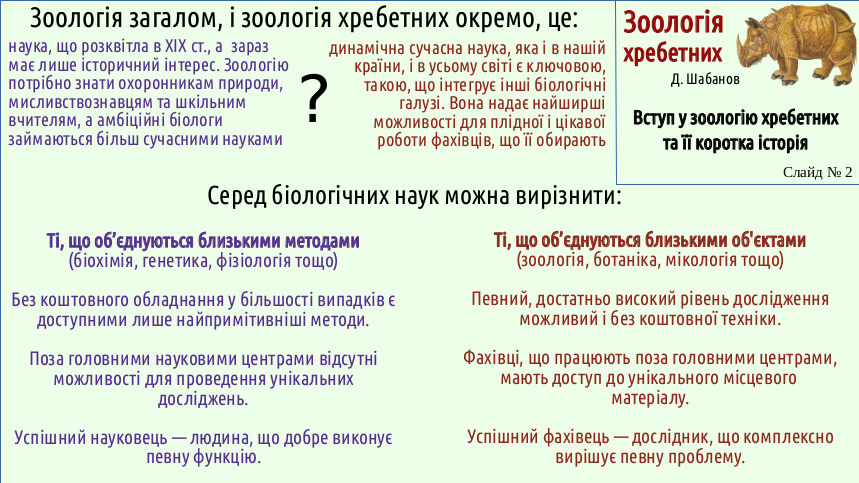
 Albrecht Dürer’s rhinoceros, 16th century. A copy from Conrad Gessner’s book. This image is the symbol of our course
Important 2025 addendum: the recorded lecture describes the grading system established during the normal in-person learning process. Unfortunately, normal academic activities have been disrupted. In 2025, classes are held somewhat differently for the ‘Kharkiv’ and ‘Munich’ student groups. In the ‘Kharkiv’ group, classes are held online, 3 hours per week (with the possibility of in-person consultations with the instructor, Oleksiy Vladyslavovych Korshunov, and students who are in Kharkiv). In the ‘Munich’ group (where classes are led by Maryna Oleksandrivna Kravchenko), time is scheduled for weekly online sessions (2 hours per week), and in addition, an in-person ‘session’ with practical classes is to take place at facilities provided by the Munich partners of V. N. Karazin Kharkiv National University.
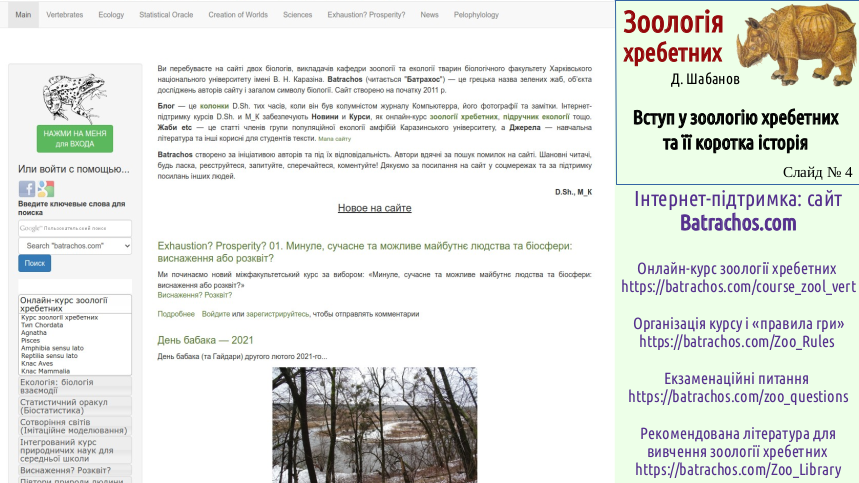
Lectures are given by Dmytro Andriiovych Shabanov. According to the schedule, these sessions are to be held alternately, every two weeks. To prevent the lectures from falling behind the practicals, in the first half of the semester they will be held weekly (and in the second half they are to become optional consultation sessions). In weeks when the ‘Munich’ students have their practical sessions, these lecture sessions will also take on the character of optional consultations. In general, lecture sessions will be structured so that the more important information from the lecture part of the course is reflected on this website, in the online zoology course. The optimal approach for students is to prepare in advance for discussion during lectures and to ask the lecturer questions. Naturally, working with literature is an important part of students’ preparation when studying the course. Links to textbooks in electronic form are available here.
The zoology examination will consist of three parts: a test covering all the material and open-ended questions: on general problems of vertebrate zoology and on mammals. Each student’s answers to the open-ended questions must be openly discussed with the instructor (on video). In addition, at the exam it will be possible to submit topics that were not submitted during the semester, or to improve the grades for topics received during the semester. The list of examination questions is available here.
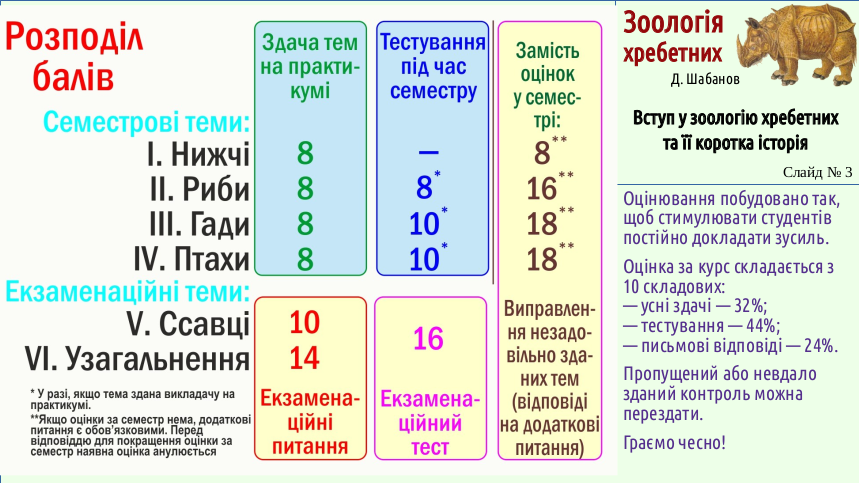
During the semester, students are required to submit 4 topics to the instructor leading the practical sessions:
— archaic chordates (8 points);
— fish (16 points);
— reptiles (18 points);
— birds (18 points).
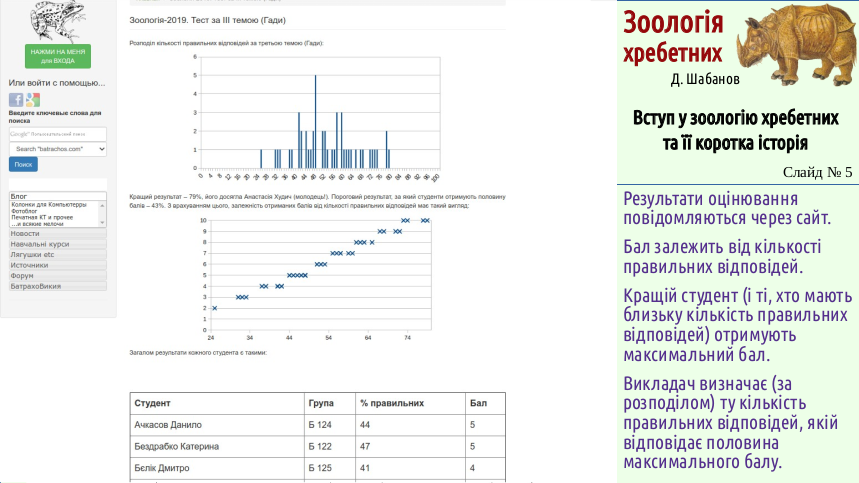
How exactly the submission of these topics will be organised, what the contribution of test sessions and discussions will be, and whether re-submission of topics that were not submitted in the best manner is possible — is determined by the instructor leading the practical sessions. At the end of the course, the instructors leading the practicals assign grades to each student for each of the topics submitted during the semester. These grades will be entered in a Google document that will be open for students to view.
Albrecht Dürer’s rhinoceros, 16th century. A copy from Conrad Gessner’s book. This image is the symbol of our course
Important 2025 addendum: the recorded lecture describes the grading system established during the normal in-person learning process. Unfortunately, normal academic activities have been disrupted. In 2025, classes are held somewhat differently for the ‘Kharkiv’ and ‘Munich’ student groups. In the ‘Kharkiv’ group, classes are held online, 3 hours per week (with the possibility of in-person consultations with the instructor, Oleksiy Vladyslavovych Korshunov, and students who are in Kharkiv). In the ‘Munich’ group (where classes are led by Maryna Oleksandrivna Kravchenko), time is scheduled for weekly online sessions (2 hours per week), and in addition, an in-person ‘session’ with practical classes is to take place at facilities provided by the Munich partners of V. N. Karazin Kharkiv National University.
Lectures are given by Dmytro Andriiovych Shabanov. According to the schedule, these sessions are to be held alternately, every two weeks. To prevent the lectures from falling behind the practicals, in the first half of the semester they will be held weekly (and in the second half they are to become optional consultation sessions). In weeks when the ‘Munich’ students have their practical sessions, these lecture sessions will also take on the character of optional consultations. In general, lecture sessions will be structured so that the more important information from the lecture part of the course is reflected on this website, in the online zoology course. The optimal approach for students is to prepare in advance for discussion during lectures and to ask the lecturer questions. Naturally, working with literature is an important part of students’ preparation when studying the course. Links to textbooks in electronic form are available here.
The zoology examination will consist of three parts: a test covering all the material and open-ended questions: on general problems of vertebrate zoology and on mammals. Each student’s answers to the open-ended questions must be openly discussed with the instructor (on video). In addition, at the exam it will be possible to submit topics that were not submitted during the semester, or to improve the grades for topics received during the semester. The list of examination questions is available here.
During the semester, students are required to submit 4 topics to the instructor leading the practical sessions:
— archaic chordates (8 points);
— fish (16 points);
— reptiles (18 points);
— birds (18 points).
How exactly the submission of these topics will be organised, what the contribution of test sessions and discussions will be, and whether re-submission of topics that were not submitted in the best manner is possible — is determined by the instructor leading the practical sessions. At the end of the course, the instructors leading the practicals assign grades to each student for each of the topics submitted during the semester. These grades will be entered in a Google document that will be open for students to view.