
One and a Half Natures of the Human Being – 15. Hints for Finding Answers to Questions about Female Reproductive Biology
On the previous page, some challenging questions were posed. The following hint can help in finding answers to them.
Hints for Finding Answers to Questions about Female Reproductive Biology
Discussion of the questions posed on the previous page allowed certain cause-and-effect relationships to be established.
First of all, the difference between the estrous and the menstrual cycle should be emphasized. In the estrous cycle, the moment of receptivity (ability to become pregnant) in the female is conspicuous. Estrus is associated with ovulation — the release of eggs from the ovaries and the creation of conditions for fertilization. In many species, bloody discharge from the reproductive tract is observed. In effect, during estrus the female signals her receptivity to males. This is what underlies sexual activity in species with an estrous cycle.
What is happening in the photo?
The photo shows what is called a "dog wedding." In front is a bitch, i.e., a female dog (in this context, the word is not pejorative). Behind her follow at least 10 male dogs. It is likely that some of these males escaped from their owners when they detected the scent of a female in heat, as some of them appear to be purebred. This ceremony will end with one or several of the males mating with the female. At that point, the vivid period of sexual preoccupation in the lives of these dogs will come to an end. At other times, outside of estrus, dogs do not mate (although they may imitate mating-related movements). So why would the males mate with the female if she would not become pregnant as a result?
In the menstrual cycle, ovulation and the external signs of the cycle are separated in time. Discharge from the reproductive tract includes destroyed cells of the endometrium (uterine epithelium), secretion from specific glands, and a certain amount of blood. The fundamental difference between the estrous and the menstrual cycle is that external discharge is a sign of ovulation in the estrous cycle and, conversely, is not associated with ovulation in the menstrual cycle. The main characteristic of the menstrual cycle is concealed ovulation.
As a consequence, in the menstrual cycle the male (i.e., the man) does not know when to mate with the female (i.e., the woman). Humans are a continuously sexual species. In permanent pairs (and not only in them), mating can occur almost continuously (except during menstruation, though sometimes, in one form or another, even then). If a man's reproductive behaviour is influenced by innate mechanisms (and we have strong grounds for such an assumption), these mechanisms — as a product of selection — must increase this man's fitness, i.e., his contribution to future generations. A single mating, as in dogs, is insufficient to ensure a high probability of the woman becoming pregnant. To increase the probability of pregnancy, a man must mate with a woman repeatedly (and, incidentally, where possible prevent the woman from mating with other men). In this way, the man increases his chances of "catching" the moment of ovulation and leaving offspring.
Are changes in female reproductive biology (the transition to the menstrual cycle being one of them) connected with the distinctive features of the human species? Probably yes, precisely because changes in family functioning contributed to ensuring the prolonged and resource-intensive development of the child with parental support (ideally, both parents).
One way of showing cause-and-effect relationships is by constructing diagrams, such as the one shown below.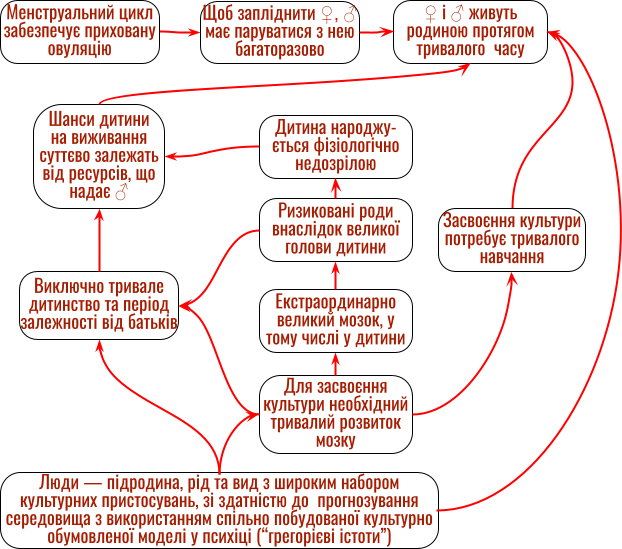
It is clear that the diagram shown is only a fragment of a broader scheme. The diagram made by the course author demonstrates cause-and-effect relationships among 40 theses. Some of these concern the general case most common among sexually reproducing animals; others characterise the casus Homo. Some of these theses are shown in the fragment provided.
The course author proposes that students assemble this diagram as a puzzle, from separate components. Here the theses are listed below outside their logical connections, simply in alphabetical order. Nevertheless, this may help in understanding the logic of a possible answer, which will be proposed on the next page — access to which the author will open later than the students receive this hint.
1. Biological fitness (which natural selection increases) is measured by contribution to future generations
2. The decisive physiological contribution to reproduction is made by ♀
3. An exceptionally long childhood and period of dependence on parents
4. Deviations from the typical scenario are possible: alternative strategies of ♂ and ♀
5. ♂ displays markers of "quality genes" in appearance and behaviour
6. Some ♂ may have an enormous number of offspring
7. The child is born physiologically immature
8. A child who does not receive resources from ♂ has chances of survival
9. A child who loses its mother early will most likely die
10. For a prolonged bond between ♀ and ♂, she must assess ♂'s ability to provide resources
11. Selection favours ♀ who mate multiple times
12. An extraordinarily large brain, including in the child
13. Courtship is "three-phase": ♀ signals that she is young, beautiful, fertile, and ready for a new relationship; ♂ demonstrate generosity and "quality genes"; ♀ chooses the best ♂
14. Cultural learning requires prolonged education
15. A significant proportion of ♀ are "taken" and cannot enter a long-term bond
16. ♀ and ♂ live as a family over an extended period
17. Humans are a subfamily, genus, and species with a wide range of cultural adaptations, with the capacity for environmental forecasting using a jointly constructed, culturally conditioned model in the psyche ("Gregorian beings")
18. The menstrual cycle ensures concealed ovulation
19. During courtship, which can be costly, ♂ demonstrates to ♀ the ability to provide resources
20. After a certain age, ♀'s fitness increases more when she cares for grandchildren than when she gives birth to new children
21. ♀'s fertility is substantially limited
22. ♂'s offspring by any ♀ have certain chances of survival
23. ♂'s fitness is increased even by very late-born children
24. Fitness is increased by: bearing children; caring for children; caring for grandchildren...
25. ♂ produce many "cheap" gametes (sex cells)
26. ♀ produce few "costly" gametes and often carry offspring through gestation
27. The resources provided by ♂ may alter his child's chances no less than ♂'s genes
28. Risky childbirth due to the large head of the child
29. Different sexes — different reproductive strategies. Each sex is subject to selection that corresponds to the features of their reproductive strategies
30. In many species, ♀ chooses ♂ for his "nuptial gift"
31. In a healthy ♀ menopause occurs at a certain age; a healthy ♂ remains fertile until the end of life
32. In the case of multiple matings, the "nuptial gift" is "payment for mating"
33. In the typical case, ♀ is selective in choosing ♂ for mating
34. In the typical case, ♂ is ready to mate with almost any ♀
35. In the typical case, ♂ is ready to mate with almost any ♀
36. The success of offspring depends on qualities inherited from both ♀ and ♂
37. The physiological contribution of ♂ to reproduction is small
38. ♀ is often unable to provide all the resources for the child
39. The child's chances of survival depend substantially on the resources provided by ♂
40. To fertilise ♀, ♂ must mate with her multiple times