
Hoyle's argument. Column in ComputerreOnline #26
It is more likely that a hurricane sweeping over a graveyard of old aircraft will assemble a brand‑new superliner from scrap pieces, rather than a single random event giving rise to life from its components.
It is more likely that a hurricane sweeping over a graveyard of old aircraft will assemble a brand‑new superliner from scrap than that a single random event will give rise to life from its components.
Chandra Vikramasinghe retells the Hoyle argument.
Since molecules have learned to compete and create other molecules in their own image, elephants and similar creations will inevitably appear wandering the savanna.
Peter Atkins (quoted in Richard Dawkins' book "The Blind Watchmaker").
The human psyche is a tool that has evolved to solve particular tasks. Interpreting the actions of other living beings, detecting the consequences of their activity is one of the purposes of our instrument of world‑knowledge. What is the first thing a person confronted with something incomprehensible assumes? "Someone did it!" Yet this is only the first step. Accumulating experience, we become acquainted with natural, non‑personified regularities. It is not God who directs a thrown stone; to predict the stone’s trajectory it suffices to have concepts of momentum, inertia, gravity and medium resistance.
As the natural laws are studied, invoking Divine will to explain regular processes becomes superfluous. How should a believing person react? One can "relieve" God of routine miracles and invoke Him only in entirely different matters. One can continue to insist on the necessity of miracles, but use them to explain still‑unexplored processes. Thus one might claim that the very laws of mechanics (or, for example, the principle of equivalence of gravitational and inertial forces, one of their foundations) are the result of a miracle.
Paradoxically, fundamentalists themselves are the cause of accusations of atheism against science. "Piously" explaining everything incomprehensible by miracles, they force scientists to gradually strip scientific explanations of references to God. When a problem becomes sufficiently studied, fundamentalists must lie and backtrack, denying accumulated facts. Thus today creationists are forced, in order not to abandon their convictions, to ignore a multitude of fossil discoveries. How many statements and writings do they produce about early‑20th‑century events, for example the erroneously interpreted "Nebraska man" ("hesperopithecus") or the fabricated "Piltdown man"! Why do they conceal the huge body of qualitatively described modern finds? They have nothing to hide, yet ideology prevents them from abandoning appeals to miracles.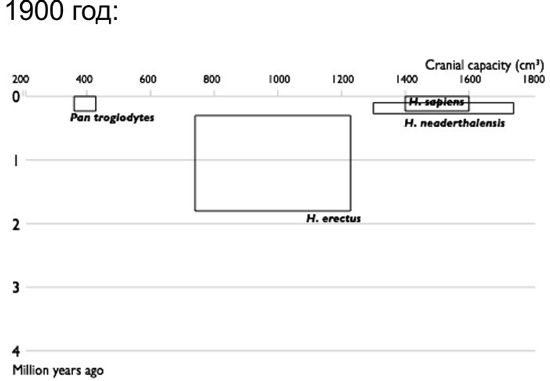
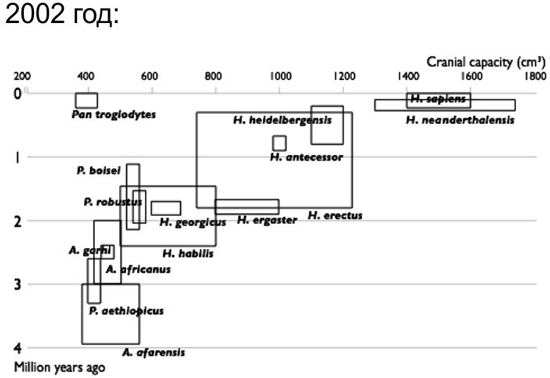
Change in the number of known species of the family Hominidae over a century of research (rectangle height – species duration; width – brain volume). The scheme is simplified: in 1900 the duration and variability range of *Homo erectus* ("Pithecanthropus") and Neanderthal were greatly underestimated; even the second diagram does not show all species known today.
Do you see on the diagram a small gap between *erectus* (large central rectangle) and Neanderthal (the "stripe" corresponding to people with the greatest brain volume)? What to do: wait impatiently for new data or, foam‑foaming at the mouth, insist that this gap is the result of a miracle?
An example of hiding miracles beyond the horizon of knowledge was the reaction of some readers to my previous column. Some commentators simply did not understand my explanations. The analogy of natural selection is not an enumeration of all possibilities, not a blind leap into the unknown, but a slow yet inexorable tactile movement.
Some grasped something but used the opportunity to hide the miracle in the unknown: it does not matter what is written about evolution, what matters is that without God life would not have arisen. In the comments, metamorphoses of the old and venerable argument related to the Peyli argument surfaced. This argument is often associated with the name of Fred Hoyle (1915–2001) – a leading British astrophysicist and author of science‑fiction novels. Speaking about the Boeing‑747 in a "Nature" article that all creationists cite, Hoyle essentially repeated Peyli. However, perhaps through the light hand of Chandra Vikramasinghe, Hoyle’s co‑author on many works, the aircraft argument became linked to the origin of life.
Hoyle’s argument in Vikramasinghe’s edition – first epigraph. In the second – problem solution.
Oh, I think I already know what will be written to me in the comments. Debaters, attention: disclaimer!
I ask commentators to consider the following.
1. I do not discuss the problem of God’s existence; I only prove that the emergence of life did not require miracles and is explainable by science.
2. Natural sciences are built on the assumption that phenomena are explained by natural laws. Appeal to a miracle (Divine intervention) takes the explanation beyond scientific bounds.
3. Due to several limitations, this column does not mention all data categories relevant to its theme.
4. The version that life originated from a random "jump" of molecules into a cell or even into DNA is far‑fetched nonsense. Here we do not discuss why some sources repeat it.
5. At the dawn of life, a modern cell in all its complexity did not exist. Science posits transitional stages ("pre‑life") that were later displaced by cellular life.
To explain the origin of life, the regularities of the following stages should be studied.
Stage 1: abiogenic synthesis of organic compounds.
Stage 2: emergence of a geochemical cycle of substances.
Stage 3: emergence of autocatalytic reactions and their competition.
Stage 4: increasing complexity of "pre‑life" due to natural selection.
Stage 5: compartmentalisation of reaction spaces by membranes and the appearance of cells.
Critics of the first stage get stuck discussing the Stanley Miller and Harold Urey experiment performed back in 1953. Here the mentioned principle works: modern results that creationists dare not discuss. Yet from the Miller‑Urey experiment an entire science grew, and on the "map" of transitions from inorganic substances to biologically significant molecules there are almost no gaps. Even more data are gathered here than in the study of extinct humans! By the way, no sane person ever expected that an organism would spontaneously assemble in Miller’s flask. Those who vigorously refute such a possibility are the ones who invented it.
In the Runet one can find a wealth of information on abiogenic synthesis of organics; I especially recommend the reviews and news by Oleksandr Markov on evolbiol.ru and elementy.ru (especially the chapter from his book "The Birth of Complexity"). Here I will only summarise. All key types of organic compounds, including amino acids, nitrogenous bases, sugars and lipids, can arise abiogenically. The same molecules arise under various experimental setups: in solution, on mineral surfaces, in geothermal sources and in space.
Studies of meteorites, comets, interstellar clouds etc. show a wide distribution of such organics. The beloved creationist problem of amino‑acid and sugar chirality is successfully resolved. Researchers of abiogenic synthesis now focus not on proving its possibility but on studying how environmental conditions influence its course.
Open questions are being answered step by step. Here is one of many examples. As previously thought, one important compound for abiogenesis – the ribonucleotide cytidine – could not be formed under early Earth conditions. Creationists would have shouted that cytidine synthesis is a miracle; chemists have identified which cytidine synthesis pathway works under such conditions.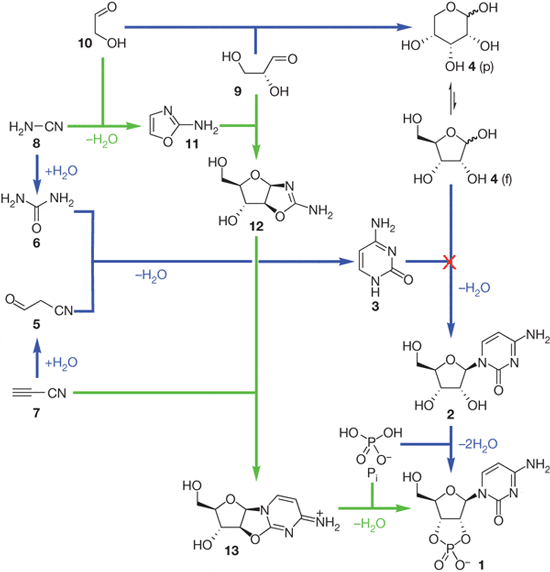
The "blue" pathway of cytidine synthesis could not have supplied its appearance on early Earth. Failure of the abiogenesis theory? No. Chemists simply did not know about the "green" pathway.
And what about the subsequent listed stages? I have something to say about them. I have already written something for "Kompyutera" on this. If you, dear readers, wish, I will elaborate on dobiological selection in another column. Believe me, the scientific version is not only more convincing – it is also far more interesting than miracle tales!
Here I will only say that natural selection is far older than life. In the earliest stages of Earth’s history geochemical cycles were set in motion. The same organic compounds were repeatedly synthesized and broken down… Some reactions that enabled such transitions were autocatalytic, i.e., self‑amplifying. An example is the Butlerov reaction, synthesis of sugars from formaldehyde. Since different autocatalytic reactions competed for the same substrate, natural selection was at work – the very process that, as we recalled from the previous column, can build the most complex systems brick by brick!
It is time to finish. I regard Hoyle’s argument worse than Peyli’s. In Peyli’s time science lacked satisfactory explanations for the utility of organisms. Hoyle, who calculated the probability of a cell arising in a single jump, could easily have learned (and probably knew) that science had long since rejected such a possibility. Why did Hoyle and Vikramasinghe argue not with their contemporaries but with old fictions? I think the reason is non‑scientific. They wanted to compromise their opponents’ views so much that they did not shy away from intellectual "hand‑skill" – substituting the opponent’s arguments. For scientists this is, of course, shameful.
Nevertheless, Hoyle’s argument needs only a slight modification for us to confidently endorse it.
It is more likely that a hurricane sweeping over a graveyard of old aircraft will assemble a brand‑new superliner from scrap than that a single random event will give rise to life from its components.
Obviously: life arose as a result of a long chain of events guided by natural selection!