
Prebiological selection. Column in KompyuterreOnline #27
For Darwinian evolution, only four prerequisites are sufficient: reproduction, variation, heredity, and selection!
Yes... The discussion of arguments against evolutionary biology has come down to clarifying relations with commentators on the "Kompyuterra" website...
I was asked to elaborate on the topic of pre-biological selection. I am fulfilling this request. I will not engage in endless disputes with people who repeatedly invent some arguments for me and then rejoice, demonstrating the absurdity of their own fabrications. However, much in this column also addresses their comments.
So. For a hook – a quote from creationist propaganda.
"Natural selection by definition could not function before the appearance of the first living cell. It could act only in relation to organisms capable of self-reproduction, that is, in relation to cells containing a DNA molecule that transmits genetic changes to subsequent generations. Without DNA there is no self-reproduction, and without self-reproduction there is no natural selection. Therefore, it is impossible to explain the origin of DNA itself as a result of natural selection"... (Creationist film "Unlocking the Mystery of Life")
Strange. Who gave such a narrow definition of natural selection? Ah-hah, the creationists themselves... Well, this is their favorite method of argumentation: substituting their opponents' claims. In fact, selection in its most general form can be considered as differential (property-dependent) reproduction. Not very clear? Let me explain in more detail.
There are units (replicators) capable of reproduction (creating copies of themselves);
replicators can acquire new traits (for example, due to disturbances during reproduction);
during reproduction, the characteristics of replicators (at least some of them) are transmitted to their copies;
these characteristics affect the probability of reproduction of the replicators.
Otherwise, the elements of this tetrad can be called reproduction, variability, heredity, and selection.
There is a terminological nuance here. Sometimes selection (as well as selection) is used to denote the result of the action of the described tetrad – a change in the composition of replicators corresponding to the environment in which they exist. Here we will call this change evolution (Darwinian evolution). The described mechanism ensures the evolution (change) of replicators, ensuring their correspondence to the current environmental conditions.
A few additional notes. Some characteristics of replicators may affect their reproduction but not be transmitted to their copies. At this level of analysis, they can be considered as noise.
How far evolution can go depends on the variability of replicators. If it were limited by initial diversity, the process would stop when the most adaptive of the original forms remained. However, if changes can arise during reproduction, remarkable prospects open up for the evolution of replicators. Remember what I wrote about multiple selection with accumulation of the experience gained from it?
Of course, the prospects of evolution can be limited by various obstacles to the reproduction of replicators. Reproduction requires resources; resources cannot be infinite. Evolution of replicators has the best prospects if some of them are destroyed and the resources used for their construction become available to other replicators. If so, the success of replicator reproduction should consist of two components: their preservation and their replication. Selection can be considered as differential survival and differential reproduction. However, one can account only for reproduction, based on the fact that those who did not survive did not reproduce either.
Enough theory. Let's see how this works. First, let's discuss artificial molecular selection.
In 1981, Thomas Cech, while studying the ciliate Tetrahymena, discovered ribozymes – RNA molecules with catalytic activity. Previously, it was believed that only enzymes (proteins) are biological catalysts.
Ribozymes can be used for various technological purposes. Knowing the sequence of the ribozyme we need, it can be synthesized nucleotide by nucleotide (you remember that nucleic acids, including RNA, are polymers of nucleotides, don't you?). This sequence can then be amplified using PCR (polymerase chain reaction). The required ribozyme is placed in a PCR amplifier (multiplier): a reactor containing nucleotides and enzymes that synthesize a second RNA chain corresponding to the chain. In the PCR amplifier, the temperature is raised, and the chains separate from each other. The temperature is lowered, we wait. On both chains, two more are constructed. The temperature is raised. There are now four chains in the reactor. Lower, wait, raise: eight. Lower, wait, raise: sixteen...
But how to find the sequence of a ribozyme needed for some technological purpose? It most likely does not exist in nature. Calculating what this polymer should be so that after folding it forms a spatial structure of atoms and charges that will interact with the required substance is an extremely complex task. It is easier to entrust its completion to selection.
We fix the target molecules on a surface. We pass a random mixture of RNA oligonucleotides (short fragments) past them. Those RNA molecules capable of binding to the targets will be retained on them, while the others will be washed away. We change the conditions to wash off the bound molecules. We synthesize copies of them in a PCR amplifier (with a certain rate of errors). We again run the resulting mixture past the targets. Eventually, we can read the sequences that have been obtained and work with them already.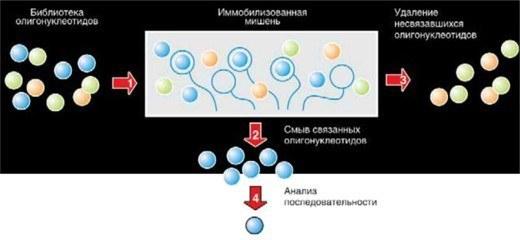
Principle of molecular selection of RNA sequences binding a specific target (V. Vlasov, A. Vlasov. 2004)
Probably, "fine-tuning" the result to match the technological task will still be necessary, but it will be based on a sequence that was created "by itself," "based on chance."
Probably, "fine-tuning" the result to match the technological task will still be necessary, but it will be based on a sequence that was created "by itself," "based on chance."
Darwinian evolution is declared impossible because it is based on chance. What do you think: is the RNA sequence corresponding to the target molecule obtained by the described procedure random or lawful? Of course, lawful, because lawfulness can well be based on chance! It is important that reproduction, variability, heredity, and selection act simultaneously.
But the described processes occur under conditions controlled by humans. We will be told that they require management by a creator. But what about the conditions of the early Earth...
Such processes must have occurred on the early Earth.
Planets form during the formation of star systems. Most of the matter of such systems concentrates in stars, where gravitational compression triggers thermonuclear processes. Star energy is radiated into space, heating planets. Thus, in the case of the Sun and Earth, the temperature of the star's visible surface is approximately 6000°K (inside it is much hotter!), the planet's surface is on the order of 300°K, and the temperature of open space is not much above absolute zero – about 4°K. The planet is in a stream of energy from the star, absorbs and re-emits it.
Probably, the situation when a star has several planets is quite typical. On those closer to the star, it will be hot; on distant ones, it will be cold, but some will be in the temperature range where various organic substances will form.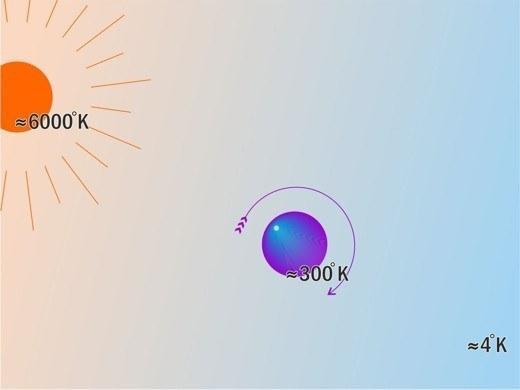
Planets are in energy streams from stars. Due to the rotation of planets, the intensity of the stream and temperature on them should fluctuate periodically
Organic matter often forms as a result of reversible reactions. The equilibrium between synthesis and breakdown of complex substances depends on environmental conditions, in particular – on temperature. The change of day and night, winter and summer will cause fluctuations in the state of chemical equilibrium. The planet behaves like a PCR amplifier: it raises and lowers the temperature!
Competing autocatalytic reactions can participate in the synthesis and subsequent destruction of complex organic matter. These are reactions whose progress is stimulated by their own products. Are such reactions rare? No.
A classic example of such reactions is the Butlerov reaction, the synthesis of monosaccharides from formaldehyde in an alkaline solution with catalysts. It was discovered in the mid-19th century by Alexander Mikhailovich Butlerov, the creator of the theory of the structure of organic substances. In the 20th century, this reaction began to be studied with particular interest, hoping that it could be used to produce food for astronauts. Alas, besides the monosaccharides that are attempted to be obtained by placing the required seeds in the reaction mixture, others are also produced, making the output mixture toxic. However, the variability of the reaction products and the competition between the processes forming them makes the Butlerov reaction an excellent object for studying the Darwinian evolution of autocatalytic reactions!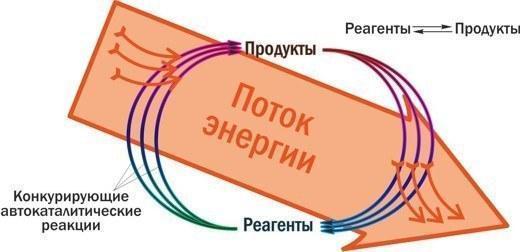
Reversible reactions occur on planetary surfaces, some of which are autocatalytic. Fluctuations in energy flow lead to synthesis or breakdown of more complex compounds gaining the advantage
Which sugars will "win" in the competition for reagents in the Butlerov reaction depends on conditions. In the cited article, for example, it is reported that in the presence of apatites (phosphorus-containing rocks) ribose – the sugar forming the backbone of RNA – is obtained almost selectively in the Butlerov reaction. In the presence of silicates (extremely common silicon-containing rocks), the composition of the products of the Butlerov reaction is stabilized, that is, the heritability of a certain composition of reaction products increases.
The main thing is that under these conditions, reproduction, variability, heredity, and selection are observed. There are every grounds to expect the transformation of the geochemical cycle into a biogeochemical one. And – oh, wonder! – the biogenic cycle turns out to be organized almost the same way.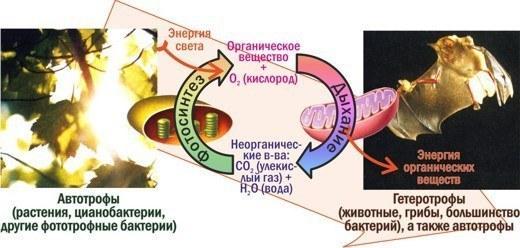
In the modern world, an amazing coincidence can be seen. There are two groups of organisms corresponding to each other like two halves of a broken plate: the waste of one group is the resource for another! And their existence is maintained by the same energy stream that created them.
From this point of view, the question of which appeared first – heterotrophs or autotrophs – is meaningless. Life arose in the form of ecosystems where the cycle of substances was realized: both the synthesis of organic matter and its breakdown.
So, the allowable volume of the column is exhausted... As soon as you begin to explain something in more detail, space for text and time for explanations slip away, like dry sand through loosely clenched fingers. Dear readers, if you wish, I will tell about possible transitional stages between the world of autocatalytic reactions and the world of life next time.
Remember: reproduction, variability, heredity, selection!