
Biliaiev et al., 2018. Composition and Changes of Three Hemiclonal Population Systems of Green Frogs in NNP “Homilshanski Lisy”
Biliaiev I., Bondarenko H., Harbuz D., Drohvalenko M., Siervatovska Y., Sudarenko Y., Teplenko Y., Fedorova A., Shabanov D. Composition and changes of three hemiclonal population systems of green frogs in NNP “Homilshanski Lisy”.
COMPOSITION AND CHANGES OF THREE HEMICLONAL POPULATION SYSTEMS OF GREEN FROGS IN NNP “HOMILSHANSKI LISY”
Biliaiev I., Bondarenko H., Harbuz D., Drohvalenko M., Siervatovska Y., Sudarenko Y., Teplenko Y., Fedorova A., Shabanov D.
V.N. Karazin Kharkiv National University
e-mail: annaph94[]gmail.com, shabanov[]karazin.ua
I. Biliaiev, H. Bondarenko, D. Harbuz, M. Drohvalenko, Y. Siervatovska, U. Sudarenko, U. Teplenko, A. Fedorova, D. Shabanov. COMPOSITION AND CHANGES OF THREE HEMICLONAL POPULATION SYSTEMS OF WATER FROGS FROM NNP “GOMILSHANSKI LISY”. Three R-E-Ep HPSs of the Siverskyi Donets center of Pelophylax esculentus complex diversity were studied. Each system has specific features of composition and dynamics. The HPS of Iskiv Pond approximates E-HPS, whereas the HPSs of Koryakiv Ravine Pond and Lower Dobrytskyi Pond belong to E-Ep-HPS. The HPS abundance was estimated as 374±143 individuals for Iskiv Pond and 1264±619 individuals for Lower Dobrytskyi Pond.
Keywords: Pelophylax esculentus complex, hemiclonal population systems, diploids, triploids, Kharkiv region.
The hybridogenic green-frog complex, Pelophylax esculentus complex, consists of Pelophylax lessonae (Camerano, 1882), Pelophylax ridibundus (Pallas, 1771), and their hemiclonal hybrid, for which the species-like name Pelophylax esculentus (Linnaeus, 1758) is used. Its representatives form different hemiclonal population systems (HPS). We worked in the R-E-Ep subregion of the Siverskyi Donets center of green-frog diversity, where P. lessonae is absent and many HPSs include triploid P. esculentus [8].
In Iskiv Pond (N 49°37'38", E 36°16'60") and Koryakiv Ravine Pond (N 49°36'57", E 36°18'44"), in 1995 H. A. Lada [5] recorded E-HPS (in modern notation), i.e., HPSs composed exclusively of diploid P. esculentus. In 1996, a single triploid was found in Iskiv Pond [3]. In 2000, the pond was drained; after refilling, HPS composition changed. Presumably [6], in 1995 the following crosses were characteristic for this HPS: ♀(XL)(XR) × ♂(YL)(XR) → ♂(XL)(YL) : ♀(XL)(XR) : ♂(YL)(XR) : ♀(XR)(XR) → ♀(XL)(XR) : ♂(YL)(XR). Two amphigametic hybrid clones reproduce themselves when intercrossed and also produce representatives of both parental species, which predictably die due to irreversible changes in the clonally inherited genomes.
In Koryakiv Ravine Pond, green-frog reproduction in 2006–2010 almost ceased. Since 2015, HPS abundance has increased here, possibly due to a few successful cohorts. This water body contains an R-E-Ep HPS, i.e., a system with diploid and triploid hybrids [7]. Lower Dobrytskyi Pond (N 49˚33′22″, E 36˚18′39″) is inhabited by an R-E-Ep HPS with a high proportion of triploids and occasional sexually immature tetraploids [8].
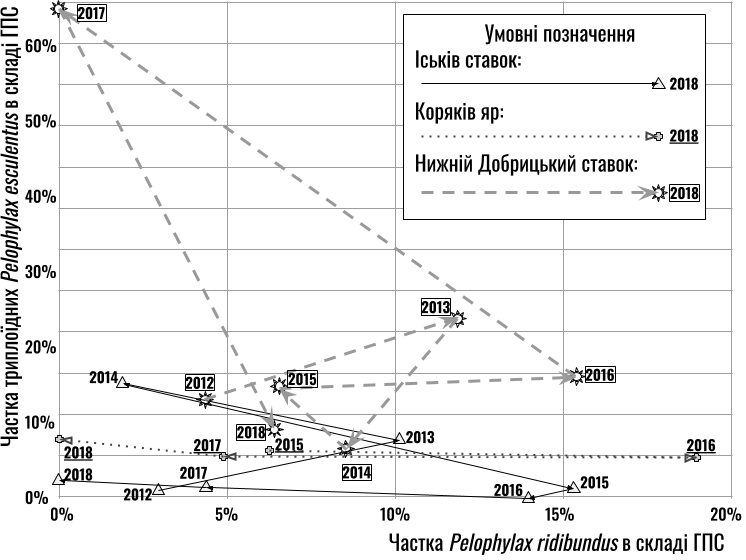
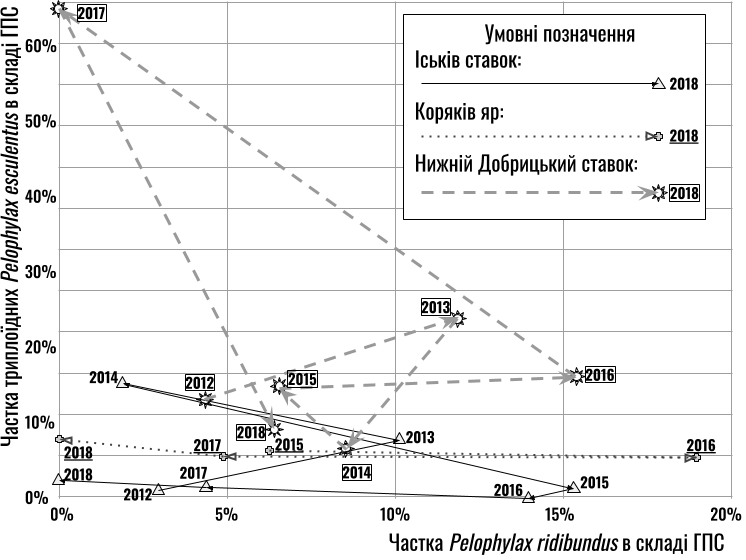
In June–July 2018, we collected samples from these three HPSs. Frogs were dazzled with flashlights and hand-captured at night. Taxonomic identity and sex were determined by external traits. Frogs were toe-clipped for marking, and blood smears were collected. Dry smears were photographed at ×40 magnification. Ploidy was determined by erythrocyte length measured on photographs [2] and by karyological analysis of intestinal cells [1]. Significance of differences between 2017 and 2018 sample compositions was tested with Pearson’s χ2 test. HPS abundance was estimated from returns of previous-year marks using the Petersen–Bailey method [4]. Our results were compared with earlier data obtained by O. V. Meleshko and R. M. Makarian. Composition of 2018 samples is shown in Table 1, and long-term dynamics of HPS composition in Fig. 1.
Table 1. Composition of samples studied in 2018
|
HPS |
Pelophylax ridibundus |
Pelophylax esculentus |
Exam points |
||||
|
2n (diploids) |
3n (triploids) |
||||||
|
♀♀ |
♂♂ |
♀♀ |
♂♂ |
♀♀ |
♂♂ |
||
|
Iskiv Pond |
– |
– |
– |
86 |
1 |
1 |
88 |
|
Shabanov D. A., Biriuk O. V., Korshunov O. V., Kravchenko M. O. Distribution of different types of hemiclonal population systems of the hybridogenic green-frog complex (Pelophylax esculentus complex) in the Siverskyi Donets basin // Current state and conservation of natural complexes in the Siverskyi Donets basin. Sviatohirsk, 2017. P. 139–144. |
– |
– |
1 |
86 |
– |
7 |
94 |
|
Nizhniy Dobritsky Pond |
4 |
1 |
7 |
59 |
4 |
3 |
78 |
Biriuk O. V. Cytogenetic features of spermatogenesis in diploid and triploid hemiclonal interspecific hybrids of Pelophylax esculentus complex // PhD thesis. Kyiv, 2017.
Bondareva A. A., Bybyk Y. S., Samylo S. M., Shabanov D. A. Cytogenetic features of erythrocytes in green frogs from the Siverskyi Donets center of Pelophylax esculentus complex diversity // Visnyk of V.N. Karazin Kharkiv National University. Series Biology. 2012. Issue 15 (No. 1008). P. 116–123.
Borkin L. Ya., Zinenko A. I., Korshunov A. V., Lada G. A. et al. Mass polyploidy in the hybridogenic Rana esculenta complex (Ranidae, Anura, Amphibia) in Eastern Ukraine // Proc. 1st Conf. of the Ukrainian Herpetological Society. Kyiv, 2005. P. 23–26.
Caughley G. Analysis of Vertebrate Populations. Moscow: Mir, 1979. 362 p.
Lada G. A. On the need to conserve unique “pure” populations of diploid edible frog (Rana esculenta Linnaeus, 1758) in Belgorod and Kharkiv regions // Problems of conservation and rational use of natural ecosystems and biological resources. Penza, 1998. P. 333–335.
Makarian R. M., Biriuk O. V., Korshunov O. V. et al. Composition of green-frog tadpoles (Pelophylax esculentus complex) in Iskiv Pond (NNP “Homilshanski Lisy”) // State and biodiversity of ecosystems of Shatskyi NNP and other protected areas. Lviv: SPOLOM, 2016. P. 61–65.
Stakh V. O., Bobrova A. A., Yermakov D. V. et al. Features of the hemiclonal population system of green frogs (Pelophylax esculentus complex) of Koryakiv Ravine (NNP “Homilshanski Lisy”) // State and biodiversity of ecosystems of Shatskyi NNP and other protected areas. Lviv: SPOLOM, 2016. P. 88–92.
Shabanov D. A., Biriuk O. V., Korshunov O. V., Kravchenko M. O. Distribution of different types of hemiclonal population systems of the hybridogenic green-frog complex (Pelophylax esculentus complex) in the Siverskyi Donets basin // Current state and conservation of natural complexes in the Siverskyi Donets basin. Sviatohirsk, 2017. P. 139–144.
Meleshko O. V., Korshunov O. V., Shabanov D. A. The study of three hemiclonal population systems of Pelophylax esculentus complex from the Seversko-Donetskiy center of green frogs’ diversity // Visnyk of V.N. Karazin Kharkiv National University. Series Biology. 2014. Issue 20, No. 1100. P. 153–158.
Biliaiev I., Bondarenko H., Harbuz D., Drohvalenko M., Siervatovska Y., Sudarenko Y., Teplenko Y., Fedorova A., Shabanov D. Composition and changes of three hemiclonal population systems of green frogs in NNP “Homilshanski Lisy” // Proceedings of the scientific conference “State and biodiversity of ecosystems of Shatskyi National Nature Park and other protected areas,” Shatsk, 13–16 September 2018. Lviv: SPOLOM, 2018. P. 21.