

Cordylidae (Girdled Lizards)
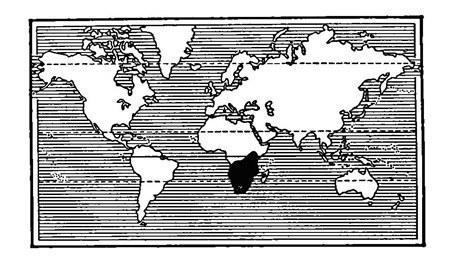
Family Cordylidae (Girdled Lizards) The family Cordylidae includes 64 species. Distribution: representatives of the family are widely distributed mainly in rocky and arid regions of sub-Saharan Africa, including Madagascar.
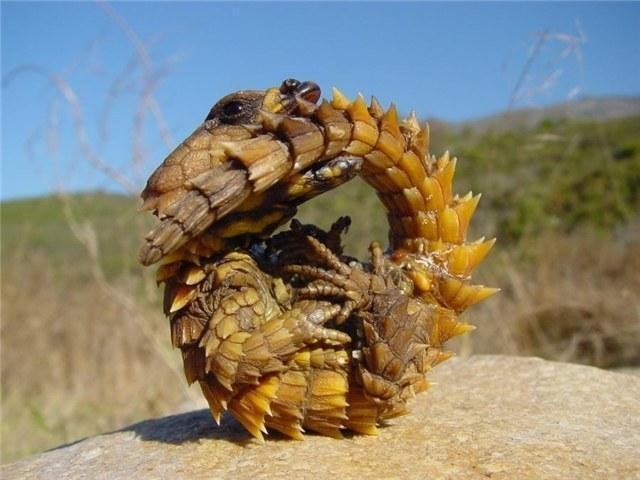
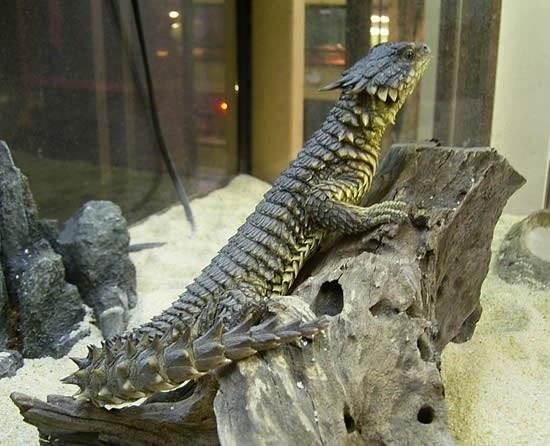
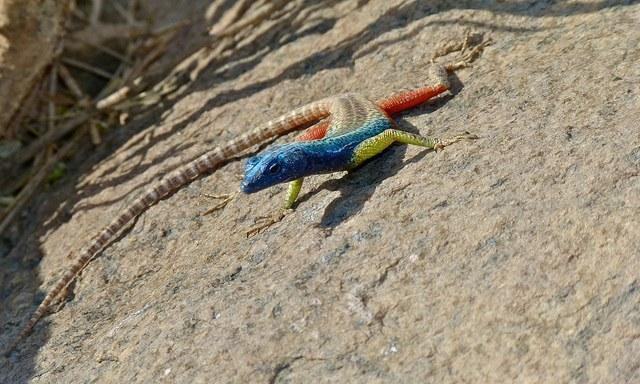
Representatives of Cordylidae are characterized by well-developed cranial arches, a distinct parietal foramen, and uniform pleurodont teeth. Dorsally, their head is covered by bony plates fused to the skull (osteoderms), which also form the roof of the upper temporal opening. The well-developed eyes of girdled lizards, with round pupils, are protected by separate movable eyelids. The trunk is covered with transverse rows of large shield-like scales, usually keeled, which on the belly transition into plate-like scutes. Large, symmetrically arranged tuberculate or smooth shields cover the upper side of the broad triangular head. Girdled lizards are diurnal and mainly terrestrial. They occur in rocky deserts and semi-deserts, savannas, and shrublands; some species ascend quite high into mountains. Lizards often inhabit boulder fields and rocky outcrops. As shelters, girdled lizards use crevices between stones, cracks in rocks, and burrows. Girdled lizards feed on insects and other invertebrates; some are omnivorous and may consume plant food. Large species hunt small mammals and other lizards. Most of these lizards are ovoviviparous, though oviparous species also exist. For defense, girdled lizards employ various strategies. Some, when hiding in crevices between stones, cling with their claws and inflate their bodies, bracing against the shelter walls so an attacker cannot pull them out. The armadillo girdled lizard, when threatened, curls into a ring and bites its tail so it cannot be uncoiled. In the southern part of the range, girdled lizards may enter winter dormancy. Cordylus cataphractus Cordylus giganteus Platysaurus broadleyi 1. Vitt L.J., Caldwell J.P. Herpetology. An Introductory Biology of Amphibians and Reptiles. — Academic Press, 2009.
2.
Higher Taxa in Extant Reptiles 3.
THE REPTILE DATABASE