

Evolution of Photosynthesis
The evolution of photosynthesis is closely linked to the development of the biosphere of living systems, concentration of CO2 and O2 in the atmosphere. Interpretation of data for the Phanerozoic showed the existence of repeated fluctuations in the biological productivity of the biosphere in response to external influences. It has been shown that during the era of tectono-magmatic activation, regional metamorphism, and active volcanism, the concentration of CO2 increases, which in turn enhances the growth of biomass formed as a result of active photosynthesis. There is an opinion that photosynthesis arose 3000 million years ago, and the existing angiosperms emerged about 300 million years ago. According to the generally accepted evolutionary theory of the origin and development of life, formulated over 50 years ago by A. I. Oparyn, primary, capable of self-reproduction, living formations arose as a result of abiogenic chemical evolution. Being surrounded by close in composition, but still non-living organic compounds, these primary beings could carry out anaerobic heterotrophic nutrition in a oxygen-free environment with the help of a small set of enzymes. This type of nutrition was called chemo-reduction. The emergence of light-absorbing pigments - photosensitizers during this period, characterized by strongly reducing environmental conditions, led to the replacement of chemical energy in chemo-reduction processes with light energy. The simplest type of photoautotrophic nutrition, called photoreduction and bacterial photosynthesis, arose. It can be noted that the equation of bacterial photosynthesis (photoreduction) is very similar to the total equation of photosynthesis of chlorophyll-containing plants (Fig. 1). It is known that as a result of comparative analysis, Van-Niel showed that both of these processes can be recorded in a general form by one summary equation (Fig. 2).

Fig.

1. Total equation of photosynthesis of chlorophyll-containing plants Fig. 2. Summary equation of photosynthesis - where H2A is the hydrogen donor, which photosynthetic bacteria use hydrogen sulfide, and other plants - water. Water is a more oxidized compound compared to hydrogen sulfide. Its use as a hydrogen donor is associated with the need for additional energy expenditure and became possible due to the further improvement of the photochemical apparatus, which consisted in the appearance of chlorophyll in plants (instead of bacteriochlorophyll) and an additional photochemical system. As we can see, the considered scheme gives an idea only of the general features of the evolution of photosynthesis and is largely hypothetical. Many stages of the evolution of photosynthesis, and even more so its details, remain unclear, and a number of points are interpreted differently by scientists. Photosynthesis is a unique physicochemical process carried out on Earth by all green plants and some bacteria and provides the conversion of electromagnetic energy of solar rays into the energy of chemical bonds of various organic compounds. The basis of photosynthesis is a sequential chain of redox reactions, during which the transfer of electrons from the donor - reducing agent (water, hydrogen) to the acceptor - oxidizer (CO2, acetate) with the formation of reduced compounds (carbohydrates) and the release of O2, if water is oxidized. Photosynthesis plays a leading role in biosphere processes, leading to the formation of organic matter from inorganic on a global scale. Photosynthetic organisms, using solar energy in photosynthesis reactions, carry out the connection of life on Earth with the Universe and ultimately determine all its complexity and diversity.
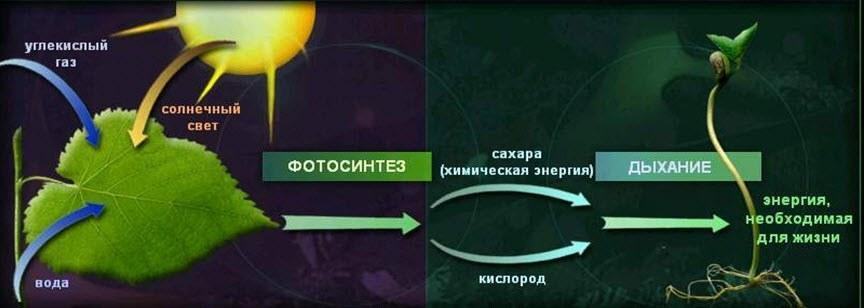
Fig. 3. Photosynthesis and respiration There are known time intervals when significant changes were noted, accompanied by an increase in O2 levels and a decrease in CO2 in the atmosphere. The largest decrease in CO2 in the atmosphere of our planet began about 120 million years ago and quickly reached the modern level, which is considered almost unchanged over the past 30-50 million years. Currently, it is customary to distinguish three types of photosynthesis: C3 - type of photosynthesis, C4 - type of photosynthesis, and metabolism of organic acids, according to the type of succulent. Evolutionarily more ancient in higher plants is considered to be the C3 - type of photosynthesis, in which there was an increase in the specificity of Rubisco to CO2 in the direction of greater predominance of the carboxyl reaction over the oxygenase reaction. The adaptation of plants to life on land was accompanied by the appearance of vascular plants, and then angiosperms. A decrease in atmospheric CO2 concentration under conditions of limited water supply and high temperature led to the emergence of the C4 type of photosynthesis, approximately 30 million years ago. A characteristic feature of C4 plants is the unusual anatomy of leaves, which received the name "Kranz anatomy". It is characterized by a concentric arrangement of cells around the conductive bundles. Outer layers of cells form the mesophyll, inner - cladding. Primary fixation of CO2 occurs in the mesophyll in the Hatch-Slack cycle.
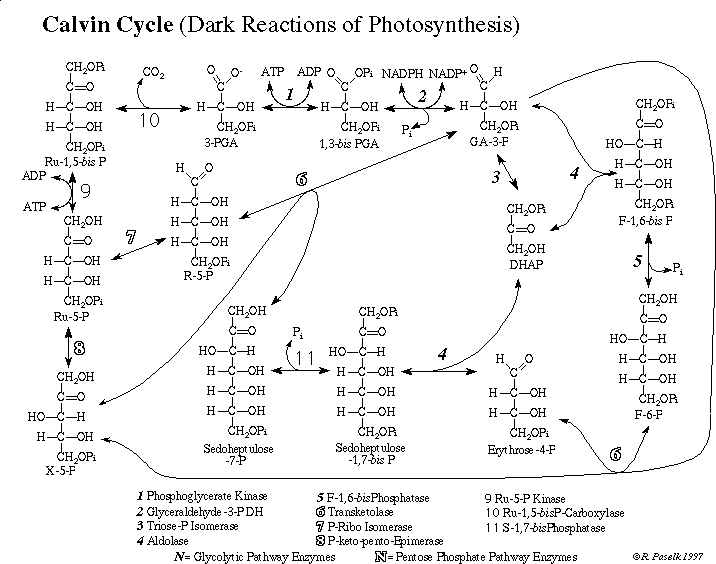
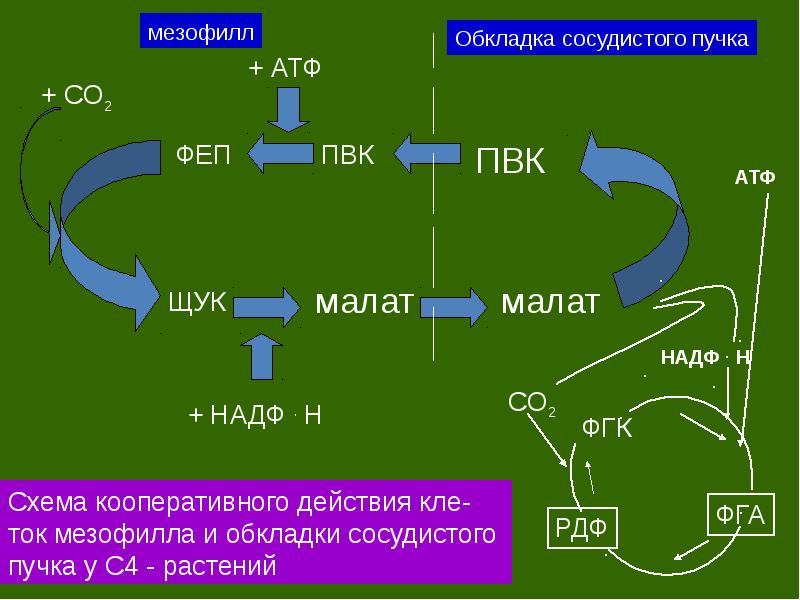
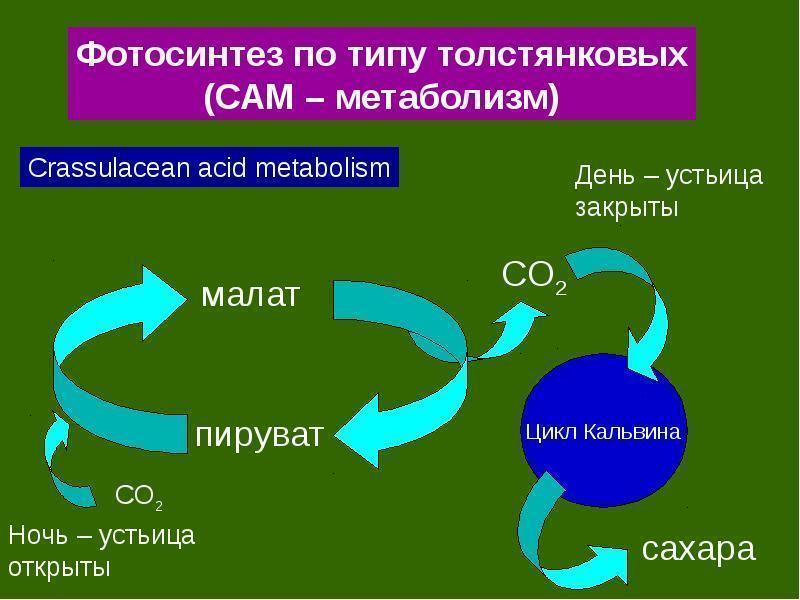
Analyzing some articles, I found data on the variety of C4-type plants. These data indicate that in C4 plants, there are differences in the biochemistry of decarboxylation of C4 acids, which occurs not only in chloroplasts. It was also shown that one of the decarboxylating systems was identified in the mitochondria of mesophyll cells, and that mitochondria participate in the processes of C4 photosynthesis. Examples of types of photosynthesis are given in Figure 4. Fig. 4. Types of photosynthesis a) C3-photosynthesis; b) C4-photosynthesis; c) CAM - metabolism The study of the evolutionary tree of angiosperms showed that 11 of its orders contain C4 species, which are widely distributed in different branches of evolution and are found among most of the relatively recently emerged, which allows us to refer to the C4 pathway as new evolutionary formations. The main difference between C3 and C4 plants is manifested under limited illumination and temperature variations. Under modern conditions, the CO2 content in the atmosphere is a small part of the entire carbon fund, but photosynthesis of higher terrestrial plants and algae is considered the main driving force of the planet's carbon cycle. An increase in CO2 content in the air led not only to an increase in the leaf area of modern plants, but also to an increase in the duration of life and leaf thickness, an increase in the number of mesophyll cells and chloroplasts in cells. In response to the growth of CO2 concentration, the stomatal gap decreased, which led to a decrease in water vapor conductivity. It has been shown that in the leaves of young plants, an increase in CO2 concentration in the air had little effect on the activity of the main enzyme of photosynthesis, Rubisco, but in mature leaves, it decreased. It is believed that an increase in CO2 content in the atmosphere, warming, and aridization of the climate contribute to the spread of C4 plants, but C3 plants remain more resistant to stress, as they have been for millions of years. It is also possible that a retro-evolution of the more recent C4 pathway of photosynthesis is possible. In the process of eukaryote evolution, a system of carotenoids was formed, which participate in the energy processes of photosynthesis. The process of evolution of photosynthesis continues to this day and is determined by global changes in the planet's climate. Preservation of the Earth's green cover, intensification of photosynthesis, and increase in the productivity of cultivated plants remain the main strategic tasks of modern plant physiology at all levels - from molecular to ecological. The process of photosynthesis led to an unprecedented explosion of biological activity on Earth, allowing life to thrive and change in huge steps, as evidenced by the fossil remains of animals and plant organisms preserved in the Earth's crust from former geological epochs, as well as the number and diversity of living organisms on our planet today. In my opinion, it would be reasonable to study photosynthesis in detail, because the processes of photosynthesis contain many mysteries, and by solving them, humanity could learn a lot. Literature: Chikov V.I. Evolution of ideas about the connection between photosynthesis and plant productivity // Plant Physiology. - 2008. - T. 55. - P. 140-154. Igamberdiev A.U. Photorespiration and biochemical evolution of plants // Advances in Modern Biology. - 1988. - T. 105. - P. 488-504. http://fizrast.ru/fotosintez/znachenie-i-istoriya.html http://ukrdoc.com.ua/text/9777/index-2.html