

Evolution of eukaryotes
The very emergence of the eukaryotic cell is one of the most significant events in biological evolution. The difference between eukaryotic and prokaryotic organisms lies in a more sophisticated system of genome regulation. Thanks to this, the adaptability of unicellular organisms increased, their ability to adapt to changing environmental conditions without introducing inherited changes into the genome. Due to the ability to adapt, eukaryotes were able to become multicellular – in a multicellular organism, cells with the same genome, depending on the conditions, form tissues that are completely different in morphology and function. This aromatosis occurred at the boundary of the Archean and Proterozoic (2.6–2.7 billion years ago), as determined by biomarkers – residues of steroid compounds unique to eukaryotic cells. The appearance of eukaryotes coincides in time with the oxygen revolution. It is generally accepted that eukaryotes appeared as a result of the symbiosis of several types of prokaryotes. Obviously, mitochondria originated from alpha-proteobacteria (aerobic eubacteria), plastids from cyanobacteria, and the cytoplasm from an unknown archaebacterium. There is no generally accepted theory for the origin of the nucleus, cytoskeleton, or flagella yet. Hypotheses about the origin of life on Earth have not clarified the question of the origin of the cell. While there are practically no plausible hypotheses describing the origin of prokaryotes, there are several viewpoints regarding the origin of eukaryotic cells. Main hypotheses of eukaryote origin: 1. The symbiotic hypothesis is based on two concepts. According to the first concept, the most fundamental distinction in the living world is the distinction between bacteria and organisms composed of cells with true nuclei – protists, animals, fungi, and plants. The second concept is that the source of some parts of eukaryotic cells was the evolution of symbioses – the formation of permanent associations between organisms of different species. It is assumed that three classes of organelles – mitochondria, cilia, and photosynthetic plastids – originated from free-living bacteria that were incorporated into prokaryotic host cells through symbiosis. This theory relies heavily on neo-Darwinian ideas developed by geneticists, ecologists, and cytologists, who linked Mendelian genetics with Darwin's idea of natural selection. It also relies on molecular biology, particularly data on protein structure and amino acid sequences, micropaleontology, which studies the earliest traces of life on Earth, and physics and chemistry of the atmosphere, as these sciences relate to biologically derived gases. 2. The invagination hypothesis states that the ancestral form of the eukaryotic cell was an aerobic prokaryote. Inside, there were several genomes attached to the cell wall. Corpuscular organelles and the nucleus arose from the invagination and budding off of parts of the membrane, followed by functional specialization into the nucleus, mitochondria, and chloroplasts. Then, in the process of evolution, the nuclear genome became more complex, and a system of cytoplasmic membranes appeared. This hypothesis explains the presence of two membranes in the envelopes of the nucleus, mitochondria, and chloroplasts. However, it faces difficulties in explaining the differences in the details of protein biosynthesis in corpuscular organelles and the cytoplasm of the eukaryotic cell. In mitochondria and chloroplasts, this process precisely matches that in modern prokaryotic cells.
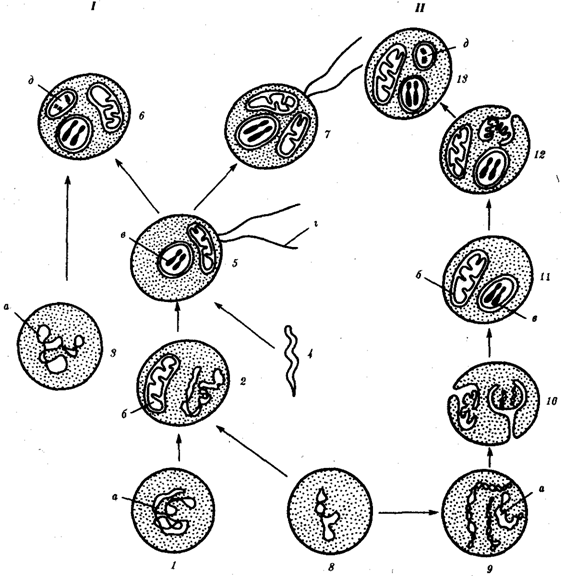
The origin of eukaryotic cells is explained by two main hypotheses: the symbiotic (I) and the invagination (II) theories. **Hypothesis I (Symbiotic):** 1. An anaerobic prokaryote (host cell) engulfs prokaryotes that have mitochondria (8), which are aerobic prokaryotes. 2. The host cell also engulfs a blue-green alga (3), which becomes a presumptive chloroplast (d), and a spiral-shaped bacterium (4), which becomes a presumptive flagellum (g). 3. This leads to the formation of a primitive eukaryote with a flagellum (5). 4. Further development results in a plant cell (6, 13) with chloroplasts (d) and an animal cell (7) with a flagellum (g). The nucleus (c) and mitochondria (b) are also key components. The prokaryotic DNA is represented by (a). **Hypothesis II (Invagination):** 1. An aerobic prokaryote (9) serves as the ancestral cell. 2. The cell membrane invaginates (10), forming the nucleus (c) and mitochondria (b). 3. Further invagination (12) of the cell membrane leads to the formation of chloroplasts (d). 4. This results in a primitive eukaryote (11), which can develop into plant (13) or animal (7) cells. Currently, there isn't enough evidence to definitively favor one hypothesis over the other or to create a new one that satisfies most scientists. However, in recent years, the theory of endosymbiosis (symbiogenesis) for the origin of eukaryotic cells has been convincingly supported. Eukaryotic cells possess higher evolutionary potential than prokaryotic cells. This is largely due to the eukaryotic nuclear genome, which is larger than prokaryotic genomes. Significant differences include the diploid nature of eukaryotic cells, with two sets of genes in the nucleus, and the multiple repetitions of some genes. The regulatory mechanisms of cellular life are more complex, evidenced by an increased proportion of regulatory genes and the replacement of the "naked" circular DNA molecules of prokaryotes with chromosomes where DNA is associated with proteins. Aerobic respiration also paved the way for the development of multicellular organisms. Eukaryotic cells themselves appeared on Earth after the atmospheric oxygen concentration reached 1% (the Pasteur point), a necessary condition for aerobic respiration. It is known that each eukaryotic cell contains genomes of different origins. Animal and fungal cells have nuclear and mitochondrial genomes, while plant cells also possess plastid genomes. Small circular DNA is also found in the basal bodies of eukaryotic cell flagella. According to the molecular clock method, eukaryotes emerged simultaneously with prokaryotes. However, it is clear that prokaryotes dominated for a significant portion of Earth's history. The earliest cells resembling eukaryotes in size (acritarchs) date back 3 billion years, but their nature remains unclear. Almost undisputed eukaryotic fossils are about 2 billion years old. Favorable conditions for eukaryotes on the planet's surface only developed after the oxygen revolution, around 1 billion years ago. It is highly probable that the primary ancestors of eukaryotic cells were archaebacteria that transitioned to feeding by engulfing food particles. The change in cell shape required for this engulfment was facilitated by a cytoskeleton composed of actin and myosin. The genetic material of such a cell moved deeper within the cell, away from its changing surface, while maintaining a connection with the membrane. This is believed to be the origin of the nuclear envelope with nuclear pores. Bacteria engulfed by the host cell could continue to exist within it. For instance, purple alpha-proteobacteria, a group of photosynthetic bacteria, became the ancestors of mitochondria. Within the host cell, they lost their photosynthetic ability and took over the oxidation of organic matter, making eukaryotic cells aerobic. Symbioses with other photosynthetic cells led to plant cells acquiring plastids. It's possible that eukaryotic cell flagella originated from a symbiotic relationship between host cells and bacteria capable of bending movements. The genetic apparatus of eukaryotic cells was initially organized similarly to that of prokaryotes. However, to manage a larger and more complex cell, the organization of chromosomes eventually changed, and DNA became associated with histone proteins. The prokaryotic organization persists in the genomes of intracellular symbionts. Through various acts of symbiogenesis, different groups of eukaryotic organisms arose: * Eukaryotic cell + cyanobacteria = red algae * Eukaryotic cell + prochlorophyte bacterium = green algae Even the chloroplasts of golden, diatom, brown, and cryptomonad algae are thought to have arisen from two successive symbiotic events, as indicated by the presence of four membranes. The emergence of eukaryotes coincided with a period in Earth's biosphere history characterized by extreme instability and unpredictability. During this time, the adaptive strategy of prokaryotes (rapid mutation, horizontal gene exchange, and selection of resistant clones) proved too costly and inefficient. In such a situation, a fundamentally more universal and economical adaptive strategy, based on the development of directed modificational variability, could gain a significant advantage. The establishment of eukaryotes and the development of sexual reproduction within them likely made the structure of variability and biodiversity more discrete and "controllable," leading to accelerated biodiversity growth and increased evolutionary plasticity and ecological tolerance of species, communities, and the biosphere as a whole. The appearance of eukaryotes can rightly be called a "benchmark" aromatophore (a significant evolutionary innovation). This event vividly demonstrated the general progressive direction of biological evolution. Progress was manifested not only in increased organizational complexity, expanded overall adaptive zones, greater biomass and numbers, and enhanced organismal autonomy but also in increased stability of living systems. The example of eukaryotes clearly shows that the emergence of new life forms should be viewed not as the result of the evolution of individual phylogenetic lineages or clades, but as a regular and inevitable outcome of the development of higher-order systems—communities, the biosphere, and perhaps the entire planet as a single entity.