

About the man of Flores Island
Other people. The most dissimilar representatives of our genus. Homo floresiensis. Tell me, who is your enemy… Knowing which enemies the people we are interested in defended themselves against, we can guess what was going on in their heads. Hobbits or Morlocks? Could this be an example of degeneration?
Other People In late October, *Nature* magazine reported on a sensational discovery by paleoanthropologists. On the island of Flores in Indonesia, the remains of seven individuals of a new species, Homo floresiensis, belonging to the same genus as us, were discovered. Individuals of this species differ significantly from modern humans. They stood about one meter tall, like three-year-old children (for comparison: the smallest modern humans, pygmies, grow to 1.4–1.5 m) and had relatively long arms (which may reflect an adaptation to climbing trees). Homo floresiensis vs.

Homo sapiens To understand the uniqueness of the discovery, we must consider how our genus evolved. Humanity originated in Africa. Several genera of the Hominidae family lived there, and several species of the genus Homo emerged there. One species after another gradually spilled out of this melting pot and spread across Eurasia. The first to arrive on our continent was H. erectus (1.7 million–300,000 years ago), the species to which the famous Pithecanthropus belonged and which (contrary to arrogant fabrications) was quite similar to us, although it had a smaller brain. It is possible that the finds in Georgia, dating back approximately one and a half million years, belong to another African immigrant—H. ergaster. About 800,000 years ago, H. antecessor inhabited the territory of present-day Spain. H. heidelbergensis lived 500,000–100,000 years ago, and H. neanderthalensis—150,000–30,000 years ago. About 120,000 years ago, H. sapiens emerged in Africa. Members of this species were smaller in stature and likely had less physical strength. However, there is reason to believe that they reproduced more rapidly than other species and were far more aggressive. When H. sapiens set out to spread across the world, its arrival in a given region meant the rapid extinction of all other human species. For a time, coexistence and even cultural exchange proved possible only with H. neanderthalensis. For example, Neanderthals were the first to place wreaths made of coniferous branches, with flowers woven into them, in the graves of their fellow tribesmen (it is interesting that this tradition is still relevant today). Probably, living in different regions, the two species led different lifestyles, which is why they competed less. Alas, over time, the Neanderthal (who, by the way, had a larger brain than humans) faded into oblivion. Perhaps it was simply a case of competitive displacement, or perhaps we simply ate all the outsiders.
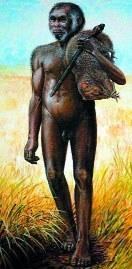
The xenophobia characteristic of our species likely has its roots in those very times. This is what a representative of the new species might have looked like. Knowing these characteristics of H. sapiens, researchers didn’t really look for our young relatives. It was clear that none could have remained… But this logic doesn’t account for the islands. Some descendants of H. erectus, as it turned out, mastered seafaring and settled in Indonesia. About 95,000 years ago, H. floresiensis appeared on Flores, possibly having arrived from elsewhere. Most surprisingly, this species lived there as recently as 13,000 years ago—at the same time as “us”… Life on islands generally has a strange effect on fauna, many of whose members become smaller. Living alongside the one-meter-tall Floresian man was the pygmy stegodon, an elephant weighing just one ton. With their small bodies, the Floresians had very small brains, about 0.38 liters—even smaller than that of a chimpanzee. We, on the other hand, have brains with a volume of about 1.5 liters, and until now it was believed that such a volume was necessary for complex behavior. Now anthropologists are surprised that creatures with such small brains made tools and led complex social lives (Perhaps this is a reason to treat chimpanzees with more respect?). To spark interest in their discovery, the researchers compared the new species to Tolkien’s hobbits, and the media immediately picked up on the comparison. However, this is merely a metaphor. Reality is more interesting. A fundamentally different culture existed on Earth quite recently! What do we know about it? Very little so far. Flores Man kept fires going, cooked food over them, made stone tools, hunted young stegodons, and likely survived for quite some time alongside a very dangerous neighbor—H. sapiens. The extinction of this species on Flores is apparently linked to a volcanic eruption that occurred 12,000 years ago. This new discovery is a gift for cryptozoologists. Local residents have long amazed people with detailed stories about small, hairy forest dwellers who communicate with each other through muttering and repeat words spoken to them. If these stories are to be believed, one might assume that H. floresiensis still exists today. Finally, just to add a touch of intrigue, let’s consider one detail. With what is the grandeur and nobility of H. sapiens—which originated in the African savannas—associated? With big cats and eagles (the eagle, of course, poses no danger to modern humans, but our ancestors were much smaller than we are)—predators that threatened our ancestors. An innate tendency to watch these animals closely saved people’s lives. The genealogy of our leaders’ symbols of authority traces back to the lion skin draped over the shoulders and eagle feathers in the hair. But on the Indonesian islands, the dangerous predators were different. H. floresiensis was hunted by dragons—giant (three-meter-long!) monitor lizards. Today, these lizards survive only on Komodo Island, where they sometimes hunt cattle, horses, wild boars, and even humans. I wonder how the leaders of the small forest islanders emphasized their kinship with the monitor lizards? Tell me who your enemy is… First, a few facts from ecological theory. The more the ecological niches (range of needs, role in communities) of two species overlap, the more intensely these species compete, that is, they reduce each other’s population. The strongest rivalry is often between two closely related species, which is why they end up geographically separated. According to the rule of competitive exclusion, formulated by the Russian scientist G. F. Gauze, the long-term coexistence of two competitors with identical ecological niches proves to be unsustainable. Sooner or later, competition must lead either to the extinction of one of the species or to the division of niches (that is, the acquisition of differences between the species)... The applicability of Gause’s rule in biology is the subject of much research. Most often it is confirmed, though sometimes not entirely. For example, if competing species are under pressure from a predator or adverse conditions, competitive exclusion may be suspended. Imagine that you are examining a water sample from a river or lake under a microscope. You might find several dozen species of single-celled algae there. The niches of these species overlap almost completely, but their abundance depends not on the behavior of competitors, but on the influence of predators (such as small filter-feeding crustaceans). But as soon as the algae break free from the predators’ grip (this happens, in particular, during algal blooms), some of the competing species are suppressed. In blooming water, two or three of the most competitive species dominate, distinguished by the specifics of their niches. Here is another example. If a section of steppe or meadow is designated as a nature reserve and livestock grazing is stopped there, after some time the number of grass species in that area will decrease: strong competitors will “outcompete” the weak ones. If we want to understand the characteristics of a particular species, we need to figure out how and with whom it competes. And do the patterns described above apply to the species that interests us most—the human species? With whom does Homo sapiens Linnaeus, 1758, compete? Five thousand and fifty years ago, our competitors were closely related species—H. erectus (upright man), H. neanderthalensis (Neanderthal), and H. floresiensis (Flores Man). As long as human population size depended mainly on a combination of favorable and unfavorable environmental factors, different but related species emerged in various parts of the world. When, thanks to adaptive behavior, we and our competitors managed to break free from the rigid constraints of our circumstances, the expansion of the ranges of different human forms meant that the principle of competitive exclusion would come into play. One species had to prevail. We know that members of the victorious species were relatively weaker physically (excluding the dwarf H. floresiensis), but they were more fertile, more aggressive, and more adaptable. Likely, only the dwarfs from the island of Flores 1 had a chance of surviving under our dominance, since this species’ ecological niche differed significantly from ours. Alas, their habitats were destroyed by a volcanic eruption. How long were different human species in close contact? A radiocarbon dating method recently refined by paleontologists from Cambridge allowed us to answer this question. Its essence is as follows. Under the influence of ionizing radiation on the atmosphere, ordinary carbon (12C, 13C) in carbon dioxide is converted into radioactive carbon (14C). During photosynthesis, radioactive carbon is absorbed by plants and then passed along the food chain. Over time, it decays (half-life—approximately five and a half thousand years). The lower the proportion of radioactive carbon in the organism’s remains, the older they are. By selecting for study only large organic molecules clearly belonging to fossil organisms—rather than those introduced from outside—the researchers reduced dating errors. Using the refined data, they were able to reconstruct the dynamics of the expulsion of Neanderthals from Europe by members of our species. It turned out that the period of close coexistence between the two species lasted only about five thousand years, and for a single region, it likely did not exceed a thousand years (fifty generations). Remember the old saying: in fighting an enemy, you inevitably adopt their traits? As far as we can tell from the ancient remains, the competitors managed to learn something from each other. “KT” has already mentioned that the custom of bringing wreaths of coniferous branches with flowers to the graves of relatives was apparently common to both of our species. And what about now? Have we really been left without competitors? Judging by the rapid growth of the human population, one might think so. But now, humans have many competitors—species very different from us—that we call “pests” (which doesn’t sound very generous). First among them is the brown rat, Rattus norvegicus, a long-time co-inhabitant and enemy of humans. Long-time, but not eternal: the spread of the brown rat across the globe from India (and not Norway at all, as one might think based on the name) took place in modern times. Although the lifestyles (ecological niches) of humans and rats differ significantly, the resources consumed by humans can also be utilized by rats. Of course, one can take comfort in the fact that humans are far smarter than rats. But it’s not quite that simple. A rat’s mind is not adapted to human life, just as ours are not adapted to the rat’s way of life. It is difficult for us to understand what is going on inside the skull of our fellow human beings, and to gain insight into the rat’s psyche, we have to conduct complex experiments. Researchers at the University of California, Los Angeles published findings in the journal Science suggesting that rats are capable of distinguishing cause and effect. The test animals were trained to associate flashes of light with a sound (a neutral stimulus) and, at times, with a sweet drink. It was expected that the animals would establish an association between these three stimuli and begin to respond to both the light and the sound as precursors to a treat. The rats that had become accustomed to this combination were divided into two groups. The first group could press a lever to trigger the sound. They understood that the sound was the result of their own actions and did not check the water bottle. The second group, which could not influence events, would rush to check for a reward upon hearing the distinctive signal. They didn’t know who was triggering the sound: the experimenter or their neighbors! Finally, let’s ask ourselves two questions. Have rats always been this smart, or have they become smarter through interaction and competition with us? And also: how will the fight against rats affect us ourselves? 1 “KT” has already written about these people, whose remains were recognized as the biggest sensation of 2004. Back to the text Hobbits or Morlocks? If you recall, the most significant scientific event of 2004 was the discovery of Homo floresiensis, the dwarf people who lived on the island of Flores in Indonesia as far back as 13,000 years ago (“KT” ##566, 571). Sadly, in the public consciousness, these creatures have come to be associated with Tolkien’s fantasies and are frequently referred to as “hobbits.” The remains of nine individuals have been discovered; only the skull of one elderly woman, specimen LB1, has been preserved. However, many anthropologists refused to recognize this sensational find as a previously unknown species of Homo sapiens, viewing LB1 as the remains of a microcephalic freak. In their dispute with the discoverers of the new species, the general public’s sympathies, of course, lay with the latter. Indeed, the theory of the recent existence of another branch of humanity is breathtaking, while the theory of deformity is dull and prosaic. In their day, the first Pithecanthropus (H. erectus) found was portrayed as an ugly gibbon, and the first Neanderthal (H. neanderthalensis) as a Cossack from Alexander I’s army during the war with Napoleon. Today, such descriptions are viewed as historical anecdotes. Will the same happen to the diagnosis of “microcephaly” applied to the Floresian? Let’s consider some arguments from the opposing sides. According to the scientists who discovered the Indonesian burial site, H. floresiensis is a diminutive descendant of H. erectus, the bipedal human. This is indeed what happens with island fauna: on islands, large animals can become smaller (like the stegodon elephants hunted by the dwarf humans), while others, conversely, can grow in size (as happened with the Floresian rats). But there is one catch. Changes in size in humans, as well as in all other animals, occur allometrically—that is, with a change in proportions. Thus, a small child’s head is smaller than an adult’s, but relative to the body, it turns out to be larger! If we were to breed a race of giant humans, the relative size of their heads would decrease, and if we or evolution under island conditions were to create dwarf humans, the relative size of their heads would have to increase. Strangely enough, nothing of the sort is observed among the ancient inhabitants of Flores. A brain of that volume would be expected in creatures three times smaller! So, does this mean that H. floresiensis is indeed microcephalic? Or perhaps the small islanders did not descend from the relatively large-headed H. erectus, but from some more primitive ancestors (such as Australopithecus)? In that case, their resemblance to humans is the result of parallel evolution, and their small brains are a consequence of general underdevelopment. However, although LB1 had a brain the size of an ape’s (smaller than that of a chimpanzee), stone tools and evidence of fire use were found alongside the remains of her fellow tribespeople. And finally, to reach Flores, the ancestors of the pygmy islanders would have had to master seafaring, which is no easy feat. Perhaps LB1’s skull belonged to a seriously ill woman, and the tools were made by others, individuals with larger heads? Incidentally, island life, malnutrition, and degeneration due to inbreeding could have contributed to deformities… And if the Floresian was not microcephalic, then his brain must have been organized much better than ours (since it solved complex problems despite its small size). Why, as their bodies became smaller, did the islanders’ brains not only shrink but also become optimized? Why doesn’t our brain optimize in a similar way? When discussing the issue of microcephaly, opponents compare the LB1 skull with the skulls of various deformities and arrive at diametrically opposed conclusions. Apparently, it is not easy to diagnose a creature so unlike us when we have only a single skull. So, LB1 is either a human who underwent some profound change not known from modern evidence, or the product of the independent evolution of some primitive ancestors, or another human species with a surprisingly economical brain organization. Clearly, solving this puzzle requires new data and further research on the island of Flores. The latest news relevant to our topic comes from the findings of a European-Indonesian team that studied the evolution of stone tools on the island. It turned out that the first stone tools on this mysterious land appeared more than 700,000 years ago. In terms of their technology, these stone flakes correspond to H. erectus. For hundreds of thousands of years, they remained virtually unchanged, and it was these very tools that the pygmy islanders used. In Africa and Europe, our species evolved rapidly. New species emerged and spread, while glaciers advanced and retreated. H. sapiens, which appeared 200,000 years ago, did not leave Africa for two-thirds of its history, but then set out for Eurasia and gradually displaced all other human species… But on Flores, life came to a standstill. Perhaps the reason behind the Floresians’ ability to make tools despite their small brain size was a gradual reduction in brain size within a culture that remained stable over many generations? A brain designed for a specific activity honed over thousands of centuries may be much simpler than a brain “ready for any task.” Remember the Morlocks from Wells’s *The Time Machine* (naturally, the book by Herbert Wells the grandfather, not the film by Herbert Wells the grandson)?

This form of humanity had degenerated, yet continued to use technology created by their distant ancestors. By the time the time traveler visited them, they still knew how to operate it, though they no longer understood the principles behind its operation. These underground little people, with their feeble minds and claw-like hands, struck terror into the hearts of early 20th-century people (the era of Wells the grandfather), and in order to capture the attention of the undemanding early 21st-century viewer, Welles the Grandson had to turn the Morlocks into muscular monsters galloping on all fours. The 20th-century time traveler was driven by a thirst for knowledge; in the 21st century, he suffers from a romantic tragedy and brings the ideals of democracy to oppressed peoples. A century ago, a book appealing to science was a success; the modern product had to incorporate parapsychology and mysticism. A thoughtful reader of a century ago was interested in nuances of meaning; the mass audience of today loves vivid visuals and is not inclined to connect its fragments with one another… We are not Floresian dwarves frozen in time. Let’s not talk about technological progress: how our perception of reality has changed over the course of a century! Whether it’s evolution or involution, it has occurred without any manifestations of microcephaly. Could the solution to the Flores mystery really lie in the gradual dumbing down of an entire people, preoccupied with reproducing old technology against a backdrop of steadily declining mental abilities and evolutionary flexibility? How this changes the associations evoked by the LB1 skull. Poor Floresians! D. Shabanov. Other People // Kompyuterra, Moscow, 2004. – No. 42 (566). – p. 20 D. Shabanov. Tell Me Who Your Enemy Is… // Computerra, Moscow, 2006. – No. 9 (629) D. Shabanov. Hobbits or Morlocks? // Computerra, Moscow, 2006. – No. 23 (643). — pp. 16–17