
Ecology: biology of interaction. 6.09. Global warming
One of the most striking recent environmental changes has been global warming — the gradual increase in the Earth's atmospheric and hydrospheric average annual temperature. Surprisingly, until relatively recently the very fact of global warming sparked fierce debates. K...
Ukrainian language (latest version) / Russian language (update discontinued)
6.08. Water supply and soils in Ukraine
D. Shabanov, M. Kravchenko. Ecology: the biology of interaction Chapter 6. Human ecology and nature conservation
6.10. Ozone and the destruction of the ozone layer
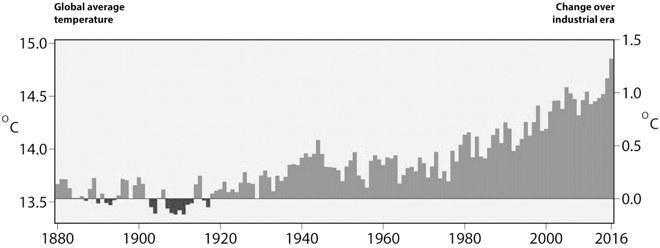
6.09. Global warming One of the most striking recent environmental changes has been global warming – the gradual increase in the average annual temperature of the Earth’s atmosphere and hydrosphere. Surprisingly, until relatively recently the very fact of global warming sparked fierce debate. Unfortunately, now the debates about which direction the climate is changing seem to have ended: it is warming. A warming of the World Ocean by 0.1 °C per year, a reduction in glacier area and a sea‑level rise of 0.7–3 mm per year have been recorded. In the summer of 2003, according to WHO data, 20 000 people died in Europe from heat, and 30 % of the harvest was lost in the southern continent. The UN forecasts that as a result of global warming, in the coming decades about one‑third of a billion people will become environmental refugees and nearly 2 billion inhabitants of the planet will be deprived of access to fresh water. “From how the modern world copes with climate change will directly determine the prospects for the further development of a significant part of humanity. … Failure to solve this problem will condemn 40 % of the poorest population of our planet – about 2.6 billion people – to a future with progressively diminishing possibilities” (UN Development Programme Report, 2007). The planet’s average temperature has increased since the beginning of the 19th century by at least 1 °C. The fastest temperature rises are observed on the Antarctic coast: in some places by 2.5 °C over the past sixty years. This leads to accelerated glacier calving into the ocean and further melting. Another consequence of global warming is the increase in destructive hurricanes, droughts and floods due to changes in atmospheric circulation. By the way, a rise in the Earth’s average temperature does not mean that the whole planet becomes warmer: changes in atmospheric and hydrospheric circulation can cause local cooling. The latest observed warming data are shown in Fig. 6.9.1 and Fig. 6.9.2 (source) [IMG_1] Fig. 6.9.1. In 2015 the warmest year in the entire history of systematic observations was 2015. 2016 broke this record. The figure shows the average surface temperature of the Earth (left scale) and its change relative to the level characteristic of the beginning of the industrial era. [IMG_2] Fig. 6.9.2. Change in the average temperature of 2016 across different parts of the Earth’s surface relative to the average temperature recorded over the thirty‑year period from 1981 to 2010. Thus, the fact of warming is documented. One would think the causes should be clear. The Intergovernmental Panel on Climate Change presented a 2007 report concluding that with 90 % probability the main cause of global warming is human activity, primarily greenhouse‑gas emissions (carbon dioxide and methane). Nevertheless, some scientists, including Russian researchers, dispute this conclusion, considering human activity a secondary factor in climate change. It would seem there is nothing to argue about. One must build a climate‑change model, incorporate all known interrelations, and make a scientifically based forecast. Unfortunately, the Earth’s atmosphere is so complex that constructing a detailed model is impossible. A slight change in initial parameters can lead to radical changes in the expected future of the climate system. Moreover, we still do not know all the causal links influencing climate. Here are just a few sketches. — Apparently, in recent years solar activity has increased, leading to Earth’s warming. — Rising carbon‑dioxide concentration stimulates photosynthesis and increases planetary productivity. — Warming leads to increased water evaporation, greater cloud cover and more solar radiation reflected by clouds – i.e., self‑cooling. — Sea‑level rise will flood the most fertile land and reduce carbon‑dioxide sequestration. — Acid rain stimulates sulfur‑oxidizing bacteria, which suppress methane‑producing bacteria – providers of another “greenhouse” gas. — In response to excessive ultraviolet radiation, phytoplankton release substances that promote cloud formation. — Human activity leads not only to CO₂ emissions but also to atmospheric dust and soot pollution. Global “darkening” could cause cooling. Finally, some specialists convincingly argue that higher carbon‑dioxide concentration cools rather than warms the planet! Heating of the lower atmospheric layers may enhance vertical circulation and energy radiation into space. Proponents of this view claim that Antarctic drilling results show that in recent Earth history the rise in carbon‑dioxide concentration was a consequence, not a cause, of warming. Thus, the world community is trying to combat global warming without being firmly certain of its cause. The prevailing view is that warming is caused by emissions of carbon dioxide and methane, which intensify the greenhouse effect. The main mitigation measure adopted is the reduction of CO₂ emissions. Is this the right decision? It is hard to say. Clearly, reducing fossil‑fuel consumption, which is a prerequisite for cutting emissions, is a beneficial change regardless of its link to global warming. And, after all, something has to be done! As noted earlier, the biosphere has maintained a positive ecological balance throughout almost its entire history. Because of this, living organisms have not only accumulated fossil fuel reserves that modern humanity relies on, but have also simply created their own habitat. Photosynthesis now outweighs respiration, which is why atmospheric oxygen is about 21 % and carbon dioxide about 0.038 %. But humanity is increasingly shifting the balance toward carbon dioxide; at the beginning of the 20th century its concentration was only 0.029 %. We use organic matter not only for our bodies but also to “feed” our machinery with fossil organic material. Combustion is analogous to respiration, but occurs faster and is accompanied by the dispersion of released energy. We lack the organic matter produced by autotrophs in real time, so we draw on reserves from other epochs – fossil fuels. As a result we emit CO₂ and shift the global ecological balance. Yet burning fossil fuel is not the whole story. Our agricultural practices lead to rapid soil degradation and the loss of stored organic matter. Detritus – organic material at various stages of decomposition – plays an important role in soil fertility. The more we exploit arable lands, the more we accelerate detritus breakdown and CO₂ release into the atmosphere! Measuring these emissions is more difficult than industrial ones, but they are likely comparable in intensity. Today, atmospheric carbon‑dioxide concentration attracts special attention because it is assumed to enhance the greenhouse effect. The greenhouse properties of the atmosphere maintain life‑supporting conditions on Earth’s surface, so even a small change can be highly significant for the biosphere. Obviously, our activities increase carbon‑dioxide input into the atmosphere. Therefore, it must be reduced. The Kyoto Protocol to the UN Framework Convention on Climate Change was designed to address this task. How to reduce carbon‑dioxide content? The usual answer is to plant more vegetation. Unfortunately, a climax ecosystem absorbs as much CO₂ as it releases. Otherwise, the amount of organic matter in the ecosystem would change, altering its quality. When firewood is burned and forest soil organic matter degrades, all the carbon stored in the forest returns to the atmosphere. Nevertheless, while forests grow they sequester CO₂. What can help? Technological change. The tried path: improve fuel combustion, increase the efficiency of heat engines, save energy. The Kyoto Protocol pushes signatory economies toward such measures. Yet it is evident that current actions are still insufficient. The Kyoto Protocol to the UN Framework Convention on Climate Change was signed by the heads of developed countries at the end of 1997. Its goal is to significantly (for example, by 8 % for Western Europe) reduce industrial carbon‑dioxide emissions by 2010 compared with 1990 levels. This limitation could slow global economic growth by about 1 % per year. In the second phase of the protocol, beginning after 2012, emissions should be cut roughly by half. According to the document, highly developed countries may purchase emission quotas from other nations. Moreover, leading powers can earn the right to over‑produce carbon dioxide by financing the transition to modern technologies in other countries. The more a country lags, the more attractive its development becomes. To reduce carbon‑dioxide emissions by one tonne, Ukraine would need to spend $7, Russia $20, the EU $270, and Japan $600! Are there more effective measures than those provided by the Kyoto Protocol? Accelerating the shift to alternative energy sources – nuclear, (potentially) fusion, solar, geothermal, wind, etc. – is possible. All real alternatives to fossil‑fuel energy have drawbacks, but they still need development. Stop soil erosion. This requires changing every land user’s mindset, shifting egoism from short‑term gains to long‑term sustainability. Can the ecological balance be shifted the other way? Yes, by accumulating non‑decomposable organic matter: for example, planting forests, harvesting them and filling abandoned mines with timber. Yet our activity goes in the opposite direction: we extract organic matter from the Earth’s crust rather than bury it. In the USA an idea is being developed to inject liquefied CO₂ into mines. But again, to obtain the energy required for CO₂ liquefaction, 30 % more fuel must be burned. A closed loop… Accelerate CO₂ sequestration into limestone, calcium carbonate… This function is tirelessly performed by mollusks, reef‑forming corals, foraminifera and other marine organisms with calcareous shells and skeletons. Unfortunately, increasing ocean acidity hampers their activity. They need help! Yet where can sufficient calcium salts be obtained without significant energy costs (which would increase CO₂ emissions)? So, is there no way out? At least we do not know one yet. Therefore, while making the efforts we are capable of now, we should continue studying the interconnections in Earth’s climate system. Man appeared when our planet became feverish. This was no accident – climate change spurred animal evolution. Earth’s history includes cold periods (e.g., at the end of the Paleozoic, 250–300 million years ago), but the relatively recent period was warm. Cooling began about 36 million years ago. As lithospheric plates moved, Antarctica separated from South America and Australia and settled near the South Pole. A circumpolar current formed around it, reducing heat exchange with the rest of the planet. Antarctica became covered by an ice sheet, which reduced solar absorption and “cooled” the climate. However, glaciation starts only when, year after year, precipitation on glaciers exceeds loss by evaporation and melting. In isolated Antarctica, precipitation was scarce. Three to four million years ago the Americas closed the Panama Isthmus. Warm Atlantic water, previously flowing into the Pacific, was redirected northward by the Gulf Stream and the North Atlantic Current, bringing abundant precipitation. Glaciers in Greenland, North America and northern Eurasia began to grow and advanced southward in massive sheets. They linked huge water masses; climate cooling altered atmospheric and oceanic circulation. Yet cold, dry air settled over the glaciers, causing glaciation to “stall” and retreat – a warm interglacial began. Restored warm currents again promoted glacier growth – glaciation resumed… Since then Earth has experienced about two dozen glacial and interglacial periods (Fig. 6.9.3). Mean‑temperature fluctuations over a cycle range by several degrees (up to 10 °C), and sea‑level changes by tens to hundreds of meters. During the last warming (over 20 000 years) the ocean rose by 120 m; melting of the Antarctic and Greenland ice caps could add another 65–70 m. [IMG_3] Fig. 6.9.3. Dynamics of average surface temperature over the past 400 thousand years In addition to the “major” glaciations and interglacials, there were minor ones. For example, from the late 9th to the late 12th centuries the climate was especially mild. During this time Norwegian Vikings settled Greenland (the “Green Land”) and founded a settlement in North America. With cooling, contacts with the colonies ceased and the colonists perished; the remains of the last bear marks of chronic malnutrition. From 1450–1850 a “little ice age” covered canals in the Netherlands and even the Thames. 6.08. Water supply and soils in Ukraine
D. Shabanov, M. Kravchenko. Ecology: the biology of interaction Chapter 6. Human ecology and nature conservation
6.10. Ozone and the destruction of the ozone layer
6.10. Ozone and Ozone Layer Depletion