

History of skeletal faunas formation
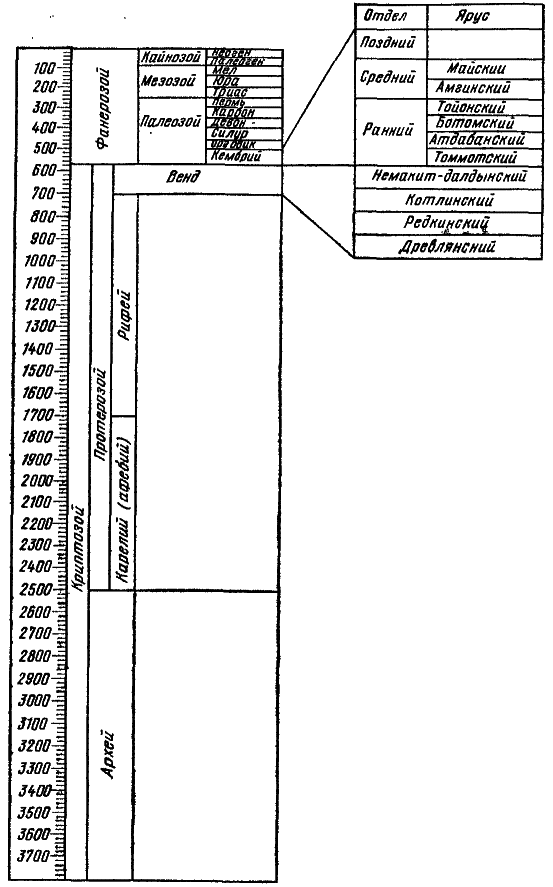
{"output":"The most important events that occurred in the biosphere since the appearance of the skeleton are quite clearly recorded in the paleontological record. As a result of studying the sequence of appearance of various associations of skeletal organisms from the time of their mass spread to the present, a Geochronological Scale (Fig. 1) of relative time was created, which is widely used throughout the world. Fig.1 Geochronological Scale Today, as a result of the introduction of electron microscopy and other methods, paleontology is capable of studying what previously seemed absolutely impossible: fossilized remains of bacteria and other organisms of micron size, remains of DNA and other fragments of organic structures.
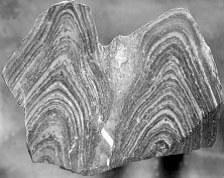
All of them allow building conclusions about the level of organization of those organisms that lived, but from which seemingly nothing remained. In addition, ancient organisms left their traces in the rocks. So-called stromatolites (Fig.2) have been described in Precambrian rocks. It turned out that a stromatolith is formed as a result of the vital activity of a prokaryotic community that is absolutely unlike anything else, called a cyanobacterial mat. Mats exist in many regions of the world, mainly in such hypersaline lagoons as Sivash, however, true stromatolites, as in Shark Bay and on the Bahama Banks, they form quite rarely. The mat located on the upper surface of the stromatolith created by it represents a dense multilayered \"carpet\" with a total thickness of up to 2 cm; its basis is composed of filamentous or palmelloid cyanobacteria, however, besides them, a multitude of the most diverse microorganisms participates in the formation of the community. Fig.2 Stromatolite Australian scientists have identified minerals in ancient rocks whose isotopic age exceeds 4 billion years. In carbonate rocks in stromatolites about 3.5 billion years old, American and Australian scientists have found fossilized remains of organisms extremely similar to cyanobacteria. One can with a high degree of probability assume the existence already at that time of a \"prokaryotic biosphere\", i.e., a biosphere saturated with primitive communities of non-nucleated cells. At the same time, it is extremely important that oxygen is generally necessary for the vital activity of cyanobacteria. Thus, bacteria that do not require oxygen probably existed earlier, and accordingly a non-cyanobacterial but bacterial biosphere could have already existed. However, the extraterrestrial origin of life cannot be excluded.
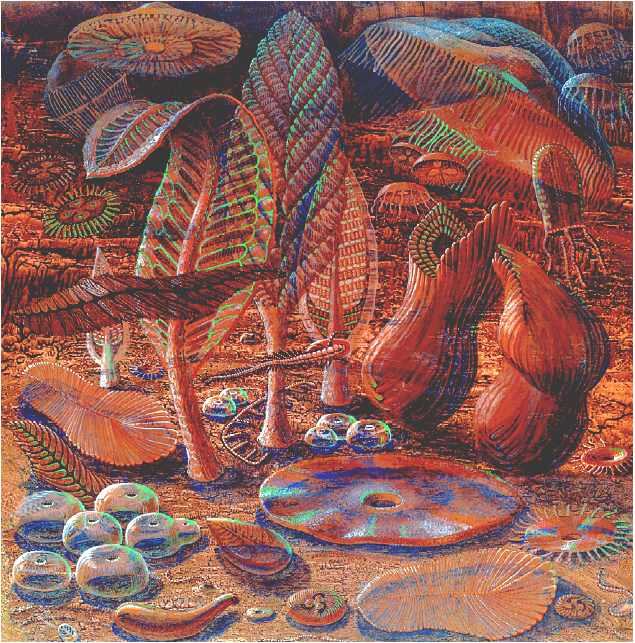
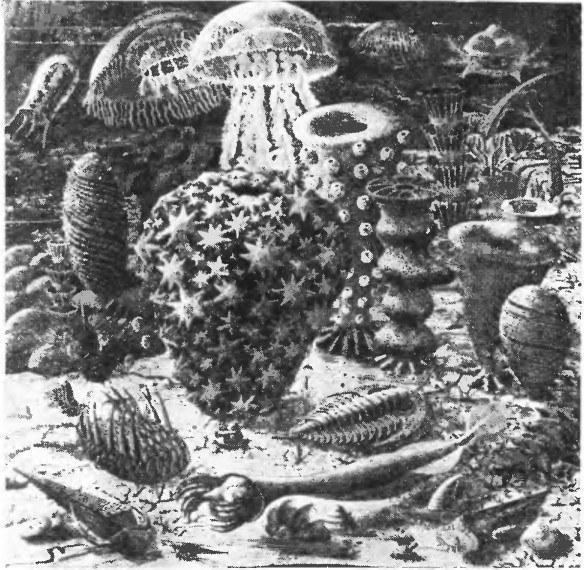
In any case, materials about finds of organic compounds or even fossilized primitive organisms in meteorites have been published repeatedly. The main body of researchers has always treated these publications very skeptically, but even today very interesting materials appear that do not allow rejecting the extraterrestrial origin of life. A group of Moscow researchers found fossilized cyanobacteria and possibly imperfect fungi in carbonaceous chondrites (meteorites), and American specialists found traces of bacteria in fragments of Mars. The transition from a predominantly prokaryotic biosphere to a eukaryotic one is extremely difficult to record. The approaches here can be different, but none of them gives an unambiguous answer. Approximately 20 years ago, Moscow geologist A. Leytes (Leites) identified tubular formations in the Udokan deposits of Siberia, which he named Udocania problematica, which from the very beginning some researchers considered remains of worms or coelenterates, while others rigidly took the position of their inorganic origin. The latter believed that these tubes are pseudomorphs after crystals of some minerals. However, study of this material using an electron microscope showed that we are dealing not only with eukaryotes but also with Metazoa, i.e., multicellular animals, and also with a skeleton. Even if one considers that the age of rocks with Udocania does not exceed 1.4 billion years, this poorly agrees with previous conclusions about the time of appearance of eukaryotes. It should be noted that in recent years such data are becoming more and more numerous. Polish and Russian researchers found not only cyanobacterial filaments in the metamorphic rocks of the basement of the East European Platform with an age certainly exceeding 2 billion years, but also pseudomorphs after conidia of imperfect fungi. However, no less interesting are the results of analysis of traces of organisms' vital activity. Their form in a number of cases can convincingly indicate their extremely complex multicellular structure. Such traces were discovered by Novosibirsk scientists in the deposits of the Igano-Norilsk region. The world-famous Vendian localities of skeletaless Metazoa of Europe, Australia, and Newfoundland are literally teeming with imprints of unusual animals. After the first locality discovered and described in Ediacara (South Australia), this association of skeletaless organisms began to be called the Ediacaran fauna. Later, when even richer localities were discovered in the Vendian deposits of the Russian (East European) Platform, this fauna is often called the Vendian-Ediacaran. The richest localities of these remains have also been found in South Africa, Siberia, Podolia, and on the White Sea coast. The number of these finds is constantly increasing (Fig. 3). According to various estimates, 65-70% of the Vendian biota are coelenterates: about 25% are worms and about 5% are arthropods. Fig.3 Vendian time biota The main distinguishing feature of the Vendian-Ediacaran fauna is that it is represented only by imprints of skeletaless organisms. And although some of these animals are up to 1 m in length, they probably consisted of jelly-like substance exactly like today's medusae. It is surprising, of course, how could they have been preserved in burials in such massive quantities? Among the Vendian-Ediacaran animals there were both benthic (lived on the bottom, attached or lying freely) and nektonic and planktonic forms, i.e., passively or actively swimming in the water column (Fig. 4). Fig.4 Reconstruction of Early Cambrian biota (by A. Zhuravlev and L. Tolmacheva) From the Vendian rocks, by means of chemical preparation, a huge number of microscopic organisms and fragments of organisms that probably had a pectic membrane are extracted. Due to the pectic membrane, they are well preserved in fossil state and are almost not destroyed by chemical action on the rock. These formations in most cases are phytoplankton. The Vendian phytoplankton is extremely abundant, although mainly these are smooth spherical forms 10-20 μm in size, but they have various surface structure features. On large areas of the Vendian shallow water, quite large algae (up to several centimeters in length) grew - vendotenids, very reminiscent of modern laminaria. They are preserved in the form of carbonified remains (phytolelm). By form and structure of the thallus, they are divided into 5 orders: round; crustose; bush-like and cord-like; ribbon-like. The connection of vendotenids with modern groups of algae is unclear. At the last stage of development of the Vendian biota, a very peculiar picture is observed. Here several groups of organisms that build a mineral or organic tube are already present.
And at the very top, primitive mollusks with cap-shaped shells appear. From the Nemakit-Daldynian time, a progressive increase in forms with a skeleton begins (Fig.5). Fig.5 Nemakit-Daldynian tubular fossils a - Anabarites, × 25, b - Sabellidites, × 16 BEGINNING OF \"SKELETONIZATION\" Moving upward along the section from Precambrian to Cambrian rocks, one finds that the rock is saturated with numerous and diverse remains of organisms, the appearance of which is more or less familiar to us. Here one begins to encounter the remains of sponges, mollusks, brachiopods, and other organisms that are common throughout the entire Phanerozoic. Only their dimensions are unusual (the first millimeters). All known (discovered) in the Cambrian, or more precisely, in the Lower Cambrian, remains of organisms constitute two large groups: 1) remains of organisms whose systematic position is clear, since they have younger and even modern analogs, and 2) remains of organisms whose systematic position is absolutely unclear or very problematic.
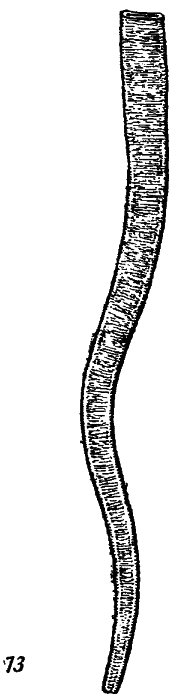
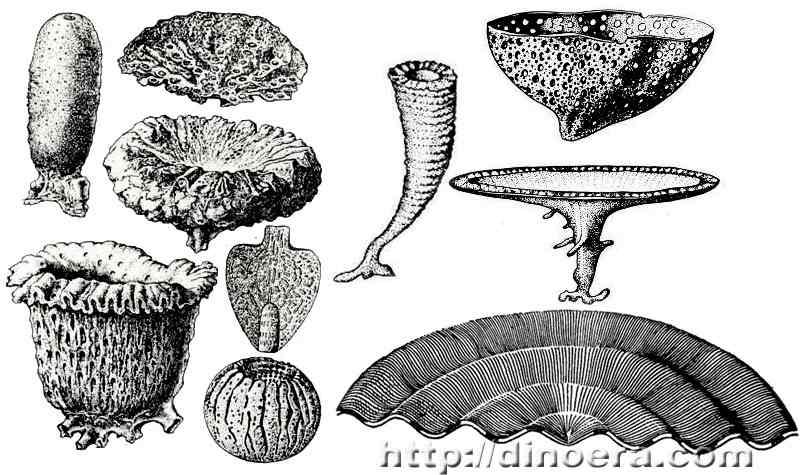
Among single-celled animals (Protozoa), reliable foraminifera are known. The first obviously foraminifera have a discoidal agglutinated shell. They are described in the Atdabanian deposits of the Baltic region and are called lukatielles (Lukatiella). Platysolenites tubes (Fig. 6) are quite often referred to as foraminifera, the first representatives of which were found at the very top of the Precambrian. Fig.6 Platysolenites Sponges with siliceous and carbonate spicules are known from the very beginning of the Cambrian. Whole specimens are encountered extremely rarely. Almost always, when sponge remains are found, these are only accumulations of isolated spicules. Some researchers also refer archaeocyaths (Fig.7) to fossil sponges. Although it has long been considered that archaeocyaths are an independent phylum of animals. Archaeocyaths represent in most cases double-walled cups of various shapes. Usually they were attached to the bottom, although they could also lie freely. The diameter of the cups - from several millimeters to several centimeters.
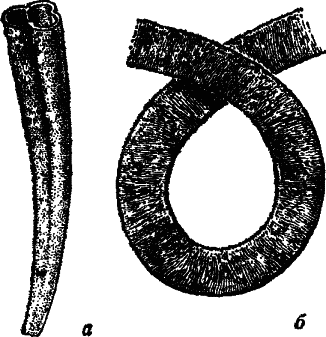
Fig.7 Various forms of archaeocyath cups Archaeocyaths - the first of skeletal organisms - became active builders of reef structures. Later, corals came to replace them. The interest of many researchers in archaeocyaths was initially determined by the fact that this was the second group after trilobites used for subdivision and correlation of Cambrian deposits. Coelenterates at the beginning of the Cambrian are poorly represented. However, several groups were still discovered. Mollusks are very widely represented. But it is unclear to which classes of mollusks the shells found here should be assigned. And this is often a very difficult task, because here we encounter the ancestral forms of all mollusks bearing archaic features. But in any case, it is clear that reliable monoplacophorans already occur in the Early Cambrian. In recent decades, research into ancient representatives of mollusks has led to the idea that in those ancient times there existed an independent class of mollusks called Rostroconchia. Quite early, almost from the very beginning of the Cambrian, the first primitive bivalve mollusks are also recorded. They occur not very often, but their finds are now known from practically all over the world.
They were named Fordilla. So-called chiolites are widely represented in the Cambrian. They usually have a shell in the form of a straight or curved horn with a cross-section of various shapes. The shell was closed by an operculum, the form of which corresponded to the shape of the shell cross-section. The Cambrian is a time of the rapid development of arthropods, and especially one of their groups - trilobites. About 50 families of these animals were distributed only in the Early Cambrian.
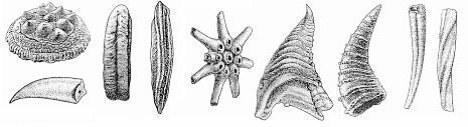
Also from the Atdabanian time, the earliest representatives of another class of arthropods - Crustacea - are known, its representatives are known from Siberia, China, the East European Platform, and North America. From the second half of the Early Cambrian, brachiopods begin to colonize vast spaces, and by the beginning of the Middle Cambrian, they become the second most numerous group among skeletal fossils. And finally, one more group - echinoderms. Their modern descendants - starfish, sea urchins, etc. The first representatives of this group appear at the end of the Atdabanian age and quickly spread throughout the world. Echinoderm skeletons consist of separate plates, which, in turn, are represented by single calcite crystals. After the death of the organism, its skeleton, as a rule, disintegrates, and in the rock one could find only isolated plates. But still, scientists were lucky. In North America in the Early Cambrian, whole skeletons were found, and after that it became easy to detect the presence of echinoderms in the rock by isolated microcrystalline plates. All the animal remains listed above belong to invertebrates. However, there is a suspicion that the most primitive vertebrates already appeared in the Cambrian and, moreover, in the Early Cambrian. This idea is based on the study of so-called Hadimopanella, which by their internal structure most of all resemble the scales of the most ancient fish-like organisms (Fig. 8a). Just as earlier in the Vendian, in the Cambrian seas there was probably very much phytoplankton. Evidence of this - numerous remains of spherical smooth or spiny forms usually 10-20 μm in size, rarely up to 100 μm, which are found in large quantities in Cambrian rocks. In carbonate rocks, as a rule, calcareous algae are encountered. Today there is very much evidence of the quite widespread development of cyanobacteria in the Cambrian. This was shown especially effectively by the example of the study of phosphorites and high-carbon shales (Fig. 9). Fig.8 Some Early Cambrian fossils: a - Hadimopanella, b - Sachites, c - Siphonogonuchitids, d - Hanchiencelloria, e - Tommotiids, f - Anabarites A very interesting and unusual group of problematic fossils received the name tommotiids (Fig.4,e). It was first described from the Lower Cambrian deposits of the Siberian Platform. Fig.9 Cyanobacteria in Lower Cambrian phosphorites The last group among problematic fossils that should be mentioned a few words about is the so-called anabaritids. These are tubular forms usually several millimeters in length. The most characteristic feature of these fossils is their three-rayed symmetry (Fig. 8f). Their tubes are carbonate. A probable connection of anabaritids with Vendian three-rayed soft-bodied organisms is indicated. The overwhelming majority of the listed organisms lived in the shallow water area, within epicontinental seas, i.e., seas located on continents. References: 1. Rozanov A.Yu. What Happened 600 Million Years Ago? M.: Nauka, 1986. 2. Sokolov B.S., Fedonkin M.A. And Another 100 Million Years // Science in the USSR. 1983.
No. 5. 3.
Tommotian Stage and the Problem of the Lower Boundary of the Cambrian / Ed. by M.E. Raaben. M.: Nauka, 1969. 4. Fedonkin M.A. Skeletaless Vendian Fauna and Its Place in the Evolution of Metazoa // Proceedings of the Paleontological Institute. 1987. Vol. 226. 5. Fedonkin M.A. Skeletaless Vendian Fauna and Its Place in the Evolution of Metazoa. M., 1987. 6. http://www.nestego.ru/2013/09/blog-post_9.html"}