
Hardening freedom. Column in ComputerreOnline #34
The traits of our species that intensified during the final stages of our evolution will become less stable, more frequently giving rise to various anomalies affecting our health.
In the previous column I began by stating that there are “old” and “young” adaptations. Here we will discuss this topic, and to start the conversation I will tell you something about the early evolution of fish.
In my office stands, in embodied form, my long‑standing dream: an aquarium with bichirs—almost implausibly African fish. Their Russian name derives from *kalama*, reed, and the Latin (in light of the latest systematic trends), *Erpetoichthys*, means “snake‑fish”. Bichirs and polypterids (*Polypterus*) are modern representatives of the cladist group, the most archaic group of ray‑finned fishes.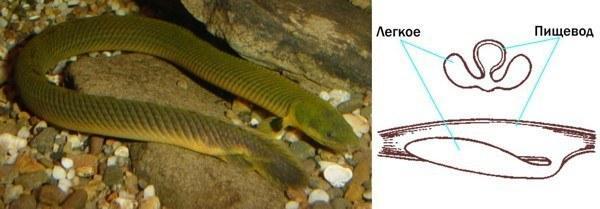
Bichir and schematic of its lung structure (in transverse section and laterally, after A. Romer and T. Parsons)
The bichir is, of course, a modern fish, but it has retained the lung structure that was characteristic of Devonian fishes that colonized polluted shallow waters (and of our ancient ancestors!). At that time the land was almost bare, and vegetation did not protect it from water erosion. As river waters slowed near the sea, they deposited sand and clay on the bottom. When the deposits compressed the flow, the site of deposition shifted further downstream. Tides rolled over wide deltas—transitional habitats between land and sea. Through these moist lowlands, regularly flooded, both plants and animals reached the land. Rich vegetation supplied a great deal of organic matter to these waters, supporting a rich fauna. Fish exploited this environment.
In water rich in decaying organic matter oxygen was often scarce. How to obtain it? Some fish simply exposed their blood‑vessel‑rich backs out of the water. Others swallowed air bubbles, which were then retained in a special pouch in the esophagus for gas exchange. In early bony fishes the gas‑exchange organ was separated from the digestive tract so as not to interfere with feeding. Air replacement in such a primitive lung did not require special adaptations, like our thoracic cage that works like a bellows. Rising to the surface, the fish expelled a bubble from the lung, filled its oral cavity with air, and, descending, allowed water pressure to push the bubble where needed.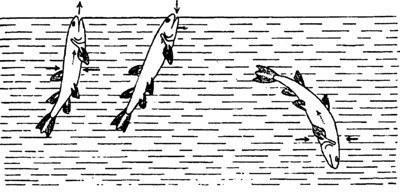
Fish renew air in their lungs using water pressure (according to I.I. Shmalgauzen)
Thus, lungs originated as air‑breathing organs in water. At the same time they acquired a second, hydrostatic function: they reduced the fish’s body density, making it effectively weightless in water. The fishes that first ventured onto land could not initially use their lungs, because their bodies were pressed against the ground. Limbs capable of lifting the body helped.
The fate of the lung in fish that remained in water was varied. Some of them later migrated to fully marine environments. Problems of gas exchange receded, the respiratory function of the lung disappeared, the hydrostatic function remained, and the lung transformed into a swim bladder. Some fishes shifted to benthic life and lost the now‑redundant swim bladder. Some lung‑less fishes (e.g., catfishes, loaches, etc.) colonized fresh waters and found themselves in organically polluted water where breathing was difficult. They began to gulp surface air; a pouch developed in their esophagus for gas exchange. If you have an aquarium with air‑gulping fish, you know the characteristic movement: up to the surface, slightly protruding from the water, and down again, just as illustrated. The circle closed, but the next turn of the spiral never began: modern fishes never evolved lungs.
Why were the esophageal modifications that arose rapidly in Devonian shallow waters unavailable to modern fishes?
Before answering, I note that this situation is quite typical. The study of the paleontological record shows the same pattern. While a group is young, its members display considerable variability in key structural features, demonstrating what is called “archaic diversity.” Over time, only a few lineages within the considered group persist. The group reaches its peak. The environment changes, but this is only weakly reflected in the morphology of the organisms we are interested in; only at the very end of the group’s existence, before its extinction, do deviating representatives appear. Youth, peak, old age, and degeneration… Concepts of “age” and “aging” of individual groups were widespread among paleontologists of the late 19th–early 20th centuries.
An example of the transition from archaic diversity to the preservation of a few stable groups is provided by the class Echinodermata. This remarkable animal group is, incidentally, the closest of the “large” groups to our own—Chordata.
Organismal development is not a mechanical implementation of a blueprint encoded in genes. It is a complex process that depends both on the flow of regulatory signals from the hereditary program and on interaction with the environment. Newly acquired adaptations are inherited rather unstably, often only under specific environmental conditions. If an adaptation proves successful, selection will maintain it. Over time, other traits—more recent adaptations—will exert greater influence on the survival and death of the organisms we study. Regarding older traits, selection will focus solely on one thing: maintaining their normal development. New adaptations will evolve in organisms that possess these stable traits. Changing those traits will then entail a profound restructuring of many organismal properties, likely incompatible with life.
Thus, not all evolutionary changes of comparable magnitude in a given lineage require the same intensity of selection. “New,” plastic, weakly integrated traits will change much more easily than “old,” conservative traits that are embedded in the overall background necessary for normal individual development. When “old” traits do change, the changes tend to be disharmonious and maladaptive.
Consequently, we can expect that those characteristics of our species that changed intensively during the latest stages of our evolution will be less stable and more prone to generate various anomalies affecting our health. Changes in traits whose development was tightly regulated in earlier evolutionary stages should be especially difficult. Let us examine our anatomy (and health problems) from this perspective.
First, recall which medical specialties are hardest to enter. Note that not all medical professions—such as laryngology, ophthalmology, dentistry, neurology, and gynecology—correspond to specific systems of our body. Professions like therapist, surgeon, infectiologist, or sanitary doctor are linked to characteristic types of activity. Since in an acute case a surgeon’s role often outweighs that of a sanitary doctor, the former is considered more prestigious. What about specialties distinguished by their object of work?
Outside competition are gynecologists and dentists. Understand why: they will always have work. The functioning of the female reproductive system was reshaped in relatively recent stages of our evolution. The female reproductive cycle changed, sexual activity became vastly more intense, and childbirth became more complicated. Of course, the main cause of more difficult births is the very increase in brain size and, consequently, head size.
In our quadrupedal relatives, the pelvic bones constrain the pelvic organs laterally but do not support them. With the transition to an upright torso, the supportive functions of the pelvis expanded. This is one of the characteristic anatomical features of humans: the pelvic girdle has a bowl‑like shape. The halves of the pelvis spread… and narrowed the outlet. Here lies the difficulty! A child must be born with a large head. Maternal and neonatal mortality rates increase, especially in first births. Selection for survival during birth leads to a whole “bouquet” of solutions, none of which is ideal.
First of all, there is a shortening of embryonic development, assessed not by duration but by the newborn’s maturity. I have read that to reach the level of maturity at which a chimpanzee infant is born, a human would need not 9 months of embryonic development but 21! I doubt the exactness of that figure, but it is clear that human children are born relatively premature compared with our closest relatives. This adaptation costs us in terms of newborn helplessness, higher mortality, and greater “care cost.”
Two other solutions are the “foldable” skull and the “expandable” pelvis. The newborn’s cranial vault is not fully ossified; its parts are mobile. This incurs risks of cerebral blood‑flow disturbances during birth and raises the frequency of many anomalies. Weakening of the pelvic symphysis in the pubic fusion brings biomechanical problems for women. Yet mortality in childbirth without qualified assistance remains high…
What happened to our teeth? That is another bouquet of problems, not only linked to increased lifespan and an evolutionarily novel diet. The point is that changes in proportions during evolution are achieved primarily by altering growth rates of different body parts. To enlarge the braincase, facial growth had to be slowed. The growth of its various parts slowed unevenly (which, incidentally, is linked to the development of our chin) and often becomes mismatched. I will give a personal example.
I, like my parents and other relatives, have poor teeth. My left lower wisdom tooth had no space in the jaw; as it grew it broke the neighboring tooth and damaged the lower jaw. In the absence of proper care such a defect would likely have caused death around age 30. I received qualified treatment, survived, and have since had more children. Unfortunately, they also have poor teeth; one of my sons now wears a special brace to align teeth that do not fit in the jaw. In a primitive society such a dental defect would not have been very serious, because it manifests seriously only at an age that very few reached, so it would not have been fully resolved. Now lifespan has increased, and selection pressure on this trait has been essentially removed. The only hope is that medical care will continue to improve rather than worsen, and that my children will cope with their teeth even more easily than I did.
What do my son and I have to pay for? The vicissitudes of our evolutionary history. We must endure…