

Kravchenko et al., 2018. Hemiclonal Inheritance in Water Frogs: A Random Curiosity, a Transitional State, or a Regular Stage of Evolution?
Kravchenko M., Pustovalova E., Fedorova A., Shabanov D. Hemiclonal inheritance in water frogs: a random curiosity, a transitional state, or a regular stage of evolution? / Proceedings of the scientific conference "State and Biodiversity of Ecosystems of Shatsky National Nature Park and Other Protected Areas"...
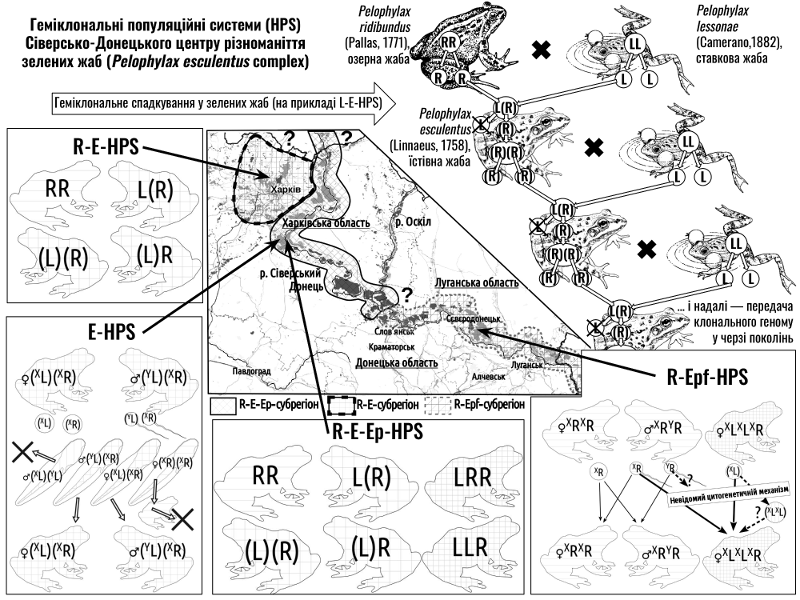
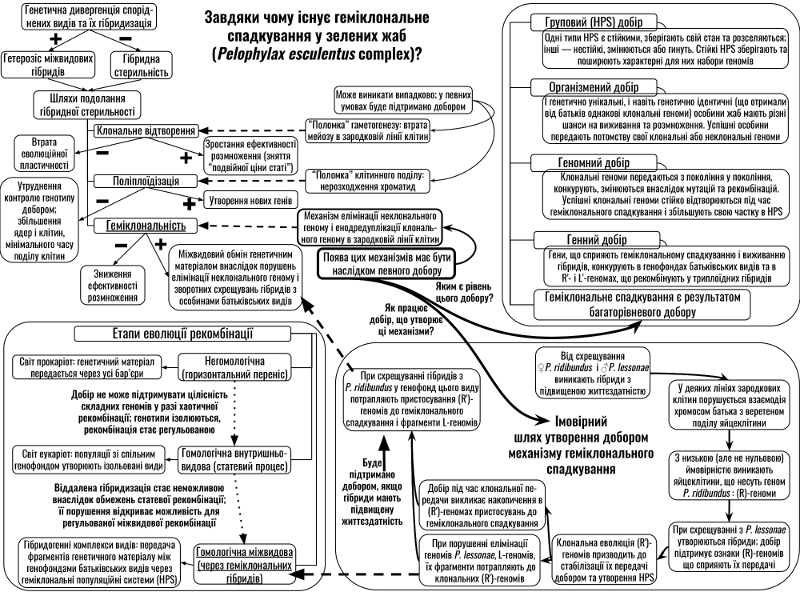
HEMICLONAL INHERITANCE IN WATER FROGS: A RANDOM CURIOSITY, A TRANSITIONAL STATE, OR A REGULAR STAGE OF EVOLUTION? Kravchenko M., Pustovalova E., Fedorova A., Shabanov D. V. N. Karazin Kharkiv National University e-mail: marinakravchenko2106[]gmail.com, shabanov[]karazin.ua M. Kravchenco, E. Pustovalova, A. Fedorova, D. Shabanov. HEMICLONAL INHERITANCE OF WATER FROGS: OCCASIONAL INCIDENT, TRANSITION STATE OR THE NATURAL STAGE OF DEVELOPMENT? We propose hypothesis that defines hemiclonal inheritance as a rare natural evolutional way to overcome interspecies hybrid sterility (as well as clonality and polyploidy). The main consequences of hemiclonal inheritance are clonal evolution of genomes and homological interspecies recombination. On the example of hybridogenic Pelophylax esculentus complex we discuss possible reasons and steps of evolution of hemiclonal population systems (HPS). We also discuss unique types of HPS that are typical for the Siverskyi Donets center of diversity of water frogs. Keywords: Pelophylax esculentus complex, hibridogenesys, hemiclonal population systems, recombination, multilevel selection. Hemiclonal inheritance in water frogs (Fig. 1) is often regarded as a certain stage in the formation of a hybrid tetraploid species [1]. Thus, in water toads, triploidy can be both an accidental occurrence and a stage in the emergence of hybrid species [6]. Unlike toads, population systems of water frogs containing triploids regularly arise in many parts of the range [7] and are capable of stable and long-term existence [3, 4]. We consider hemiclonality as a regular (though rare) way of overcoming the sterility of interspecific hybrids (Fig. 2). We propose a hypothesis regarding the pathway of origin of this phenomenon and the nature of the selection that sustains it (Fig. 2, 3). Fig. 1. Hemiclonal reproduction of interspecific hybrids of water frogs and typical HPS in the Siverskyi Donets center of their diversity Fig. 2. Probable mechanism of the origin of hemiclonal inheritance Fig. 3. Probable stages of HPS evolution in water frogs The results of hemiclonal inheritance include clonal genome evolution, one consequence of which is the phenomenon of hybrid amphigamety (= hybrid amphispermy) [2, 4], as well as homologous interspecific recombination between parental species. Borkin L. Ya., Darevsky I. S. Reticulate (hybridogenous) speciation in vertebrates // Zh. obshch. biol. 1980.
Vol.
41 (4).
![Рис. 3. Вірогідні етапи еволюції HPS зелених жаб Результатами геміклонального спадкування є клональна еволюція геномів, одним з наслідків якої є явище гібридної амфігаметності (= гібридної амфіспермії) [2, 4], а також гомологічна міжвидова рекомб](https://s3.prozo.re/batrachos/images/Kr_3_800_PZXvEE0.original.png)
P. 485–506. Borkin L. Ya., Zinenko A. I., Korshunov A. V., Lada G. A. et al. Mass polyploidy in the hybridogenous complex Rana esculenta (Ranidae, Anura, Amphibia) in Eastern Ukraine // Proc. I Conf. Ukr. Herpetological Soc. Kyiv: Zoomuseum NNPM NANU, 2005. P. 23–26. Shabanov D. A. Evolutionary ecology of population systems of the hybridogenous complex of water frogs (Pelophylax esculentus complex) in the Left-Bank Forest-Steppe of Ukraine. Author's summary of doctoral dissertation, 03.00.16 — ecology. Dnipropetrovsk, 2015. 36 p. Shabanov D. A., Biriuk O. V., Korshunov O. V., Kravchenko M. O. Distribution of different types of hemiclonal population systems of the hybridogenous complex of water frogs (Pelophylax esculentus complex) in the Siverskyi Donets basin // Current State and Conservation of Natural Complexes in the Siverskyi Donets Basin. Sviatohirsk, 2017. P. 139-144. Biriuk O., Shabanov D., Korshunov O., Borkin L. et al. Gamete production patterns and mating systems in water frogs (hybridogenetic Pelophylax esculentus complex) in North-Western Ukraine // J. of Zool. Systematics and Evolut. Res., 2015. — Vol. 54 (3). P. 215–225. Borkin L. J., Shabanov D. A., Brandler O. V., Kukushkin O. V. et al. A case of natural triploidy in European diploid green toad (Bufo viridis), with some distributional records of diploid and tetraploid toads // Russian Journal of Herpetology, 2007. – Vol. 14 (2). P. 121–132. Plötner J. Die westpaläarktichen Wasserfrösche. Bielefeld, 2005. 161 S. Kravchenko M., Pustovalova E., Fedorova A., Shabanov D. Hemiclonal inheritance in water frogs: a random curiosity, a transitional state, or a regular stage of evolution? / Proceedings of the scientific conference "State and Biodiversity of Ecosystems of Shatsky National Nature Park and Other Protected Areas", Shatsk, 13–16 September 2018. – Lviv: SPOLOM, 2018. – P. 69-73.