

Creationism as a form of intellectual doublethink
Troitsky variant. — 2008. — No 7N (821). — p. 6.
Published in the online edition “Troitsky Variant”. — 2008. — No. 7N (821). — p. 6. Everyone has heard that biology is the science of the 21st century. Everyone knows about the achievements of biotechnology. Laypeople are interested in new dinosaur finds. Research on humans shows a long evolutionary history of neurological, biochemical, genetic and other structures related to the formation of our essence. People whose names are associated with the successes of modern biology express no doubts about the theory of evolution. At the same time, the teaching of biology becomes a subject of legal proceedings and public debates. Sociological surveys show that the general public prefers the version of human creation by God or aliens rather than the scientific knowledge about the emergence of our species during the evolution of terrestrial life. Highly spiritual authorities protest against the “suppression” of dissent by professional science, against the restriction of freedom of speech by biologists. How to explain such a contradiction? Could the successes of biology really be compatible with a lack of freedom of discussion within it?
At the same time, the teaching of biology is becoming the subject of court proceedings and public discussions. Sociological surveys show that the general public prefers the version of human creation by God or aliens over the scientific knowledge of the origin of our species in the process of the evolution of terrestrial life. Highly spiritual authorities protest against the "suppression" of dissent by professional science, and the infringement of freedom of speech by biologists.
How can this contradiction be explained? Can the successes of biology be combined with an uninhibited discussion within it?
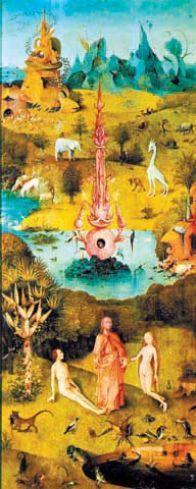
The miracle of existence is no less paradoxical than the mystery of origin. Debates about evolution reflect different ideas about human nature. (Hieronymus Bosch. "The Garden of Earthly Delights" left wing)
Most publications dedicated to the confrontation between creationists and evolutionists are related to the discussion of creationist "aces" – often fabricated "problems" of evolutionary teaching. The arguments of both sides have been expressed many times. Here, we will not give in to creationists by answering their questions again, but will consider the roots of the observed confrontation.
Why are no lawsuits filed against physics and astronomy courses with claims that they contradict the biblically authoritative miracle of Joshua stopping the sun's movement across the sky? Why are the norms of food consumption outlined in public catering institutes not challenged with reference to the fact that they do not take into account the miracle of the loaves and fishes? In these matters, potential opponents have learned to separate the recognition of scientific and technological facts from belief in miracles.
Belief in miracles is a territory beyond the competence of science. Each individual can integrate their own life experience and the paradoxical nature of their own existence in a form acceptable to them. The credo quia absurdum (a paraphrased statement by Quintus Septimius Tertullian, 1st–3rd centuries AD), repeatedly ridiculed by atheistic propaganda, characterizes not the weakness of faith, but its strength. That which can be unequivocally proven is not a matter of faith; its acceptance is not an act of courage and trust in the Creator.
The main line of confrontation between creationists and evolutionists has long ceased to be about whether Charles Darwin himself was right. Darwinism is a theory a century and a half old, and the years that have passed since Darwin's time have been a period of flourishing for modern biology, as well as for natural sciences and technologies in general. The fact of the natural development of life was understood by many scientists even before Darwin. Darwin's merit is not that he "discovered" evolution, but that he proposed an excellent explanation for its mechanism for his time. The persuasiveness of the mechanism of evolution proposed by Darwin led to the inclusion of the concept of the evolutionary formation of observable phenomena today into the cognitive models of practically all fields of biology. This concept significantly contributed to the progress of biology. Over time, the shortcomings and incompleteness of the explanation proposed by Darwin became increasingly apparent, leading to their replacement by more current hypotheses. Modern ideas about the mechanisms of evolution differ significantly from Darwin's, and, like the key problems of many sciences, are the subject of disputes among proponents of different theories.
The fundamental confrontation between creationists and evolutionists concerns another issue: is the process of the development of life and the origin of humans knowable by scientific methods? Are the factors whose effects we can observe and record in repeatable experiments sufficient to explain these phenomena?
It is impossible to answer this question by scientific means, as it is "external" to it. However, science builds its models "from within" by accepting such a hypothesis. Procedures for proposing and testing hypotheses, starting from it, have led to the unprecedented progress, of which mobile phones, heart transplant operations, quantum computers, and much more are a vivid manifestation. This progress is so remarkable, so contrary to common sense, that ordinary people, far from understanding scientific procedures, are prone to believe in miracles that abolish the natural laws of causality.
Hieronymus Bosch. "The Garden of Earthly Delights" altarpiece, outer wings

An ordinary person can use the wonders of modern technology without thinking about their explanation, but people who determine the orientation of education have to worry about reproducing citizens who understand what has been acquired and create new things. Countries interested in the development of science and technology, which seek to prevent conflicts between denominations, organize the study of sciences in general educational institutions. General democratic norms on the separation of church and state and school from church protect not only the state and the school, but also the church. In every generation of church hierarchs, there will be people who seek to expand their capabilities - whether it is state-organized teaching children to the "correct" denomination, or, for example, duty-free trade in goods harmful to health. The history of faith shows that after such initiatives were successfully implemented, churches had to cleanse themselves of their consequences.
So, the school teaches science, and the church takes care of souls... But why is it precisely the theory of evolution that is associated with the greatest difficulties in reconciling scientific and religious views of reality?
The theory of evolution touches upon people's ideas about themselves. Although disputes between "creationists" and evolutionists often concern the origin of birds or amphibians, everyone understands that what is at stake is primarily the idea of human nature. Is man in general and each of us in particular a natural or a miraculous object? Was this world created specifically for us, or are we the result of evolution just like other creatures? Does death await us, or is death merely the end of an exam in the form of earthly life, after which another, true life will begin?
The importance of these questions suggests that faith and the comfort it provides will always be needed by human nature. However, the image of man created by modern science increasingly contradicts the image of man based on the sacred texts of revelations that came from deep antiquity. The image of "evolutionary man" is increasingly difficult to reconcile with the image of "created man," and this is where the reasons for the conflict between evolutionary teaching and faith in the Creator lie.
Can the fact of biological evolution be challenged? Absolutely! The way to maintain the "strength" of the scientific edifice is to constantly question all its key elements (this is the polar difference between science and faith). But this must be done by people competent in scientific matters, and the judges in these matters must also be qualified scientists. A show in the style of "a schoolgirl who doesn't want to study biology argues with Darwin for viewer votes" has nothing to do with scientific discussions. And as soon as the discussion moves to a professional level, it becomes clear that the data from paleontology, biogeography, comparative anatomy, physiology, genomics, and proteomics are more than sufficient to justify the need to recognize the fact of evolution.
The prominent biologist, author of many books, Richard Dawkins recounts the autobiographical memories of Kurt Wise, an undoubtedly decent proponent of a 6-day creation. In his youth, Wise took scissors and cut out all the sentences from the Bible that, when interpreted literally, contradicted the claims of modern science. Although the margins of the book remained untouched, it became completely unreadable. Convinced of this result, Wise decided to believe the Bible, not science.
Such a decision seems entirely honest. If the literal interpretation of the Holy Scriptures presents a person with an "either-or" choice, they will have to either make a choice between faith and science... or abandon the literal interpretation.
Paradoxically, a certain analogue of natural selection operates in cultural evolution. Views that are effectively transmitted from person to person are preserved, developed, and influence social life. The mechanism of education "works" for the transmission of a scientific worldview. If a scientific view of reality were easily transmitted from person to person, we would live in a civilization of scientists. However, scientific explanations often turn out to be complex, non-trivial, and different from common sense logic (everyday thinking). That is why the scientific worldview has not become dominant in modern society.
However, creationism in the spirit of Kurt Wise is not very common in the modern world. It's not just that accepting it requires strong faith and honesty with oneself. Another reason is that in democratic states, for the reasons we discussed above, schools teach a more or less scientific, rather than religious, worldview. In the USA (despite the fact that the majority of the country's inhabitants are believers), as in other democratic countries, norms on the separation of religion and state are in effect. Will school education undermine the creationist worldview?
A layperson can use the miracles of modern technologies without pondering their explanations, but people who determine the direction of education must care about reproducing citizens who understand what has been achieved and create new knowledge. States interested in the development of science and technology and seeking to prevent conflicts between confessions organize the study of sciences in general‑education institutions. Democratic norms concerning the separation of church from state and school from church protect not only the state and the school but also the church. In every generation of church hierarchies people will appear who strive to expand their possibilities – whether it is state‑organized indoctrination of children into a “correct” confession or, for example, untaxed trade in health‑harmful goods. The history of faith shows that after such initiatives succeeded, churches had to cleanse themselves of the consequences. Thus, the school teaches sciences, and the church cares for souls… But why are the greatest difficulties in reconciling scientific and religious views on reality associated specifically with evolutionary theory? Evolutionary theory touches people’s conceptions of themselves. Although disputes between “creationists” and evolutionists often concern the origin of birds or amphibians, everyone understands that what is at stake first and foremost are conceptions of human essence. Is a human in general and each of us in particular a natural or a miraculous object? Was this world created especially for us, or are we the same result of evolution as other organisms? Does each of us have to die, or is death merely the end of an exam in earthly life, after which another, true life begins? The importance of these questions indicates that faith and the consolation it provides will always be demanded by human nature. Yet the image of a human being constructed by modern science increasingly diverges from the image of a human based on sacred revelation texts from deep antiquity. The image of an “evolutionary human” becomes ever harder to combine with the image of a “created human,” and this underlies the reasons for the conflict between evolutionary doctrine and belief in a Creator. Can the fact of biological evolution be disputed? Certainly! The way to preserve the “building” of science is to constantly question all its key elements (this is a diametric difference between science and faith). But this must be done by people competent in scientific matters, and judges in these matters must also be qualified scientists. Shows in the spirit of “the schoolgirl who does not want to study biology argues with Darwin for TV viewers’ votes” have nothing to do with scientific discourse. As soon as the discussion moves to a professional level, it becomes clear that data from paleontology, biogeography, comparative anatomy, physiology, genomics and proteomics are more than sufficient to substantiate the necessity of accepting the fact of evolution. The eminent biologist and author of many books Richard Dawkins recounts the autobiographical memories of Kurt Wise, an unquestionably respectable proponent of a six‑day creation. In his youth Wise took scissors and cut out from the Bible all the verses that, when taken literally, contradicted modern scientific statements. Although the book retained untouched passages, it became completely unreadable. Convinced of this result, Wise decided to believe the Bible rather than science. Such a decision appears entirely honest. If a literalist interpretation of Scripture places a person before an “either‑or” choice, he must either choose between faith and science… or abandon the literalist interpretation. Paradoxically, a certain analogue of natural selection operates in cultural evolution. Views that are efficiently transmitted from person to person are preserved, develop, and influence public life. The mechanism of education “works” for the transmission of a scientific worldview. If scientific views of reality were easily passed from person to person, we would live in a civilization of scientists. However, scientific explanations are often complex, non‑trivial, and differ from everyday common‑sense logic. That is why a scientific worldview has not become dominant in modern society. Nevertheless, contemporary creationism in the spirit of Kurt Wise is not widespread. This is not only because its acceptance requires strong faith and personal honesty. Another reason is that in democratic states, for the reasons mentioned above, schools teach a more or less scientific rather than religious worldview. In the United States (despite the fact that most of the country’s inhabitants are believers), as in other democratic countries, norms on the separation of religion from the state are in force. Could school education really undermine a creationist worldview? The solution was found in 1961 by Henry Morris, the founder of so‑called “scientific creationism”. To allow creationism to be taught in secular institutions, it was given the appearance of a scientific theory. The logic of Morrisian reasoning is as follows. Let us impartially consider two scientific theories – “Darwinism” and “scientific creationism”. The former explains organismal diversity by evolution. The latter – by the miracle of Creation. The “facts” extracted from the Morrisian sleeve (add our comment: it does not matter whether they are genuine, misinterpreted, or outright fabricated) fit poorly with the first explanation but fit well into the second. Conclusion: the miracle of Creation is proven… Surprisingly, this approach bore fruit. This viewpoint is sufficiently “contagious” (has a high potential for expansion). In several U.S. states laws were adopted forcing the teaching of “scientific creationism” as one of the scientific alternatives. As a simpler and therefore more easily transmitted worldview, “scientific creationism” multiplied its supporters. When the danger of creationist mimicry was recognized by the scientific community, resistance from scientists intensified. Demands to teach “scientific creationism” were replaced by bans on religious propaganda in educational institutions. “Morrisianism” began to take various forms; today it often appears as “Intelligent Design Theory”. Now creationists appeal less to their scientific credentials and more to laws protecting the right of individuals to freely express their opinions. Debates over teaching creationist alternatives to science continue in the United States and have spread worldwide, reaching Russia as well. A wave of anti‑evolutionary agitation crashes onto the modern Russian layperson. The “Morrisian standard” is used in propaganda by Protestants (Jehovah’s Witnesses, Seventh‑day Adventists and others), Muslims (such as Adnan Okhtar, writing under the pseudonym Harun Yahya), Orthodox fundamentalists, and even neo‑pagan groups. Anti‑evolution agitators try to transfer the propaganda of their ideas “to the enemy’s territory” – schools and universities. What should scientists and educators do in such conditions? Clearly separate evolutionary doctrine as such from individual theories – Darwinism, STE (Synthetic Theory of Evolution), etc. In polemics among proponents of various evolutionary theories emphasize that opponents differ in assumptions about the mechanism of evolution, not in the recognition of the phenomenon itself. When describing the technological “miracles” of modern biology, show their connection with the whole complex of scientific knowledge. Explain that teaching within biology as a science “the theory of creation in six days”, “scientific creationism” or “Intelligent Design Theory” aims at intentional mixing of scientific facts and religious revelations and is therefore unacceptable. And finally, the main point. Better educate, more vividly popularize knowledge, more honestly study reality… Additional materials: Has the theory of evolution been refuted? 1. Is the choice between evolutionism and creationism a scientific one? Has the theory of evolution been refuted? 2. Is the variability of scientific knowledge a drawback or an advantage? Has the theory of evolution been refuted? 3. The problem of transitional forms Has the theory of evolution been refuted? 4. What is a human?
Strange as it may seem, this approach has borne fruit. This point of view is quite "contagious" (has a high expansion potential). In several US states, laws were passed that required "scientific creationism" to be taught as one of the scientific alternatives. As a simpler and therefore more easily transmissible worldview, "scientific creationism" began to multiply its adherents. When the danger of creationist mimicry was realized by the scientific community, the resistance from scientists also intensified. Demands to teach "scientific creationism" began to give way to prohibitions on religious propaganda in educational institutions. "Morrisianism" began to take various forms; for example, it is now often encountered in the form of "intelligent design theory." Now creationists appeal not so much to their scientific nature as to laws protecting human rights to freedom of expression. Disputes over teaching creationist alternatives to science continue in the USA, and have also spread throughout the world. They have reached Russia as well.
A stream of anti-evolutionary propaganda is falling on the modern ordinary Russian person. Protestants (Jehovah's Witnesses, Seventh-day Adventists, etc.), Muslims (in particular Adnan Oktar, who writes under the pseudonym Harun Yahya), Orthodox fundamentalists, and neopagans all use the "Morris standard" in their propaganda. Anti-evolutionary propagandists try to transfer the propaganda of their ideas "to the enemy's territory" - to schools and universities.
What should representatives of science and education do in such conditions?
Clearly distinguish evolutionary teaching as such from individual theories - Darwinism, the Synthetic Theory of Evolution (STE), etc. In polemics between representatives of different evolutionary theories, emphasize that opponents differ in their assumptions about the mechanism of evolution, not in their recognition of the phenomenon itself. When describing the technological "wonders" of modern biology, show their connection with the entire complex of scientific knowledge. Explain that teaching "6-day creationism," "scientific creationism," or "intelligent design theory" within the framework of biology as a science is aimed at deliberately mixing scientific facts and religious revelations and is therefore unacceptable.
And, finally, the main thing. Teach better, popularize knowledge more vividly, study reality more honestly...
Additional materials: Has the theory of evolution been disproved? 1. Is the choice between evolutionism and creationism scientific? Has the theory of evolution been disproved? 2. Is the variability of scientific knowledge a disadvantage or an advantage? Has the theory of evolution been disproved? 3. The problem of transitional forms Has the theory of evolution been disproved? 4. What is man?