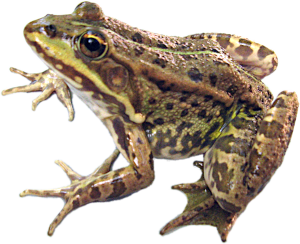

Shabanov (2006) Humans, hybrids, frogs
[An already quite old article in Computerre, which, in my opinion, may still be of some interest due to its discussion of possible scenarios in interspecific hybridization and the evolutionary role of partial recombinants. Among other things, it is available here: https://dspace.univer.kharkov.ua/handle/123456789/756] D....
The journal *Nature* has published an article that could change the way we view ourselves. Humans: American geneticists from Harvard and the Massachusetts Institute of Technology have published the results of a study of the DNA sequences of six primate species: humans, chimpanzees, gorillas, orangutans, macaques, and spider monkeys[1]. What sets this work apart from previous studies is the significant volume of data used[2]. It would seem that it should provide a precise answer as to when exactly the evolutionary paths of our species and our closest relatives diverged. Such considerations are based on a well-established method. “Related” DNA sequences from the two species are selected. Changes that do not affect the synthesized proteins are filtered out. The recorded level of differences between the two species is divided by the average rate of change accumulation in this region (estimated based on the aggregate data obtained from a group of related species). The result is the time of divergence (the separation of evolutionary paths). Practice has shown that such calculations are quite accurate and are confirmed by additional evidence. However, the results of recent studies of humans and their relatives have turned out to be paradoxical.Analysis of different parts of our genome yields discrepancies differing by more than four million years. The strongest link between humans and chimpanzees is the female chromosome—the X chromosome—which, moreover, exhibits remarkable genetic homogeneity. Based on some parts of our genome, our closest relative is the chimpanzee; based on others, it is the gorilla. How can we solve this puzzle? The study’s authors propose a hypothesis that they themselves call provocative. The divergence of the human and chimpanzee lineages was not simultaneous and involved a prolonged period of hybridization! It is likely that humans and chimpanzees diverged earlier than humans and gorillas, but then, over the course of four million years, interbreeding occurred between early humans and early chimpanzees, leading to the convergence of many of their genetic sequences. It was only about six million years ago that our paths with the apes finally diverged! Of course, this hypothesis raises a host of new questions. One of them is: how could such an original sin[3] have occurred? Why was hybridization with very dissimilar partners possible among animals with such complex psyches as the ancestors of humans and chimpanzees? Observing ourselves and modern humanity, we can easily see various manifestations of xenophobia. A creature similar to us but different from us (whether an “ugly” monkey or a member of a “barbaric” ethnic group) evokes antipathy in most people, which can turn into both disgust and hostility. One might assume that the emergence of xenophobia in us was precisely the factor that put an end to the coexistence of the two species, hindering their independent evolution and adaptation to their characteristic ways of life. But this trait is also characteristic of other monkey species… And through what genetic mechanisms could hybridization have occurred between proto-humans and proto-chimpanzees? To answer this question, we need to discuss the phenomenon of hybridization in more detail.Hybrids In its most general form, hybridization is the crossing of organisms that differ in certain inherited traits. From this perspective, each of us is a hybrid of our parents. However, we are more interested in the phenomenon of crossbreeding between distantly related forms.
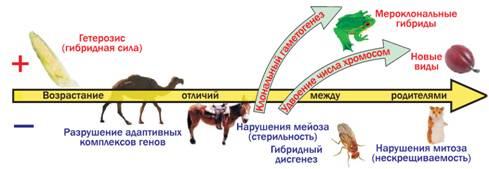
The relationship between the possible consequences of hybridization and the degree of differences between the parental forms is schematically shown in Fig. 1. Some effects caused by hybridization: In the case of cultivated plants and domestic animals, hybridization between different varieties and breeds often helps increase the viability of the offspring as a result of heterosis (hybrid vigor)—the advantage of hybrids over their parental species. Thus, it was no coincidence that N. S. Khrushchev began promoting corn cultivation: at that time, the United States derived benefits from the introduction of hybrid corn lines that exceeded the costs of the Manhattan Project (the development of nuclear weapons).The result of the evolution of each species is the formation of an adaptive gene complex—an interconnected set of their successful combinations. When crossed, such complexes “break apart.” This effect can be combined with heterosis. For example, in the first generation resulting from the crossbreeding of a dromedary (one-humped camel) with a Bactrian (two-humped camel), a nar appears, which has two low humps fused into one. Combining the advantages of its parents, the nar is a hardy and strong animal. Unfortunately, its offspring include low-value camel-donkey hybrids, which is likely due to the disruption of adaptive gene complexes.However, the nar can produce offspring, whereas the mule (a hybrid of a donkey and a mare) cannot. The differences between the mule’s parents are so great that it cannot produce gametes (except in extremely rare cases). The formation of an egg cell and a sperm cell requires meiosis—a type of cell division distinct from that which drives an organism’s growth (mitosis). At a certain stage of meiosis, paired chromosomes must join together. If they are very different (and, as in the case of the mule, their number has become odd due to the difference in the chromosome sets of the parental species), meiosis proves impossible. Mules are valued for their heterosis, whereas in the reciprocal (arising from the opposite combination of parents, from the Latin reciprocus—opposite) mule-hybrid of a stallion and a donkey-mule, heterosis does not manifest.When there are significant genetic differences between the crossed forms, hybrid dysgenesis—a phenomenon well-studied in Drosophila—may occur: a conflict between different genomes that manifests as major or minor developmental abnormalities.Finally, in completely distantly related species, due to disruptions in mitosis and cellular metabolism, development does not occur at all. If, under artificial conditions, a hamster egg is fertilized with human sperm, we obtain a so-called humster (from “human” and “hamster”). Humster are incapable of normal development, but they have found practical application: they are used to study the chromosome set of human sperm.However, for hybridization to lose its evolutionary significance, it is sufficient to block meiosis, which means that the hybrids will not produce offspring. However, there are two possible ways out of this impasse. One of them is the doubling of chromosome sets. For example, the cultivated plum—a hybrid of cherry plum and wild plum—was obtained both naturally and in experiments. The cells of the plum contain two sets of cherry plum chromosomes and two sets of wild cherry chromosomes, and thanks to this, each chromosome can find a partner during meiosis. Polyploid hybrids are common among cultivated plants, but are much rarer among animals. Another solution is the partially clonal, or meroclonal (from the Greek meros—part, portion), formation of gametes. If a cell contains two different sets of chromosomes that cannot form pairs during meiosis, one of them can be discarded, and the remaining one can be duplicated. As paradoxical as this solution may seem, it is not unique and has been observed in some fish (dace and peciliopsis), insects (stick insects), amphibians (green frogs), and a number of other species.If our ancestors used one of these two methods to overcome hybrid sterility, it is clear that they followed the frog’s path rather than the chimpanzee’s—compared to chimpanzees, our genome has not doubled, since the difference in our chromosome sets is just a single pair of chromosomes. Frogs Meroclonal reproduction is best illustrated by the example of green frogs. These are the very creatures that sit on the banks of ponds and splash into the water as we approach. As was discovered several decades ago, three main forms are widespread in Central and Eastern Europe: the pool frog (Rana lessonae), the marsh frog (R. ridibunda), and their hybrid—the edible frog (R. esculenta). Edible frogs can result from the interbreeding of pool and lake frogs (Fig. 2). Since their parents have quite significant differences, the development of hybrid frogs can exhibit both signs of heterosis and a range of abnormalities. But the most remarkable thing is the reproduction of the hybrids. Before meiosis, they expel one of the parental sets of chromosomes from the cell nucleus. Which genome is expelled depends on the environment in which the hybrids live. In Western Europe, they usually live alongside pond frogs, whereas, for example, near Kharkiv, they live alongside lake frogs. Let’s examine the second scenario in more detail (Fig. 3). Hybridization in Central European green frogs. The genome (chromosome set of thirteen chromosomes) of the pond frog is designated by the letter L, and that of the lake frog by R (photo by Oleksiy Korshunov) In fact, the hybrid produces gametes of the parental species that is absent in this habitat! It can be said that edible frogs only temporarily utilize the genome of the partner species and do not pass it on to their offspring. However, the genome of the other species is transmitted without recombination (the formation of new combinations of inherited information)—clonally.
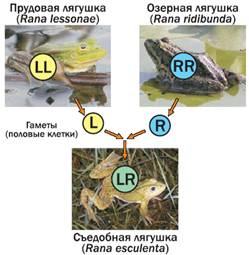
According to a common (though insufficient) explanation, one of the genomes (likely the parental one) cannot properly interact with the other genome and its environment within the cell nucleus and is therefore expelled outward. Reproduction of edible (hybrid) frogs when crossed with the parental species (lake frog). The pond frog genome (clonal genome), highlighted in red, is passed on as a single unit. The box shows the events occurring with the genomes of hybrid frogs before and during meiosis. As you can see, living alongside the pond frog, the hybrids clonally transmit the lake frog’s genome. Of course, this choice does not reflect the will of the amphibians themselves: the parent species’ population acts as a filter that weeds out the hybrid’s clonal lines that reproduce inefficiently.
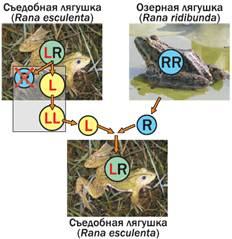
When crossed with lake frogs, the hybrid line that produces gametes of the same species simply disappears in the next generation, dissolving into the parental species. Those hybrids that will pass on gametes of the other species will successfully reproduce hybrid offspring just like themselves.Imagine that hybrids producing pond frog gametes (or the pond frogs themselves, from which such hybrids are obtained through crossbreeding) enter a population of lake frogs. All offspring resulting from their mating with the parental species will be hybrid (Fig. 3). However, it turns out that when hybrid frogs mate with each other, they may be sterile or produce offspring that die before reaching sexual maturity. Why? Hybrid frogs are among the few creatures whose two genomes perform different functions. The non-clonal genome sustains life, but in each generation it is destroyed and reacquired from the parental species. The clonal genome evolves as it is passed down from generation to generation. Various errors accumulate in it, and adaptations that facilitate its reproduction may also arise. Clonal genomes can change so drastically that if two copies of them come together in a single individual, neither will be able to fully control vital functions, and the frog’s development will be disrupted.Let’s return to the situation where hybrids (LR) that produce gametes of the other parental species (L) have entered a population of lake frogs (RR). Their proportion will steadily increase. All LR × RR matings will produce only hybrids (LR), increasing their proportion in the population. RR × RR matings will not change the ratio of the two forms in the population, and LR × LR matings will lead to nothing at all. As a result, over time, the hybrids may almost completely displace the parental species! Once they begin to dominate the population, other hybrid lines will be in demand (in our example, those producing lake frog gametes).It seemed like everything was clear with the frogs? That is not the case at all. Near Kharkiv, there are frogs that produce a mixture of gametes from both parental species (how they manage this is a mystery). Furthermore, both in Western Europe and near Kharkiv, a significant portion of frogs have not two, but three (some—four) sets of chromosomes. Humans and frogs—what do they have in common? Let’s return to the evolutionary history of our species. What can we say about hybridization between humans and chimpanzees, based on data from American authors? Over four million years of incomplete divergence of evolutionary branches, the differences between them should have become quite significant. Hybridization was not complete, since some regions of our chromosomes were not affected by it. However, there was a “transfer” of fragments of chimpanzee genetic material into our genome. The idea of hybridization between the two species, proposed by American researchers, has been described as provocative. Let’s add a wild hypothesis to it: at that time in our history, the same meroclonal hybridization was taking place as is currently observed in green frogs. How could this explain the observed phenomena? The fact is that a clonal genome is not always reproduced clonally. Sometimes (likely due to incomplete removal of the other genome), during meiosis in hybrid frogs, there is an exchange of segments between chromosomes from different sets (partial recombination). Thus, fragments of the pond frog’s genome can enter the clonal genome of the lake frog (Fig. 4)[4]. If the resulting recombinant individual crosses with a lake frog, inherited information from another species will be transferred into the lake frog’s gene pool! This is not mere speculation: populations of one species containing marker genes derived from another have been reliably documented.
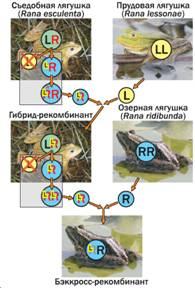
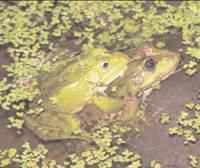
The first of the crosses shown here would be reciprocal (mirror-symmetric) with respect to the one shown in Fig. 3 if, prior to gamete formation in the hybrid frog, the L genome had been completely removed. However, a part of it remained and ultimately ended up in the R genome. If hybrids carrying such a recombinant genome subsequently cross with the corresponding parental species, the transfer of inherited information across the interspecific barrier will occur.Let me remind you that although the lake frog and the pond frog are capable of hybridization, they are “distinct,” substantially different species[5]. Their differences are likely no less significant than those between early humans and early chimpanzees. Therefore, it can be assumed that meroclonal hybrids formed between our ancestors and their monkey relatives. Recombination of parental genomes in these hybrids, followed by backcrossing with humans, could explain the mosaic nature of the human genome, in which some regions are relatively dissimilar to the chimpanzee genome, while others are unexpectedly close to it.The first objection to the proposed hypothesis is that meroclonal inheritance has not been documented in mammals. But hybridization over the course of four million years has not been observed in them either! An interesting fact that sheds light on human evolution is the increase in human sexual size. Compared to their living relatives, humans have an abnormally large sexual organ. A significant portion of the uniquely human genes that distinguish us from chimpanzees is associated with increased sperm production. Finally, changes in the female reproductive cycle have made sexual and parasexual interactions an important part of our social life. Perhaps our hypersexuality is a means of overcoming the xenophobia that hindered interbreeding, a legacy of human-chimpanzee hybrids? Note that hybrid frogs also exhibit heightened sexual aggression. For reasons unknown to the author, the editors did not allow the publication of an image depicting the process of human-chimpanzee hybridization. Readers will have to settle for a cross between a male edible frog and a female lake frog (photo by the author).
How can we confirm the hypothesis presented here regarding partially clonal (meroclonal) hybridization between the ancestors of humans and chimpanzees? Presumably, the described mechanism of information transfer across species barriers should generate a characteristic pattern (distribution type) of the transferred information. American geneticists report that the observed pattern of differences between human and chimpanzee DNA cannot be explained by any effects currently known for humans and apes. Let’s compare it with what is observed in frogs—after all, they are so similar to us![1] Patterson N. et al. Genetic evidence for complex speciation of humans and chimpanzees// Nature. - 2006/ - 04789[2] More than 20 million base pairs representing all parts of the genome were studied. This is nearly a thousand times more than was examined in previous studies[3] Adam and Eve are often blamed for a far less remarkable event[4] The diagram in Fig. 4 illustrates only the general logic of the process. Perhaps, instead of a portion of genome L, a piece of genome R is immediately discarded; perhaps, as a result of recombination, gametes with an incomplete or excessive chromosomal genome are produced—we will not consider these circumstances here[5] However, what we have referred to alongside them as a hybrid form, giving it a species name identical to that of true species, is a simplification intended to facilitate the exposition. Comment from 2011. Since this article was written, we have had to change the terminology we use when studying the hybridization of green frogs. The term “meroclonality” turned out to be already in use to describe a different process, so the author and his colleagues now use the term “hemiclonality” (“semi-clonality”). Even the name of the frogs has changed: the latest revision moved them from the genus Rana to the genus Pelophylax. Well, words change over time too... D. Shabanov. People, Hybrids, Frogs // Kompyuterra, Moscow, 2006. – No. 24 (644). – pp. 56–59.