

M. Kravchenko, D. Shabanov “Learning About Nature.” Textbook for Grade 5
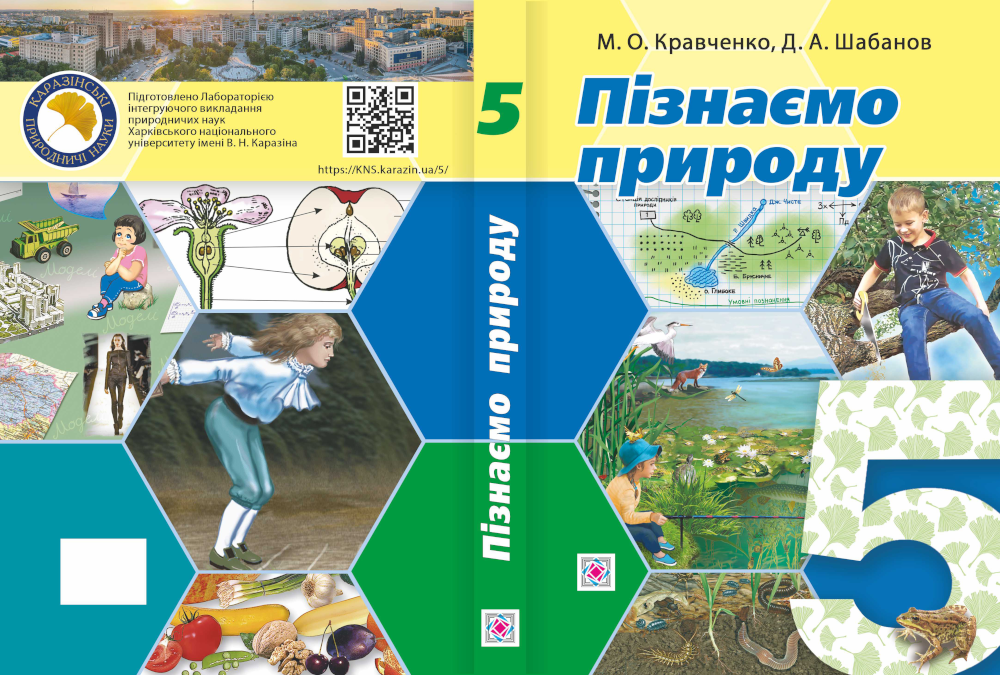
The authors of “Batrachos,” as members of the Laboratory of Integrative Teaching of Natural Sciences at V. N. Karazin Kharkiv National University, developed the textbook “Learning About Nature” for Grade 5 of the New Ukrainian School.
The authors of "Batrachos", as employees of the Laboratory of Integrated Science Education at V. N. Karazin Kharkiv National University, have developed the textbook "We Understand Nature" for the 5th grade of the New Ukrainian School. This work was supported by the Ternopil publishing house "Pidruchnyky ta Posibnyky". The textbook received the Ministry of Education and Science stamp. On February 23, 2022, it (and many alternatives!) was offered for teachers to choose from. On February 24, the war began... The war is not yet won by Ukraine, but it is clearly already lost by the aggressor, Russia. Russia will not be able to either occupy Ukraine or turn it into a satellite. When the war ends, how many more victims will be made—we do not yet know. However, it is obvious to us that the time will come to introduce new courses and new textbooks again. Even if, as a result of the war, the textbooks cannot be printed on time (let's hope they will be!), our textbook and additional materials will be available online. Our textbook and course are the result not only of the work of two individuals, Maryna Kravchenko and Dmytro Shabanov. This is the first step in creating a new educational space—" Karazin Natural Sciences ". The preliminary layout of the textbook is here: Kravchenko_Shabanov_2022_Pidruchnyk_Piznaemo_pryrodu. This is not yet the final text. Work on it is ongoing. We would be grateful for critical discussion and advice on its improvement (in any case, there is still time to correct mistakes!). What will be the components of "Karazin Natural Sciences"? Its first part is this course. It contains the text and illustrations of the theoretical and practical parts of each week. We will not include tasks from the printed textbook, but we will include others, additional ones.
In addition, this environment should contain: 1. Important—appendices. Both those currently included in the textbook and others. 2. Even more important—additional illustrations, video illustrations, links, and interactive models. Currently, there is not enough strength to create the models we dream of, but they may appear over time. We are confident in the powerful potential of using models in education. 3. Perhaps the most important thing is an environment for interaction, a meeting place. We promise not to abandon those teachers and students who seek help. When "Karazin Natural Sciences" has several courses, we will combine them with links, dictionaries, etc., into a single whole. How does this textbook differ from alternatives? Some information is here: And here is a small "advertisement"... Our textbook is quite complex; we have tried to encourage students to develop reading, thinking, and discussion skills. We understand that for many schools, textbooks that allow conducting classes according to a similar course as stress-free as possible will be more suitable.
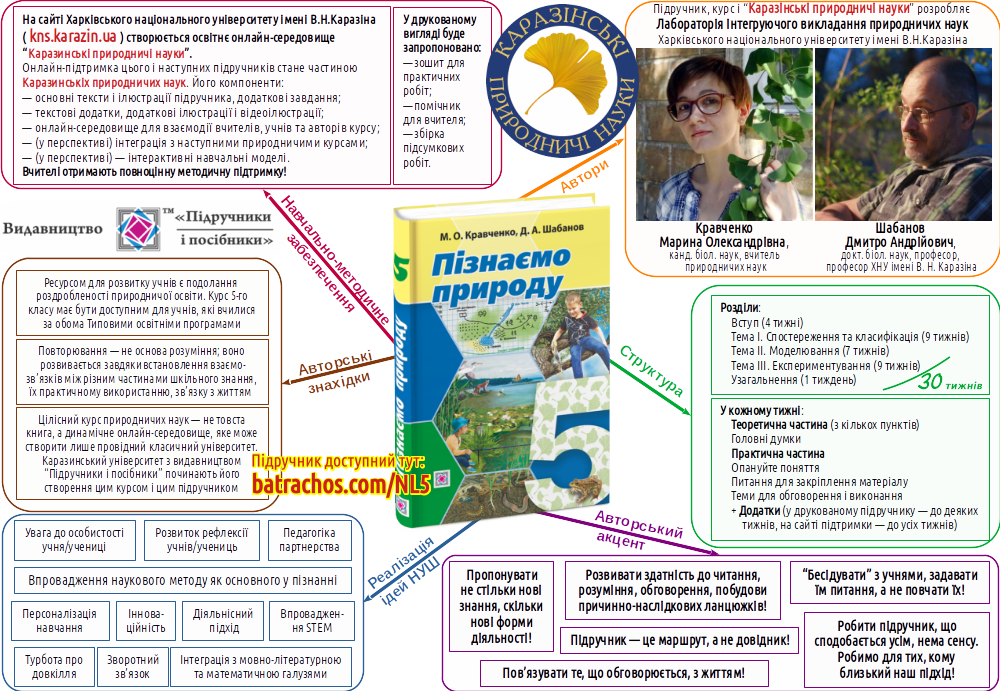
However, we hope that our option will be useful to someone; we are writing specifically for such students and teachers (and, by the way, for parents too).
The style of the main parts of the textbook imitates conversation, and not with a foolish child, but with a younger interlocutor who commands respect from an adult (in any case, we tried to create such a text, not a didactic one). In this conversation, we touch upon truly complex topics; we wanted not to draw a line under a certain problem, but to encourage movement towards its solution. To some, the structure of the textbook may seem incomprehensible. This is not only due to the program we used; we understand a textbook not as a reference book, but as a route. This makes our text clearer to the reader who follows this route. For someone who simply flips through the pages, understanding its logic will be more difficult. Some readers of our text are surprised that we explain certain things differently than they are always done. They even try to help us do it the way it's always done, and we resist! If you are interested, we can name some key points of the textbook that we tried to do differently than others. These are not the names of structural elements of the textbook, but our explanations of what we consider most important! Week 1. (p. 6) Nature and culture, external and internal worlds; on the "Karazin Natural Sciences" website: How has science changed our lives? Week 2. (p. 12) Systems and (without naming unnecessary concepts, of course) explanation of emergent properties of systems; on the "Karazin Natural Sciences" website: What does science study? Week 3. (p. 20) Modeling in the psyche as a way of prediction; on the "Karazin Natural Sciences" website: How can nature be studied? Week 4. (p. 27) Scientific method (it turned out complex; how to simplify without loss of quality - we don't know yet); on the "Karazin Natural Sciences" website: What is the power of science? ... Week 12. (p. 93) Classification of animals—and an attempt to show that classifications are different; on the "Karazin Natural Sciences" website: How to classify animals? Week 13. (p. 99) Complex relationships between similarity and kinship; on the "Karazin Natural Sciences" website: Which classification of animals is correct? Week 14. (p. 108) Modeling is almost everything we do! on the "Karazin Natural Sciences" website: Models. What kinds are there? ... Week 19. (p. 145) Formulas as models; on the "Karazin Natural Sciences" website: A formula is a mathematical model. Week 20. (p. 152) Malthusian population growth limits and natural selection; on the "Karazin Natural Sciences" website: How does the number of living beings grow? (M.K. considers it too complex, while D.Sh. considers it his favorite fragment) ... Week 23. (p. 178) Relative and absolute measurement scales; on the "Karazin Natural Sciences" website: Competition of minerals for hardness ... Week 29. (p. 221) Fundamentals of ecology; on the "Karazin Natural Sciences" website: Environmental factors. Week 30. (p. 229) An attempt to motivate reflection on the future; on the "Karazin Natural Sciences" website: Study. Understand. Preserve. What is currently available is before you. The work is just beginning. We would be grateful for your help!