
Ontological adaptationism. Column in ComputerreOnline #88
Do not seek a way to shift responsibility from yourself onto “objective reality,” God, or the mysterious properties of the universe.
I want to know for my own benefit…
Augustine Aurelius
A debate arose in my virtual space under my recent columns with a competent reader, a professional philosopher. He was outraged that Marina Kravchenko and I included a statement he considers proven in the list of myths to be abandoned. This statement (myth, in our view) is formulated by us as: “the myth of the existence of ‘objective reality’ as a world of separate objects (things, bodies) that exist independently of us and our interaction with them (and which we also belong to).”
According to the reader, the alternative to this myth is to accept Berkeley’s claim that the world only appears to us. Strangely, I see an entire spectrum of possible alternatives in this problem, but the professional philosopher, emphasizing that I have entered a territory where he is the master, does not notice these alternatives. Why? Perhaps, for example, because philosophical education is still built on imposing a spurious dichotomy: materialism or idealism. These constructs are the product of philosophers’ imaginations, trying to build a picture of the cosmos much like Euclid built geometry: from axioms. Depending on which axiom is chosen first, the result of these mental constructions can be assigned either to the category “materialism” or to “idealism”. To me they seem initially lifeless; let the dead bury their dead, and we will turn to the only possible starting point for our reasoning: the fact of our existence, perception of actuality, and adaptation to it. To avoid spending much time on explanations, I note that I discussed the difference between actuality and reality here, and the formulation “percipimus ergo sum”, as well as the reasons for disagreement with materialism, idealism, and solipsism, here.
Percipimus ergo sum. Realize, feel yourself at the moment you read this column. Your inner world is extremely complex, you exist in a high‑technology environment that would cause an information shock even to your great‑great‑great‑grandparents. And, oddly enough, this state, the specificity of your perception and cognition of your environment, has its roots in the simplest mechanisms of chemical orientation that our unicellular ancestors developed more than a billion years ago.
Where did what we now perceive come from? No arguments can logically refute both that this world only appears to us (the solipsist version) and that this world was deliberately created by someone some time ago (a whole spectrum of versions—from the fashionable current ideas about an external cause of the Big Bang, according to which the world was created billions of years ago, to the orthodox interpretation of the Old Testament assigning the world six thousand‑plus years, and even to Gossen’s argument in Russell’s version, according to which the world in all its complexity and even our memories of an allegedly existing past were created a minute ago). Unfortunately, we cannot prove either the existence or the absence of reality outside our interaction with it. We cannot establish the true picture of the cosmos on the basis of logical proof.
From this I conclude that we must choose the version that is most convenient for us to use.
Of course, there are social situations in which doubting the version of a party’s supporters or some prophet can land you either in a cell or on a pyre. In such cases, for most people the most convenient worldview will be the one prescribed from above: it interferes the least with peaceful living. And now imagine, however illusory, a situation of freedom of choice…
My answer is clear. Actuality is something external that we interact with, that we perceive and to which we adapt. By accepting this, we will adapt most efficiently. And as soon as we agree with this, it becomes clear that the processes in our psyche grew out of the processes in the psyche of other animals, our ancestors. What we can observe is the result of evolution—not necessarily linear. At first this process proceeded extremely slowly, then began to accelerate gradually; at times it probably halted and even reversed. It had its own revolutions. I will not dare to give a more‑or‑less complete list, but I suppose that the capacity for reflection (viewing oneself from the outside) and the use of language to describe actuality were serious phase transitions in our history.
Does every picture of actuality, every cognitive model organically fit such a history? I doubt it. Yet it corresponds to the understanding that our perception and cognition of actuality are parts of our adaptation to it. We return to where we started. Having made the initial choice, we fall into an internally consistent picture of actuality, all details of which confirm this choice.
What would happen if we had taken a different first step? We would end up in a different picture, and it is not certain that it would be equally consistent. But before we examine alternatives more closely, I emphasize that our choice (ontological adaptationism) turned out to be very convenient. It starts from the truly primary fact of our being and perception. It opens a picture of actuality that, for the purpose of our adaptation, can be developed and specified. One way of such adaptation is called science. It unfolds quite naturally, unlike the primary choice that belongs to philosophy.
When we are inside a scientific picture of the world (clearly I speak only of natural sciences and mathematics; all other mental constructions belong to a different domain), we can make quite logical inferences, find consequences, and grounds for certain facts and premises. But can we prove by scientific methods the existence of the actuality we study? After David Hume’s work, we cannot hope to do so. And can we prove that our representations of what we study are correct? Unfortunately, after Karl Popper we cannot even hope for that.
From the foregoing it follows that the scientific mechanism of cognition lacks a reliable foundation. In one lecture I explained this with the following slide. The Kazan Cathedral stands steadily on a reliable foundation, firmly supported by the ground with its columns spreading outward. Dali’s hallucination balances on fragile spider legs. The temple of science, alas, hangs without any support, like Baron Münchhausen pulling himself out of a swamp by his hair. Remarkably, this does not at all deprive science of its adaptive potential!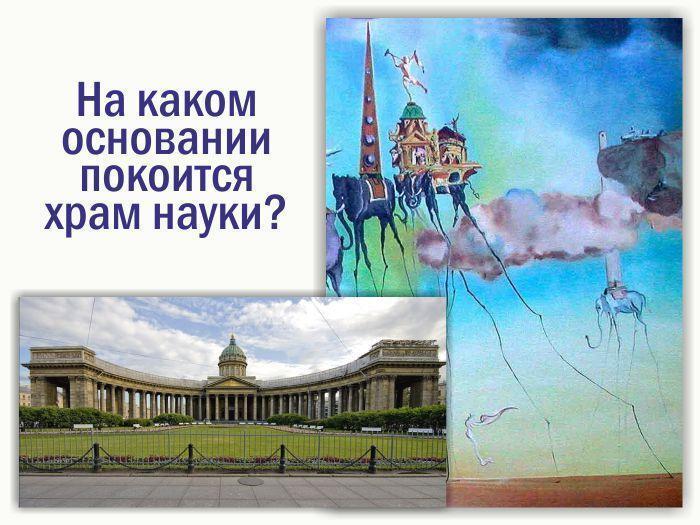
Science has no scientifically justified foundations. Does that upset you? Nothing can be done!
An interesting conclusion: when philosophers proudly claim that science is impossible without them, they present the desired as the actual. If science needed philosophical justification, it would not exist! Münchhausen pulls himself up by his own hair. Science establishes the fact of evolution, reveals the phenomenon of adaptation, and finds its basis in it. Yet even before the development of ideas about evolution and adaptation, science could develop without any foundation or could use one foundation or another—simply because it was useful, adaptive.
And if you do not like this solution to the ontological problem, note that the others are even worse. To see this, return to the beginning of our reasoning. We refused to make a priori assumptions about primary causes. Let us try otherwise and assume God‑Creator as the primary cause. Is such a foundation better for the development of science? No. Science is built on the notion of natural law action, and appeal to God as the primary cause requires a miracle, i.e., a denial of those laws.
Solipsism? I examined it in the already quoted column. A very economical and fundamentally irrefutable version, which, alas, turns out to be maladaptive. Feel free to play with it while the environment allows such amusement.
Finally, suppose there exists some “objective reality” conceivable outside any of our interactions, even potential ones, and therefore outside our perception. Excellent. We build science on this foundation and test whether it conforms to that assumption… It does not! Both in the micro‑world (Heisenberg’s uncertainty principle) and in the macro‑world (the anthropic principle) the version of an objective reality independent of the observer must be discarded. Falsification according to Popper, you know…
Perhaps the existence of objective reality can be somehow proven? The philosopher to whom I am grateful for prompting this column is convinced that it has been done. Look at the picture and read his triumphant relations regarding the experiment in which it was obtained.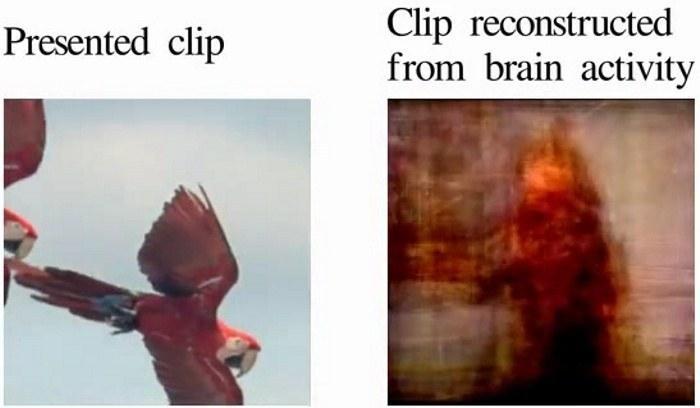
A person is shown a picture with a parrot (left), and then, based on the activity of neurons in the visual centre of the brain, reconstructs what he sees (right)