

Pipidae
Family Pipidae Genera: 5 (Hymenochirus, Pseudhymenochirus, Xenopus, Silurana, Pipa) Species: 33 Distribution: sub-Saharan Africa; tropical forests of South America Pipids are a family of anuran amphibians whose representatives are aquatic. Pipids lack a tongue, and the lateral-line organs are retained in adults.

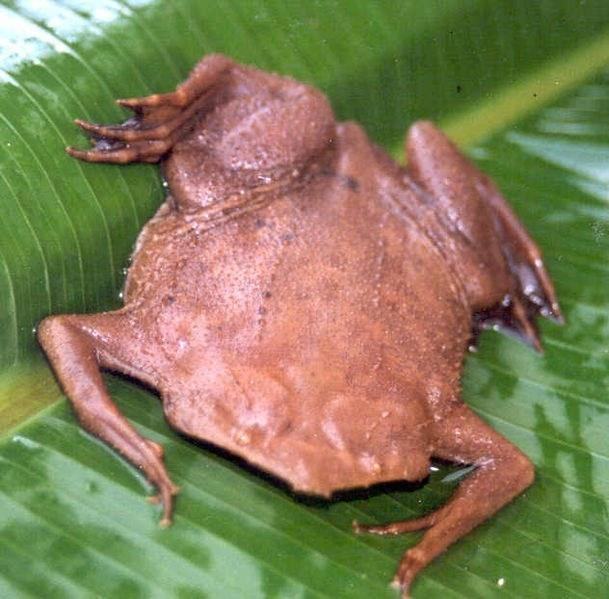
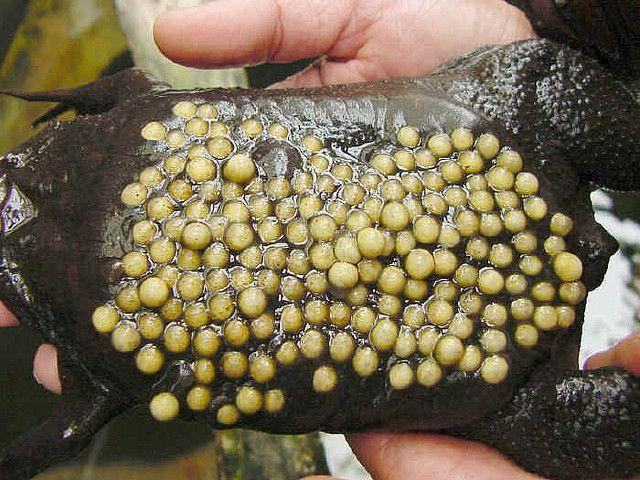
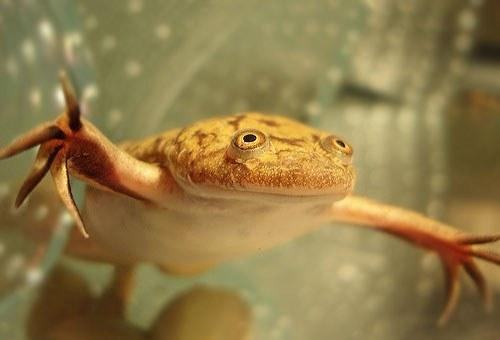
In males of all family members, vocal cords and resonators are absent, but they attract females by producing sharp clicking sounds using the hyoid apparatus. Representatives of the genus Pipa have specific reproductive features. During amplexus, the male holds the female above the hind limbs; at this time her cloaca (functioning as an ovipositor) moves under the male onto the female's back. The male presses the ovipositor, and the eggs are distributed evenly over the female's back, entering cells located there. These cells are covered above by a leathery membrane, while the partitions between them are very thin and rich in blood vessels. In this way, the female carries the eggs until full maturation. One of the most famous pipids, Xenopus laevis (African clawed frog), is a classic model for studying developmental biology. Notably, larvae of clawed frogs differ from tadpoles of other anurans in mouthpart structure. They have no teeth or keratinized jaws and feed by filtration. Pipa pipa Pipa pipa with eggs on the back Xenopus laevis Sources: 1. Vitt L.J., Caldwell J.P. Herpetology. An Introductory Biology of Amphibians and Reptiles 2. Animal Life. In 7 volumes.
Volume 5.
Amphibians.
Reptiles 3. https://animalworld.com.ua/ 4. https://www.aquan.ru/