

Subclass Ichthyopterygia
Subclass Ichthyopterygii: Among the reptiles best adapted to marine life, inhabiting not only the open water but also coastal zones. They first appeared in the Early Triassic (Spitsbergen, Japan, China, Thailand, Nevada, western Canada), reached their peak in the Early Jurassic, and began to disappear by the middle of the Early Cretaceous.
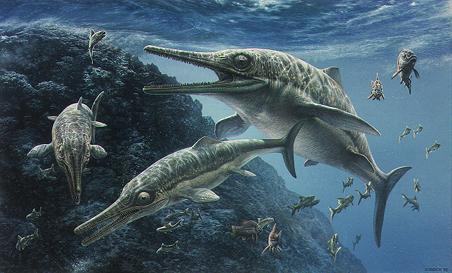
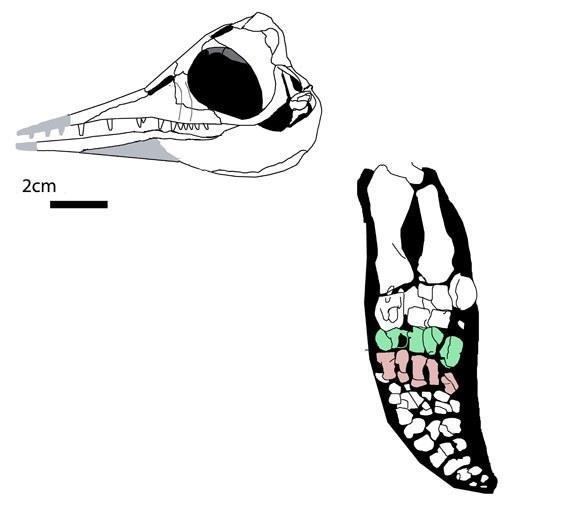
They are known from Western Europe, East Asia, North and South America, as well as Australia. On average, ichthyosaurs were 4–7 m long, but individual specimens ranging from 1 m to 23 m in length have been found. They possessed a superior temporal fenestra located above the posterior process of the postorbital bone. The cheek region of the ichthyosaur skull is formed primarily by an extremely enlarged quadrate bone, which makes extensive contact with the postorbital bone and, in some cases, extends into the edge of the temporal fenestra. Most species have a long snout with nostrils and choanae shifted backward.
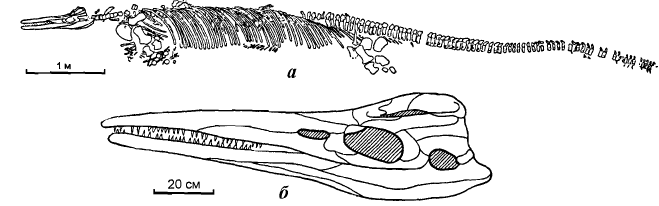
The teeth are almost always short, uniform, and conically pointed. Transverse pterygoid phalanges are developed only in primitive Triassic forms.
The articulation of the neck with the skull is practically immobile, since the atlas-epistropheus complex is undifferentiated or secondarily lost; the ribs are double-headed. The tail is hypocercal, which counteracted the buoyancy produced by the lungs underwater.
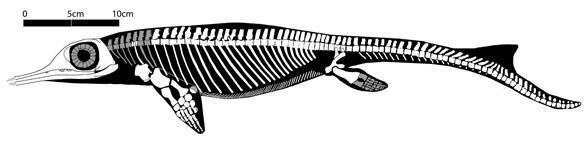
The sacrum consists of a single vertebra; in the shoulder girdle, the coracoid is undivided and separate from the scapula. The limbs are transformed into pectoral fins with polydactyly or even polydactyly.
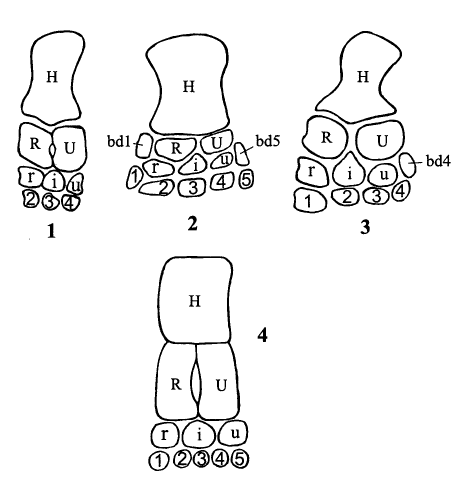
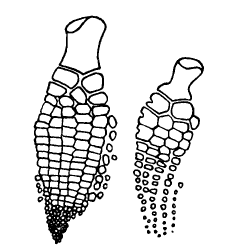
Cymbospondylus petrinus Merriam, 1908 The debate regarding the phylogenetic relationships of ichthyopterygids centers primarily on the structure of the pectoral fins. One hypothesis (according to Huene, 1916, 1922, 1956) suggests the existence of two branches: the broad-finned group, in which four main digits and several additional ones (including extra ones beyond the five) extend from each of the four distal carpal bones, while in the narrow-finned group (the majority of ichthyopterygids), there are three main digits and several additional ones, generally fewer in number than in the broad-finned group. The broad ( Ichthyosaurus communis Conybeare, 1821) and narrow (Stenopterygius quenstedt Quenstedt, 1858) types of forelimb structure in ichthyosaurs. Thus, early Triassic representatives were classified as broad-finned: Grippia longirostris (Wiman, 1929), Chaochusaurus geishanensis (Yong and Dong, 1972), Utatsusaurus hataii (Shikama, Kamei, and Murata, 1978), and Mixosaurus nordenskioldii (Wiman, 1923).
Chaochusaurus geishanensis (Yong and Dong, 1972) Parvinatator wapitiensis (Nicholls and Brinkman, 1995) And among the narrow-finned, later representatives, which manifested themselves in several lines of development: similar to the families Shastasauridae, Stenopterygiidae, and Platypterygiidae, differing mainly in the structure of the fin skeleton.
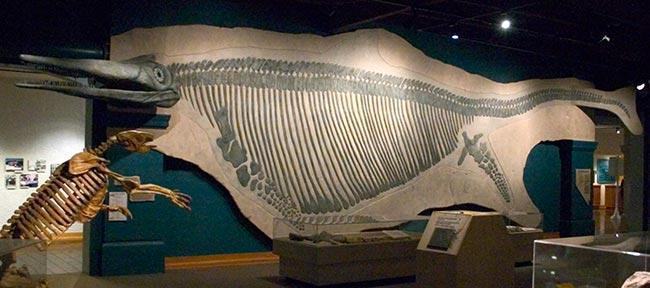
Schematic of the forelimb structure of representatives of three evolutionary lineages of narrow-finned ichthyosaurs: 1-Shastasauridae; 2-Platypterygidae; 3-Stenopterygiidae; 4 - original proto-narrow-finned structure. (Designations: bd1-5 - basal elements; H-humerus; i-intermedium; R-radius; r-radiale; U-ulna; u-ulnare; 1-5 - main digits) In Shastasauridae, the displacement of the 1st and 5th digits resulted in the complete clearance of space beneath the radiale and ulnare for the 2nd and 4th distal carpal bones, and beneath the intermedium for the 3rd distal carpal bone, respectively. Most members of the family are small forms, but Shonisaurus popularis (Camp, 1976) (Upper Triassic of Western Europe and North America) is one of the largest ichthyosaurs, reaching up to 15 m in length.
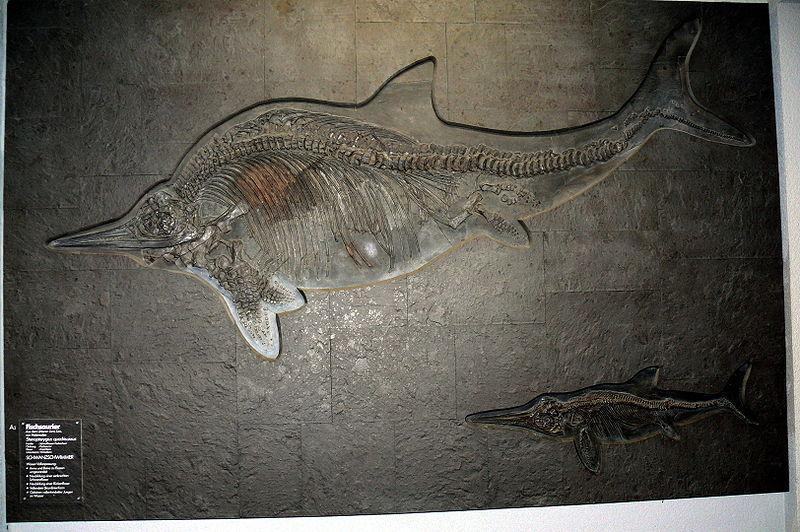
Due to the presence of numerous other differences: elongated and widened toward the end of the body ribs, teeth present only in the front part of the jaws, two sacral vertebrae, and elongated, three-rayed flippers, this giant is often classified in a separate family. The most typical representative of the subfamily is Shastasaurus pacificus (Merriam, 1895).
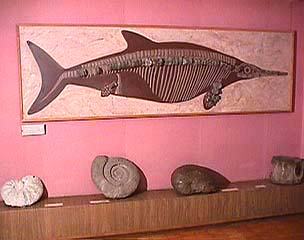
Shonisaurus popularis (Camp, 1976) (Nevada State Museum) Shastasaurus pacificus (Merriam, 1895) In Stenopterygiidae, the 4th and 5th digits shifted from their axial position, followed by their reduction to varying degrees across different genera and species.
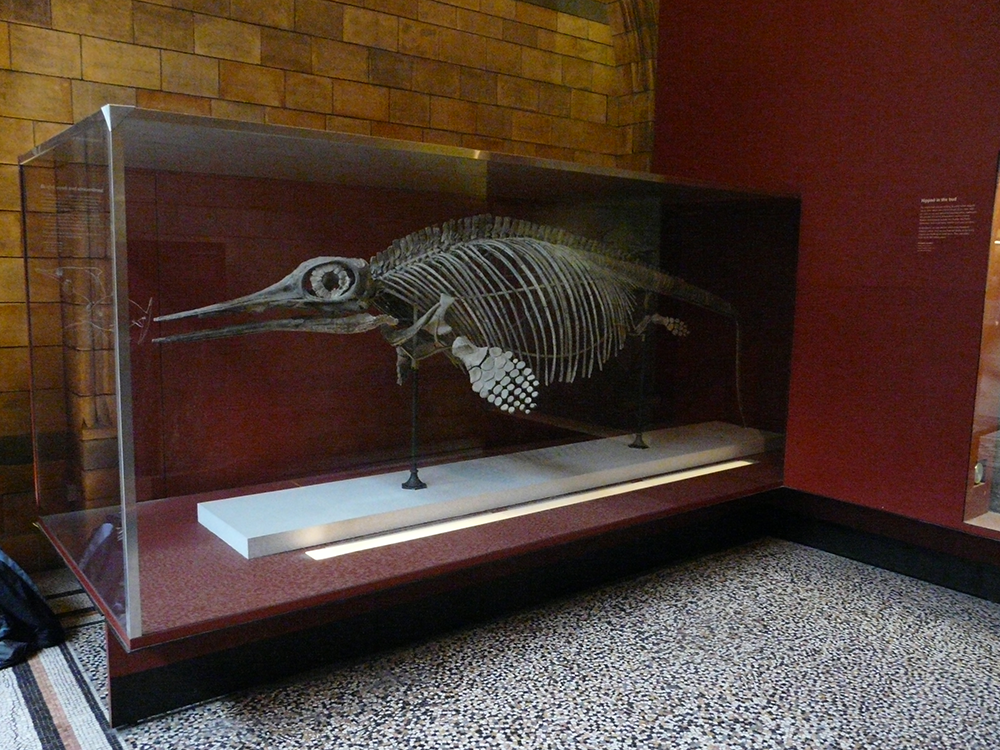
This freed up space under the ulnare for the third digit and under the intermedium for the second digit. In the genera Leptopterygius, Leptonectes, Eurhinosaurus, and Temnodontosaurus, a three-toed configuration is clearly expressed, in contrast to the four-toed representatives of the genus Stenopterygius; nevertheless, all of the above-mentioned genera belong to a clade with a general trend toward fin transformation, which allows them to be grouped into a single family, the Stenopterygiidae. S tenopterygius quadriscissus (Quenstedt, 1856) In the family Platypterygiidae, there is no reduction of the digits, and both the first and fifth digits shift from their axial position; consequently, the intermedium comes into broad contact with the third distal element, and additional digits appear in later representatives.
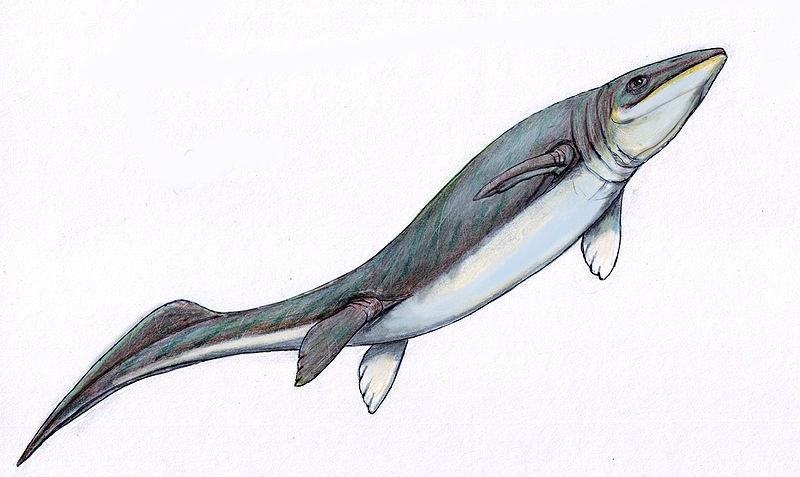
The family includes the genera: Undorosaurus [Efimov, 1999], Paraophtalmosaurus [Arkhangelsky, 1997, 1999], Otschevia [Efimov, 1998], Caypullisaurus [Fernandez, 1997; Arkhangelsky, 2001]. Brachypterygius (Otschevia) zhuravlevi Arkangelsky, 1998 (Saratov Regional Museum of Local History) Ophthalmosaurus icenicus Seeley, 1874 (Natural History Museum, London) Hune himself once classified the Triassic short-winged Omphalosauria as a separate group, but later abandoned this classification altogether. However, in the classifications of L.P. Tatarinov (1964) and O. Kuhn [Kuhn, 1966], the special status of the Omphalosauria is retained. Omphalosaurus from the Middle Triassic of Nevada and Spitsbergen, known from an incomplete skull, isolated vertebrae, and limb fragments tentatively associated with them. The snout is relatively short, the mandibular symphysis is robust, and the snout is spatulate in shape. The palate is covered with multiple rows of flattened teeth set in shallow alveoli; the mandibular teeth are arranged in a single row. Omphalosaurus nevadanus Merriam, 1906 According to the second version, the systematic classification takes the following form: Subclass Ichthyopterygii Order Ichthyosauria Suborder Ichthyosauroidei Superfamily Shastasauroidea Merriam, 1902 Family Mixosauridae Baur, 1887 Family Cymbospondilidae F. von Huene, 1948 Family Shastasauridae Merriam, 1902 Family Stenopterygiidae Woodward, 1932 Family Platypterygiidae Bardet, 1995 Superfamily Ichthyosauroidea Baur, 1887 Family Ichthyosauroidea Bonaparte, 1841 Suborder Omphalosuroidei Family Omphalosauridae, Merriam, 1906 There are several theories regarding the origin of Ichthyopterygiidae, none of which is dominant, since the accepted characteristics are insufficient to establish precise phylogenetic relationships: -from labyrinthodonts or "promicrosaurids," due to the presence of radial dentin striations on ichthyosaur teeth, as well as grooves on the snout in some individuals, the preservation of a spiral intestinal valve, and the preservation of the parietal bones; - from captorinomorphs or ophiacodont pelicosaurs [Romer, 1948, 1956; Watson, 1957], as indicated by undeveloped paroccipital processes directed horizontally toward the squamosal bones, as well as the absence of ectopterigoids; - from primitive diapsids or even archosauromorphs, based on the discovery in the Middle Triassic of China of the bizarre aquatic reptiles Nanchangosaurus and Hupehsuchus, which are sometimes classified alongside choristoderms in the order of primitive diapsids.