
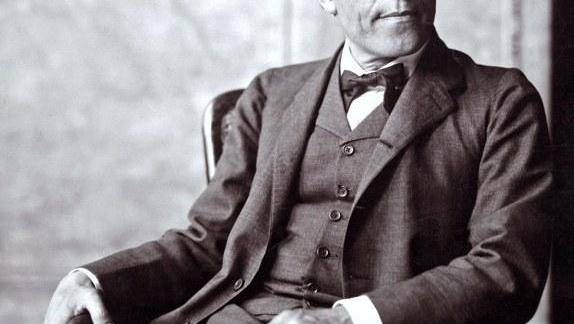
The Last Concert of Kondrashin. Column in KomputerraOnline #80
Before me — a rectangular box of transparent material. Inside it — a cellulose insert bearing the image of a man and an inscription in an archaic language. The box can be opened and from it one may extract a thin disc with a hole in the centre.
On the torrent tracker (name removed).com, a RAID array failure occurred. After the site's restoration, the following text appeared in the comments on the page linking to a torrent of Kirill Kondrashin's recordings. When the site was restored, this text was deleted from it, but owing to its unusual character it has been preserved here. In content it is a kind of document from a future era, with entirely incongruous mentions of "tulku" — persons capable of reincarnation in Tibetan Buddhism. In the Tibetan tradition, tulku (or, alternatively, rinpoche — "precious ones") acquire the capacity for reincarnation through their spiritual perfection. For them it is a means of fulfilling their calling, passing from one life to another. Tulku are reborn without causing harm to other living beings, and therefore a reference to "tulku" such as that found at the end of this document is nonsensical. In any case, this warning is superfluous, for it would be absurd to suppose that we are dealing with a document that has made its way to our time from the future. There is no doubt that the text below is someone's clumsy mystification.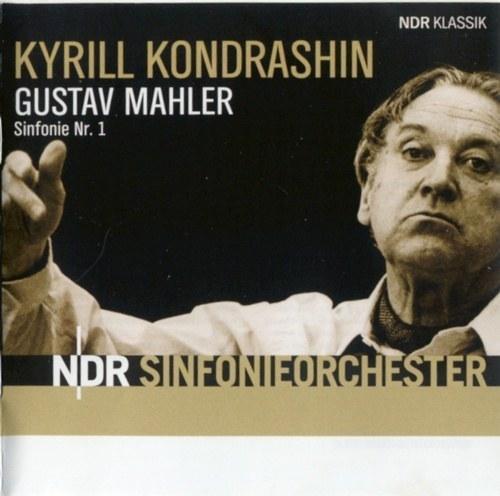
Category of archival unit:
document bearing the autograph of Tulku ▀╬╪▐░▬◙
Yes, thank you — she is what I was seeking. A fine girl, possessed of keen feeling, who divines much. Her high intensity of inner life is what I need. I have made my choice; the further search should cease. To the organisers of the search and to those who found her — My gratitude.
Tulku ▀╬╪▐░▬◙
To the Head of the Chancellery of Tulku ▀╬╪▐░▬◙
from the Inspector-General of the Education System
Your Excellency!
I venture to draw Your attention
to the essay by ██████████, devoted to
an artefact from the past. It caught the interest
of the covert school inspector, who
forwarded it to me. I believe that
the schoolgirl who wrote this essay
corresponds to the criteria You have formulated.
Wholly devoted to the immortal Tulku ▀╬╪▐░▬◙
The Artefact
Before me is a rectangular box of transparent material. Inside it is a cellulose insert bearing the image of a man and an inscription in an archaic language. From the box one may extract a thin disc with a hole in the centre. On one side of the disc is the same image. On its other, iridescently gleaming surface is a layer that once served for recording information. In ancient times such discs were used to record sounds. The people who created this disc could hear what was preserved on it by means of a special device.
I was assigned to recount my thoughts in connection with some artefact. I wished to turn to an object bearing the imprint of the feelings of people unlike us, and I searched the Archive for rarities of the late Age of States. I chose this disc for my essay. Several centuries ago its contents were read and transcribed in ordinary form. Thanks to this, I was able not only to hold this rarity in my hands but also to hear the music recorded upon it.
Yes, it contains music — only not such as we have today. It consisted exclusively of sounds. At that time music was not generated in response to the state of the listener himself, but was composed in advance, reflecting the intention of the person who devised it — the composer. Other people, performers or musicians, played (produced according to the plan laid down by the composer) this music on special musical instruments that they operated by hand. The sounds conveyed to the listeners the intention of the composer and performer, and thereby the listeners gained the opportunity to glimpse the inner world of the music's creators. In order to hear the sounds of music, listeners would gather for special events — concerts. Not every music lover could attend a concert. Special devices recorded the sounds in order subsequently to preserve the music performed at these events on gleaming perforated discs — such as this one that I hold in my hands.
Sometimes music was brought to life by a single performer, and sometimes by dozens or hundreds of musicians with different instruments. Such groups of musicians were called orchestras. The work of an orchestra was directed by a conductor — the principal musician. Through gestures and facial expressions he directed the other performers. Thus the other musicians gave expression not to their own understanding of the composer's intention, but to the conductor's understanding, as he guided them like animate instruments. To comprehend the cultural practices of that era, I was obliged not only to consult reference systems but also to read texts written at that time.
As is known, at the close of the Age of States our planet was divided into countries (territorial parcels). In each country there was a state (a group of people who had arrogated to themselves the right to compel all others to submit to their will). Many states deliberately killed a certain number of people within their own countries. The greatest number of people (from prehistoric times to the end of history and the beginning of the World of Tulku) was killed in the largest country of that era — the USSR. States killed not only the inhabitants of their own countries but also those of others. During particular disputes between states — wars — states sent people from their own countries to kill people from other countries, and also employed complex and sophisticated machinery for killing and destruction.
On the disc — the artefact of which I am writing — is recorded a concert directed by the conductor Kirill Kondrashin. By the chronology of that time the concert took place on 7 March 1981 in Amsterdam, the principal city of the country of Holland. At this concert was performed music that had been written less than 100 years earlier by the composer Gustav Mahler. This music is called Mahler's First Symphony. People in those days did not live long, and by the time Kondrashin was performing his symphony, Mahler was already dead.
Kondrashin was born and raised not in Holland but in the USSR — that very country which destroyed its own inhabitants more successfully than any other. Kondrashin was the most celebrated conductor in the USSR. He was highly esteemed. At that time the principal figure in the government that ruled the USSR was Stalin. Kondrashin received from Stalin two awards called the Stalin Prizes. Stalin led the VKP(b) — a party (a group of people whose interests differed from those of everyone else) that ruled (imposed its interests on the whole of society) the USSR. Kondrashin had joined the VKP(b) in his youth. It was the VKP(b) and Stalin who (presumably with the participation or at least the tacit approval of Kondrashin) carried out the greatest sacrifice (destruction of living beings in the name of some idea) in history.
Three years before the concert recorded on the disc of which I write, Kondrashin performed an unexpected act. Between the USSR and Holland there was at the time a "cold war," when two states sent no people or machinery to kill, but constantly reminded each other that they were prepared to do so at any moment. The state of the USSR sent Kondrashin and his wife to Holland for a brief period. When the time came to return, the conductor refused to do so (this was called "seeking political asylum"), claiming that the USSR was restricting his creative freedom. Kondrashin's wife did not support her husband and returned to the USSR. I find it difficult to imagine: the choice of a place to live was more important than the bond between spouses!
At the concert of which I write, Kondrashin conducted an orchestra with which he was working for the first time and was not acquainted. Ordinarily, if a conductor was not well acquainted with the other musicians, this hampered the performance of the music. If a new conductor proposed to perform music differently from the musicians' accustomed manner, the orchestra's work would fall into disarray and the listeners would be dissatisfied. The way in which Kondrashin subjugated the orchestra to his will and conveyed his understanding of Mahler's music was spoken of as a miracle (a supernatural event). This performance was sometimes considered the finest performance of Mahler's First Symphony in all of history.
Among the many people at this concert, listening to the music was a Dutch woman named Nolda. She was closely associated with Kondrashin, though in a manner that is somewhat unclear. Contemporaries call Nolda Kondrashin's "common-law wife," yet note that the state did not recognise this (it was called an "unregistered marriage"). Nolda recalled that during the concert Kondrashin "turned entirely green and transparent, and began to radiate a luminescence, rays." However difficult it may be to believe, Nolda and the people present were so naive that they did not understand the significance of this radiance.
After the concert the musicians presented Kondrashin with something of great value by the standards of that time — a "sumptuous old cognac." This was a symbol of the musicians' recognition of Kondrashin's mastery. What exactly this was I have not fully managed to comprehend. It is written that cognac is a liquid, a product of the fermentation of the juice of particular berries, which for a brief time altered the consciousness of those who drank it. In describing the changes that cognac produced, contemporaries write of both pleasant and repellent sensations. It seems to me that the mixture of the good and the vile was a characteristic feature of that era... After the concert Kondrashin left his friends to drink cognac and went away briefly to coach some singers. Singers were musicians who used their own voice as a musical instrument. Kondrashin was teaching the singers to perform the music called "The Bells" by Rachmaninoff. This music reflected an entire life: from the joys and hopes of youth to the frightening prospect of death. Afterwards Kondrashin went home with Nolda and several hours later died of a cardiac circulatory failure. He had lived 67 years and one day.
There is much in Kondrashin's story that I do not understand. If in the country of the USSR he lacked creative freedom, if he could not express his true self, how did he become one of the most celebrated conductors in the entire world? If he supported Stalin's and the VKP(b)'s unfeeling destruction of great numbers of people, how could he so keenly feel and transmit the emotional movements of another person — a composer? Why did his wife leave Holland while he lived with Nolda? Why did Nolda allow him to die from a minor physical ailment? Why was he called an exile when he himself had chosen to remain in Holland? How did the fact that he felt himself an exile, standing on the threshold of death, find expression in his performance of Mahler's First Symphony?
I have not yet written anything about Mahler's music. I have listened to it many times, and now I am no longer the same as I was before encountering it. I still understand almost nothing of it, yet I find myself wishing to listen to it again and again. In one text from that era I read that there are three things one begins to use without pleasure, only to acquire a taste for them and find one can no longer do without them. These are cognac, olives (yet another type of berry, also fermented), and classical music, such as Mahler's symphonies. I was unable to try the cognac and olives, but where music is concerned, things turned out for me exactly as described in that ancient text.
Mahler was born in the country of Bohemia within the Austrian Empire. This means that the country of Bohemia was governed by the state of the country of Austria. Mahler belonged to a minority that spoke the German language — the language of Austria. He was Jewish — he belonged to a people who had once been expelled from their own land. In many countries the state forbade Jews from choosing their own destiny and living as they themselves wished. For this reason Jews often felt themselves strangers in their own countries. Mahler died (by the chronology of that time) in 1911, having lived only 51 years; several decades later, the performance of his music in the country where he had spent his entire life was banned. This was connected precisely with the fact that Mahler was Jewish — a stranger. Mahler did not live to see the exile, but from his homeland they expelled his music, the meaning of his life.
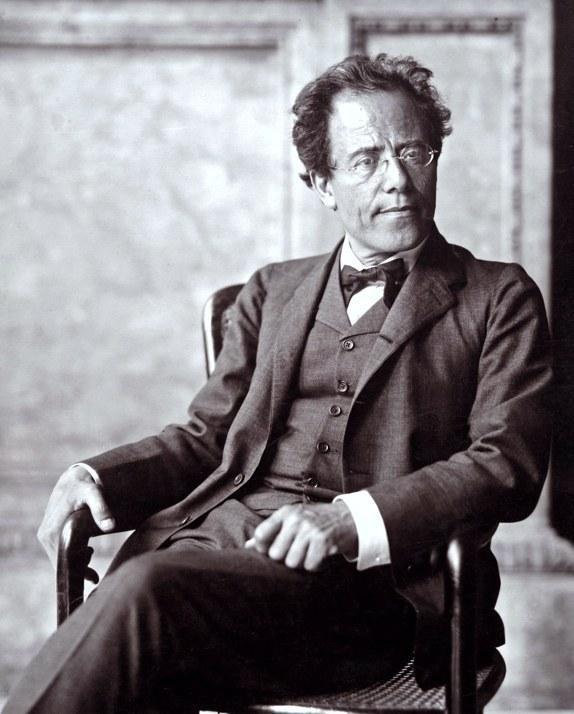
Mahler wrote the First Symphony at the age of 28 and later revised it. Initially it was called "Titan," but Mahler subsequently removed that title. The Titans are figures from ancient belief — rebellious heroes connected with the force of the Earth. The Titans drew their strength from the earth that was native to them, and became entirely weak if their connection with the earth was severed. The first section of the symphony was called "From the Days of Youth" and consisted of three movements; the second — "Human Comedy" — of two. Kondrashin conducted the second version, in which four movements remained. Here are the titles of the symphony's movements and descriptions of how they are to be performed (I have combined the movement titles from the first version with the performance markings from the second).
1. "Spring Without End." Slow. Dragging. Like a sound of nature — at first very calm, unhurried.
2. "Under Full Sail." Vigorously agitated, but not too fast.
3. "Funeral March in the Manner of Callot." Solemn and measured, without dragging.
4. "From Hell to Paradise." With stormy agitation.
If I have understood correctly, this symphony somehow reflects a person's search (perhaps Mahler himself, or perhaps the mythical Titan) for oneself throughout life. In describing the first movement, contemporaries spoke of calm and joyful sounds of nature. The second is a dance of that era, perhaps somewhat simplified, with deliberately accentuated philistine intonations (from the name for philistines — spiritually undeveloped inhabitants of small towns and market towns).
The growth of joyful natural sounds in the first movement is comprehensible to me. How the speech and dances of inhabitants of small and large towns differed I was unable to determine. It seems that the second movement conveys the sensation of an exile who is detached (perhaps even haughtily detached) from the life around him, from the simple pleasures he considers beneath him.
This is one of the interesting things about acquainting oneself with history: through it we learn of feelings that are impossible today. In a world where no one is exiled, people do not feel themselves exiles. Where there is no conflict between a person and their surroundings, one need not experience alienation. Through Mahler and Kondrashin I came to know of strange experiences that a person is capable of feeling. These are states that are interesting to learn about, but which one would not wish to experience. The feelings reflected in the second movement of the symphony seem to me morbid. They involve both self-admiration and self-pity, yet also a certain joy at the seething life all around. It turns out that even a person alienated from life can be impelled toward creativity by the life seething around him.
The third movement is an enigma for our time. In those days, after a person's death, people would convey or carry the body to some place where they would dispose of it by burying it in the ground. Living people would walk behind the dead body and perform a special music — funeral marches. The third movement is a funeral march, but a particular one. Mahler explained it by recalling a picture he had seen in childhood. In it, forest animals were following after a dead hunter: a man who had killed them. As I understand it, these animals represent grief, yet in reality rejoice at the hunter's death, though they conceal this. It was written that they "hold a fig behind their back" (inserting the thumb between the middle and index fingers with the hand tucked into a pocket — a pocket being a fold in clothing for small items), though I did not quite understand why. In this music everything is turned inside out, joy is transformed into sorrow and sorrow into joy. Strangely, yet... I hear in this music also genuine, unfeigned grief, somewhere there in the distance, behind the ostentatious mourning and the concealed exultation. This movement is simultaneously somewhat malicious and gloating, and yet compellingly beautiful.
The last, fourth movement is bound up with feelings that are quite inconceivable in our time. How it begins — powerfully, terrifyingly, majestically! Hell and paradise are the anguished and harmonious states of a soul that has not yet found liberation after the death of the body. In the music a movement that strives somewhere now takes shape, now flies apart in fragments. Contemporaries said that in the last movement of the symphony the hero, like a Titan, finds himself, having passed through despair and returned to nature, to his true essence. I heard there the turbulence of frightening passions and the echoes of the first movement. Then the passionate surges and the sounds of nature unite... and somehow disappear. Perhaps Mahler means that one must die in order to find oneself? At the very least, Mahler himself explained that his Second Symphony begins with a funeral feast (a commemoration of the dead) for the hero of the First Symphony... It is difficult for me to grasp Mahler's intention, for in his music is reflected an unbearable spiritual tension that tore apart a man whose inner world could not reach accord with the outer world. Having experienced so acute an inner conflict, a person could no longer remain as he had been. Mahler passed through such an inner struggle, and I merely heard its echoes from another time.
In my view, it was not by chance that Kondrashin died on the day of the concert. He set off for the place to which Mahler had led him by his intention, and passed through the door through which an exile may depart. And the recording of the concert remained. Listening to it, I tried to hear how the door opens through which Kondrashin passed. Sometimes it seems to me that I hear it. Fortunately, unlike Mahler and Kondrashin, I am not an exile; I do not feel alienated from what surrounds me, and therefore I cannot pass through this door.
It is difficult for us to imagine a time when states, in pursuit of strange ideas, suppressed the will of people, curtailed their freedom, and even sent them to their deaths. Our chief characteristic — the capacity for creativity — manifested itself even then, but at that time it was coloured by suffering, inner conflicts, and struggle with society. People did not feel their unity with the world and humanity, felt themselves exiles, and sought painfully for themselves. To understand how whole and harmonious our life has become today, one must feel what a contradictory life our predecessors led.
I am not certain of this thought of mine, but I will nonetheless venture to express it. I am overwhelmed, knocked off my feet, by the passions concealed in Mahler's music and in Kondrashin's performance. Why were the people of that time capable of creating such music? I think they were driven by the turbulent inner conflicts raging within them. Might it be that exile, alienation from one's surroundings, not only made these people unhappy? Seeking to find themselves in this flame of inner impulses, they gave themselves to creativity. That in which they expressed themselves preserved the imprint of the force that drove them, and for this reason became compelling in a particular way. For such people, to overcome the inner conflict burning within them — to find themselves — meant to die... The works of the creators of our time, for all their perfection and harmony, seem to me more calm. They carry a light coolness or a gentle warmth, but are never icy or scorching. I would not wish to have lived in the time of Mahler and Kondrashin, but I would wish to understand the people who lived then.
I am grateful to have been given the assignment of recording my reflections on some artefact. I am glad to have chosen this ancient disc with this frightening, passionate music. I am happy that I need not die in order to find myself. I have learned more about the past. How good it is to return to our free era, when no one will make me an exile, limit my freedom, or deprive me of the possibility of self-expression!
__________________________________________________________
This archival unit is an appendix to the act
by which the members of the reincarnation commission confirm
that under their supervision, in the course of a ceremony hallowed by tradition,
the identity of ██████████, who wrote this essay, was liberated,
and the purified neural structure of her brain was deemed worthy to receive
the next reincarnation of the immortal Tulku ▀╬╪▐░▬◙
|
Gustav Mahler. Symphony No. 1 in D major. 1. Langam. Schleppend. (Wie ein Naturlaut); Im Anfang sehr gemachlich 2. Scherzo. Kraftig bewegt, doch nicht zu schnell; Trio: Recht gemachlich 3. Feierlich und gemessen, ohne zu schleppen 4. Sturmisch bewegt |
 |