

Ecology: biology of interaction. 5.11. Features of organisms related to their size
{ "title": "", "summary": "", "body": "We can very conditionally divide terrestrial organisms into three groups (size classes) depending on their sizes. Microcosm includes organisms whose size is usually less than a millimeter. Mesocosm — a size range from millimeters to tens of centimeters. Macrococosm — a set of animals [BATRIMG1>BATR]..." }
5.10. Selye's concept of stress
D. Shabanov, M. Kravchenko. Ecology: Interaction Biology Chapter 5. Autecology and Fundamentals of Environmental Studies
5.12. Solar Radiation Composition
5.11. Organism Features Related to Their Size
Have you ever wondered why a blade of grass has a thin, flexible stem, while tall trees have thick, strong trunks? Why can't there be a tall tree with the proportions of a blade of grass? Why is it harder for large animals to carry their own weight than for small ones, and why is the proportion of the skeleton in their body volume and weight much larger?
Let's consider a simplified example (Fig. 5.11.1). The linear dimensions of an organism (body length and, proportionally, all its other measurements) double. The surface area of this organism will increase not by two, but by four times (2 × 2). The volume of such an organism will increase even more – by eight times (2 × 2 × 2)! The reason for the uneven growth of linear dimensions, area, and volume is very simple and lies in elementary geometric principles. As the linear size of the body increases, its area and the area of any of its cross-sections increase proportionally to the square of the size, and the volume increases proportionally to the cube of the size! The area is proportional to the square of the linear dimensions, and the volume is proportional to the cube!
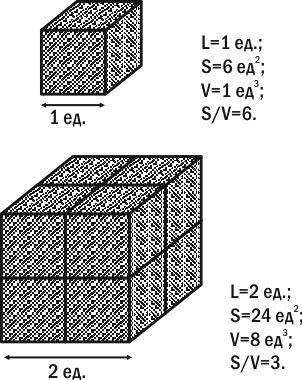
Fig. 5.11.1. Doubling the dimensions of a cube results in its surface-to-volume ratio becoming twice as small.
The strength of supporting structures (plant stem, animal skeleton) is approximately proportional to their cross-sectional area. However, the body weight that these structures have to support grows faster: it is proportional to the body volume. Therefore, if the body proportions do not change when its dimensions are doubled, its ability to support its own weight will decrease by half – it will seem twice as heavy for itself! Thus, as an organism grows, it becomes heavier and heavier for itself.
Remember how a young child walks: they stumble and fall quite often. Falling from their own height may cause tears, but almost never leads to serious injuries. Unfortunately, for an adult, who has a much stronger skeleton, falling from their own height can be much more dangerous (threatening, in particular, with fractures).
Similar patterns are reflected not only in supporting one's own weight. For example, it is much easier for small animals to fly than for large ones. The lift of flying animals is proportional to the area of their wings or other structures that support them in the air, i.e., it increases proportionally to the square of their linear dimensions. Muscle strength also increases proportionally to the square of linear dimensions: it is proportional to the cross-sectional area of the muscles. However, the weight increases much faster with increasing organism size: proportionally to the cube of the dimensions, as it is determined by the body volume. A small aphid only needs small wings with weak musculature to fly. Conversely, an albatross needs a body whose structural solutions are all aimed at reducing its own weight and increasing lift to take off. An albatross with a wingspan of 3.5 m weighs only about 15 kg!
Note that the considerations discussed are not related to the specifics of living organisms. For example, similar reasoning suggests that a dust particle easily floats in the air, while a bubble made of the same material and having the same shape, if it finds itself in the air without support, will immediately move downwards.
We have established that as an organism grows, its relationship with its own weight changes. However, both newborns and adults belong to approximately the same size class: their body lengths differ by no more than 4–5 times. And how do the living conditions of organisms that are incompatible in size differ?
We can very conditionally divide terrestrial organisms into three groups (size classes) depending on their size. The microsphere includes organisms whose size is usually less than 1 mm. The mesosphere is the range of sizes from millimeters to tens of centimeters. The macrosphere is the collection of animals whose size exceeds several tens of centimeters (sometimes reaching tens of meters). Organisms within each size class can vary in size by hundreds of times (it should be noted that in other contexts, for example, in physics literature, the terms "micro-", "meso-", and "macro-" may be used differently). The difference in the sizes of organisms in different size classes leads to environmental factors acting on them in fundamentally different ways!
In the microsphere, the force of gravity is almost imperceptible. Organisms of this size class easily float in water and can even be carried by air currents, like dust. However, surface forces (surface tension, capillary effect) are practically insurmountable for organisms of the microsphere. Some microsphere creatures have a complex structure (e.g., ciliates), but they do not typically have specialized physiological systems for gas exchange. Such small organisms have a very high surface area to volume ratio. The distance from any point in their body to the surface is very small, and the concentrations of gases or other substances equalize quickly. Temperature differences also equalize just as quickly. The body temperature of microsphere organisms always matches the ambient temperature.
Mesosphere organisms "feel" both gravity and surface forces, but at the same time are capable of successfully overcoming them. Recall water striders running on the surface of water or pond skaters crawling on the surface tension film. Many mesosphere organisms, such as ants, can easily lift masses many times their own body weight. At the same time, representatives of this size class have developed respiratory and circulatory systems. By the way, the fact that in insects the functions of gas exchange and circulation are separate is a consequence of these animals originating in the middle size class. Gas exchange is provided by a tracheal system that delivers air to almost every cell, and the circulation of substances in the body is provided by hemolymph. As body size increases, its volume grows faster than its surface area (including the surface area of the tracheae), air movement becomes more difficult in the narrow, thin tracheal tubes, and the organism begins to experience difficulties with gas exchange. This is one of the main reasons why insects have not moved from the mesosphere to the macrosphere. However, quite a few mesosphere animals are capable of flight. Mesosphere plants and fungi have certain supporting structures (most often "working" due to turgor), but generally retain some elasticity of their bodies.
Finally, in the macrosphere, the main force that must be overcome is the force of gravity. Our muscles hardly feel the resistance of the surface water film, but they must constantly tense to support our weight. Only a few, the smallest, representatives of the macrosphere are capable of flight. With few exceptions, macro-world animals have an internal skeleton; the vast majority are vertebrates. In addition to them, cephalopod mollusks, primarily squids, have also reached macro-sizes (in an aquatic environment). Interestingly, the remnant of the internal shell of squids forms an internal support in their bodies, somewhat resembling a chord in its properties.
In macro-world plants (e.g., trees), rigid mechanical tissues occupy a significant part of the body. Fungi, if they reach macro-sizes, essentially remain in the mesosphere, as they are located in or on a substrate.
Of course, micro-, meso-, and macro-world organisms are connected by transitions, but it is hard to even imagine how different the properties of the environment are for them! You have likely encountered statements where the characteristics of organisms of one size are transferred to others, significantly different in size. A person cannot jump as high (relative to their own body) as a flea, carry a load many times their weight like an ant, or move at the same relative speed as a fly, not because they are "made" worse. A person simply belongs to a different size class!
Since the proportions between different parameters of an organism change as it grows: surface area and volume, muscle strength, skeleton strength and weight, etc., growth is associated with changes in proportions in the vast majority of organisms.
Therefore, we easily distinguish a photograph of a child from a photograph of an adult, even if we don't know the sizes of the people depicted. A child and an adult differ in proportions. A child has a significantly larger and rounder head, shorter arms and legs. Proportions change continuously with growth, and this is characteristic not only of humans but of all modern animals and plants.
Julian Huxley called the change in proportions with organism growth allometric growth (allometry). One of the simplest equations that describe such growth quite well is called Huxley's equation: y = bxa, where y is the size of some organ, x is the size of the organism as a whole, and b and a are allometric growth constants.
For example, if an organ increases to such an extent that its surface area (or cross-sectional area) grows proportionally to the volume of the entire organism, the allometry constant a will be 1.5.
If organism growth occurred while maintaining proportions (i.e., was isometric), the corresponding equation would be simply y = bx. It is likely that many of the organisms that inhabited the Earth during the Vendian (Ediacaran) period grew isometrically, without changing proportions. This is one of the significant reasons not to consider Vendobionta as true animals.
Allometric growth can be registered by comparing organisms of different sizes. Depending on which individuals are compared, the following forms of allometry are distinguished: - ontogenetic allometry, observed during the ontogeny of an individual or established by comparing individuals of different ages of the same species; - intraspecific allometry, revealed by comparing individuals at the same stage of development (usually adults) that differ in size; - interspecific allometry, revealed by comparing the average values of the studied trait in individuals (usually adults) of different species belonging to the same group; - evolutionary allometry - interspecific allometry in a series of phylogenetically sequential forms.
Additional materials: Educational model: Dependence of animal body proportions on its size
5.10. Selye's concept of stress
D. Shabanov, M. Kravchenko. Ecology: Interaction Biology Chapter 5. Autecology and Fundamentals of Environmental Studies
5.12. Solar Radiation Composition