
Ecology: Biology of Interaction. 5.12. Composition of Solar Radiation
Temperature of the Sun’s outer surface is about 6000 K, and maximum solar emission falls in the visible spectrum region near wavelength 550 nm. Earth is much cooler and emits predominantly in the far-infrared range.
Ukrainian language (latest version) / Russian language (updates discontinued)
5.11. Features of organisms associated with their size
D. Shabanov, M. Kravchenko. Ecology: Biology of Interaction Chapter 5. Autecology and Foundations of Environmental Science
5.13. Biological effects of electromagnetic radiation
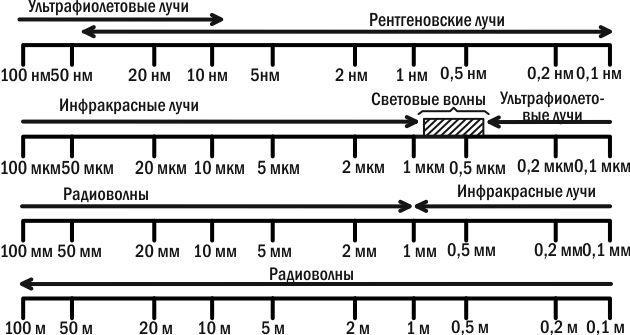
5.12. Composition of solar radiation Any body whose temperature differs from absolute zero emits electromagnetic radiation (EMR). The higher the body temperature, the more energy it emits. In addition, with increasing temperature, wavelength of maximal energy emission decreases. Thus, temperature of the Sun’s outer surface is about 6000 K (kelvin, degrees above absolute zero), and maximum solar emission lies in visible spectrum at around 550 nm. Solar luminosity (summed over all wavelengths) is 3.8×10^26 W. Earth is much colder, and its surface temperature is only about 300 K. Naturally, Earth emits much less energy than the Sun, and its emission maximum is near wavelength 10,000 nm, corresponding to far infrared radiation. Outside Earth’s atmosphere, each square centimeter of a surface perpendicular to solar rays receives about 2 calories per minute (more precisely 1.93 cal/cm2 per min). This value is called the solar constant. It can also be expressed as 1400 J per 1 m2, with solar radiation energy flux density of 1.4 kW/m2. About 40% of energy is reflected back to space, 15% is absorbed by atmosphere. Ultimately, incoming solar energy is compensated by Earth’s thermal radiation. In general, electromagnetic radiation spectrum consists of the following parts (Fig. 5.12.1): < 150 nm — ionizing radiation, X-rays, and gamma radiation; 150–400 nm — ultraviolet (UV) radiation; 400–800 nm — visible light; 800–1000 nm — infrared (IR) radiation; > 1000 nm — far infrared radiation, followed by super-high frequencies (microwaves) and radio range (up to 100 m). [IMG_1] Fig. 5.12.1. Spectrum of electromagnetic oscillation frequencies 5.11. Features of organisms associated with their size
D. Shabanov, M. Kravchenko. Ecology: Biology of Interaction Chapter 5. Autecology and Foundations of Environmental Science
5.13. Biological effects of electromagnetic radiation
5.13. Biological effects of electromagnetic radiation