

Student Works After the Second-Year Field Practice – 2014
Artjukh O. A., Pereverzeva Ya. V., Brusianskyi I. I. A description of the ventral and dorsal patterns of fire-bellied toads. Vakulenko M. V., Meleško E. V., Khazeyeva A. A. A study of the population-system structure of green frogs (Pelophylax esculentus complex) of the Lower Dobrytskyi pond, Zmiiv district, Kharkiv region.
Student papers after 2nd-year practicum – 2008
Student papers after 2nd-year practicum – 2009
Student papers after 2nd-year practicum – 2010
Student papers after 2nd-year practicum – 2011
Student papers after 2nd-year practicum – 2012 (Part I)
Student papers after 2nd-year practicum – 2012 (Part II)
Student papers after 2nd-year practicum – 2013
Student papers after 2nd-year practicum – 2015
Student papers after 2nd-year practicum – 2016
Student papers after 2nd-year practicum – 2017
Description of the ventral and dorsal patterns of fire-bellied toads
Artyukh O. A., Pereverzeva Ya. V., Brusyanskyi I. I.
V. N. Karazin Kharkiv National University, Faculty of Biology, Department of Zoology and Animal Ecology, Svobody Square, 4, Kharkiv, Ukraine, 61077
e‑mail: neagame123@gmail.com
A formalized description of the patterns of fire-bellied toads Bombina bombina (Linnaeus, 1761) can be used for individual marking of specimens and for the phenetic study of populations (determining kinship, population boundaries and their groups). The material for the work consisted of 23 sexually mature and 1 juvenile specimen, collected in the floodplain of the Siverskyi Donets river near the biological station of the Faculty of Biology of V. N. Karazin Kharkiv National University in the "Homilshanski Lisy" National Nature Park in the first ten days of July 2014.
To obtain quality images of the dorsal and ventral patterns, the toads were pressed against the glass of an office scanner with a white cloth and then scanned. The studied specimens were released at the collection sites.
In the studied sample of pattern scans, we identified 3 traits (each of which could take several states) on the ventral and dorsal sides for each individual. For the dorsal side, the following traits were identified: trait 1 – bean-shaped dorsal spots (0 – absence of bean-shaped spots; 1 – 1 bean-shaped spot; 2 – 2 spots; 3 – 3 spots; 4 – 4 spots), trait 2 – green colour on the back (0 – absent; 1 – present), trait 3 – spots in the head region (1 – Y-shaped spot; 2 – rare Y-shaped spot; 3 – X-shaped spot; 4 – horizontal stripe between the eyes; 5 – rare stripe between the eyes, from 2 to 4 spots). On the ventral side, the following traits were identified: trait 4 – bright red spots in the shoulder-girdle zone (1 – 8 spots; 2 – fewer than 8 spots), trait 5 – spots on the belly and head (1 – small; 2 – large; 3 – small and large), trait 6 – transition zone from belly to hind limbs (1 – 2 elongated spots; 2 – 3 spots; 3 – 4 or more spots).
The coding of an individual's pattern consists of two groups (for the dorsal and ventral sides of the body), each of which consists of three numbers reflecting the states of the traits we identified. For example, the dorsal pattern code 1.1.5 means that the toad has, by trait 1, 1 bean-shaped spot, by trait 2 – a green back colour, and by trait 3 – a rare stripe between the eyes (from 2 to 4 spots). For the ventral side, the code 1.1.2 is decoded as follows: by trait 4 – presence of spots in the shoulder-girdle zone, by trait 5 – small spots on the belly and head, by trait 6 – 3 spots in the transition zone from belly to hind limbs. Based on these codes, a computer database of scans or photographs should be organised, with the ability to form selections of available images possessing a certain state of any of the traits used. Final identification should be carried out by comparing two images, or an image and the studied specimen.
The method we developed can be applied for individual marking or for studying the local population structure of the toads.
Summary. The subject of work is Bombina bombina (Linnaeus, 1761). The material has been collected in the vicinities of the biological station of the Kharkiv National University named by V. N. Karazin in the National park "Gomilshansky Forests" and consist of 23 mature individuals and 1 juvenile.There was developed a method of encoding. The code consists of three numbers, each number indicates a certain state of the trait.
The authors thank their academic supervisor, Associate Professor D. A. Shabanov.
Artyukh O. A., Pereverzeva Ya. V., Brusyanskyi I. I. Description of the ventral and dorsal patterns of fire-bellied toads // «Biology: from Molecule to Biosphere». Proceedings of the IX International Conference of Young Scientists (November 18–20, 2014, Kharkiv, Ukraine). – Kharkiv: FOP Shapovalova T. M., 2014. – P. 122.
Study of the structure of the population system of green frogs (Pelophylax esculentus complex) of the Lower Dobritsky pond, Zmiiv district, Kharkiv region
Vakulenko M. V., Meleshko Ye. V., Khazeeva A. A.
V. N. Karazin Kharkiv National University, Faculty of Biology, Svobody Square, 4, Kharkiv, Ukraine
e‑mail: mashavmv@rambler.ru
The group of green frogs (Pelophylax esculentus complex) consists of Pelophylax lessonae (Camerano, 1882), Pelophylax ridibundus (Pallas, 1771) and their hemiclonal hybrid Pelophylax esculentus (Linnaeus, 1758). Representatives of this complex, living and reproducing together, form hemiclonal population systems (HPS). In this work, we studied the composition of the HPS of green frogs of the Lower Dobritsky pond (territory of the "Homilshanski Lisy" National Nature Park, Zmiiv district, Kharkiv region), for which a high proportion of triploid hybrids had previously been recorded (Bondareva, 2012; Meleshko et al., 2014). Studies of this HPS using marking (by toe clipping) have been conducted since 2011. The objective of the work was to study the composition and estimate the abundance of this HPS, and to compare the obtained data with the results of the 2013 studies.
A random sample collected on 7 July 2014 was studied. Frogs were caught by hand at night using a flashlight. Species and sex were determined by a set of morphological traits (Korshunov, 2010). Ploidy was determined by erythrocyte size (Bondareva, 2012). Blood smears were photographed at high magnification with a USB microscope camera, erythrocyte length was measured using the PDF XChangeViewer program, and the results were processed in Statistica 8.0. The abundance of the studied HPS was estimated by the Petersen method as the ratio of the 2014 sample size to the proportion of individuals collected that had been marked in 2013, with the Bailey correction (mark-recapture method).
We studied 51 individuals, of which P. esculentus – 46 specimens (90 %), and P. ridibundus – 5 (10 %). Among P. esculentus, 35 males (76 %), 8 females (17 %) and 3 immature individuals (7 %) were found. The proportion of triploid individuals was 8 % of the whole sample (4 individuals: 2 males, 1 female and 1 immature individual). Among P. ridibundus, 4 females and 1 immature individual were found. Compared with the 2013 catch results (Mikhailenko et al., 2013), the relative proportion of triploid hybrids decreased significantly (p = 0.02). 2 of the 76 individuals marked in 2013 were recaptured in the 2014 sample. The estimated HPS abundance was 1317 ± 639 individuals. 42 marked individuals were released back into the Lower Dobritsky pond.
Thus, the HPS of green frogs of the Dobritsky pond belongs to the REt type, in which diploid male P. esculentus predominate. A decrease in the proportion of triploids compared to the previous year was recorded (p = 0.02). The causes of the observed changes cannot be established by the methods used in this work and require separate study. Further monitoring of this HPS is of interest in connection with the detected changes in its composition.
Summary. The hemiclonal population system of green frogs from Lower Dobristky pond (National Park “Gomilshansky lissy”) was studied. Sexual and species structure was determined. The diploid males P. esculentus prevailed in this population system (the population type is REt). The portion of parental species (P. ridibundus) is 10 %. The portion of male in sample is 69 % (35 individuals of 51). The portion of female is 23 % (12 individuals), the portion of juvenile is 8 % (4 individuals). The number of triploids was shown (p=2 %) to decrease with respect to 2013 data (Mikhajlenko et al., 2013). The estimated population size is 1317±639.
The authors thank the Associate Professor of the Department of Zoology and Animal Ecology of V. N. Karazin Kharkiv National University D. A. Shabanov for academic supervision, as well as A. V. Korshunov and Ye. Ye. Usova for help in collecting frogs.
Vakulenko M. V., Meleshko Ye. V., Khazeeva A. A. Study of the structure of the population system of green frogs (Pelophylax esculentus complex) of the Lower Dobritsky pond, Zmiiv district, Kharkiv region // «Biology: from Molecule to Biosphere». Proceedings of the IX International Conference of Young Scientists (November 18–20, 2014, Kharkiv, Ukraine). – Kharkiv: FOP Shapovalova T. M., 2014. – P. 126‑127.
Comparison of the length and body mass of tadpoles of green frogs (Pelophylax esculentus complex) developing in the floodplain of the Siverskyi Donets and in Iskove pond
Drohvalenko N. A., Chernenko A. V.
V. N. Karazin Kharkiv National University, Faculty of Biology, Department of Zoology and Animal Ecology, Svobody Square, 4, Kharkiv, Ukraine
e‑mail: Jaegernicholaus@gmail.com
Differences in the living conditions of tadpoles of the hybrid complex Pelophylax esculentus complex may affect the dynamics of their growth and development. In this regard, we studied the development of tadpoles taken from different water bodies of the Siverskyi Donets centre of green frog diversity.
We studied two samples: 65 tadpoles from the Siverskyi Donets (N 49.635; E 36.338; caught 01.07.14) and 53 tadpoles from Iskove pond (N 49.627; E 36.284; caught 07.07.14). Tadpoles were caught with sweeping movements of a hydrobiological net (mesh 7 mm) in aquatic vegetation in shallow water. Both representatives of the parental species Pelophylax ridibundus and interspecific hybrids Pelophylax esculentus spawn at the collection sites, so it can be assumed that the tadpole samples we studied represented a mixture of different forms of representatives of the Pelophylax esculentus complex.
Body length (from the tip of the snout to the base of the tail) was measured in tadpoles with an automatic caliper (accuracy 0.01 mm) and body weight with electronic scales (accuracy 0.01 g). 10 stages of hind limb development were distinguished (Vynohradska et al., 2010). Analysis of variance was performed using the Statistica program.
Tadpoles at the 7th–10th stages of hind limb development predominated in the samples. Tadpoles from the river floodplain slightly (p = 0.22) exceeded tadpoles from the pond at the same developmental stages in body length, and significantly (p = 0.04) exceeded them in body mass. Our data correspond to the results of a similar work performed 2 years ago (Hubenko, Mykhailova, 2012), which confirms the stability of the recorded effect.
Summary. Weight, length and developmental stage of hind limbs of tadpoles from two population of hybridogeneous comlex Pelophylax esculentus complex were studied. Tadpoles of bottomland of Siversky Donets have bigger average length and average weight.
The authors thank their academic supervisor Shabanov D. A., Associate Professor of the Department of Zoology and Animal Ecology of V. N. Karazin Kharkiv National University
Drohvalenko N. A., Chernenko A. V. Comparison of the length and body mass of tadpoles of green frogs (Pelophylax esculentus complex) developing in the floodplain of the Siverskyi Donets and in Iskove pond // «Biology: from Molecule to Biosphere». Proceedings of the IX International Conference of Young Scientists (November 18–20, 2014, Kharkiv, Ukraine). – Kharkiv: FOP Shapovalova T. M., 2014. – P. 128‑129.
Impaired fertility in interspecific hybrids of green frogs from the Siverskyi Donets centre of diversity of the Pelophylax esculentus complex
Makaryan R. M., Sheiko V. P.
V. N. Karazin Kharkiv National University, Faculty of Biology, Svobody Square, 4, Kharkiv, Ukraine
e‑mail: inessasheiko@mail.ru
The hybrid complex of green frogs (Pelophylax esculentus complex) includes three main forms. These are the pond frog Pelophylax lessonae (Camerano, 1882), the lake frog Pelophylax ridibundus (Pallas, 1771), and their hemiclonal hybrid, the edible frog Pelophylax esculentus (Linnaeus, 1758). During a study of the reaction of male green frogs to an injection of surfagon (a synthetic analogue of the gonadotropin-releasing hormone luliberin), carried out by A. A. Bobrova over the summer season of 2014, male green frogs were found that did not respond to hormonal stimulation. The objective of our work was to compare the size of the testes in such individuals with those of frogs that showed a normal response to the hormone. In addition, we checked for the presence of active spermatozoa in the testes themselves of P. ridibundus and P. esculentus.
We studied 22 male green frogs, including 8 Pelophylax ridibundus and 14 Pelophylax esculentus. The animals were collected in the vicinity of the biological station of V. N. Karazin Kharkiv National University (Zmiiv district, Kharkiv region). We studied 11 P. esculentus and 2 P. ridibundus among those that did not respond to hormonal stimulation, as well as 3 P. esculentus and 6 P. ridibundus collected at random in natural habitats. The frogs were anaesthetised, their brain and spinal cord were destroyed, the abdominal cavity was opened, and the testes were extracted. The frog (dorsal side down) and its separated testes were laid out on the glass of an A4 office scanner and then scanned at a resolution of 600 dpi. Measurements of frog body length and testis length were made from photographs using PDF XChangeViewer, using a scanned measuring scale. To determine the presence of active spermatozoa, one of the testes was cut with scissors into several pieces, which were placed in pond water. After a few minutes, the resulting suspension was examined under a microscope and the presence or absence of spermatozoa was recorded.
In P. esculentus the testes are small (average length – 6 mm); the testes in P. ridibundus are larger (average length – 8.2 mm). Among 14 P. esculentus, the proportion of individuals with active spermatozoa was 28.6 % (4 individuals), and among 8 P. ridibundus – 75 % (6 individuals).
In P. ridibundus, testes 8 to 11 mm in length contained active spermatozoa, while in P. esculentus individuals with testis lengths from 8.4 to 10 mm, no active spermatozoa were found.
The more substantial impairment of fertility in P. esculentus is likely caused by disruption of their gametogenesis as a result of interspecific hybridisation.
Summary. It was investigated impaired fertility in interspecific hybrids of green frogs from Donetskiy center of diversity Pelophylax esculentus complex. We identified the presence of active sperm in the suspension of the cut of the testes, as well as the size of the testes. It was found impaired fertility of P. esculentus in our results of investigations.
The authors express their deep gratitude to A. A. Bobrova for the provided material and assistance in the work, as well as to Associate Professor D. A. Shabanov for academic supervision and help in interpreting the results.
Makaryan R. M., Sheiko V. P. Impaired fertility in interspecific hybrids of green frogs from the Siverskyi Donets centre of diversity of the Pelophylax esculentus complex // «Biology: from Molecule to Biosphere». Proceedings of the IX International Conference of Young Scientists (November 18–20, 2014, Kharkiv, Ukraine). – Kharkiv: FOP Shapovalova T. M., 2014. – P. 129‑130.
Simulation modelling of self-organisation in biological systems using the example of the chorus singing of green frogs
Malakhova D. O.
Regional Specialised Boarding School “Obdarovanist” of the Kharkiv Regional Council
e‑mail: sunlilika@i.ua
Simulation modelling can be used to test whether the properties of whole systems emerge from a given set of properties of its elements. This work aims to test assumptions about the mechanisms of chorus singing in green frogs.
The singing of frogs has often seemed mysterious, as if requiring the presence of a “conductor” to explain the coordination of the chorus. We tested whether this coordination could be explained by applying the hydraulic model of instinctive behaviour proposed by Konrad Lorenz. According to it, the manifestation of a certain form of behaviour is explained by the growth of the corresponding motivation (which can be compared to a fluid that accumulates or is expended); during the performance of this behaviour, motivation decreases. As motivation increases, the corresponding form of behaviour is either triggered by a specific stimulus or begins spontaneously.
We assumed that the behaviour of each frog can be described by the following parameters:
— B (begin), the singing threshold (the level of motivation at which a silent frog starts singing);
— E (end), the silence threshold (the level of motivation at which a singing frog falls silent);
— A (accumulation), the rate of increase of motivation in a silent individual;
— S (spending), the rate of decrease of motivation in a singing individual;
— P (provocation), the effectiveness of vocal provocation (lowering of the singing threshold, which accelerates the singing of another frog).
A frog with a motivation level L1 (level) remains silent if it was silent at the previous step of the model and L1 < B (or L1 < B–P, if other frogs are singing). It will start singing after such a time (number of model steps) t1 that L1 + t1×A = B (in the case where other frogs are singing, L1 + t1×A = B–P). A frog that started singing (for example, during the singing of other frogs, with a motivation level L2 = B–P) will fall silent after such a time t2 that L2 – t2×S = E (both when other frogs are singing and in silence). It is clear that these assumptions make sense if B > E, and also P < B–E.
We created a model reflecting these assumptions in Microsoft Office Excel. It simulates the behaviour of 28 frogs arranged in a circle, each of which is influenced by the singing of its 10 nearest neighbours. The model is publicly available at: http://dspace.univer.kharkov.ua/handle/123456789/10058.
Experiments with the model showed that the assumptions adopted are sufficient to explain the emergence of periodic chorus singing. We recorded the chorus singing of green frogs kept in the laboratory of amphibian population ecology of V. N. Karazin Kharkiv National University. To do this, we recorded all sounds in the laboratory after the staff finished work on 18 October 2014. The periodicity of the frog chorus “switching on” was 50 minutes. We selected such values of the initial parameters at which the model produces dynamics of chorus singing similar to the recorded one (B=56; E=18; A=1; S=24; P=2; a model step corresponds to 1 minute). There are values of the initial parameters at which the chorus splits into two parts singing alternately.
At the next stage of our work, we plan to record the dynamics of solo and chorus singing of green frogs under natural conditions, to assess the level of individual variability in the motivation to sing, and to establish the model parameters corresponding to these data.
Summary. The goal of this model is to explain the harmony in the chorus of frogs. We decided to simulate using Excel a real chorus of frogs with stewed parameters that are proportional relationship. Through experiments with the model and using the true record of singing frogs, we proved that our assumptions sufficient to explain the frequency of thisoperation.
The author sincerely thanks her academic supervisor, Associate Professor D. A. Shabanov of V. N. Karazin Kharkiv National University, for the idea of this work and help in implementing it as a model.
Malakhova D. O. Simulation modelling of self-organisation in biological systems using the example of the chorus singing of green frogs // «Biology: from Molecule to Biosphere». Proceedings of the IX International Conference of Young Scientists (November 18–20, 2014, Kharkiv, Ukraine). – Kh.: FOP Shapovalova T. M., 2014. – P. 130-131.
Study of the hybrid complex of Carassius in the pond at Koryakiv Yar (Kharkiv region, Ukraine)
Miroslavska M. A., Sukhov V. A., Shlakhter M. L.
V. N. Karazin Kharkiv National University, Department of Zoology and Animal Ecology, Svobody Square, 4, Kharkiv, Ukraine
e‑mail: marina.miroslavskaya@yandex.ua
Hybrid diploid-polyploid complexes are a model for evolutionary-genetic and ecological research. The study of hybrid crucian carp complexes is also of particular importance for nature conservation. Studies of hybrid crucian carp complexes have already been carried out for the Siverskyi Donets river basin (Kulish, 2013); their results allow the conclusion that there is a high probability of the formation of unique crucian carp settlements in individual water bodies.
We studied 63 crucian carp caught between 25.06.2014 and 27.06.2014 with cone-type traps in a pond at Koryakiv Yar (Kharkiv region, Zmiiv district, near the village of Haidary). 10 traits were determined: presence of a spot on the tail, shape of the dorsal fin, shape of the anal fin, colour of the fins, shape of the head, colour of the scales, colour of the eyes, number of gill rakers, number of spines on the dorsal and anal fins, colour of the subcutaneous lining. Depending on the state of these traits, the studied individuals were assigned to one of the morphotypes: Carassius cf. carassius or Carassius cf. gibelio, based on the description of the two species in the “Fauna of Ukraine” (Movchan, Smirnov, 1982).
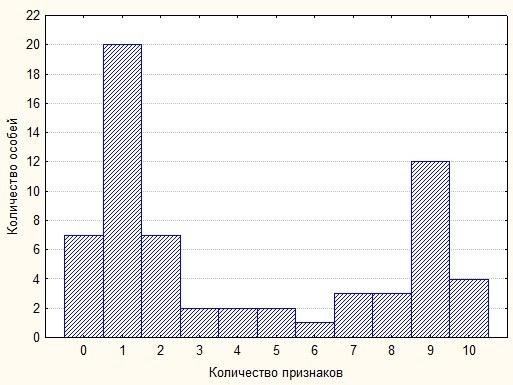
Fig. 1
Fig. 1 shows the recorded distribution of individuals by the number of traits characteristic of Carassius cf. gibelio (not characteristic of Carassius cf. carassius). The distribution turned out to be continuous and bimodal. The peaks of the distribution fall on individuals that differ from the typical description of the pure morphotype by one trait. Based on this result, we can hypothesise that hybridisation is occurring in this pond, leading to a redistribution of traits between different morphotypes.
The distribution of crucian carp body length at the age of 3 years (age was determined by scale rings) differs significantly from normal (p=0.0016) and has a bimodal character. Body length does not depend on morphotype. This indicates the heterogeneity of the group and suggests that it consists of fast-growing and slow-growing individuals, or di- and polyploids, since ploidy can also affect organism size, and the formation of polyploids is a common phenomenon for hybrid complexes.
Summary. Identified 10 characteristics, depending on the state of these characteristics of the studied individuals was attributed to one of the morphotypes: Carassius cf. carassius or Carassius cf. gibelio. The distribution of the length of the body carp at the age of 3 years is significantly different from normal and has a bimodal nature, it demonstrates the heterogeneity of the group and suggests that it consists of fast‑growing and slow‑growing individuals or di‑ and polyploids.
The authors thank Shabanov D. A. and Honcharov H. L. for academic supervision, collection of material and help with statistical processing of the data.
Miroslavska M. A., Sukhov V. A., Shlakhter M. L. Study of the hybrid complex of Carassius in the pond at Koryakiv Yar (Kharkiv region, Ukraine) // «Biology: from Molecule to Biosphere». Proceedings of the IX International Conference of Young Scientists (November 18-20, 2014, Kharkiv, Ukraine). – Kh.: FOP Shapovalova T. M., 2014. – P. 132-133.
Resistance to hypoxia in representatives of the Pelophylax esculentus complex
Paramonova V. V., Kovalev V. V.
V. N. Karazin Kharkiv National University, Faculty of Biology, Department of Zoology and Animal Ecology, Svobody Square, 4, Kharkiv, Ukraine, 61022
e‑mail: vika_paramonova@mail.ua
Representatives of the hybridogenetic complex of green frogs (Pelophylax esculentus complex) are a convenient object for studying the effect of cell size on physiological processes. In the Siverskyi Donets centre of green frog diversity, interspecific hybrids, Pelophylax esculentus (Linnaeus, 1758), are represented by di- and triploids. The size of erythrocytes (and probably many other cells) is increased in triploids, while body mass and size correspond to those of diploids (Shabanov, Litvinchuk, 2010). An increase in cell size, and a decrease in their relative surface area and number, should complicate gas exchange; this assumption is consistent with the higher activity of anaerobic glucose breakdown enzymes (Bondareva et al., 2013). We tested the hypothesis that triploid frogs should differ from diploid ones in hypoxia resistance.
Frogs were caught at the end of June 2014 in the vicinity of the biological station of V. N. Karazin Kharkiv National University in the floodplain of the Siverskyi Donets river and at the Lower Dobritsky pond (“Homilshanski Lisy” National Nature Park). We determined hypoxia resistance in 33 individuals (25 males and 8 females): 5 triploid P. esculentus, 18 diploid P. esculentus, 10 Pelophylax ridibundus (Pallas, 1771), representatives of the parental species. Belonging to the parental species or to hybrids was determined by a set of external traits (Atemasova et al., 2008), ploidy — by erythrocyte size (Bondareva et al., 2012). Frogs were placed in a jar with degassed water without access to air, and the time to loss of activity was determined. After the experiment, the frogs were released at their capture sites. Results were processed in Statistica 7 using multifactor analysis of variance (Fig. 1).
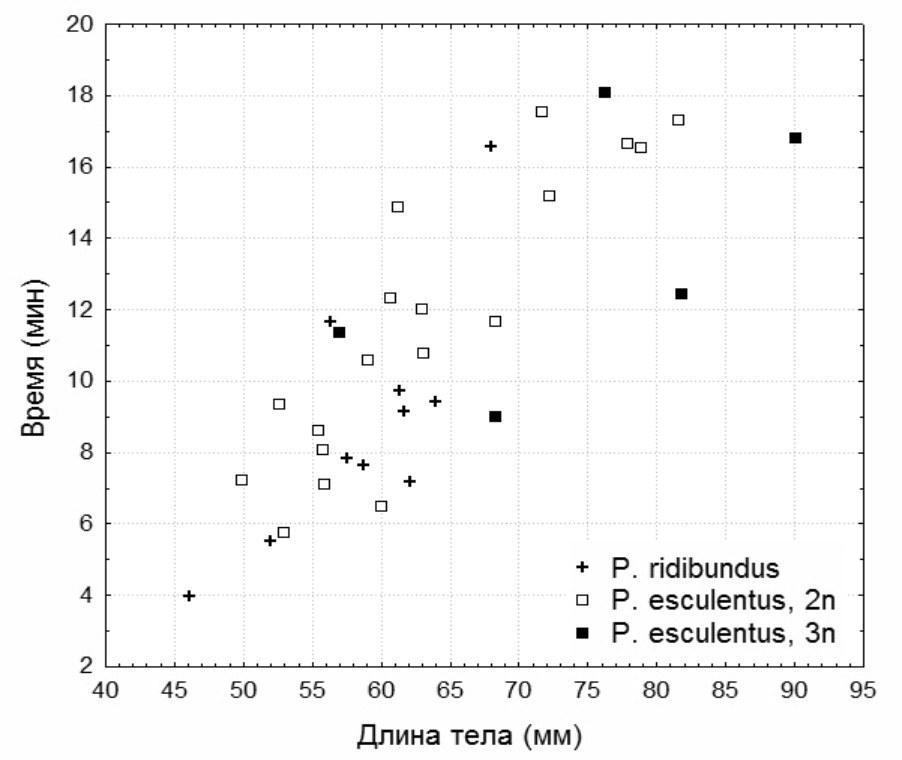
Fig. 1. Dependence of hypoxia resistance on the body length of green frogs. Of the factors considered, only body length significantly affects hypoxia resistance. As body length increases, hypoxia resistance increases. Differences in resistance between di- and triploid P. esculentus, between P. ridibundus and P. esculentus (Fig. 1), and between females and males, are not significant.
Although based on previously available data it might be assumed that the physiological features of the reaction of di- and triploid P. esculentus to hypoxia could differ, our results show that the change in cell size in triploids is effectively compensated. The mechanisms of such compensation require further study.
Summary. The influence of ploidy on the hypoxia resistance Pelophylax esculentus was investigated. The time what frog spent in degassed water to moment of loss the activity was the indicator of resistance. The results showed only one dependence: dependence of the resistance to body length.
The authors are grateful to Associate Professor Shabanov D. A. for academic supervision and help with the work.
Paramonova V. V., Kovalev V. V. Resistance to hypoxia in representatives of the Pelophylax esculentus complex // «Biology: from Molecule to Biosphere». Proceedings of the IX International Conference of Young Scientists (November 18-20, 2014, Kharkiv, Ukraine). – Kh.: FOP Shapovalova T. M., 2014. – P. 133-134.
Study of the characteristics of release calls of green frogs from the Siverskyi Donets centre of diversity of the Pelophylax esculentus complex
Tymchenko K. M., Fedorova A. O.
V. N. Karazin Kharkiv National University, Faculty of Biology, Department of Zoology and Animal Ecology, Svobody Square, 4, Kharkiv, 61077
e‑mail: karisha_139@mail.ru
In the vicinity of the biological station of V. N. Karazin Kharkiv National University (Haidary village, Zmiiv district, Kharkiv region), interspecific hybrids of green frogs, Pelophylax esculentus (Linnaeus, 1758), live alongside representatives of one of the parental species — Pelophylax ridibundus (Pallas, 1771). Anurans are among the few groups of animals for which bioacoustic methods are useful in describing diversity. Among the calls of anurans, the mating calls of males are the most complex and informative. Differences in such calls have been described and are used both for taxonomic purposes and for field identification of frog forms. Less studied are release calls, produced by representatives of both sexes when an attempt is made to grasp them in amplexus.
In this work, we compared the release calls of males and females of P. ridibundus and P. esculentus. For this, we recorded the release calls of 62 green frogs (8 males and 17 females of P. ridibundus, 30 males and 7 females of P. esculentus). Frogs were held by the torso from the sides, recording their reaction on video with a digital camera. Oscillograms of the sound signals were analysed in Audacity 2.0.5. For each individual, 4 cyclic calls were analysed. For each cycle, the total duration, the duration of the active phase, and the number of pulses in the call were measured, as well as the pulse duration, the duration of the active phase of the pulse, and the number of impulses in the pulse at the beginning, middle, and end of the call. Analysis of the results was performed in Statistica 8.0 (Fig. 1).
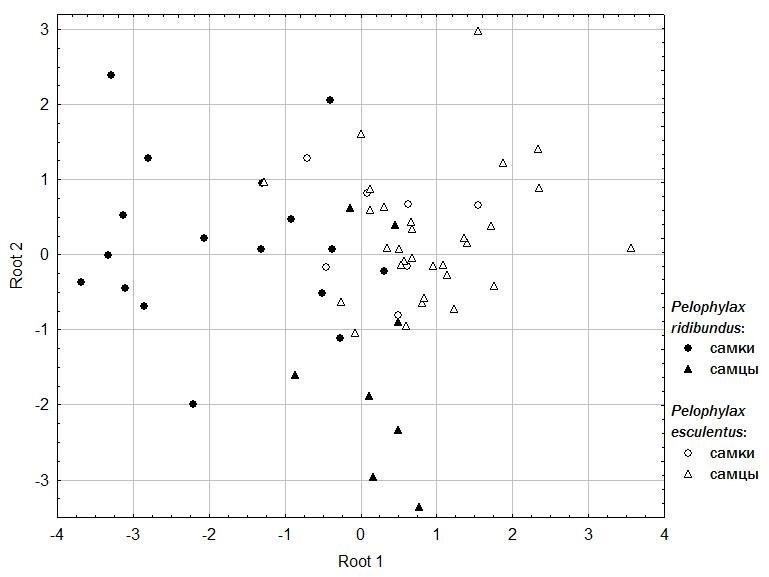
Fig. 1. Results of discriminant analysis of frog voice recordings (using the 12 oscillogram parameters used). The release calls of males and females of the parental species, P. ridibundus, form two weakly overlapping groups. In interspecific hybrids, P. esculentus, sex differences are largely lost.
Overall, according to the results of the discriminant analysis, 77 % of individuals were correctly classified.
In our opinion, the work begun requires continuation and development. It is necessary to include in the analysis the release calls of the second parental species, Pelophylax lessonae (Camerano, 1882), to continue the search for traits of calls characteristic of different groups of frogs, and to study the variability of these traits.
Summary: In the vicinity of the biological station V. N. Karazin Kharkiv National University live interspecific hybrids of green frogs Pelophylax esculentus (Linnaeus, 1758) and the representatives of one of the parental species – Pelophylax ridibundus (Pallas, 1771). The main goal of the research was to determine the differences between the releasing calls of males and females of the two species. Differences between males and females calls of P. ridibundus were identified. Differences between males and females calls of P. esculentus were not found.
The authors thank their academic supervisor, Associate Professor D. A. Shabanov.
Tymchenko K. M., Fedorova A. O. Study of the characteristics of release calls of green frogs from the Siverskyi Donets centre of diversity of the Pelophylax esculentus complex // «Biology: from Molecule to Biosphere». Proceedings of the IX International Conference of Young Scientists (November 18-20, 2014, Kharkiv, Ukraine). – Kh.: FOP Shapovalova T. M., 2014. – P. 134-135.