
Tiktalik and evolution
The description of *Tiktaalik* — one of the earliest tetrapod species — provides an excellent opportunity to discuss the evolution of quadrupeds and the principles of phylogenetic reconstruction
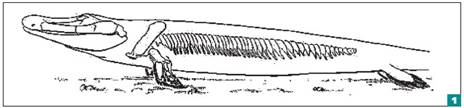
Network and print media recently circulated reports of another paleontological discovery, presented almost as proof of the theory of evolution. It concerns an Upper Devonian fish named Tiktaalik (Fig. 1). To understand the significance of this find and the errors of its numerous commentators, one must delve into the problem of the origin of tetrapods.
Reconstruction of Tiktaalik
From Fish to Tetrapods We, without false modesty, consider ourselves one of the most "successful" groups of animals – vertebrates. The most serious competitors of vertebrates are arthropods and cephalopods. Thanks to the "modular" assembly principle and rigid exoskeletons, arthropods have achieved dominance in the small size class, both in the sea (crustaceans) and on land (insects). But the size of arthropods is strictly limited by their external skeleton and (for terrestrial representatives) the tracheal respiratory system, which must supply air to every cell. The limits on maximum size for vertebrates are less stringent, and only cephalopods have managed to approach them in body size. Unfortunately (or fortunately), cephalopods never left the sea. In our world, the biggest often wins, so our group became the main player in the large size class. The body plan of fish allowed them to become the dominant group of large animals in water, and the body plan of tetrapods – the ability to conquer land. Both fish and tetrapods are successful design solutions. But how to transition from one design to another? Is it necessary to pass through a half-fish, half-tetrapod stage, or can this transition be overcome in a single leap?
Evolutionary Leap Classical Darwinism (a product of the second half of the 19th century) and the Modern Synthesis (mid-20th century) predict that evolution proceeds in small steps over long periods. However, saltation theory (from saltus – leap), which emerged at the beginning of the 20th century, asserts that evolutionary changes can occur within a single generation. Let's consider an example that supports this view. An interesting stage in the evolution of tetrapod ancestors was the change in the structure of their nostrils. Evolutionarily, the olfactory organ developed from olfactory pits on the anterior part of the head. It is not surprising that the nostrils of the first fish (like most modern species) were not connected to the respiratory system. The anterior nostril opened into the olfactory canal, from which water exited through the posterior nostril (Fig. 2). The fish's forward movement ensured a flow of water past the olfactory epithelium. In the fish that were our ancestors (called lobe-finned), the anterior nostril opened on the upper surface of the head, and the "posterior" one (called a choana) opened into the oral cavity, on the palate. Its presence facilitated the life of an ambush predator lurking in still water. Water flowed through the oral cavity, pumped by the gills. This ensured a flow of water through the olfactory canal, allowing the fish to sense the approach of prey. But how did the opening of the olfactory canal move from the upper surface of the head into the oral cavity? Ivan Ivanovich Shmalhausen, a classic Soviet evolutionist, suggested that the opening of the nasal canal shifted towards the edge of the jaw, where some water flow was observed. Thus, over several generations, the nostril gradually "crawled" into the mouth. Unfortunately, it is unclear how the nasal opening "overcame" the tooth-filled maxilla that stood in its way. It likely could only enter the oral cavity in a leap. Consider an analogy. In humans, an anomaly called "harelip" sometimes occurs. The fact is that during our evolution, the choanal opening became separated from the oral cavity by the secondary bony palate. Normally, in humans, the choanae open not into the oral cavity, but into the nasopharynx (this allows breathing while chewing food). "Harelip" is caused by a disruption in the formation of the secondary bony palate. Looking into the mouth of such a patient, one can see a gaping hole leading to the nasopharynx. Choanae (internal nostrils) are the result of the transformation of nostrils located on the surface of the head. It appears that in the evolution of Devonian fish, an anomaly similar to "harelip" emerged. Some developmental defect led to incomplete formation of the septum between the olfactory canal and the oral cavity. This defect significantly improved the function of the olfactory organ and was supported by selection. The development of choanae stabilized, and the second external nostril disappeared due to redundancy. As a result of this event, we can breathe with our mouths closed!
Devonian world Nevertheless, the transition from fish to tetrapods could not have occurred in a single leap, because it required coordinated changes in many organs and systems. Apparently, in the Devonian there was a transitional zone between two adaptive zones (sets of lifestyles) corresponding to fish and tetrapods. Consider the Devonian environment. It was a largely different world, where a year consisted not of 365¼ days but roughly of 4002 days. Plants were just beginning to colonize land, and continents were not covered by vegetation or soil. Rain washed away loose rocks, and water streams carried suspended particles to the sea. When water flow slowed, these particles settled, forming bottom deposits. Today, at the mouths of the Danube into the Black Sea or the Volga into the Caspian, extensive deltas form. Bottom sediments advance into the sea, and the river splits into many channels. Modern deltas become vegetated, stabilizing the land‑water boundary (unless tides interfere). In the Devonian, sediments were far more abundant and vegetation far scarcer. On vast shallow shelves without clear land‑water boundaries, a semi‑aquatic, semi‑terrestrial environment was occupied by half‑fish‑half‑tetrapods. The most important features for terrestrial life in these animals arose as adaptations to an aquatic habitat. The first such adaptation was lungs. Because most terrestrial tetrapods breathe with lungs, it may seem that this organ is an adaptation to land. It is not, as modern fish demonstrate. Those that possess lungs 3 do not leave the water, and those that do leave the water 4 do not use lungs but respire through the skin!
The Fate of Lungs In the Devonian shallows, breathing was not easy. Decomposing plant matter consumed dissolved oxygen in the water. However, air was nearby, and it only needed to be captured. Fish would rise to the surface and gulp air with their mouths. As they sank to the bottom, the air bubble would reach a certain point in the esophagus where a rich network of blood vessels facilitated gas exchange. To avoid interfering with feeding, this area evolved into an outpocketing – the lungs. Unfortunately, lungs were unsuitable for breathing on land. The fish's weight, magnified a thousandfold by the absence of buoyancy, squeezed the air out of its lungs. On land, they had to breathe through their skin... Lungs not only helped fish breathe but also kept them suspended in the water column, making their bodies virtually weightless. When such fish colonized the seas, the respiratory function of the lungs became redundant, while hydrostatic buoyancy proved very useful. The lung transformed into a swim bladder. Some fish adapted to life on the bottom and lost this organ. Some of those that lost their swim bladder colonized freshwater environments, where oxygen scarcity forced them to start gulping air bubbles from the surface. This behavior can be observed in many aquarium catfish and loaches. The circle has closed... But why didn't it complete a second revolution? Why didn't these fish develop new lungs? The epigenetic theory of evolution may offer an answer. From its perspective, the role of selection lies in stabilizing successful variants of individual development. In the Devonian, fish were a young group, and their development was weakly regulated. The changes in body plan that were possible then have become impossible now, after tens and hundreds of millions of years of selection for the stabilization of the "fish-like" structure. Behavior, however, is much easier to modify. As a result, modern fish behave like their distant ancestors but do not undergo analogous structural changes5.
"Fish with Legs" The second important adaptation acquired in water for terrestrial life was limbs. As strange as it may sound, they did not appear for crawling on land. Fish that adapted to crawling in shallow waters and on land moved in a way called "concertina" locomotion. The fish's body bends to the side. The pectoral fin on the bent side of the body droops onto the support, while on the extended side, it pushes against the ground and propels the body forward. The body bends in the opposite direction, and the fins switch roles. This movement does not require significant changes to the fish's structure. The same musculature used for swimming is employed, and the fin simply transforms into a rigid support axis. However, this axis is not yet a leg. So how did legs arise? Have you ever swum in shallow water? Imagine: you are paddling with your hands in the water and suddenly, at least with your fingertips, you touch the bottom and push off – your body gets a noticeable impulse. Similarly, ambush predators that lunged at prey in shallow waters also pushed off from the bottom. Classic6 and modern reconstruction of Ichthyostega – the most famous early tetrapod species. But how do you push off from a soft, muddy bottom? With spread toes. They will sink into the mud, but one of them might hit something solid and provide adequate support. A fish fin, composed of many relatively soft rays, was not suitable for this role, nor was a single rigid axis. The optimal solution was a limb with several projections – toes. Different groups used variants with four to eight toes, but the five-toed limb proved to be the most common. This is how various animals, which can be called "fish with legs," originated. Half a century ago, only Ichthyostega, found in Upper Devonian deposits of Greenland (Fig. 3), was known among them. Today, at least a dozen genera of Devonian tetrapods, "fish with legs," have been described. The oldest among them is Acanthostega (Fig. 4). Recent research has changed previous notions about the lifestyle of these animals. They were likely still primarily aquatic and rarely ventured onto land. The true colonization of land began later, in the Carboniferous period...
Where arms should grow Comparing the earliest tetrapods with each other allows many different characters to be used. Consider one of them — the connection of the shoulder girdle with the skull. [IMG_4] Illustration and caption from a school textbook 7: a fish (Panderichthys, 378 Ma, top) and already a tetrapod (Acanthostega, 360 Ma). Our ancestors could have been animals similar to them Our arms are transformed pectoral fins that originally served as rudders for turning while swimming. The pectoral fins rested on a plate within the body — the shoulder girdle; the support for the pelvic fins (our legs) became the pelvic girdle. To prevent the force generated by the pectoral fins from being dissipated in the body musculature, the shoulder girdle needed to be linked to the axial skeleton. This link connected the shoulder girdle to the skull — a large, rigid structure in the anterior part of the body (Fig. 5). On land, however, a connection between the shoulder girdle and the occipital region of the skull would be detrimental. Imagine a fish on land raising its body by straightening its legs. Because of the flexibility of its vertebral column, it would simply pull its head and tail upward. To avoid this, the shoulder girdle detaches from the head and shifts backward, while the weight of the anterior part is balanced by a heavy head. A massive tail then develops to counterbalance the posterior part. This gave rise to a muscular tail, a characteristic feature of modern amphibians (tailed) and even reptiles (lizards and crocodiles) 8. The first truly terrestrial animals had a shoulder girdle embedded within the muscle mass. Only later, in the lineage leading to us, did the shoulder girdle become fused to the thoracic cage and, through it, to the vertebral column. The evolutionary role of being able to lift the body on limbs is hard to overestimate. As noted, early tetrapods on land performed gas exchange through the skin. But if they lifted their bodies, they freed the lungs and could employ much more efficient pulmonary respiration! Lungs and legs, independently acquired as adaptations to aquatic life, proved extraordinarily useful in combination for terrestrial existence. [IMG_5] The connection of the shoulder girdle to the skull would be highly inconvenient for an animal with a flexible spine on land. The very first terrestrial visitors avoided the situation shown in the third picture by reinforcing the thoracic cage
Evolutionary Bush Without delving further into the anatomical and physiological transformations associated with the colonization of land, let's examine which animals realized them. And here we encounter a paradox. If we only knew Ichthyostega, it would be easy to say: here it is, the intermediate form! But we already know many species at the transitional stage of evolution. No matter how you look at it, they do not arrange themselves into a single sequence. Examining the species known to us, we see a mosaic of archaic and advanced features. For example, Ichthyostega still had a laterally flattened body shape, characteristic of fish, supported by a very strong rib cage. Its contemporary, Tulerpeton (Fig. 6), had a much more terrestrial appearance but retained the connection of the shoulder girdle to the skull – evidence that its history did not include a period of terrestrial life. Thus, several evolutionary lineages evolved towards terrestrialism in fish, and several towards the first tetrapods. It is impossible to precisely trace the developmental trajectory that led to us. There is nothing surprising in parallel development: mammals and flowering plants, birds and reptiles also evolved along parallel evolutionary branches. Moreover, it is evident that the rate of evolution from fish to tetrapods varied, and the main transformations occurred rapidly. Let's recall another theory – punctuated equilibrium, which emerged at the end of the 20th century. It posits that periods of rapid change alternate with long periods of stability in the history of species. Rapid changes are likely associated with unstable environments and small, fluctuating populations. The chances of finding remains of animals from such populations in the fossil record are extremely small – we primarily encounter mass forms. Tulerpeton9 We knew quite advanced fish – for example, Panderichthys (Fig. 4), and very primitive tetrapods, like the aforementioned Acanthostega. However, one should not assume that Acanthostega is a descendant of Panderichthys. In addition to the features we discussed, many others are important for reconstructing evolution – for example, the simplification of the skull roof. In fish, it consists of many bones. In tetrapods, some of these bones disappear, others fuse. Panderichthys had already lost skull roof bones that Acanthostega still retained... It is into this gap (not genealogical, but comparative anatomical) in the inheritance from Panderichthys to Acanthostega that the new find – Tiktaalik – "fits."
A New Stone in an Old Mosaic The name Tiktaalik comes from the Eskimo language, as it was found in Upper Devonian deposits in northern Canada. It was a crocodile-like creature that had progressed further than Panderichthys in adapting to life on land. Almost a tetrapod, but still with fins, not legs. Like Acanthostega, its body flexibility was reduced due to a powerful rib cage, and the disconnection of the shoulder girdle from the skull indicates good adaptation for terrestrial locomotion. How to assess this find? As very interesting. However, one should not say that it proved the origin of tetrapods from fish, as many media outlets do – this news is already significantly outdated. Nor should one think that Tiktaalik is our ancestor. This would be unlikely, and some features of its anatomy contradict it. A cautionary tale has repeatedly unfolded in evolution. A new adaptive zone was initially occupied by animals that underwent relatively shallow transformations, and then they were displaced by a group that evolved more slowly but acquired a more successful design. Fish that ventured onto land with fins had no evolutionary future. They could crawl and feed on land, but they could not utilize their lungs. The "front line" was breached by those who underwent deeper transformations while living in shallow waters and emerged onto land equipped with limbs. The combination of legs and lungs became the key to conquering land. Among them, there was also an avant-garde and a main contingent. Those that pumped air into their lungs using a laryngeal pump (remember how a frog moves its larynx) gave rise to all amphibians. Various reptiles descended from animals that ventilated their lungs by changing the volume of their thoracic cavity. Our ancestors belonged precisely to this group.
Is Evolution Economical? The views presented above are not universally accepted. Moreover, if you visit Western websites, you will see cladograms (reconstructions of evolutionary relationships) where Panderichthys, Acanthostega, and Tulerpeton are arranged in a single line (see, for example, tolweb.org/Terrestrial_vertebrates). Soon, Tiktaalik will also occupy its place on such cladograms. So, will it still be considered our ancestor or its closest relative? It's a matter of the method of reconstructing evolution. Most foreign authors use "objective" cladistic methods (phylogenetic systematics), supposedly reducing the researcher's subjective influence on the scientific result. We describe the organisms known to us based on available traits and instruct a computer program to construct a sequence of changes that would connect the known points in the most economical way. It is assumed that the number of evolutionary changes (acquired or lost traits) should be minimal.