
How do adaptive traits emerge in the course of evolution, or Which evolutionary theory is supported by modern genetics data?
{ "title": "", "summary": "", "body": "Critics of ETÉ reproach her (alas, to a large extent justifiably) for excessive theoreticality. However, the situation in science is changing: currently, thanks to the successes of comparative genomics, a huge amount of data has been obtained about how the genes of organisms change as they evolve. So far, this array is mainly studied to..." }
Once again about the nature of ethnos, and also about the diversity of supersystems
Once again about the nature of ethnicity, as well as about the diversity of supersystems How adaptive traits arise during evolution, or Which evolutionary theory is confirmed by modern genetics data? A brief outline of the epigenetic theory of evolution, or ETE for short
Column for KompyuTerra #126 Column for KompyuTerra #127 Column for KompyuTerra #128
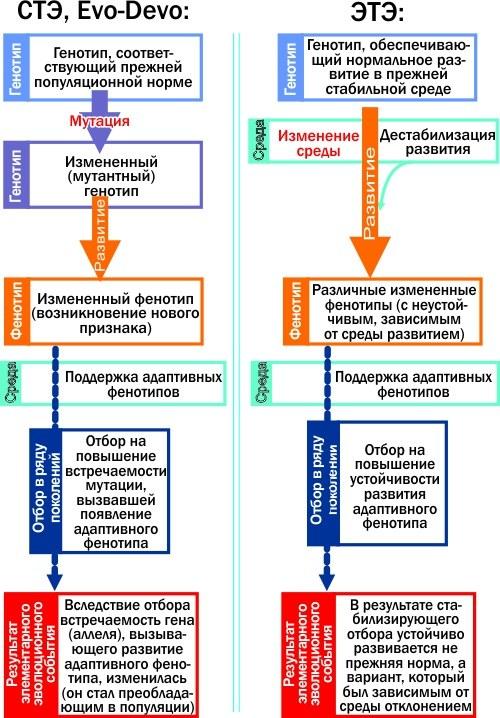
{ "title": "Once again on the nature of ethnos and on the diversity of over-systems: How adaptive traits emerge in the course of evolution, or Which evolutionary theory is supported by modern genetics data?", "summary": "A discussion on the epigenetic theory of evolution (ETE) as an alternative to the synthetic theory of evolution (STE). The author, Dmytro Shabanov, argues that ETE provides a more comprehensive explanation of evolutionary processes, particularly in relation to the emergence of adaptive traits.", "body": "In recent columns, I have repeatedly addressed the topic of ETE, the epigenetic theory of evolution. Its proponents (including myself) consider this theory a serious alternative to the views commonly accepted in evolutionary biology. The synthetic theory of evolution (STE), which has been around for over seventy years, can no longer be considered a product of modern biology. In presenting STE, one has to either go back in time or seriously rework the old theory with amendments and patches.\n\nI am critical of STE, but please do not look for a denial of evolution or sensational news in this column. The discussion is about problems related to the development of evolutionary biology. Unfortunately, in our time, internal scientific discussions (such as the opposition of STE and ETE) are lost amidst noisy attacks on science from the side of pseudoscience.\n\nETE considers the properties of an organism as a result of individual development (ontogenesis). The population norm can develop on a very different genetic basis due to long-term selection for the stability of its reproduction (stabilizing selection). When conditions change, selection begins to destabilize the previous norm and then stabilize the new one, which arises as a response to environmental changes.\n\nThe key ideas for ETE were expressed by I. I. Shmalgauzen and K. H. Waddington in the second half of the last century. These views took shape in the works of Moscow paleontologist Mikhail Alexandrovich Shishkin, published starting in 1984.\n\nETE is approaching its thirtieth anniversary. It would seem that this is an age of maturity... Unfortunately, it has relatively few supporters. One of the reasons is that to understand it, one needs to look at things described in school textbooks from an unusual angle. Many are not capable of this and compensate for the lack of understanding with ridicule or strange accusations.\n\nOne of the specific reasons for the weak popularity of ETE is that supporters of STE love to discuss criticism of their views from the perspective of alternative theories of evolution that are its \"contemporaries,\" i.e., having the same or even greater age.\n\n[Evo-Devo] (evolution-development) is a relatively young area of research that has taken shape in the late twentieth century but has its roots in the nineteenth century. The main attention in Evo-Devo is paid to changes in ontogenesis in evolution.\n\nETE is often compared to Evo-Devo, and this is not accidental. Both approaches consider evolution as a restructuring of ontogenesis. However, the classics of ETE are categorically opposed to the rapprochement of their brainchild and Evo-Devo. The deep differences between these approaches outweigh individual similarities.\n\nThe main difference lies in how they consider the emergence of adaptive traits. According to this criterion, the approach of Evo-Devo does not differ from that of the classical version of STE.\n\n[IMG_1]\n\nThe key stages of elementary evolutionary change according to STE and Evo-Devo, on the one hand, and ETE, on the other. In the left column, the cause of the adaptive trait is the mutation that creates it. In the right column, the destabilization of the previous norm and the organism's integral response to it (influenced by the expedient complex of internal relationships created by previous selection).\n\nBoth STE and Evo-Devo see the cause of new traits in mutations. Classical STE mainly considers the emergence of new alleles characterized by a relatively small effect. Evo-Devo is characterized by attention to mutations of key regulatory genes.\n\nFrom the perspective of ETE, everything looks different. A mutation can almost never create a complex new trait. It is created by a change in ontogenesis after environmental changes make normal development unstable. And then, if generation after generation selection supports a new trait, there will be what K. H. Waddington called \"genetic assimilation\": the genotype will change so that the developmental option that was required by the environment becomes stable.\n\nThe results of comparative genomics confirm the forecasts of ETE. Sergey Yastrebov, in his blog, tells us that even in sponges, the simplest multicellular animals, there are genes (and even gene networks) that control eye development. These genes appeared much earlier than the eyes themselves.\n\n[Elena Naymark] discusses the development of echolocation in dolphins and bats. It turns out that different organisms, developing similar adaptations, can use the same genes for them.\n\nThus, evolutionary innovations are not a consequence of mutations (although they use them). Selection builds a mechanism of gene regulation for such a restructuring of ontogenesis that is \"requested\" by the environment.\n\nThese thoughts of Shmalgauzen are simply ignored by supporters of STE (although Shmalgauzen sometimes contradicted himself).\n\nSTE tries to explain ontogenesis at the level of individual genes. The further genetics develops, the more complex this task becomes. This does not mean that ontogenesis does not rely on genes. It does, but it is not explainable at their level.\n\nThe situation in science is changing: thanks to the successes of comparative genomics, a huge array of data has been obtained on how the genes of organisms change in the course of their evolution. So far, this array is mainly used to reconstruct phylogeny, but its analysis can provide a lot of valuable information about the mechanisms of recorded changes." }
← Dmytro Shabanov → Once More on the Nature of Ethnos, and Also on the Diversity of Supersystems How Adaptive Traits Arise During Evolution, or Which Theory of Evolution is Supported by Modern Genetic Data? A Brief Summary of the Epigenetic Theory of Evolution, or ETE for Busy People Column for Kompyuterra #126 Column for Kompyuterra #127 Column for Kompyuterra #128
Once again about the nature of ethnos, as well as about the diversity of supersystems. How adaptive traits arise during evolution, or Which theory of evolution is supported by modern genetics data? A brief summary of the epigenetic theory of evolution, or ETE for busy people Column for Kompyuterra #126 Column for Kompyuterra #127 Column for Kompyuterra #128
Column for KompyuTerra #126 Column for KompyuTerra #127 Column for KompyuTerra #128