
III. Pisces-04. Class “Osteichthyes” — Bony fishes
It is time to consider the origin and characteristics of bony fishes.
Let us begin by reviewing the chordate system once more.
Phylum Chordata — Chordates
Subphylum Acraniata — Acraniates
Subphylum Tunicata — Tunicates
† Subphylum Conodontochordata — Conodontochordates
Subphylum Vertebrata — Vertebrates
Superclass “Agnatha” — Jawless vertebrates
Superclass “Pisces” — Fishes
†Class “Placodermi” — Armored fishes
†Class “Acanthodii” — Spiny sharks
Class Chondrichthyes — Cartilaginous fishes
Class “Osteichthyes” — Bony fishes
Subclass “Sarcopterygii” — Lobe‑finned fishes
Subclass Actinopterygii — Ray‑finned fishes
Superclass Tetrapoda — Tetrapods
As we have repeatedly noted, in our course quotation marks denote paraphyletic taxa—groups that share a common ancestor but do not include all its descendants. For teaching purposes a system in which mammals are classified as fishes is inconvenient—it does not allow a convenient characterization of fishes. In the latest edition of the most authoritative ichthyofaunal synthesis by J. Nelson (published posthumously), Nelson et al., 2016, the class Osteichthyes has been restored, which includes, among others, tetrapods.
As you recall, the question “what is correct?” is not entirely adequate. Around us there are more or less isolated gene pools (species) that have a definite history (phylogeny). How we “slice” the branching tree of these gene pools is a matter of convenience, not scientific truth. From the various ways of “slicing” this tree (i.e., macro‑systems) one should choose the one that least biases conclusions about tree topology and, conversely, best facilitates its understanding. This textbook adopts such a system.
Thus, the class Bony fishes is the most numerous vertebrate group. According to the latest Nelson synthesis with co‑authors, two subclasses are recognized within this group. In the modern fauna the subclass Lobe‑finned fishes comprises two infraclasses, 4 orders, 4 families and 8 species, while the subclass Ray‑finned fishes comprises three infraclasses, 67 orders, 469 families, ~4 400 genera and ~30 500 species.
As for many other animal groups, the earliest stages of bony‑fish evolution are poorly known. This is because major evolutionary transformations occur in small groups that exist for limited periods. One of the best‑studied early bony fishes is the Devonian cheirolepid—Cheirolepis.
[IMG_3]
In this reconstruction the cheirolepid looks exactly like a ray‑finned fish.
[IMG_4]
Many authors consider this fish a transitional link between the spiny‑shark group and the early ray‑finned group—the palaeoniscids.
[IMG_5]
As the previous slide shows, the earliest stage of ray‑fin divergence is associated with palaeoniscids. Branches of this divergence stage are the most archaic modern ray‑fins (multirays, osseous‑shaped). As the next slide shows, palaeoniscids were quite diverse.
[IMG_6]
Palaeoniscids, in turn, resemble some modern lobe‑finned fishes, especially multirays.
[IMG_7]
On the other hand, the body shape of both palaeoniscids and multirays is archaic. The true success of lobe‑finned fishes is linked to the typical body shape of bony fishes.
[IMG_8]
Various transformations of the typical ray‑fin body shape gave them exceptional success.
[IMG_9]
A complex issue is the relationship between lobe‑finned and ray‑finned fishes. How should their origin be evaluated—independently, or from a common root in early stages? This could be answered if we had a much clearer picture of bony‑fish ancestors.
One of the most interesting taxa for studying the relationship of lobe‑finned and ray‑finned fishes is the Silurian Psarolepis.
[IMG_10]
Its phylogenetic position is uncertain. It may represent an early stage of bony‑fish evolution before the split into lobe‑finned and ray‑finned branches. According to another view, it is an early representative of lobe‑finned fishes.
[IMG_11]
A characteristic feature of all bony fishes (both lobe‑finned and ray‑finned) is the opercular covers that close five gill slits and facilitate water flow through them.
[IMG_12]
Bony fishes lack cosmoid scales, but they may have cosmoid, ganoid, or elasmoid scales. Cosmoid scales are covered with a layer of cosmine, ganoid scales with ganoin; these types of bony tissue differ in their histological characteristics. The “most successful” turned out to be the elasmoid—thin bony scales.
[IMG_13]
Fish body shape reflects adaptation to swimming. It seems simple, but consider how diverse body shape and locomotion can be!
In this video two fragments are combined: one with a fish whose body shape appears typical (with an atypical swimming mode), and one with a marine seahorse—a creature that looks like the product of a sick imagination. Of course, most fish swim in the water column in a horizontal position, sometimes alone, often in schools.
[IMG_14]
Because fish in a school perceive each other simultaneously with many sensory organs, the school’s movement appears as a kind of super‑organism. The lateral line is one of the main sensory organs that provide fish communication.
Naturally, solitary fish also use the lateral line.
For group interaction, visual, electromagnetic, acoustic… and chemical senses are also important.
For a predator, selecting a prey item from a school is a complex task. In the next video the sail‑fin first “herds” the school into a dense ball (keeping the dorsal sail fin spread), then with a rapid movement, folding the sail, attempts to snatch a fish from the school.
The flying fish has no need to rush: it is protected by poisonous spines.
[IMG_15]
The body of flounders is flattened, but unlike skates, flounders lie on the bottom on their side. The common sole swims normally in the water column and has typical bilateral symmetry. Later it settles on the bottom and becomes sharply asymmetrical.
Some basal ray‑finned fishes have a body flattened in the dorsoventral direction. They are usually ambush predators.
[IMG_16]
A laterally flattened, round body is also characteristic of the giant moonfish, a slow‑moving filter feeder…
… and of fishes inhabiting reefs or algal mats, such as the brush‑tooth.
[IMG_17]
The listed forms do not exhaust fish diversity. Among them are organisms that walk on the bottom with limb‑like fins…
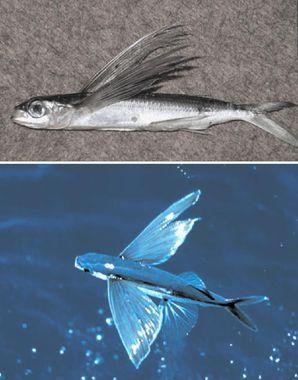
… and swift creations capable of aerial flight.
[IMG_18]
Deep‑sea fishes usually swim slowly and can afford poorly streamlined bodies. The key is a large mouth that can capture scarce deep‑water prey, and various lures to attract victims.
A vivid example of a mid‑water ambush predator is the pike. Note its coloration, which matches the light pattern in aquatic vegetation; its strongly vaulted body; odd fins shifted toward the tail (where lateral movement amplitude is greatest); and powerful flattened jaws.
[IMG_19]
Finally, camouflage considerations can lead to very strange “decorations” on fish bodies. This is the sea‑horse‑pipefish. Its body perfectly imitates a tuft of brown algae.
On the ventral side of this horse (the male!) a batch of eggs is visible. This is a relatively rare form of parental care among fishes.
Many groups exhibit more or less pronounced mating ceremonies, male tournaments, and other spectacular reproductive behaviors.
Most ray‑finned fishes produce relatively small eggs (the photo shows hatchlings emerging from red eggs, i.e., eggs of a salmonid).
[IMG_20]
Although parental care is not typical for most bony fishes, the group’s diversity is so great that it includes the most unusual behavioral forms. For example, some cichlids keep eggs in the mouth or use the mouth as a refuge for fry when threatened.
Sexual dimorphism is usually weak, but many groups contain species with striking differences between males and females.
[IMG_21]
Of course, reproduction in marine seahorses is one of the most unusual fish behaviors and sexual role specializations.
Fishes constitute an extremely important animal group for humans, primarily because they are used as food. Let us compare the exploitation of fishes (on one side) with that of birds and mammals (on the other). Exploitation types are arranged in order of decreasing impact on natural ecosystems.
|
… and of fishes inhabiting reefs or algal mats, such as the brush‑tooth. |
|
The listed forms do not exhaust fish diversity. Among them are organisms that walk on the bottom with limb‑like fins… |
|
|
I |
|
Deep‑sea fishes usually swim slowly and can afford poorly streamlined bodies. The key is a large mouth that can capture scarce deep‑water prey, and various lures to attract victims. |
A vivid example of a mid‑water ambush predator is the pike. Note its coloration, which matches the light pattern in aquatic vegetation; its strongly vaulted body; odd fins shifted toward the tail (where lateral movement amplitude is greatest); and powerful flattened jaws. |
|
II |
Finally, camouflage considerations can lead to very strange “decorations” on fish bodies. This is the sea‑horse‑pipefish. Its body perfectly imitates a tuft of brown algae. |
On the ventral side of this horse (the male!) a batch of eggs is visible. This is a relatively rare form of parental care among fishes. |
Many groups exhibit more or less pronounced mating ceremonies, male tournaments, and other spectacular reproductive behaviors. |
|
III |
|
Although parental care is not typical for most bony fishes, the group’s diversity is so great that it includes the most unusual behavioral forms. For example, some cichlids keep eggs in the mouth or use the mouth as a refuge for fry when threatened. |
Sexual dimorphism is usually weak, but many groups contain species with striking differences between males and females. |

Note that fish exploitation is mainly of type I, whereas birds and mammals are exploited according to type III. However, a shift toward more advanced exploitation forms is occurring. For example, the Black, Azov, and Caspian Seas once yielded large catches of sturgeons. Their populations were depleted by overfishing and river‑flow regulation. Fish farms were established, where a small number of broodstock produced juveniles that were released into the wild. This work continues today, but its efficiency is low. Unexpectedly, Israel entered the market of large‑scale black‑caviar production, achieving a complete sturgeon breeding and reproduction cycle in artificial desert ponds.
Nevertheless, such hopeful stories are still few. Stocks of many commercial fish species that were important a few decades ago are now depleted, and major fishing effort has shifted to other species once considered of low value.
[IMG_22]
As industrial fish stocks are exhausted, increasingly efficient (and, of course, more environmentally destructive) fishing gear is employed.
The next slide shows a group of carp (cultivated form of crucian carp, Cyprinus carpio), one of the most common fish species for pond farming.
[IMG_23]
And these are koi—decorative carp.
[IMG_24]
Interestingly, systematic artificial selection was discovered in ancient China during the breeding of the goldfish—a decorative form of the silver carp.
Some of the benthic ray-finned fish have a body flattened in the dorsoventral direction. These are usually ambush predators. A laterally compressed, rounded body is also characteristic of the giant sunfish, a slow-moving filter feeder... ...and of fish inhabiting reefs or seaweed thickets, like this surgeonfish. The diversity of fish is not limited to the forms listed. Among them are creatures that walk on the bottom on fin-like appendages... ...and swift creatures capable of flight in the air. Deep-sea fish usually swim slowly and can afford poorly streamlined bodies. The main thing is a large mouth that allows them to grab rare prey at depth, and various lures to attract prey. A striking example of ambush predators in the water column is the pike. Note its coloration, which matches the play of light in the aquatic vegetation; its strong, club-shaped body; unpaired fins shifted towards the tail (where the amplitude of lateral movements is higher); and strong, flattened jaws. Finally, considerations of camouflage can lead to very strange 'decorations' on the bodies of fish. This is a leafy seadragon. Its body perfectly mimics a clump of brown algae. On the abdomen of this seahorse (the male!), a clutch of eggs is visible. This is a relatively rare form of parental care for fish. Many groups exhibit more or less pronounced courtship ceremonies, male tournaments, and other spectacular forms of reproductive behavior. Most ray-finned fish produce relatively small eggs (in the photo—larvae hatching from red caviar, i.e., the eggs of some salmonid fish). Although parental care is not characteristic of most bony fish, the diversity of this group is so great that the most unusual forms of behavior can be found within it. For example, a number of cichlids carry their eggs in their mouths or use their mouths as a refuge for fry in case of danger. Sexual dimorphism is usually not pronounced, but in many groups, there are known examples of species with striking differences between males and females. Of course, the reproduction of seahorses is one of the most unusual forms of fish behavior and peculiarities of their sexual roles. Fish are an extremely important group of animals for humans. First of all, this is due to their use as food. Let's compare the exploitation of fish (on the one hand) and birds and mammals (on the other). The types of exploitation are listed in order of decreasing impact on natural ecosystems.
|
… and of fishes inhabiting reefs or algal mats, such as the brush‑tooth. |
|
The listed forms do not exhaust fish diversity. Among them are organisms that walk on the bottom with limb‑like fins… |
|
|
I |
|
Deep‑sea fishes usually swim slowly and can afford poorly streamlined bodies. The key is a large mouth that can capture scarce deep‑water prey, and various lures to attract victims. |
A vivid example of a mid‑water ambush predator is the pike. Note its coloration, which matches the light pattern in aquatic vegetation; its strongly vaulted body; odd fins shifted toward the tail (where lateral movement amplitude is greatest); and powerful flattened jaws. |
|
II |
Finally, camouflage considerations can lead to very strange “decorations” on fish bodies. This is the sea‑horse‑pipefish. Its body perfectly imitates a tuft of brown algae. |
On the ventral side of this horse (the male!) a batch of eggs is visible. This is a relatively rare form of parental care among fishes. |
Many groups exhibit more or less pronounced mating ceremonies, male tournaments, and other spectacular reproductive behaviors. |
|
III |
|
Although parental care is not typical for most bony fishes, the group’s diversity is so great that it includes the most unusual behavioral forms. For example, some cichlids keep eggs in the mouth or use the mouth as a refuge for fry when threatened. |
Sexual dimorphism is usually weak, but many groups contain species with striking differences between males and females. |
Note that the exploitation of fish is mainly of Type I, while birds and mammals are of Type III. However, there is a transition to more developed forms of exploitation. For example, the Black, Azov, and Caspian Seas were once waters where a significant number of sturgeons were caught. Their populations were depleted due to overfishing and river flow regulation. Fish farms were created where young fish were obtained from a small number of broodstock and released into the wild. This work is still ongoing, but its effectiveness is low. But unexpectedly, Israel entered the ranks of major producers of black caviar, which, in desert conditions in artificial reservoirs, ensured the complete cycle of reproduction and breeding of sturgeons. However, there are still few such stories with hope for successful problem-solving. The stocks of a number of commercial fish species, which were important just a few decades ago, are already depleted, and now the main fishing efforts have shifted to other species that were once considered low-value. As commercial fish stocks are depleted, increasingly effective (and, of course, more environmentally destructive) fishing techniques are used for their extraction. The next slide shows a group of carp (a cultivated form of the common carp, Cyprinus carpio), one of the most common species for pond farming. And these are ornamental carp. Interestingly, artificial selection was discovered in ancient China precisely during the breeding of goldfish—a decorative form of the silver crucian carp.