
III. Pisces-02. Class Chondrichthyes — Cartilaginous Fishes
Cartilaginous fishes are often called the most ancient of the modern groups of fishes.
|
||||
|
Dmytro Shabanov, Maryna Kravchenko. |
||||
|
I. Vertebrates Zoology |
Class Chondrichthyes - Cartilaginous |
IV. Amphibia sensu lato |
||
| ← ← III.01. Fishes, Their Characteristic Features and Archaic Groups | ← III.03. Comparative anatomy of cartilaginous fishes → | |||
Cartilaginous fishes are often called the oldest of the living groups of fishes. There is not enough evidence for this. Of course, the skeleton of cartilaginous fishes is more archaic than that of bony fishes. On the other hand, cartilaginous fishes are quite advanced in terms of their reproductive system, possess highly developed sense organs, and in general are a very successful group. In the modern fauna, about 970 species in 184 genera, 54 families, and 14 orders have been described (Nelson, 2009); a number of species are still undescribed. Thus, the number of species of cartilaginous fishes is relatively small, but it should be noted that representatives of this group occupy a prominent place in food chains in the overwhelming majority of marine ecosystems.
Cartilaginous fishes are known from the Devonian. In their history they experienced two periods of flourishing: a Paleozoic and a Meso-Cenozoic one. The second flourishing is associated with only a few groups that arose during the first period of radiation (divergence into different evolutionary branches) of this group.
[IMG_3]
[IMG_4]
The earliest cartilaginous fishes known to us were specialized predators adapted for rapid swimming (this is clearly visible in the body contour of the fish shown in the next reconstruction).
[IMG_5]
The skeleton of cartilaginous fishes, as their name implies, is built of cartilage tissue. Their exoskeletal structures contain bone-like tissues. The outer part of teeth and placoid scales is typically covered with enamel (a hypermineralized acellular skeletal tissue), while the inner part is filled with dentine (a lamellar bone-like tissue). A pulp cavity extends into the tooth and the placoid scale, and nerves and blood vessels enter it.
[IMG_6]
The tooth-like character of placoid scales makes them a serious weapon. A gliding contact with the skin of many cartilaginous sharks can result not only in scratches but also in serious injuries. The next slide shows a piece of leather goods made from sharkskin, which still bears the protection of sharp scales.
[IMG_7]
One of the striking features of cartilaginous fishes is their teeth. They are among the toughest structures created by the evolution of life; many sedimentary rocks are simply packed with shark teeth.
[IMG_8]
The shape of shark teeth depends on how they are used.
For elasmobranch cartilaginous fishes (sharks and rays), hyostyly is typical.
[IMG_9]
Jaws armed with teeth can protrude forward and downward. As can be seen in the next photograph, during an attack many sharks retract their eyes with the help of special muscles: in a struggle with a large prey, the eyes may be damaged. In close combat, sharks are helped by electroreception organs.
[IMG_10]
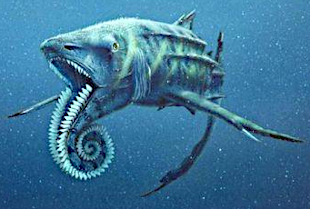
In some Paleozoic sharks a tooth spiral grew from the place where the jaws were fused.
[IMG_11]
Probably this rigid structure was used to plow through bottom sediments, extracting animals hidden there.
[IMG_12]
To detect animals hidden on the bottom, sharks also use electroreception organs. These are best developed in hammerhead sharks. The laterally spread projections of such a shark's head form something like a mine detector.
Notice the sand shark shown in the second part of the video clip below. Lying on the bottom, it pumps water through its gills, working its mouth intensely. The gill septa themselves, as can be seen in the video, are flexible and cannot actively pump water.
The paired fins of sharks are even suitable for pushing off from the bottom. Look at the next slide: roughly this is how the pectoral fins of those lobe-finned fishes, representatives of another group, which became the ancestors of tetrapods, were also bent.
[IMG_13]
Throughout their history, sharks gave rise to fishes with very different body shapes. The next slide shows an inhabitant of Paleozoic reefs with powerful jaws that crush hard food; this is also a shark.
[IMG_14]
But, of course, the “crown” life form of sharks has been and remains the active predator of the water column. The largest cartilaginous fish of all time was the Neogene megalodon (Carcharodon megalodon), which went extinct, by geological standards, quite recently: 1.5-2 million years ago. The size of megalodon is inferred from the size of its teeth, compared with those of modern great white sharks. The fish probably reached more than 20 m in length and weighed 50 t. Like its smaller modern relative, the great white shark (Carcharodon carcharias), megalodon was specialized primarily for hunting mammals. Yet another fantastic BBC series with Nigel Marven...
Although cryptozoologists still dream of finding a living megalodon, the largest modern shark belongs to another group. This is the whale shark (Rhincodon typus). The whale shark is certainly up to 12 meters long, and according to some data even 15 or 18 meters! It is a slow-moving and in its own way graceful filter feeder.
[IMG_15]
Notice how beautifully the whale shark swims in this video!
The next largest shark is the basking shark (Cetorhinus maximus), which reaches about 10 m. It occurs in cold waters. The basking shark is characterized by simply swimming with its mouth open.
[IMG_16]
Notice: through the gill slits you can see the cartilaginous gill rakers that form the shark’s filtering apparatus.
[IMG_17]
Some cartilaginous fishes shifted to a benthic way of life. As can be seen from the skeleton of this Triassic ray, the main propulsive force becomes the pectoral fins.
[IMG_18]
In the breathing of rays, a significant role is played by the spiracle, which opens as an aperture on the dorsal side of the body. When the eagle ray shown in the video stirs up mud, it can receive clean water through the spiracle.
The swimming style of rays turned out to be so successful that even in this group large filter feeders appeared - manta rays (Manta birostris). For this fish it is better to specify the width of the pectoral fin span (up to 7 m) rather than the length.
Cartilaginous fishes are characterized by internal fertilization. The mating organs are claspers - modified parts of the pelvic fins that have grooves for sperm flow. The next slide shows two sharks lying on the deck of a ship. As you understand, the one on top is the female, and the one beneath is the male.
[IMG_19]
Among cartilaginous fishes there are oviparous, ovoviviparous, and viviparous forms. Even in oviparous species, the number of offspring is small: the eggs are large and enclosed in a tough оболонка? = shell. The video lets you observe several developmental stages and the hatching process of a shark.
And here is the process of viviparity in a shark. The pup is connected to the mother by a “umbilical cord” - the yolk stalk.
[IMG_20]
Systematic overview of cartilaginous fishes
Here the classification of cartilaginous fishes according to J. S. Nelson (2009) is used. The orders highlighted in brick color are those that second-year students should know.
Class Chondrichthyes - Cartilaginous fishes
Subclass Holocephalii - Holocephalans
Order Chimaeriformes - Chimaeriformes
Subclass Elasmobranchii - Elasmobranchs
Section Neoselachii - Neoselachians
Subsection Selachii - Sharks
Superorder Galeomorphi
Order Heterodontiformes - Heterodontiformes
Order Orectolobiformes - Wobbegong-like sharks
Order Lamniformes - Lamniformes
Order Carcharhiniformes - Carcharhiniformes
Superorder Squalomorphi
Order Hexanchiformes - Sixgill sharks
Order Echinorhiniformes - Echinorhiniformes
Order Squaliformes - Dogfish sharks
Order Squatiniformes - Angelsharks
Order Pristiophormes - Sawsharks
Subsection Batoidea - Rays
Order Torpediniformes - Electric rays
Order Pristiformes - Sawfishes
Order Rajiformes - Skates
Order Mylobatiformes - Eagle rays
The class is divided into two subclasses.
Subclass Holocephalii - Holocephalans
Four gill slits on each side of the body are covered by gill covers. Modern representatives are holostylic (the palatoquadrate cartilage fuses with the axial skull). The anal and urogenital openings are separate. In modern representatives the skin is naked. The stomach and ribs are absent. In males of modern species there is a specific "clasper" on the head for holding females. The dental apparatus consists of several large tooth plates specialized for grinding hard food.
Known from the Upper Devonian; by the end of the Paleozoic they were much more diverse and numerous than they are now.
Order Chimaeriformes - Chimaeriformes
Three families, six genera, 33 species.
[IMG_21]
The structure of chimaeras is modified by adaptation to sclerophagy - feeding on hard food.
[IMG_22]
Chimaeras swim slowly.
And this chimaera was thrown onto land during an earthquake in Indonesia.
[IMG_23][IMG_24]
Subclass Elasmobranchii - Elasmobranchs
This subclass is characterized by separate gill slits, 5-7 on each side of the body. Of several groups, only one has survived to the present: Neoselachii - Neoselachians. It includes 13 orders, 51 families, 178 genera, and about 937 species (403 species of sharks and 534 species of rays)
Subsection Selachii - Sharks
The gill slits are typically located on the sides of the body. The anterior edge of the pectoral fin is not attached to the lateral surface of the head.
Order Heterodontiformes - Heterodontiformes
Two dorsal fins, each with a spine. Head with prominent supraorbital ridges. One family is distributed in the warm waters of the Indian and Pacific Oceans. Length up to 1.6 m.
[IMG_25]
One genus and 8-9 species of bullhead sharks, small benthic fishes of the Indian and Pacific Oceans.
[IMG_26]
Order Orectolobiformes - Wobbegong-like sharks
In most species there is a well-developed groove running from the nostril to the mouth, and barbels are present. Distributed worldwide.
The largest representative is Rhincodon typus, the whale shark, whose video has already been shown on this page. This is the largest fish; as noted above, its length is at least 12 m (and according to some data up to 18 m)!
[IMG_27]
This is a more diverse order than the previous one. It includes 7 families, 14 genera, and 32 species. Besides the whale shark, this order includes carpet sharks (wobbegongs), nurse sharks, as well as zebra sharks and blind sharks.
[IMG_28]
The wobbegong is a typical bottom-dwelling ambush predator. Look at how the edge of its head is camouflaged by outgrowths resembling algae. Can you see the wobbegong in the next slide?
[IMG_29]
Order Lamniformes - Lamniforms
No barbels. Seven families, 10 genera, 15 species. Distributed worldwide.
[IMG_30]
Tiger, blue, herring, megamouth, goblin, thresher sharks, and white sharks, including the great white shark (Carcharodon carcharias), which reaches 6 m in length. Of course, it is the great white shark that has the worst reputation among them.
[IMG_31]
However, the fear of the great white shark is probably exaggerated. Human beings do not match the image of a typical prey item for this predator, just as they do not for other sharks. The opposite extreme is the stories about people's “friendship” with great white sharks. Supposedly, the fisherman shown in the next photograph trained a great white shark to come and “socialize”.
[IMG_32]
Lamniformes also include the peculiar goblin shark, Mitsukurina owstoni, also called the goblin shark. It occurs at depths from 200 meters worldwide. The peculiar perception of such creatures is well reflected in the video story about the capture of a goblin shark in the Black Sea.
Order Carcharhiniformes - Carcharhiniformes
Eight families, 49 genera, and at least 224 species (more than half of all sharks)
[IMG_33]
Cat sharks, requiem sharks, grey sharks, large-eyed sharks, hammerhead sharks, and sawsharks. The silhouettes show that these are swift predators of the water column.
[IMG_34]
Do you think it is easy to snatch prey from a school of squid?
[IMG_35]
The tiger shark Galeocerdo cuvier is one of the largest sharks (up to 5.5 m). It is widely distributed. It has a very broad diet (it eats carrion and can even eat people if the opportunity arises). It is a commercial species.
Hammerhead sharks look very unusual from the front.
[IMG_36]
Seven species of carcharhiniform sharks enter fresh waters.
Order Hexanchiformes - Sixgill sharks
One dorsal fin, 6 or 7 gill slits. Two families, 4 genera, 5 species.
[IMG_37]
Frilled and sixgill sharks. Slow-moving deep-water sharks. The next two slides show a frilled shark (Chlamidocephalus anguensis).
[IMG_38]
Notice the shape of its teeth!
[IMG_39]
Order Echinorhiniformes - Bramble sharks
A small group (one genus with two species) standing apart. The body is covered with large denticles (tooth-like scales). Length up to 2 m.
[IMG_40]
Order Squaliformes - Dogfish sharks
Six families, 24 genera, and 94 species. No anal fin. Distributed worldwide.
[IMG_41]
This order includes rather diverse, mostly small species. Among them are spiny and polar sharks.
The next slide shows a diver with a group of spiny dogfish (Squalus acanthias), widespread sharks that also live in the Black Sea.
[IMG_42]
Order Squatiniformes - Angel sharks
One family, one genus, and 15 species of angel sharks. Body ray-like, length up to 2 m.
[IMG_43]
Angel sharks are benthic ambush predators that somewhat resemble rays, but like other sharks they have gill slits on the sides of the body. Look at the coloration of this shark and you will see a play of light refracted by gentle ripples on the sandy bottom.
[IMG_44]
In the next video, an angel shark spectacularly grabs a bull shark, but lets it go because of the spines with which the bull shark is armed.
Order Pristiophormes - Sawsharks
One family of sawsharks, two genera and 5 species, length up to 1.4 m. The body is elongated, with a saw-like snout lined with teeth pointing in both directions.
[IMG_45]
Sawsharks resemble sawfishes, but differ in the position of the gills (in sharks they are lateral, in rays ventral), the presence of barbels on the saw (present in sharks), and the maximum size (sharks up to 2 m, rays up to 7 m). The similarity between sawsharks and sawfishes (both can be called “sawfishes”) is a vivid example of convergence.
Subsection Batoidea - Rays
In some systems the subdivision of neoselachians into sharks and rays is not accepted, and all rays are united in one order. We, following Nelson, accept the recognition of four orders of rays.
[IMG_46]
This is the most numerous group of cartilaginous fishes. The body is flattened in the dorsoventral direction; the mouth and gill slits are on the ventral side of the body, the eyes and spiracle are on the dorsal side. The anterior edge of the greatly enlarged pectoral fin is attached to the lateral surface of the head. The teeth are in most cases flattened and rounded. Known since the Jurassic. This slide shows the ventral side of a ray...
[IMG_47]
...and this one shows the front part of the dorsal side of a completely different species, with a large spiracle located behind the eye. In most cases, in rays water reaches the gills through the spiracle.
[IMG_48]
Although rays are usually leisurely, they can leap out of the water like this mobula...
[IMG_49]
...or undertake joint spawning migrations like these eagle rays.
[IMG_50]
Order Torpediniformes - Electric rays
In electric rays, a significant part of the muscles is transformed into electric organs, whose discharge can paralyze prey that approaches the ray or be used for defense.
Two families, 11 genera, 59 species, distributed in all oceans.
[IMG_51]
Order Pristiformes - Sawfishes
These are the sawfishes mentioned above, members of the single family Pristidae in the order, with two genera and 7 species living in the tropics.
[IMG_52]
Such a rostrum makes it possible both to strike fish with lateral blows of the head and to plow animals hidden in the mud out of it.
[IMG_53]
The “swords” of the sawfish are used as weapons in many indigenous cultures. In addition, similar constructions can be made from the teeth of other sharks mounted on a wooden base.
[IMG_54]
Order Rajiformes - Skates
The tail region is very thin; most species have spines - modified placoid scales. Four families, 32 genera, 285 species.
Two species of skates are widespread in the Black Sea. One of them is the thornback ray (Raja clavata) from the family of diamond rays.
[IMG_55]
Order Mylobatiformes - Eagle rays
Ten families, 27 genera, 183 species. In addition to stingrays, this order includes eagle rays, mantas, and river stingrays.
The second common Black Sea species of ray is the stingray (Dasyatis pastinaca) from the family of stingrays.
[IMG_56]
The stingray reaches a length of more than 2 meters, although, of course, the vast majority of individuals that a diver may encounter are much smaller. A sting from the stingray’s spine is quite painful and can cause drowning.
The story of the diversity of cartilaginous fishes is over. This is a beautiful and interesting group of animals. Do not give in to the fears and hostility that are imposed toward some of them!