
IV. Amphibia sensu lato-12. Batrachofauna of Kharkiv Oblast and the Vicinity of the Biological Station (Excluding Green Frogs)
An overview of the amphibians of Kharkiv Oblast (excluding green frogs, which are covered on a separate page)
An excerpt from a field practice manual for vertebrate zoology (with minor modifications). The section on reptiles was written primarily by O.I. Zinenko, and the section on amphibians primarily by D.A. Shabanov.
Atemasova T.A., Vlashchenko A.S., Goncharov G.L., Zinenko O.I., Korshunov O.V., Tokarsky V.A., Shabanov D.A., Shandykov G.A. Field Training in Vertebrate Zoology. – Kharkiv: V.N. Karazin Kharkiv National University, 2019. – 196 p.
Batrachofauna of Kharkiv Oblast and the Vicinity of the Biological Station (Excluding Green Frogs)
Order Caudata (Tailed Amphibians)
The order Caudata comprises 737 species distributed exclusively in the Northern Hemisphere. Most are small in size, although the largest species (the Chinese giant salamander) reaches 1.8 m in length. The most primitive representatives of the order inhabit the north and the mountain ranges of Asia. Unlike the larvae of anurans, which are shaped by fast-flowing streams, the larvae of caudates are adapted to life in slower or even standing waters, where they can feed on a variety of planktonic and benthic invertebrates. The body plan of caudates is the ancestral form for tetrapods; however, this does not imply that caudates represent a more ancient group than anurans. Caudates are highly characterised by manifestations of paedomorphosis (the retention in the adult state of features characteristic of earlier ontogenetic stages), including neoteny (reproduction in the larval state, when development of all organ systems except the reproductive system is arrested). Several families of caudate amphibians arose from neotenic larvae of certain ancestral forms, and paedomorphic traits are to some degree characteristic of the entire order. The most species-rich family of the order, Plethodontidae, has lost pulmonary respiration as a consequence of paedomorphosis. Therefore, the relative primitiveness of caudates may be regarded as secondary, associated with the paedomorphic nature of the entire group. The fact that representatives of the order Caudata are treated in this manual after, rather than before, anurans reflects precisely this perspective (the conventional approach is to arrange taxa within a group in order from the most primitive, ancestral forms to the relatively more derived).
Internal fertilisation is characteristic of caudates; only the most primitive representatives of the order exhibit a specific form of external fertilisation, in which the male deposits a spermatophore adjacent to the egg mass and spermatozoa migrate to the eggs via a specialised "bridge". In all representatives of the fauna of Ukraine, as in the majority of caudate species generally, the male deposits a spermatophore on a substrate, and the female takes it up into her cloaca, where fertilisation occurs. Spawning in most caudate amphibians is accompanied by elaborate courtship displays. Unlike anurans, metamorphosis in caudates is more gradual, without a catastrophic transformation of body form.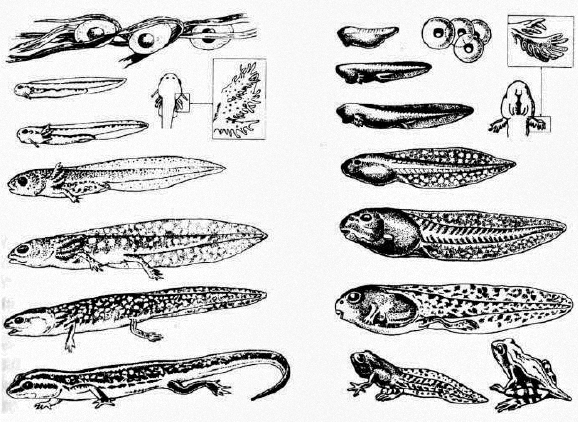
Comparison of larval development in caudates (smooth newt) and anurans (moor frog)
The fauna of Ukraine includes representatives of the family Salamandridae, which encompasses salamanders (with a round cross-section of the tail) and newts (all representatives with a laterally compressed tail).
Smooth Newt (Lissotriton vulgaris)
The smooth newt is a small and rather delicate amphibian, reaching a total length (body plus tail) of up to 90 mm. The venter is yellow or orange with dark spots; the dorsum is brownish, with more or less distinct dark longitudinal stripes. In nuptial colouration, the male becomes spotted and a blue stripe appears along the tail. In the nuptial male, the dorsal crest continues uninterrupted into the tail crest without a notch. A characteristic feature of the species is the presence of dark stripes on the head passing through the eye.
The range extends from the British Isles to western Siberia, and from Karelia to the Danube Delta.
The smooth newt is a terrestrial animal that enters water bodies only in spring, during the breeding season. After the courtship display, the male deposits a spermatophore, which the female takes up into her cloaca; she then lays individual eggs, wrapping each in a leaf of aquatic vegetation. Larval development lasts 2–2.5 months. Larvae feed on small aquatic invertebrates. Cases of overwintering by larvae that have not completed metamorphosis have been recorded, as have isolated neotenic populations of smooth newts.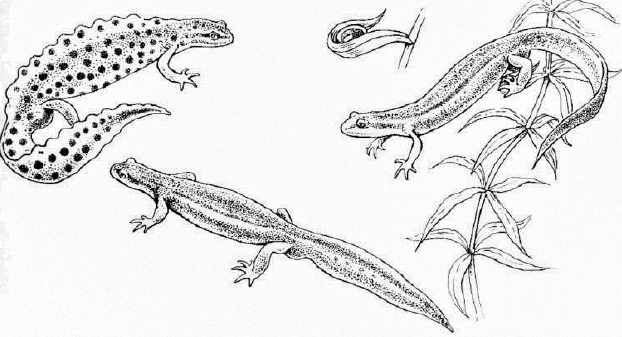
Courtship display and egg-laying in the smooth newt
In the vicinity of the biological station, smooth newts have become scarce in recent years. The smooth newt spawns in shallow, vegetated sections of ponds, and in floodplain water bodies of the Siverskyi Donets River and the Homilsha River. Outside the breeding period, it may be found under logs and pieces of bark in the upland oak forest, in the floodplain, and in the pine forest. During hydrobiological field excursions, larvae of the smooth newt frequently enter the net together with other aquatic organisms.
Northern Crested Newt (Triturus cristatus)
Considerably larger than the preceding species, with a total length of up to 120 mm. It is further distinguished by the absence of stripes on the head, a more coarsely granular dorsal skin, and a pronounced notch between the dorsal and caudal crests of the male.
The crested newt is a European species distributed from France to the Urals. In southern Ukraine, closely related species that attained independent species status relatively recently are found: the Danube crested newt (Triturus dobrogicus) is distributed in the Zakarpattia, Odesa, and Kherson oblasts (lower reaches of the Danube and Dnipro rivers), and Karelin's newt (Triturus karelinii) in Crimea.
Crested newts spend spring and the first half of summer in water bodies; in the second half of summer they inhabit forest, concealing themselves under logs and in the leaf litter.
Spawning occurs in floodplain water bodies and ponds. After the courtship display, the male deposits a spermatophore, which the female takes up. The female lays several dozen eggs individually, carefully wrapping each in a leaf of aquatic vegetation. Larval development lasts 2.5–3 months. Larvae feed on small aquatic invertebrates. Larvae in the latest developmental stages are considerably larger than larvae of the smooth newt.
Wintering occurs on land in leaf litter, under tree stumps, and in the burrows of moles and rodents.
In Kharkiv Oblast, this is a rare species listed in the Red Data List of Kharkiv Oblast; it occurs in the vicinity of the biological station in upland oak forest, floodplain oak forest, mixed pine-deciduous forest, and birch groves. Due to its cryptic habits, encounters during summer field practice are very rare.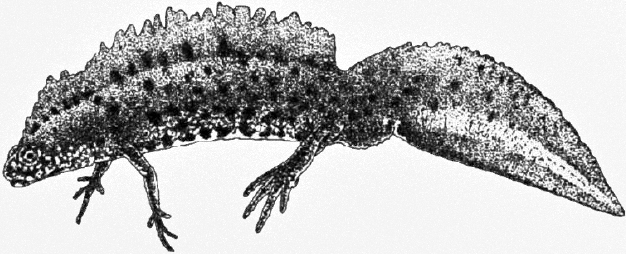
Male crested newt in nuptial colouration
Order Anura (Anurans / Frogs and Toads)
Anurans are a group of amphibians that originated in the Jurassic period. All representatives of this group are characterised by the so-called "frog-like" body form. They possess a shortened vertebral column, an elongated pelvic girdle, caudal vertebrae fused into a urostyle, elongated hind limbs with an additional tibiale-fibulare element, a large broad head, and well-developed sense organs. This distinctive body plan was shaped by a "shore-leaping" lifestyle, in which these animals escape pursuit with a single jump. This group proved highly successful; various representatives have diversified in association with their particular lifestyles. To escape a stalking predator, these animals required well-developed visual and auditory organs. The advanced development of hearing promoted the evolution of acoustic signalling. Nevertheless, the frog-like body form proved suitable for colonising other adaptive zones (modes of life).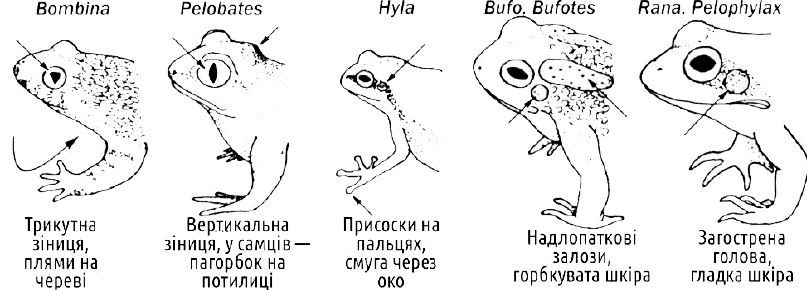
Characteristic features of adults of 5 families of anuran amphibians
Fertilisation in most anuran species (and in all species of our fauna) is external; eggs are typically deposited in water. In our species, spawning is restricted to spring and early summer. An essential element of spawning behaviour is amplexus — the prolonged clasping of the female by the male using the forelimbs, which stimulates egg maturation and synchronises the release of gametes. Amplexus in the majority of anuran amphibians is of two types: inguinal (the male clasps the female at the base of the thighs, "at the waist") and axillary (the male clasps the female behind the shoulders, "under the armpits").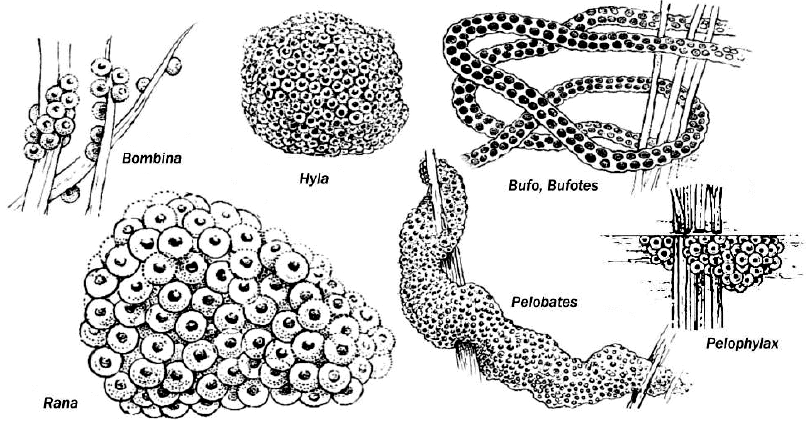
External appearance of egg masses of anuran amphibians of Kharkiv Oblast
The spawning period may be brief or protracted. In the former case, spawning commences immediately upon the arrival of the animals at the water body and lasts for a short period — 1–2 weeks for males and 2–3 days for females. This is because males remain in the water body throughout the entire spawning period, whereas females leave immediately after oviposition. This type of spawning is characteristic of most terrestrial anuran species. In protracted spawning, which is characteristic of aquatic and semi-aquatic species, breeders initially feed actively for several days or even weeks after arriving at the water body, after which spawning continues for 1–1.5 months.
The evolutionary origin of anurans is associated with high-mountain environments (the most primitive extant representatives of this order still inhabit such environments). To prevent larvae from being swept downstream in fast mountain currents, they required a streamlined body form and the ability to attach effectively to a substrate. This is associated with the formation of the characteristic larval form — the tadpole. Since zooplankton is virtually absent in mountain streams, anuran larvae became adapted to scraping food particles from substrates. The oral disc of a tadpole is surrounded by keratinised plates that permit scraping of zoo- and phytoperiphyton from the substrate to which the larva has attached itself. Metamorphosis in anurans is catastrophic, that is, it is accompanied by pronounced changes in body form and the reorganisation of internal organs.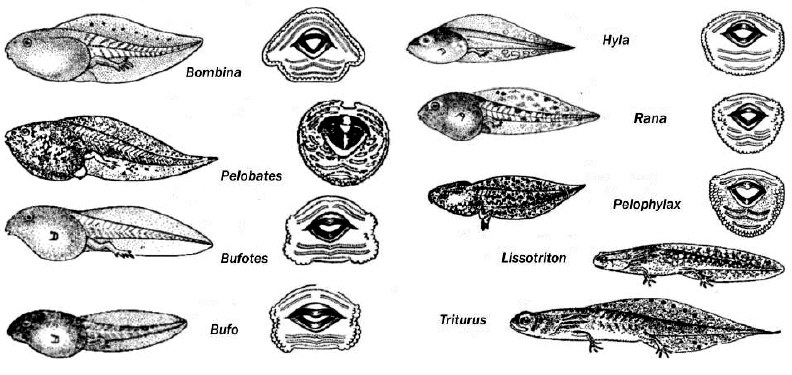
Features of external morphology of larvae of certain amphibian species of the fauna of Ukraine
Fire-Bellied Toad (Bombina bombina)
A small semi-aquatic anuran species with a body length of up to 64 mm. The dorsum is brownish, sometimes greyish-green, and cryptically coloured. When threatened, the fire-bellied toad arches its back, exposing yellow or orange marbling and spots on the ventral surface of the body — warning (aposematic) colouration. A diagnostic character is the triangular or heart-shaped pupil. It secretes an acrid mucus, the principal active component of which is the polypeptide bombesin. The antibacterial properties of this mucus have long been known: fire-bellied toads (known in folk usage as "kholodushky" or "krestiyanky") were placed in jugs of milk to prevent souring.
Feeds predominantly in water. Unlike other anurans of Kharkiv Oblast, it possesses a small, rounded tongue incapable of being projected. The advertisement call is a plaintive "oo" or "unk". Amplexus is inguinal. Eggs are deposited in small batches as clumps. Larvae develop for approximately three months. Hibernation occurs on land.
The species inhabits the northern portion of the steppe zone, the forest-steppe zone, and the forest zone in Central and Eastern Europe; it occurs throughout most of Ukraine. In western Ukraine, a closely related species — the yellow-bellied toad, Bombina variegata (Linnaeus, 1758) — is found. The primary external distinction between the two species is that in the fire-bellied toad, red spots are set against a dark background, whereas in the yellow-bellied toad, dark spots are set against a yellow background. In the zone of contact, the two species are capable of hybridising.
A common species in small water bodies in the floodplains of the Siverskyi Donets and Homilsha rivers, in Iskove and Dobrytske ponds, and in the pond in Koryakove ravine. In summer, during wet years, migrating individuals may be encountered in rain puddles in upland oak forest, on the gas pipeline clearing, and on forest roads far from permanent water bodies.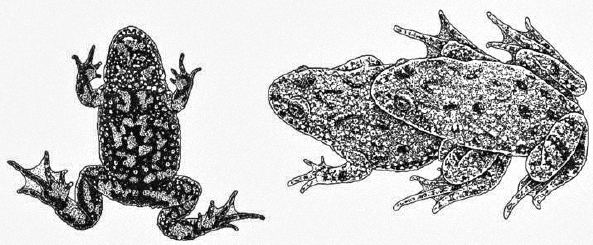
Ventral surface of the fire-bellied toad and inguinal amplexus of a pair of fire-bellied toads
Pallas's Spadefoot Toad (Pelobates vespertinus)
At the beginning of the twenty-first century, during a study of variation in the common spadefoot toad, Pelobates fuscus (Laurenti, 1768), it was established that the species' range is inhabited by two forms differing in nuclear genome size. On the basis of these findings, the species name Pelobates vespertinus (Pallas, 1771) was restored for the eastern form, which has a larger genome. The boundary between the eastern and western (nominotypical P. fuscus) forms passes through Poltava, Dnipro, and Zaporizhzhia oblasts. External differences between the two forms are slight; a comparative study of the ecological characteristics of the two forms has not yet been carried out in an adequate manner. Species that are virtually indistinguishable morphologically but differ genetically are termed sibling species (cryptic species).
The species resembles a small toad, differing from it by a vertical pupil, smooth skin, the absence of large parotoid glands, and a strongly developed, spade-like, keratinised metatarsal tubercle. The skull bears large dermal ossifications that form a characteristic protuberance on the occiput. Body length up to 80 mm. Tadpoles may be very large (in some cases up to 180 mm). Juveniles are approximately 4 cm in size at metamorphosis — considerably larger than the juveniles of all other anuran amphibians in our fauna at the same stage (ranging from 1–1.5 cm in toads and fire-bellied toads to 2 cm in frogs and tree frogs). Animals of this size are much better able to burrow into the ground and accumulate the water reserves necessary to survive underground during dry periods.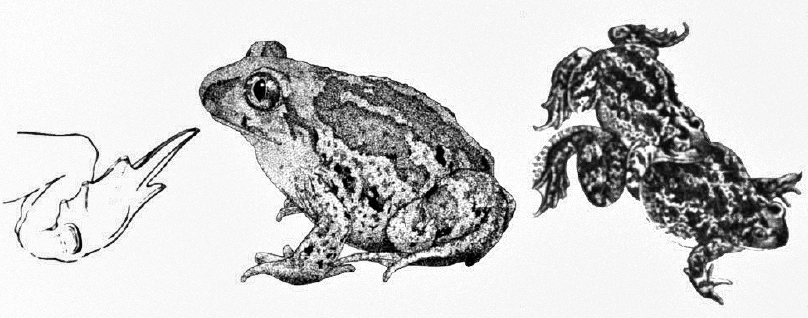
Pallas's spadefoot toad (centre) and its spade-like metatarsal tubercle (left); inguinal amplexus of spadefoot toads (right). These illustrations were originally produced as depictions of the common spadefoot toad, Pelobates fuscus, which is indistinguishable from Pallas's spadefoot toad in such figures.
Distributed in the steppe and forest-steppe zones, as well as in the Polissia region of Eastern Europe and Western Asia. The boundary of the ranges of the two forms requires further clarification.
A species superbly adapted to burrowing (even into dry soil). The male's call is a quiet grunting or clucking; vocalisation occurs underwater. The egg mass is a short, thick cord with several rows of eggs. Amplexus is inguinal. Larval development lasts 2.5–3 months.
A common species in the vicinity of the biological station, occurring predominantly at night. Spawns in standing water bodies — in all ponds, temporary floodplain water bodies, and oxbow lakes. Terrestrial habitats of the spadefoot toad outside the breeding period are rather diverse, but as a rule it achieves greatest abundance in open areas and on sandy soils: floodplain meadows, clear-cuts in pine forest, and similar habitats.
Advertisement call of the male Pelobates fuscus — common spadefoot toad (presumably very similar to the call of Pelobates vespertinus)
Eastern Tree Frog (Hyla orientalis)
A slender arboreal species reaching a length of 50 mm. Characteristic features are adhesive discs on the tips of the digits and long, slender hind limbs. The dorsal colouration is typically green. Yellow-green, grey, or brownish individuals occasionally occur; colour changes in response to temperature or physiological state of the animal are possible. The venter is white, separated from the dorsum by a black stripe that forms a characteristic inguinal loop in front of the thighs. Tree frogs are also known in folk usage as "raiky", "rakhavky", and "krakavky".
All tree frogs distributed in Ukraine were long attributed to the species Hyla arborea (Linnaeus, 1758). Molecular studies established (Stöck et al., 2012) that two species of tree frogs inhabit Eastern Europe, with ranges separated by the Carpathians. West of the Carpathians (and in the Transcarpathian region of Ukraine), Hyla arborea is distributed, while to the east, Hyla orientalis Bedriaga, 1890 is found.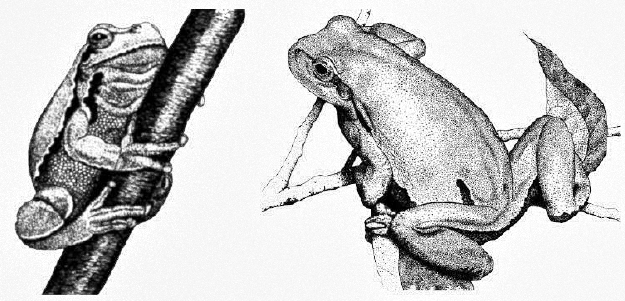
Eastern tree frog (these illustrations were originally produced as depictions of the common tree frog, Hyla arborea, which is indistinguishable from the eastern tree frog in such figures)
Distributed in Eastern Europe from the Carpathians to the Caucasus. Inhabits meadows, shrublands, and forest biocoenoses. The advertisement call is sharp, resembling the sound of filing the edge of a metal sheet with a rasp, the call of cicadas, or duck quacking, but more intense. A calling male inflates a large gular resonator. Amplexus is axillary. The egg mass is compact and rounded. Development lasts 2.5–3 months.
During the day, individuals typically sit motionless on vegetation, sometimes ascending even into the upper canopy of trees; foraging occurs at night. In summer, individuals may be encountered in moist locations in the floodplain forest or in the upland oak forest, in shrub thickets at the forest edge, in mixed pine-deciduous forest, and in birch groves on the pine terrace. In these habitats, vocalising males may be heard in mid-summer and in September. In spring (April–May), spawning takes place in almost all standing water bodies in the floodplains of the Siverskyi Donets and Homilsha rivers and in all ponds.
The eastern tree frog is listed in the Red Data List of Kharkiv Oblast.
Advertisement call of the male Hyla arborea — common tree frog (presumably very similar to the calls of males of Hyla orientalis — eastern tree frog)
Common Toad (Bufo bufo)
A large anuran species — individuals up to 110 mm are found in the vicinity of the biological station of V.N. Karazin Kharkiv National University. Maximum length up to 130 mm.
The skin is dry, covered with numerous protuberances — "warts". Behind the head are situated large parotoid glands. A predator attacking the toad bites these glands and thereby promotes the discharge of venom from them. The venom is chemically complex and includes toxic steroids (bufadienolides), hallucinogenic amines (bufotenin), and proteins.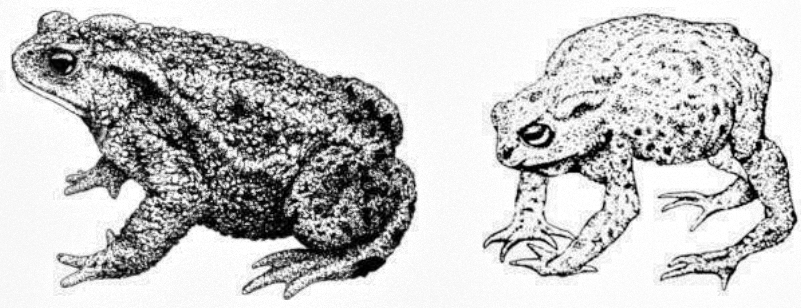
Common toad in normal posture (left) and in the defensive posture adopted in response to snakes (right)
The range extends from north-western Africa to western Siberia. The species is typically associated with forests. Habits are cryptic; individuals are active at night. This species becomes conspicuous only during the breeding season. Spawning occurs during the day, in late March to early April; it is only occasionally accompanied by advertisement calls from males (resembling a gentle piping sound). Amplexus is axillary. The egg mass takes the form of a long mucous cord with 1–2 rows of eggs. Tadpoles are capable of forming enormous aggregations within which individuals move in a coordinated manner. Larval development lasts 1.5–2 months.
The species exhibits strongly pronounced philopatry (spawning in the water body in which larval development occurred) and forms clearly delimited populations that differ markedly from one another. The population of common toads at Iskove Pond has been the subject of study by mark–recapture methods since 2000. Over this period, the population has undergone increases and decreases in abundance, and changes in size and age structure associated with different phases of population dynamics. Some individuals were encountered at spawning up to 12 years after their first capture.
The species is common in the vicinity of the biological station of V.N. Karazin Kharkiv National University, but due to its cryptic habits it is encountered infrequently in summer. The common toad is listed in the Red Data List of Kharkiv Oblast.
It differs from green toads in body form, colouration, the presence of paired articulated tubercles on the digits of the hind limbs (vs. single in green toads), and the absence of a tarsal fold.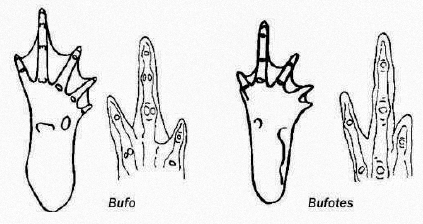
Some diagnostic characters of the common toad and the green toad
Green Toad (Bufotes viridis)
Maximum body length of green toads reaches 120 mm, although in Kharkiv Oblast individuals exceeding 85 mm have not been recorded. The range extends from the Sahara to the Altai, from Estonia to Central Asia (these data may require clarification), encompassing the whole of Ukraine. The species inhabits forests, steppes, and semi-deserts. Several subspecies are formed; closely related triploid and tetraploid species occur in Asia. Isolated triploids of green toads may also be found in Europe.
It differs from the common toad in body form and colouration: common toads are predominantly uniform in colour, whereas green toads are in "camouflage" colouration. Furthermore, unlike common toads, green toads possess single articulated tubercles on the digits of the hind limbs and a tarsal fold. In some sources, this species is placed in the genus Bufo; however, following the revision of 2006 (Frost et al.), it was segregated (together with closely related species) into the genus Pseudepidalea, for which the older name Bufotes was reinstated in 2010 (Dubois, Bour).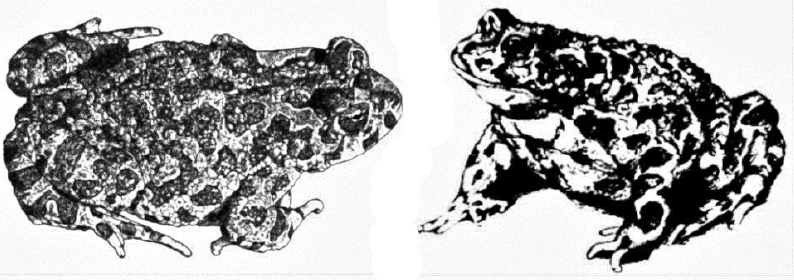
Green toad
Spawning occurs predominantly at night, in April–June, in the vicinity of the biological station in Iskove and Koryakove ponds, and in small water bodies in the village of Haidary. The advertisement call of the male is a loud, melodious trill. A calling male inflates a large gular resonator. Amplexus is axillary. Egg masses, as in the common toad, take the form of a long mucous cord. Larval development lasts approximately one month.
The green toad is far more readily encountered on the territory of Kharkiv or Zmiiv than in the vicinity of the biological station of V.N. Karazin Kharkiv National University in Haidary. Reports indicate a decline in the abundance of this species in the vicinity of the biological station.
Moor Frog (Rana arvalis)
A terrestrial frog of up to 80 mm in length, with a pointed snout. The range is vast — from France to Yakutia, from the White Sea to China. A well-defined dark temporal spot passes laterally across the head through the eye. Nuptial colouration of males is blue or lavender. During spawning, males produce barking-bubbling sounds. Amplexus is axillary. Eggs are deposited as large clumps floating on the water surface. Frequently, many pairs spawn on a small section of a water body, resulting in the formation of entire "egg fields" composed of dozens of egg masses. Development lasts approximately two months.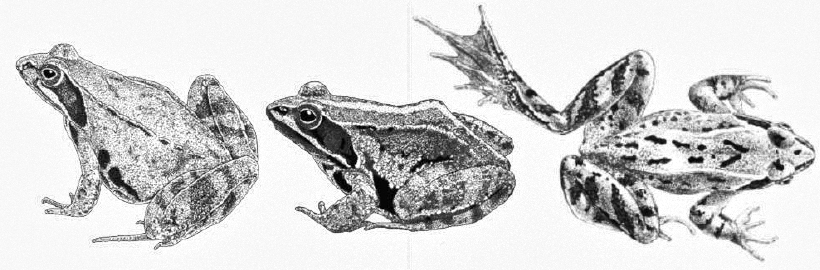
Moor frog
An interesting question concerns the relationship between the "long-legged" and "short-legged" forms of the moor frog. Relative leg length is determined as follows: when the hind limb is extended alongside the body, in "short-legged" frogs the ankle joint typically reaches as far as the eye, whereas in "long-legged" frogs it reaches the tip of the snout or extends slightly beyond it. Several authors treat "short-legged" frogs as representatives of the nominotypical subspecies R. a. arvalis and "long-legged" frogs as the Western European subspecies R. a. wolterstorffi. This interpretation is inconsistent with the status of R. a. wolterstorffi as a geographical subspecies, since "long-legged" individuals occur in western Ukraine, in the Dnipro valley, in the vicinity of Kharkiv, and in the lower reaches of the Don River. An alternative hypothesis holds that the long-legged and short-legged forms are not geographical subspecies but ecological forms associated with different habitats (for example, the "long-legged" form is associated with steppes, pine forests, and river valleys, while the "short-legged" form is associated with deciduous forests). Samples from Kharkiv Oblast (for example, from the vicinity of Haidary) are inconsistent with either hypothesis. In these samples, long-legged and short-legged forms occur with equal frequency among both females and males. It has also been proposed that the two forms differ in developmental strategy: one form is characterised by rapid growth, early sexual maturity, high fecundity within a single season, and a short lifespan, while the other is characterised by slow growth, late maturity, low fecundity, and a long lifespan.
It differs from the European common frog by a high metatarsal tubercle (low in the European common frog) and a pointed snout. Another characteristic feature of the European common frog is the red colouration of the ventral side of the limbs.
The species is common in the vicinity of the biological station. It breeds in standing water bodies both in ravines and in floodplains. During much of the season, it inhabits floodplain forests and upland oak forest, floodplain meadows, and also pine forest, mixed pine-deciduous forest, and birch groves.
Pallas's Spadefoot Toad (Pelobates vespertinus)
At the beginning of the twenty-first century, during a study of variation in the common spadefoot toad, Pelobates fuscus (Laurenti, 1768), it was established that the species' range is inhabited by two forms differing in nuclear genome size. On the basis of these findings, the species name Pelobates vespertinus (Pallas, 1771) was restored for the eastern form, which has a larger genome. The boundary between the eastern and western (nominotypical P. fuscus) forms passes through Poltava, Dnipro, and Zaporizhzhia oblasts. External differences between the two forms are slight; a comparative study of the ecological characteristics of the two forms has not yet been carried out in an adequate manner. Species that are virtually indistinguishable morphologically but differ genetically are termed sibling species (cryptic species).
The species resembles a small toad, differing from it by a vertical pupil, smooth skin, the absence of large parotoid glands, and a strongly developed, spade-like, keratinised metatarsal tubercle. The skull bears large dermal ossifications that form a characteristic protuberance on the occiput. Body length up to 80 mm. Tadpoles may be very large (in some cases up to 180 mm). Juveniles are approximately 4 cm in size at metamorphosis — considerably larger than the juveniles of all other anuran amphibians in our fauna at the same stage (ranging from 1–1.5 cm in toads and fire-bellied toads to 2 cm in frogs and tree frogs). Animals of this size are much better able to burrow into the ground and accumulate the water reserves necessary to survive underground during dry periods.
Pallas's spadefoot toad (centre) and its spade-like metatarsal tubercle (left); inguinal amplexus of spadefoot toads (right). These illustrations were originally produced as depictions of the common spadefoot toad, Pelobates fuscus, which is indistinguishable from Pallas's spadefoot toad in such figures.
Distributed in the steppe and forest-steppe zones, as well as in the Polissia region of Eastern Europe and Western Asia. The boundary of the ranges of the two forms requires further clarification.
A species superbly adapted to burrowing (even into dry soil). The male's call is a quiet grunting or clucking; vocalisation occurs underwater. The egg mass is a short, thick cord with several rows of eggs. Amplexus is inguinal. Larval development lasts 2.5–3 months.
A common species in the vicinity of the biological station, occurring predominantly at night. Spawns in standing water bodies — in all ponds, temporary floodplain water bodies, and oxbow lakes. Terrestrial habitats of the spadefoot toad outside the breeding period are rather diverse, but as a rule it achieves greatest abundance in open areas and on sandy soils: floodplain meadows, clear-cuts in pine forest, and similar habitats.
Advertisement call of the male Pelobates fuscus — common spadefoot toad (presumably very similar to the call of Pelobates vespertinus)
Eastern Tree Frog (Hyla orientalis)
A slender arboreal species reaching a length of 50 mm. Characteristic features are adhesive discs on the tips of the digits and long, slender hind limbs. The dorsal colouration is typically green. Yellow-green, grey, or brownish individuals occasionally occur; colour changes in response to temperature or physiological state of the animal are possible. The venter is white, separated from the dorsum by a black stripe that forms a characteristic inguinal loop in front of the thighs. Tree frogs are also known in folk usage as "raiky", "rakhavky", and "krakavky".
All tree frogs distributed in Ukraine were long attributed to the species Hyla arborea (Linnaeus, 1758). Molecular studies established (Stöck et al., 2012) that two species of tree frogs inhabit Eastern Europe, with ranges separated by the Carpathians. West of the Carpathians (and in the Transcarpathian region of Ukraine), Hyla arborea is distributed, while to the east, Hyla orientalis Bedriaga, 1890 is found.
Eastern tree frog (these illustrations were originally produced as depictions of the common tree frog, Hyla arborea, which is indistinguishable from the eastern tree frog in such figures)
Distributed in Eastern Europe from the Carpathians to the Caucasus. Inhabits meadows, shrublands, and forest biocoenoses. The advertisement call is sharp, resembling the sound of filing the edge of a metal sheet with a rasp, the call of cicadas, or duck quacking, but more intense. A calling male inflates a large gular resonator. Amplexus is axillary. The egg mass is compact and rounded. Development lasts 2.5–3 months.
During the day, individuals typically sit motionless on vegetation, sometimes ascending even into the upper canopy of trees; foraging occurs at night. In summer, individuals may be encountered in moist locations in the floodplain forest or in the upland oak forest, in shrub thickets at the forest edge, in mixed pine-deciduous forest, and in birch groves on the pine terrace. In these habitats, vocalising males may be heard in mid-summer and in September. In spring (April–May), spawning takes place in almost all standing water bodies in the floodplains of the Siverskyi Donets and Homilsha rivers and in all ponds.
The eastern tree frog is listed in the Red Data List of Kharkiv Oblast.
Advertisement call of the male Hyla arborea — common tree frog (presumably very similar to the calls of males of Hyla orientalis — eastern tree frog)
Common Toad (Bufo bufo)
A large anuran species — individuals up to 110 mm are found in the vicinity of the biological station of V.N. Karazin Kharkiv National University. Maximum length up to 130 mm.
The skin is dry, covered with numerous protuberances — "warts". Behind the head are situated large parotoid glands. A predator attacking the toad bites these glands and thereby promotes the discharge of venom from them. The venom is chemically complex and includes toxic steroids (bufadienolides), hallucinogenic amines (bufotenin), and proteins.
Common toad in normal posture (left) and in the defensive posture adopted in response to snakes (right)
The range extends from north-western Africa to western Siberia. The species is typically associated with forests. Habits are cryptic; individuals are active at night. This species becomes conspicuous only during the breeding season. Spawning occurs during the day, in late March to early April; it is only occasionally accompanied by advertisement calls from males (resembling a gentle piping sound). Amplexus is axillary. The egg mass takes the form of a long mucous cord with 1–2 rows of eggs. Tadpoles are capable of forming enormous aggregations within which individuals move in a coordinated manner. Larval development lasts 1.5–2 months.
The species exhibits strongly pronounced philopatry (spawning in the water body in which larval development occurred) and forms clearly delimited populations that differ markedly from one another. The population of common toads at Iskove Pond has been the subject of study by mark–recapture methods since 2000. Over this period, the population has undergone increases and decreases in abundance, and changes in size and age structure associated with different phases of population dynamics. Some individuals were encountered at spawning up to 12 years after their first capture.
The species is common in the vicinity of the biological station of V.N. Karazin Kharkiv National University, but due to its cryptic habits it is encountered infrequently in summer. The common toad is listed in the Red Data List of Kharkiv Oblast.
It differs from green toads in body form, colouration, the presence of paired articulated tubercles on the digits of the hind limbs (vs. single in green toads), and the absence of a tarsal fold.
Some diagnostic characters of the common toad and the green toad
Green Toad (Bufotes viridis)
Maximum body length of green toads reaches 120 mm, although in Kharkiv Oblast individuals exceeding 85 mm have not been recorded. The range extends from the Sahara to the Altai, from Estonia to Central Asia (these data may require clarification), encompassing the whole of Ukraine. The species inhabits forests, steppes, and semi-deserts. Several subspecies are formed; closely related triploid and tetraploid species occur in Asia. Isolated triploids of green toads may also be found in Europe.
It differs from the common toad in body form and colouration: common toads are predominantly uniform in colour, whereas green toads are in "camouflage" colouration. Furthermore, unlike common toads, green toads possess single articulated tubercles on the digits of the hind limbs and a tarsal fold. In some sources, this species is placed in the genus Bufo; however, following the revision of 2006 (Frost et al.), it was segregated (together with closely related species) into the genus Pseudepidalea, for which the older name Bufotes was reinstated in 2010 (Dubois, Bour).
Green toad
Spawning occurs predominantly at night, in April–June, in the vicinity of the biological station in Iskove and Koryakove ponds, and in small water bodies in the village of Haidary. The advertisement call of the male is a loud, melodious trill. A calling male inflates a large gular resonator. Amplexus is axillary. Egg masses, as in the common toad, take the form of a long mucous cord. Larval development lasts approximately one month.
The green toad is far more readily encountered on the territory of Kharkiv or Zmiiv than in the vicinity of the biological station of V.N. Karazin Kharkiv National University in Haidary. Reports indicate a decline in the abundance of this species in the vicinity of the biological station.
Moor Frog (Rana arvalis) A terrestrial frog up to 80 mm long with a pointed snout. The range is huge – from France to Yakutia, from the White Sea to China. A well-defined dark temporal spot runs along the side of the head through the eye. The breeding coloration of males is blue or lilac. During spawning, males emit croaking-bubbling sounds. Amplexus is axillary. Lays eggs in large clumps that float on the water surface. Often, many pairs spawn in a small area of the water body, leading to the formation of entire "egg fields" consisting of dozens of clutches. Development lasts about two months. Moor frog. The question of the "long-legged" and "short-legged" forms of the Moor Frog is interesting. The relative length of the legs is determined as follows: with the hind limb extended along the body, in "short-legged" frogs, the ankle joint usually reaches the eyes, while in "long-legged" ones, it reaches the end of the snout or slightly beyond it. Several authors consider "short-legged" frogs as representatives of the nominative subspecies R. a. arvalis, and "long-legged" ones as the West European subspecies R. a. wolterstorffi. This assumption does not correspond to the status of R. a. wolterstorffi as a geographical subspecies, as "long-legged" individuals are found in Western Ukraine, in the Dnieper valley, in the vicinity of Kharkiv, and in the lower Don. An alternative assumption is that the long-legged and short-legged forms are not geographical subspecies but ecological forms associated with different habitats (e.g., the "long-legged" form is associated with steppes, pine forests, and river valleys, while the "short-legged" one is associated with deciduous forests). Samples from the Kharkiv region (e.g., from the vicinity of Haidary) do not fit either the first or the second assumption. In them, long-legged and short-legged forms occur equally among both females and males. The assumption has also been made that these two forms of frogs differ in their developmental strategies: one form is characterized by rapid growth, early sexual maturity, high fecundity within a single season, and a short lifespan, while the other form is the opposite: slow growth, late maturity, low fecundity, and a long lifespan. Differs from the grass frog by a high heel tubercle (the grass frog has a low one) and a pointed snout. Another characteristic feature of the grass frog is the red underside of the limbs. Common in the vicinity of the biological station. Breeds in stagnant water bodies both in ravines and in the floodplain. Spends a significant part of the season in floodplain forests and upland oak forests, in floodplain meadows, as well as in pine forests, mixed forests, and birch groves. Mating call of male Rana arvalis – the Moor Frog.