
Ecology: biology of interaction. 2.14. (supplement) Some stages of the history of life on Earth
The oxygen revolution was the most significant turning point in Earth's history. Not only the composition of the atmosphere changed, but also the composition of rocks forming on Earth's surface. A consequence of an oxygenated atmosphere was the formation of the ozone layer in the atmosphere — a prerequisite for colonizing land.
Ukrainian (latest version) / Russian language (update discontinued)
2.13. (supplement) Geochronological Scale
D. Shabanov, M. Kravchenko. Ecology: Biology of Interactions Chapter 2. Biospherology
2.15. (addendum) Venus, Earth, Mars
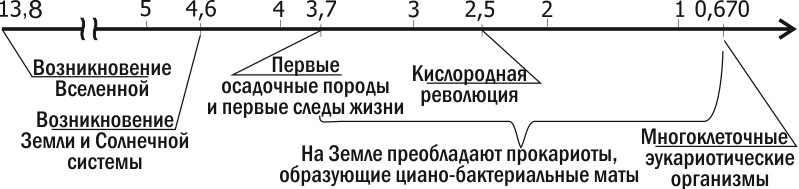
2.14. (addendum) Some stages of Earth's life history The first appearance of life during the formation of the biosphere was not in the form of a single organism, but as a community that fulfilled the geochemical functions of life. V.I. Vernadsky The common belief is that at some stage in Earth's history, the "first" organism emerged, whose descendants consumed all organic matter ("primordial soup") and gave rise to all life forms. Of course, such views are very naive. The emergence of a single organism would have required an incredible coincidence. Life arose as a result of the gradual complication of geochemical cycles due to the selection of autocatalytic reactions that ensured their individual stages. Even before the emergence of living organisms, organic matter was both formed and destroyed within these cycles. This meant that life arose not in the form of individual organisms, but as ecosystems that ensured the circulation of matter. Biochemical "novelties" that emerged at one stage of the geochemical cycle could be transferred to other stages. This is how methods of energy storage, template synthesis of biopolymers, and finally, the cellular organization of living systems would have spread. In modern ecosystems, a cycle occurs, based on the formation of organic matter by autotrophs and its destruction by heterotrophs. The waste products of each of these groups of organisms are resources for the other group. Their remarkable correspondence to each other is a consequence of the fact that such a cycle is older than life itself. One of the oldest sedimentary rocks known to modern science was found in the Isua Formation in Greenland. The age of these rocks is 3.7-3.8 billion years. These rocks formed at depth, near an analogue of a black smoker; carbon inclusions were found in them. Isotopic analysis of these carbon inclusions indicates that they are remnants of living organisms. The oldest remnants of organisms with complex structures were found in Australia, in the Warrawoona Formation, aged 3.5 billion years, and in South Africa (Onverwacht Formation, 3.4 billion years; Fig. 2.10.1). These are cyanobacteria, very similar to modern ones. This similarity even extended to biochemistry. For example, in rocks formed 3.1 billion years ago, products of chlorophyll degradation and the pigment phycoerythrin, characteristic exclusively of cyanobacteria, were found. Fig. 2.10.1. Main stages of the evolution of life on Earth Sedimentary rocks called stromatolites (literally "stone carpets") are characteristic of the Proterozoic (and to some extent the Archaean). They have a layered structure and often formed as separate blocks. The origin of stromatolites remained unclear for a long time. Their formation was clarified by the discovery of modern stromatolite-forming organisms in Shark Bay, Australia. This is a lagoon isolated from the ocean with very salty water. On the shallow seabed, there are sedimentary blocks covered on the surface by a cyanobacterial mat. Cyanobacteria are found on its surface, and beneath their layer are very diverse bacteria from other groups, as well as archaea. To show this duality, the mat is called a cyanobacterial mat, using a hyphen, indicating that it consists of cyanobacteria and other bacteria. Mineral substances that settle on the surface of the mat and are formed by its life activity are deposited in layers (approximately 0.3 mm per year) at its base. Another type of bacterial ecosystem is known in Ukraine. On the Arabat Spit, a sandbar in the Sivash Bay, there are flooded and drying limans. On the soil surface, there is a cyanobacterial mat up to several centimeters thick. Living organisms not only depend on their environment but also influence it themselves. Earth initially had a reducing atmosphere, which contained stable oxidized gases (carbon dioxide CO₂, water vapor H₂O, sulfur dioxide SO₂) and reducing gases (carbon monoxide CO, hydrogen H₂, hydrogen sulfide H₂S, ammonia NH₃, methane CH₄, hydrogen cyanide HCN, hydrogen chloride HCl, etc.). For a long period of Earth's history, easily oxidizable rocks such as graphite (C), lazurite (Na₂S), pyrite (FeS₂), and others could form on its surface. The first organisms on Earth, both autotrophs and heterotrophs, were anaerobes (adapted to life in oxygen-free conditions). During the photosynthesis of autotrophs, free oxygen (O₂) was released, which was toxic to anaerobic organisms. Initially, it was rapidly oxidized by reducing agents that were in excess in the environment. After oxygen oxidized the main supply of reducing agents in the environment, relatively neutral conditions were established. As a result, bacterial ecosystems adapted to existence in conditions of excess oxygen, and aerobes (organisms living in oxygen conditions) became widespread. Since photosynthesis occurred in water, oxygen could oxidize dissolved substances, promoting their precipitation. Most importantly, this involved the oxidation of divalent (highly soluble) iron to trivalent iron, which precipitated out. This is how jaspillites – banded iron formations – were formed, which are an important source of this metal for modern humanity. They consist mainly of hematite (Fe₂O₃) and magnetite (FeO×Fe₂O₃). With the spread of photosynthetic aerobes, oxygen accumulation in the atmosphere continued. About 2 billion years ago, the gravitational differentiation of the Earth led to almost all iron not bound in sedimentary rocks migrating to the planet's core. The cessation of iron supply to the Earth's surface meant that living organisms could oxidize practically the entire biosphere and accumulate excess oxygen in the atmosphere. This turning point (which occurred 2.5-2 billion years ago; Fig. 2.10.1) is called the oxygen revolution. However, it should not be thought that such a revolution was a one-time change. It went through a prolonged balancing, with oxidizing conditions in some parts of the biosphere and reducing conditions in others. The oxygen revolution was an important turning point in Earth's history. Not only the composition of the atmosphere changed, but also the composition of rocks forming on the Earth's surface. The consequence of an oxygen atmosphere was the formation of the ozone layer – a prerequisite for the colonization of land. Both prokaryotes and eukaryotes are characterized by the formation of complex systems. In prokaryotes, these are bacterial ecosystems with closely linked individuals of different species and even kingdoms (both eubacteria and archaea). The morphofunctional differences between cells are a consequence of their independent evolution. In eukaryotes, these are multicellular organisms – clones of descendants of a single cell, with differences determined by the realization of different variants of the same hereditary program. The development of eukaryotic multicellularity (more precisely, multi-tissue organization) requires much greater complexity of cellular control systems. In recent years, the symbiogenetic theory of the origin of the eukaryotic cell has been convincingly proven. Each eukaryotic cell contains genomes of different origins: in animal and fungal cells, these are the genomes of the nucleus and mitochondria, and in plant cells, also plastids. A small circular DNA is also contained (according to many data) in the basal body of eukaryotic cell flagella. The molecular clock method (counting neutral, from the perspective of natural selection, and undirected changes in DNA sequences) suggests that eukaryotes arose at the same time as prokaryotes. Despite this, it is evident that prokaryotes dominated for a significant part of Earth's history. The first cells with sizes corresponding to eukaryotic ones (so-called acritarchs) are 3 billion years old, but their nature remains unclear. Almost undisputed eukaryotic remnants are about 2 billion years old. Only after the oxygen revolution did conditions favorable for eukaryotes develop over most of our planet's surface. The era of their dominance began about 1 billion years ago. Probably, the "main" ancestor of eukaryotic cells was archaea, which switched to feeding by engulfing food particles. Changes in cell shape, necessary for such engulfment, were provided by the cytoskeleton, composed of actin and myosin. The hereditary apparatus of such a cell moved deeper from its variable surface, while maintaining contact with the membrane. This led to the formation of the nuclear envelope with nuclear pores (connected via the endoplasmic reticulum to the outer cell membrane). Bacteria engulfed by the host cell could continue to exist within it. Thus, the ancestors of mitochondria were a group of photosynthetic bacteria adapted to life in oxygen conditions – purple alpha-proteobacteria. Inside the host cell, they lost their photosynthetic ability and took over the oxidation of organic matter. Thanks to them, eukaryotic cells became aerobic. Symbioses with other photosynthetic cells led to plant cells acquiring plastids. Probably, the flagella of eukaryotic cells arose as a result of symbiosis between host cells and bacteria that, like modern spirochetes, were capable of undulating movements. Modern fauna provides numerous examples of swallowed organelles and cells in the cytoplasm of predator cells. Some ciliates, radiolarians, coelenterates, flatworms, mollusks, and representatives of other groups "grow" swallowed algae within themselves. Flagellates living in the intestines of termites enter into close symbiosis with spirochetes, which attach to their surface. In some of these symbiotic complexes, even a reduction in the genetic material of the symbiont and its dependence on substances synthesized by the host cell have been recorded. Similar processes occurred during the origin of eukaryotic cells. Initially, the hereditary apparatus of eukaryotic cells was organized similarly to prokaryotes (dinoflagellates, a group of single-celled flagellate algae, are still in this stage). Later, due to the need to manage a larger and more complex cell, the organization of chromosomes changed, and DNA became associated with histone proteins. The prokaryotic organization was preserved in the genomes of intracellular symbionts, but some of their functions (almost all for flagella) were transferred to the nuclear genome. Different groups of eukaryotic organisms arose as a result of different acts of symbiogenesis. As a result of symbiogenesis of a eukaryotic cell with cyanobacteria, red algae arose. Green algae arose as a result of symbiosis with prochlorophyte bacteria. This recently discovered group includes only a few modern species, but it is closely related to the chloroplasts of green algae and higher plants. Finally, the chloroplasts of golden, diatom, brown, and cryptomonad algae arose as a result of two sequential symbioses, as evidenced by the presence of 4 membranes. Their ancestors' endosymbionts were eukaryotes that harbored symbiotic golden bacteria. The development of life led to a radical transformation of the Earth's surface. What will we see when we look around us outside human settlements? One landscape or another, covered with vegetation characteristic of each region. In the vast majority of places, rocks are covered by a layer of soil. Somewhere, watercourses – streams and rivers – cut through the Earth's surface. Animals are much less noticeable than plants, but if you look closely at the vegetation, you will almost certainly see insects, and if you look up, you will recognize birds against the blue sky. What in this picture is a consequence of our planet's suitability? Everything! By colonizing land, life has significantly changed it. Even the blue color of the sky is a consequence of oxygen accumulation in the atmosphere. The result of the activity of living organisms is soil. It retains water and biogens on the land surface in a form optimal for consumption by organisms. Sheet flow from continents, where water moved in many intermittent channels, was replaced by channel flow. Before land colonization, rainwater collected in streams that eroded and carried away rock debris. Loose rocks were quickly carried to the ocean, where water flow sharply slowed down, and sediment began to settle. In the modern world, similar conditions occur where rivers carrying water with a large amount of particles flow into the sea. This leads to the formation of river deltas – areas extending into the sea, neither land nor sea. The Danube Delta is an example of such landscapes. Now, these areas are covered with lush vegetation, which stabilizes temporary channels. Before the appearance of vascular plants, this effect was absent, and tidal waves constantly transformed this transitional environment, facilitating the transition from water to land. Land itself was a collection of intensely weathered remnants of solid rocks. The mass migration to land was the result of mutualism (see section 4.7) between plants and fungi – mycorrhiza is found even in rhyniophytes. After passing through an intermediate environment, vegetation colonized the continents. Plant tissue remnants became the basis for soil formation. The soil cover protected rocks from weathering, and plants protected the soil from erosion. Surface runoff from continents became channelized. Soil retains rainwater, and the leaf surface increases the area for its evaporation (approximately doubling the land surface area). Water exchange on continents is altered, and in a direction favorable to organisms. Additional materials: Educational model: Oxygen Revolution Column: Survival
2.13. (supplement) Geochronological Scale
D. Shabanov, M. Kravchenko. Ecology: Biology of Interactions Chapter 2. Biospherology
2.15. (addendum) Venus, Earth, Mars