

Helodermatidae (Beaded Lizards)
The family Helodermatidae (beaded lizards) includes a single genus, Heloderma; only two species have survived to the present. Distribution: southwestern North America.
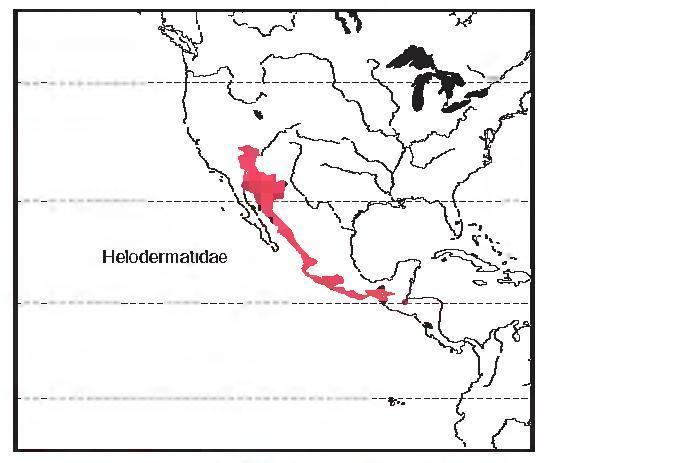
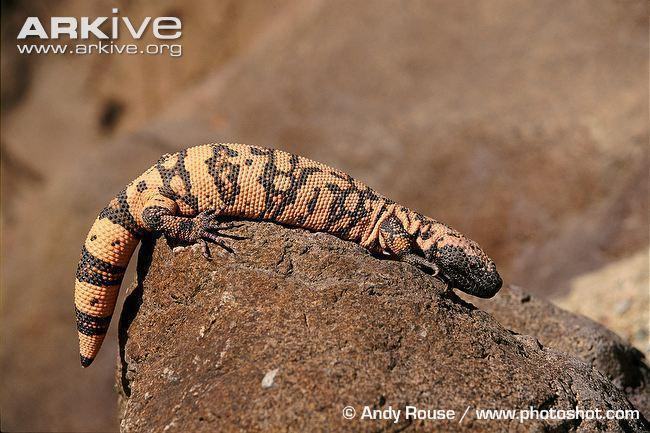
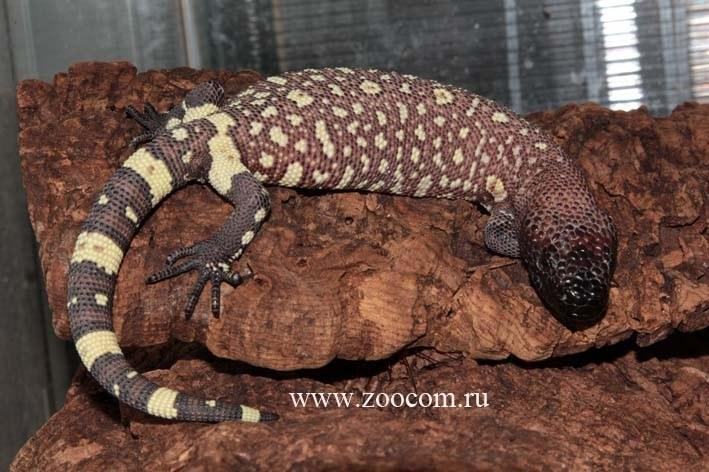
Representatives of this family are fairly large (30-50 cm in length on average, but some individuals can reach 90 cm). Beaded lizards have a rounded, somewhat flattened head, a stout body, and a rather short tail where fat reserves are stored. Beaded lizards inhabit dry rocky foothills and semi-deserts; they are sometimes found in pine forests and savannas. They may settle on reservoir banks and can swim in a way unusual for lizards: they do not press their limbs to the body but use them like oars. They live in shallow burrows. They move much more slowly than most lizards and, in case of danger, do not try to flee but lie still in place. Venom glands are the most characteristic feature of this family (most lizards are non-venomous). This is linked to their warning coloration (large orange spots on the body), as well as aspects of behavior. The venom is a serous secretion of modified salivary glands containing toxic polypeptides. It is used mainly for defense rather than for attack and hunting. For humans, a bite from a beaded lizard is very painful but, except in rare cases, not lethal; small animals, however, die from it rather quickly (within a few minutes). Diet is quite diverse and includes various mammals, birds, reptiles (as well as their eggs), and some invertebrates. Heloderma suspectum (Gila monster) Heloderma horridum (Mexican beaded lizard) Sources: 1. Vitt L.J., Caldwell J.P. Herpetology. An Introductory Biology of Amphibians and Reptiles 2. Animal Life. In 7 volumes.
Volume 5.
Amphibians. Reptiles. 3. https://www.arkive.org/ 4. https://www.zoocom.ru/