

On Snakes and Toxoplasma (Plus a Bit on Religion)
The python's piercing gaze. A symbolic dialogue with the world begins with the pacification of a totem or idol. If Professor Coulson is right, the first step of our ancestors along this path was overcoming ophidiophobia. The guilty gaze of the victim. We bear the imprint of the impact of snakes that fed on ...
{ "translated_text": "The Python’s Keen Gaze We have already written about how the necessity to notice lurking snakes in time played a decisive role in the evolutionary history of humans and other primates (see the news “The Guilty Gaze of the Victim” in “KT” #650). As recent findings indicate, snakes were also important for later stages of our evolution. Sheila Coulson, professor at the University of Oslo, conducted excavations in the Tsodilo Hills in Botswana (Southern Africa) and described the remains of a sanctuary located in a cave. There, a stone figure of a giant python was discovered. The head and anterior part of the scaly body of the snake are 6 meters long and 2 meters high; behind the figure there is a niche in which a shaman likely hid. The cave was not used for habitation, but some of the 13,000 tools found in it had been exposed to fire, apparently for ritual purposes. Most astonishing is the age of this sanctuary, determined from the stone tools used in its creation. The python was carved from the cave wall 70,000 years ago! The oldest known traces of cult practices among ancient humans to date are much younger, only 40,000 years old. To the gaze of that time, when people in Botswana worshipped the stone python, even Akhenaten or Moses would appear almost as our contemporaries. Nevertheless, the indigenous people of the Tsodilo Hills still revere the python, which carved the valleys between the hills and became the ancestor of the first humans. Clearly, this sanctuary is dedicated to the “python-idol,” the hieroglyphic python (Python sebae). It is one of the giant snake species. Most adults measure 3–6 meters, but the recorded record belongs to an individual caught on the Ivory Coast with a length of 9.81m. Today, the hieroglyphic python does not eat humans, but when our ancestors were smaller and less distinct from other animals, many of them could perish in its embrace. How does our psyche differ from that of our close and distant relatives?
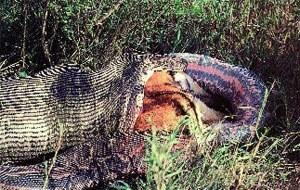
Not only humans, but also gray crows, elephants, or wolves demonstrate complex adaptation skills transmitted across generations through learning (cultural inheritance). But who, besides us, can separate the representation of self from the representation of the world and enter into a symbolic dialogue with it? This dialogue begins with the appeasement of a totem or idol. And where does it end? There is no unequivocal answer. Some of us will speak of accepting the will of the moral law of the Creator God, others—of sacrificial love for one’s neighbor, inexplicable by logic of benefit or duty, and still others—of the tragic grandeur of our role in the vast, indifferent atheistic Universe. But if Professor Coulson is right, the first step our ancestors took along this path was overcoming the fear of snakes. And have you not forgotten who offered the fruit of the tree of knowledge of good and evil to biblical Eve? This event is usually regarded as regrettable. One cannot deny that knowledge brings much sorrow. But… our (European) civilization, in Oswald Spengler’s view, possesses a Faustian character. Its central archetype is a person transgressing the limits of natural existence in search of infinity. Even if self-destructive pride drives this step, even if recklessness breaks the eternal cycle of cause and effect, depriving the world of a predictable future… This is our culture, our world, and our choice, continuing the choice of Adam and Eve. All that remains is to gather our spirit and endure the gaze of the python awakened by us. The Guilty Gaze of the Victim Each of us believes that our senses and psyche perceive the world as it truly is. The world changes, but we remain ourselves, acquiring only new experience… In reality, everything is far more complex. Human perception of the world is shaped by our prehistory, which formed both our senses and our brain—the “technical data,” the foundation of the psyche. However painful this may be to anyone, human history is the history of one evolutionary line of animals. Like most animals, our ancestors had to defend their bodies from predators and parasites. Traces of this struggle are forever preserved in the structure of the body. We are representatives of the order Primates, formed as a result of adaptation to life in tree crowns. Like many animals living in a complex three-dimensional environment, we possess acute vision sensitive to color and allowing accurate distance estimation to distant objects. Until recently, it was believed that vision developed in connection with movement among branches and food selection. However, studies by Lynne Isbell, a “behavioral ecologist” from the University of California, Davis, showed that the visual centers of primate brains are primarily linked to centers recognizing danger. The explanation given by Isbell is very simple: the leading factor in the formation of our visual system was the need to detect and avoid snakes. According to these views, snakes were a curse for mammals throughout most of their history. A cryptic predator with a mouth stretching to unimaginable limits pursued even our earliest terrestrial ancestors. With the appearance of venomous snakes, their danger increased manifold. It was vitally important for us to have vision that could detect an approaching snake before it came within striking distance. And not only vision, but also a pattern recognition system! Special structures in our brain are designed for recognizing snakes and react to any snake-like movement. By the way, it is interesting that humans have no innate fear of snakes, only innate attention to them. Seeing a panicked attitude toward snakes in adults, a child will begin to fear them; seeing interest, one may grow to love them (recall the many enthusiasts keeping terrariums). It is difficult to find a person whom snakes would not attract in some way. Do we bear the imprint of snakes that fed on our ancestors? Developing Isbell’s ideas, one can ponder the many parallels between the geometric patterns of African snakes and traditional (corresponding to deep archetypes) patterns and ornaments of different peoples.
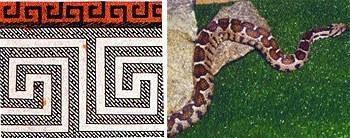
The Greek meander is almost the zigzag of vipers! And one more detail. Even when our African ancestors became sufficiently large, there remained a type of snake capable of continuing to feed on them. Besides the South African anaconda, the quartet of giant snakes includes the Asian reticulated and tiger pythons and the African hieroglyphic python. The record holder among them is the reticulated python (up to 12 meters in length), but the other snakes in this quartet can also swallow even a modern human. Fortunately, this happens rarely. Probably, one reason is the peculiarities of the victim image recognition system in the snakes themselves. For example, reticulated pythons live in Southeast Asia near villages, where they regularly steal goats, dogs, and pigs—four-legged victims. They hardly attack humans: the two-legged person looks different from the usual prey of conservative snakes in their preferences. Perhaps one of many factors that contributed to the transition of our predecessors to bipedalism was escaping from the visual prey model of hieroglyphic pythons (as well as other predators)? However, what is surprising in the fact that our senses bear the imprint of our prehistory? It would seem that the highly developed psyche of modern humans can correct distortions caused by their operation. Alas, research by Dr. Kevin Lafferty from another department of the University of California (in Santa Barbara) casts doubt on this as well. To retell the main conclusion of Lafferty’s recent article in Proceedings of the Royal Society, Biological Sciences, it is necessary to present some well-known facts. Parasitologists have long known the cat parasite Toxoplasma gondii. This is a protozoan, a distant relative of the malaria plasmodium, belonging, like it, to the Apicomplexa type. The complex life cycle of toxoplasma includes parasitism in rats (intermediate host).
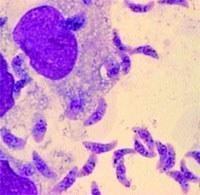
So that the intermediate host would more reliably fall into the teeth of the definitive host (the cat, in whose body the sexual cycle of toxoplasma development occurs), the parasite changes rat behavior. They lose caution, easily enter territories marked by cats, and become their prey. Small colored bodies—Toxoplasma gondii among host cells The danger of toxoplasmosis for humans was previously associated only with infection during pregnancy. If, after contact with a cat, a woman becomes infected with this parasite for the first time during pregnancy, it is transmitted through the placenta to the fetus and can cause blindness, hydrocephalus, or calcifications in the brain. It was believed that besides these complications, toxoplasmosis proceeds almost asymptomatically in humans, but it was known that a significant part of the planet’s population is infected (about 40%). Sources of infection are cat feces from cats that ate rats, or undercooked meat from animals that contacted these feces. That toxoplasma development is suppressed by schizophrenia medications gave reason to suspect the parasite’s involvement in the etiology of this disease. Some data indicated that the parasite could influence the psyche not only of rats but also of humans. After all, the human brain and the rat brain are sufficiently similar and governed by the same neuromediators. Although the parasite living in our brain would find it difficult to achieve that a person be eaten by a cat, it can in principle somehow influence the behavior of the carrier by changing the biochemistry of their brain. Due to climate and cultural peculiarities, toxoplasmosis spreads unevenly. Only about 7% of inhabitants of England and Japan are infected, compared to 80% of Brazil’s population (a climate favorable to the parasite) and France (where they like meat with blood). In the USA, infection rates vary from 18% to 29% for different states. Lafferty (who, by the way, is himself from arid California, where toxoplasmosis is rare) collected and processed available data on the connection between toxoplasmosis and personality traits (scattered in many studies). For example, it is believed that the risk of crashing one’s car is almost three times higher for toxoplasma carriers than for people free of these parasites. In addition, Lafferty studied the connection between the prevalence of toxoplasma antibodies in pregnant women and data on psychiatric deviations and cultural peculiarities of different peoples. As a result, the researcher discovered a correlation between the degree of infection of different peoples with toxoplasma and the spread of neurotic elements in culture. According to Lafferty’s data, the parasite intensifies feelings of anxiety, insecurity, depression, and guilt in humans. What form the anomaly takes is determined by the cultural context. We can assume that the guilt complex may manifest through the experience of Adam and Eve’s original sin, the feeling of personal sinfulness, or neurotic reactions to events in individual history. Interestingly, the parasite acts differently on men and women, intensifying gender differentiation in society. Under the influence of toxoplasma, women become more intellectual and conscientious, compassionate and prone to moralizing; they make more friends and do more shopping. For men, a tendency toward weakened intellect, dogmatism, emotional variability, and jealousy is characteristic. At the same time, it becomes harder for both sexes to concentrate on solving a particular task. As every American, Lafferty must be politically correct. He concludes that since the influence of toxoplasma complements cultural diversity, it may be positive. France would be less French without it, and Brazil less Brazilian. The world’s largest statue of Christ on Mount Corcovado in Rio de Janeiro can be regarded both as a spiritual feat and as a manifestation of mass psychosis In evaluating Lafferty’s work, one should not forget that his evidence is mainly indirect.

In any case, besides parasites, many other factors shift the psyche of modern humans (for example, the effects of alcohol, nicotine, caffeine, artificial lighting, excessive population density, etc.). By the way, we cannot be sure that toxoplasmosis is an unnatural state for humans. If it comes to that, African primates were eaten not only by snakes but also by cats: both the surviving lions and leopards, and the extinct saber-toothed cats. What share of the human population was infected with toxoplasma, and whether these parasites could influence human behavior in a way favorable to themselves—it is still difficult to say. Let us await criticism of Lafferty’s conclusions and the arrival of new data. Nevertheless, it can already be assumed that if someone wishes to found the Church of Wine and Repentance, communion with toxoplasma should definitely be provided for. D. Shabanov. The Python’s Keen Gaze // Computerra, Moscow, 2007. – No. 1–2 (669–670) D. Shabanov. The Guilty Gaze of the Victim // Computerra, Moscow, 2006. – No. 30 (650)" }