
The Pendulum. Column in KompyuterraOnline #83
An effectively managed process generates rapid, small oscillations in the variables by which we assess its state.
Systems thinkers view the world as a set of feedback loops.
Donella Meadows
In my recent columns I have been drawn to discussions of social issues... You will not object if I take up here some of the most elementary ideas relating to the problem of managing complex systems?
I shall begin with thoroughly rudimentary thoughts. I will describe a technique I use in ecology lectures. I do this in a large auditorium, standing beside a tall wooden lectern (climbing up onto it strikes me as slightly ridiculous). I say to the students: here before you stand I, motionless, and beside me stands the lectern. Do the two of us maintain our positions in the same way or differently? Why do I grow tired from standing like this, while the lectern does not? And what would happen if we were to record, with high precision, the small changes in the position of a human body and of an inanimate structure?
The lectern is drawn into damped elastic oscillations by various mechanical influences — for example, sounds and vibrations of the floor. The frequency of its vibrations depends both on the frequency of the oscillations acting upon it and on the properties of the lectern itself: its weight and elasticity. With a human being the situation is far more complex. His body also responds to external oscillations, but it itself generates considerably more significant vibrations. Our body is simultaneously engaged in several distinct oscillatory processes, each with its own frequency and amplitude. The cause of these oscillations is internal.
What will happen if the room in which a standing person finds himself is completely darkened (or if his eyes are simply closed)? One of the oscillatory processes in which his body is engaged will disappear. Why?
A standing person is looking at the surrounding environment. If his body deviates from the chosen position by more than some threshold amount, his vision will register this by the relative displacement of surrounding objects. The postural-maintenance centre of our brain adjusts the tone of the supporting muscles, compensating for the deviation. This typically results in overcompensation: the body deviates in the opposite direction. Vision registers the deviation, the brain issues the necessary commands, the muscles compensate (overcompensate) for the disturbance...
If we block the visual information channel in one way or another, the person does not fall. He continues to stand, relying on information from the vestibular system (the organ of balance) and on the signals from receptors in the muscles and ligaments. These systems generate their own oscillations, characterised by their own frequency and amplitude... Deviation — perception — regulatory response — compensation...
A standing person, unlike the lectern, grows tired because his muscles are working continuously. What will happen if he becomes severely fatigued or, for example, comes under the influence of substances that impair his brain's functioning? He will begin to sway like a drunkard. The speed of his reaction will slow, the amplitude of the oscillations will increase, and they will become visible to the naked eye.
We have described the regulation of posture by means of negative feedback. In our case, the direct link is the influence of muscular activity on body position. But body position itself influences muscular activity — this is the feedback. Those feedback loops by virtue of which an initial deviation is compensated (the result of the feedback loop's activation is opposite in sign to the initial deviation) are called negative (−FB). Negative feedback loops stabilise the system; the regulatory mechanism is based on their action. In the case of positive feedback (+FB), the initial deviation is amplified. Positive feedback loops shift the system to a different state.
Let me give my favourite example of negative feedback. A pot is standing over a campfire. If the fire burns too strongly, the water boils out of the pot and partially extinguishes the flame. Boiling diminishes, and the fire gradually begins to flare up again... This is a system in which negative feedback is realised. Under what circumstances would it be positive? If the pot contained kerosene (or at least fat)!
Rapana whelks collected during a field-study trip by biology students are being boiled in the pot. The fire flares up and dies down — as long as there is water in the pot.
Simple inanimate systems ordinarily keep their parameters constant by virtue of their inertness and static nature. Living systems are dynamic. Their characteristics remain constant as a result of the operation of −FB.
To manage systems effectively it is important to understand exactly which parameters determine the frequency and amplitude of oscillations. In the intoxication example we saw that an increase in the delay in the operation of −FB leads to a decrease in the frequency of self-sustained oscillations and an increase in their amplitude. If such a delay becomes excessive, the system may simply "fly out" of the range of states within which regulation remains effective. For example, a severely intoxicated person may deviate so far from the vertical that he will need to wave his arms or step his feet in the direction of the fall. In effect, this means that new feedback loops are engaged to maintain the upright position.
To demonstrate this effect I usually invite a student to come up to me, stand him alongside myself, distract his attention, and then craftily give him a push. To keep his footing, he waves his arms. The next step in the reasoning we discuss purely in thought: I ask what will happen if the deviation caused by my push exceeds his regulatory capacity. He will fall.
When a human body falls, it deviates to such an extent that gravity begins to topple it. The more strongly he deviates, the more strongly gravity will continue to deviate him. This behaviour is characteristic of systems that have moved beyond the regulatory range of −FB and entered the range in which +FB predominates.
The operation of feedback loops can be illustrated graphically as a particular surface down which a dynamical system "rolls" (something akin to Waddington's epigenetic landscape, if you know what I mean).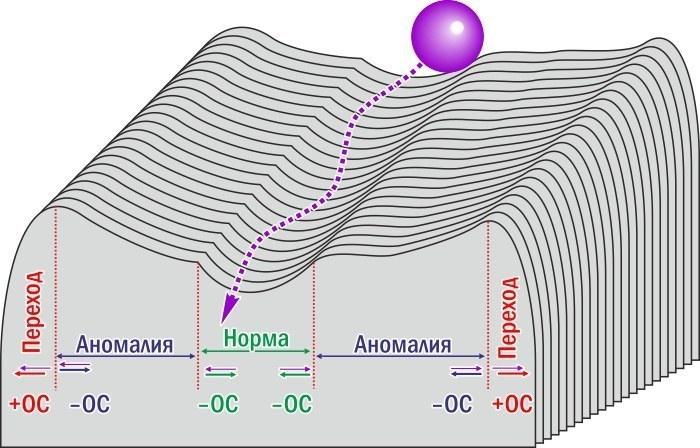
We see the range of the norm, maintained by a complex of −FB; the range of anomalies with their own −FB; and the zones in which +FB shifts the system to a different state.
Such analogies are useful, but one must not forget that the surface down which the system "rolls" is not something external to it. Consider the figure as an illustration of the state of a drunken person, and you will understand that the surface shown in it is an expression of the very connections that operate within the system itself!
Do not suppose that +FB is inherently bad. Individual development of organisms, for example, is governed primarily by positive feedback. It is positive feedback that shifts the developing system from one stage to the next.
And why does the ball, rolling down the surface shown in the figure, veer now to the right, now to the left? Why does the magnitude regulated by feedback oscillate? The cause lies in delays. No feedback loop operates instantaneously. The longer the time a system requires to react to a deviation, the more it will deviate from the optimal state, and the greater the "overshoot" past the norm will be when the reaction finally fires.
In aviation there is an effective method for assessing how well a pilot is able, for instance, to bring an aircraft in for landing. Radar registers the horizontal and vertical deviations of the aircraft's actual trajectory from the optimal one — the glideslope. Every pilot deviates from the glideslope now in one direction, now in the other. However, a good pilot responds even to small deviations of the actual route from the ideal and corrects them precisely enough to return to the optimum. A poor pilot traces a trajectory that his colleagues compare to the track left on the ground by a stream of urine from a walking bull.
Why did I explain all this? The conceptual apparatus we have been discussing is applicable to the description of the most varied processes — both relatively simple ones and highly complex ones. Let me attempt to draw some conclusions. An effectively managed process generates rapid, small oscillations in the variables by which we assess its state. More prolonged oscillations of significant amplitude testify to the ineffectiveness of management; attempts to block the oscillations may lead the system to lose controllability and transition to a qualitatively different state.
To what systems should we apply the "template" we have just constructed? To the state of society, for instance. Are you offended that I wish to use for the discussion of society an approach I illustrated with the example of an organism? For some reason many people feel that society is far more complex. I disagree. Of course, society is a system composed of a very large number of heterogeneous components, but the connections between those components are far simpler than those between the parts of an organism. An organism is a more integral, integrated system, and thanks to this it is capable of realising a complex programme of individual development. For example, while still in the womb an embryo can be preparing for the fact that, upon reaching sexual maturity, it will begin to reproduce. In society (a far more "loosely structured" system), managerial efforts directed towards distant goals prove, alas, largely ineffective.
From the oscillation of an aircraft's trajectory around the glideslope one can assess the pilot's skill. The effectiveness of economic management can be assessed from the dynamics of the most important indicators. But how is one to assess the effectiveness of political management?
One of the feedback mechanisms in politics is elections. This is, by definition, a slow-acting regulatory mechanism. Are there faster ones? Of course! The activity of various political forces in parliament, the drawing of public attention to current problems via the media, the work of civic organisations and citizens' protests — these are rapid means of correcting state policy. Alas, they do not function in all countries. Where they are blocked to a greater or lesser degree, hope remains pinned on elections. However, elections do not always amount to a correction of authority by the people; sometimes they turn out to be simply the imposition upon the electorate of a decision already taken by those in power.
For example, parliamentary elections have just been held in Ukraine. On the whole, they confirmed a long-standing conclusion: in this country, the opposition wins elections. Changes of course turn out to be quite sharp, and overall this situation corresponds to the case of ineffective governance. The pendulum swings from one set of forces to another. The only time a president succeeded in being re-elected was at the second election of President Kuchma. At that point he managed to adroitly nudge public sentiment in the direction of the Communists. In the second round, choosing between the incumbent president and the leader of the Communist Party, I myself voted with my own hands for the president — and so did very many others.
The current victory of the opposition is anything but spectacular. Three opposition parties scraped together slightly more votes than the ruling party together with the Communists. Probably through the "chemistry" of results in single-member constituencies and creative work with the winning candidates from those constituencies, the authorities will assemble a majority in parliament. In doing so, they will push the pendulum of public sentiment in favour of the radical, nationalist opposition. If the current president goes up against the nationalist leader in the next election (who has already managed to say and promise quite a few strange things, and will in all likelihood continue to burnish his reputation in the future), the outcome will be predetermined. But it is only public sentiment that will swing towards the radicals — the parliament, after all, will have been made pro-presidential! No restructuring of governance will be required for that.
Those who bring this about will rejoice that they have managed to stop the movement of society in an undesirable direction. It is interesting to consider what this will ultimately lead to.
In making such efforts, the Ukrainian authorities look with envy at Russia. How pleasant it is to govern a country where the outcome of elections is predetermined! Incidentally, do you recall: we discussed the strange "tails" in Russian distributions of votes cast for the party of power, depending on turnout? The previous Ukrainian elections could at that point be cited as an example of the absence of such anomalies. But in this election they appeared, bearing witness that the Russian know-how is operating in Ukraine as well.
So what feedback loops are correcting the governance of Ukraine? And of Russia? What dynamics of social processes can be expected against this backdrop?
...
Be on your guard! If you begin to notice the operation of feedback loops everywhere, it means you are turning into a systems thinker.
Donella Meadows.