

The Invisible Foot and the National Question. Column in KomputerraOnline #82
When interacting with a system, you wish to change it. You attempt to influence something... and receive a trip: your actions produce the opposite effect.
Betting on Immortality
Betting on Immortality
The Invisible Foot and the National Question
Pendulum
Column in KomputerraOnline #81
Recently, sharp debates related to differences between nationalities and cultures have coincided—debates taking place both in Russia, which is intellectually and culturally close to me, and in my native Ukraine. I make no claim to the final truth, but I shall attempt to give impetus to thought.
Column in KompyuterraOnline #83
It so happened that recently sharp discussions related to the differences between nationalities and cultures have been taking place both in Russia, which is intellectually and culturally close to me, and in Ukraine, which is dear to me. I do not claim to be the ultimate truth, but I will try to provide food for thought. The examples I want to discuss are united by the fact that they demonstrate the action of the Invisible Foot. Remember what I'm talking about? You interact with a system, you want to change it in the desired direction. You try to influence something... and you get tripped by the Invisible Foot: your actions lead to an effect opposite to your plans. The fact is that you have not taken into account the interconnections between subsystems... I will start with academic matters, with a discussion of the demographic transition.
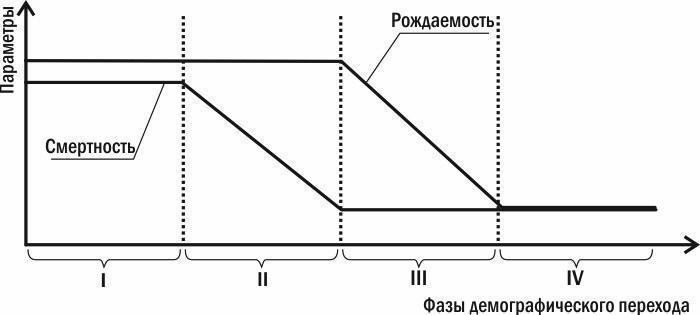
A textbook illustration. A diagram of the demographic transition: the phases through which mortality and birth rates pass as a primitive society transforms into a mature one. The population increase at each stage is determined by the degree to which the birth rate exceeds the mortality rate. In a primitive society, at Phase I of the demographic transition, both mortality and birth rates are high. Over time, technology reaches a level at which mortality drops sharply. Aseptic techniques in obstetrics, vaccinations, and intensive agriculture all contribute. But the birth rate will remain unchanged for a long time, corresponding to entrenched notions. This is Phase II. In Phase III, the birth rate also begins to decline. Children cease to be the "insurance" for parents’ normal old age and the object of their labour exploitation; in an even more mature society, it becomes evident that bearing children impedes the mother’s career. Finally, in Phase IV, the birth rate approaches the mortality rate (and may even fall below it). We still habitually speak of "developed" and "developing" countries, classifying Russia and Ukraine among the "developed." Alas, the world is changing, and there is ever less justification for this. The economies of our countries—both the enormous Russia and the smaller Ukraine—are quite modest compared to many "developing" countries, and are moreover based on the sale of raw materials and low-technology products. What unites us with the "developed" countries is only a declining population. Indeed, the contemporary division of countries is better framed not as "developed" versus "developing," but as those in Phase IV versus those in Phase III of the demographic transition—with relatively stable (often declining) or with growing populations. A sharp deterioration in living conditions (wars, famine, repression) slows population growth or even reduces it. But when the effect of these factors ceases, society responds with an accelerated (temporarily deferred) growth. And then the growth disappears of its own accord. Strange, is it not? Population growth is a consequence of improving living conditions. Decline is the response both to a sharp deterioration and to stable improvement. The countries of Western Europe and North America were the first to enter Phase IV. They still maintain a dominant position in the world. But by virtue of their populations having (nearly) ceased to grow, their share of humanity will inevitably decline—and with it, their economic capacity. How to mitigate this effect—by intensifying the exploitation of "backward" countries or by fostering their civilisational maturation? Strangely enough, in order not to be outpaced by countries in Phase III, it is necessary to help them accelerate through the transition and arrive at Phase IV! Russia and Ukraine were in Phase IV, and then (owing to their historical peculiarities) first lowered the standard of living (which contributed to depopulation) and then began to raise it. The deferred growth slightly softened the situation, but henceforth the indigenous populations of our countries will evidently decline steadily. And how is one to satisfy the ageing population of Phase IV countries? Life expectancy is increasing, demands are expanding, raising the retirement age is undesirable… How does one ensure not merely the preservation of the standard of living but its growth? Labour is needed. Where is it to come from? From Phase III countries. That is precisely why "old" Europe is filled with immigrants from Asia and Africa; Russia has followed the same path. But, of course, the Russian path has its own specific character. As I understand it, the following pattern is typical of Moscow. "Black" work (for example, that of janitors) is performed by migrants. Those registered for these positions are individuals who provide the migrants with "cover" and take the lion’s share of their income. This scheme is a breeding ground for criminality, increases unemployment, and fuels discontent among the indigenous population. How does the indigenous population react? It demands strict control over migrants and the curtailment of their rights. Will such a measure help? No—it will only worsen the overall prospects. If Russia develops normally, the share of the indigenous population in its European regions will inevitably fall. The majority will be composed of the descendants of migrants. In what ways may the new Russians differ from the old? In nationality (skin colour, the shape of the eyes, etc.). In religion. In culture and its level. In whether they perceive the country as their own or as foreign. What matters most? A friend of mine, living in a university town in the United States, was painfully struck by a demonstration of jubilant Arabs after the terrorist attacks of 2001. The majority there were US citizens who were rejoicing that a blow had been struck against the country—their country!—which they hated, and that many people had perished. Is it not toward such a state that the nationalists who seek to expel migrants are pushing Russia? The migrants will remain, but the country of their sojourn will become hostile to them. Do you wish to expel them by force, without fear of bloodshed? Then the collapse of Russian statehood will become a matter of time. Those who wish to preserve Russia must urgently engage in the assimilation and cultural integration of "aliens." This is difficult. The most important thing is that the environment must become genuinely welcoming to these very strangers. They will not change the shape of their eyes, but they can adopt a system of values. Alas, thus far the steps in this direction have been clumsy. [IMG_2] Indeed, migrants must be introduced to culture! How fortunate that the example of "culture" chosen is Karl Bryullov’s "The Last Day of Pompeii." It is a pity only that the objects of cultural introduction (unlike the tour guide) are depicted as things rather than persons. Illustration from a St. Petersburg "Handbook for Labour Migrants." Perceive the people who sustain the life of the country as objects, as instruments who must be shown their place—and you will find that you are living in a new Pompeii… Another example. Migrants wish to build mosques. In the Muslim world, a struggle is currently underway between traditional Islam and new, aggressive currents, nourished by the disparity in living standards between poor and wealthy countries. It is a serious struggle: traditionalist mullahs sometimes pay for it with their lives. Which side of Islam will prohibitions on the construction of mosques strengthen—the peaceful, traditional one, or the aggressive one, oriented toward jihad? Precisely so. But the stronger the anxiety of indigenous Russians about the threats of Islamic terrorism, the more forcefully they will suppress their natural allies—the mullahs who are prepared to integrate into civilised society. Now for Ukrainian examples of the Invisible Foot’s action. The separation of Ukraine from Russia was a pivotal event in the collapse of yet another reincarnation of the Russian Empire. I believe it was a blessing both for Ukraine and for Russia. For Ukraine it is a chance to become a European country; for Russia—to recover from the imperial illness and… also to become a European country. Throughout the entire territory of Ukraine, the share of ethnic Ukrainians is high, and it is logical that the Ukrainian language became the official state language. It is sufficiently close to Russian, and for the Russian-speaking citizens of Ukraine, attaining a functional command of it is no great problem. Ah, if only the Ukrainian language had become the language of a state that had achieved genuine success in building a free society oriented toward authentic values, that would have been the finest support for it… If reasonable people had seriously taken up the promotion of the Ukrainian language, they would have established state and civic funds to support Ukrainian-language culture, sponsor Ukrainian books, music, and broadcasts. Alas, the nationally oriented authorities chose a more familiar path. Economic and legal reforms were replaced by the imposition of the Ukrainian language and attempts (fortunately, largely unsuccessful) to obstruct the use of other languages. You know, I comprehend Ukrainian almost as readily as Russian, and I write in it reasonably well (I speak it less fluently—there is no practice). I regard it with goodwill, but… when it is imposed upon me, I experience aversion. In the Russian-speaking regions of Ukraine, an interesting situation has arisen. People speak and think in Russian, but for official documents and official speeches they use the "state language." If, in the course of a conversation with colleagues, I were suddenly to pronounce something solemnly in Ukrainian, they would understand—I am expressing not my own point of view but the official, imposed one. Sincerely, speaking for myself, I will use Russian… Did the Ukrainian language gain from such an arrangement? In my view, it lost. Dissatisfaction with this situation accumulated, and the authorities—losing credibility—decided to exploit this for pre-election warming of their electorate. A "language" law was adopted. It does not weaken state control over language use; on the contrary, it formalises everything yet further. "Regional" languages have been introduced; the law is drafted and applied so as to elevate, above all, the Russian language to regional status. For speakers of Russian, in general, nothing has changed. For instance, even before the language bill was introduced, during the three-year court proceedings arising from a traffic accident involving my son, sessions were already conducted in Russian (while documents were written in Ukrainian). And despite the fact that in Kharkiv the Russian language has become a regional one, official authorities continue to conduct correspondence in Ukrainian. So, has nothing changed at all? Something has changed for the "professional Ukrainians." Read for yourself. The fact that it is now officially permitted to litigate in Russian is perceived as an attempt to destroy the Ukrainian people; one day the UN will condemn this as genocide. They genuinely believe this! And for Russian speakers, the change was an intensification of pressure upon them by "patriots" and the imposition upon them of the role of a fifth column. On Facebook, I am "friends" with colleagues from across Ukraine. Suddenly, after the adoption of the language law, I observe how cultivated individuals begin posting links to agitprop of the sort "suitcase, station, Russia." In Ukrainian-cultural circles, there appears a demand for mockery of Russian speakers and of Russians outright. I asked: do those "patriots" who play with such things understand that they are fracturing Ukraine under the guise of fighting for its unity? Ukraine teeters on the edge of failed statehood not at all because someone thinks and speaks in Russian… In response, I am told that an occupier on foreign soil must comport himself more delicately than I do. I explain that my Russian ancestors lived in Sloboda Ukraine for centuries (and among my Ukrainian ancestors is, for instance, Ivan Bohun—one of the pillars of national self-consciousness). This land is mine in no lesser (nor greater) measure than theirs. In response, a cultivated capital-city lady insists that her ancestors were masters here from practically the time of the Pithecanthropus. Well. Another example. Here are maps from an article in the Lviv newspaper "Express"—on the whole a respectable publication, deserving gratitude at least for exposing the fraudster Slyusarchuk, who was under the patronage of Ukraine’s Ministry of Education (I once wrote about him). They compare crime rates across different regions of Ukraine and the share of those who supported the language law. They arrive at the "scientific" conclusion that Russian-language speakers (and even simply ethnic Russians) are responsible for criminality. [IMG_3] Two maps. The number of crimes per one million people for different regions of Ukraine, and the "share of those in favour of granting the Russian language advantages over the languages of other nationalities"—that is (in the authors’ view, these are one and the same thing) "those in favour of granting state status to the Russian language" (from the Lviv newspaper "Express"). Does correlation imply causation? Of course not! Often, parameters exhibiting similar variability are dependent on some other factor. That factor could be, for example, population mobility (itself dependent on urbanisation and industrialisation), which influences both crime rates and the diversity of ethnic composition. It would be interesting to examine police and judicial statistics: do Russians actually commit crimes more frequently than Ukrainians? I believe that since this is not being done, no sensational conclusions can be drawn from such statistics. …but the sediment remains! How does one explain to my Russian-speaking fellow citizens that the primary culprits behind the wave of insults that has descended upon them are their "defenders" in the authorities, who launched a provocateur law before the elections? And the "useful idiots" allowed themselves to be fully exploited and are performing their role with inspiration—pushing a significant portion of their fellow citizens out of the Ukrainian state project. So how does one combat the trips of the Invisible Foot? By using one’s head!