
Orientation and disorientation. Column in ComputerreOnline #21
The development of semi-specific behavior is a probabilistic process: a healthy environment and favorable heredity increase the chances of a normal developmental outcome, whereas a deviant environment and hereditary anomalies decrease them.
The action of genes and the environment in principle does not differ at all. Some influences of both types are hard to reverse, some are easy.
Embryologists correctly do not make a fundamental distinction between hereditary factors and environmental factors, rightly considering both necessary but insufficient.
Richard Dawkins
I have already lamented that the design of our life ignores the achievements of biology. Even worse, when biological arguments are presented but not understood. I will give an example concerning a highly demanded (excessively demanded!) topic today. Advocates for gender equality and the rights of sexual minorities are interested in the ratio of innate and acquired behavior. I emphasize that the term “innate” (antithesis of “acquired”) is not equivalent to “hereditary” (antithesis of “environmentally conditioned”). Both hereditary traits and the results of environmental influence in embryogenesis are innate. However, for our discussion this is irrelevant.
First, sexually different people want to adopt children, therefore they insist that sexual orientation is 100 percent innate. The same argument is put forward, for example, in the fight against the Ukrainian parliament’s intention to ban propaganda of homosexuality. Second, minority representatives fit poorly into the established societal division of female and male roles.
Therefore, sex‑specific behavior is declared acquired: these are gender stereotypes imposed by improper upbringing. If boys were not pushed to play with cars and girls with dolls, all children would grow up democratically identical. Thus, the traits of minorities are explained by the “overwhelming force” of genes, and the social norm is considered simply the result of the influence of a “heteronormative behavior matrix”.
Oh, it’s not that simple, even in the case of cars and dolls! In experiments by D. Alexander and M. Heinz, infant green monkeys raised under identical conditions were offered human children’s toys. Male infants chose cars significantly more often, female infants chose dolls…
I read with interest the texts written within the “Gender Democracy” program of the Russian Heinrich Böll Foundation. With the authors (author‑women) of these texts one sometimes does not even need to argue; they simply need to be read carefully: no one will compromise their ideas better than they themselves. Here, please: a wonderful article in its naive frankness, in which it is proved that innate female and male behavior does not exist.
“How do I know that I am a woman? … Here I sit before the monitor, and none of my parts—my hand, my leg, my head—feel female,” writes Anna Shadrina. The quintessence of the article is the description of a drag‑king seminar, the cross‑dressing of women as men. This is a serious act (almost for the first time performed in the post‑Soviet space): cross‑dressing; assuming another role; group reflection.
The participants bought men’s underwear and socks. They stuffed the socks between their legs, imitating male genitals. They changed clothes, glued on mustaches and beards. The author did not find men’s shoes (where can a gender‑studies specialist find such an exotic item!) and became Yakub from Belarus, who was robbed on a train. “Yakub” talks with other cross‑dressed women, astonishing in their primitiveness: “Are all men really greasy? Why should I be the same? Why do they always try to push me to the side or hit my shoulder? Is that masculinity—to speak disrespectfully about women?”—such thoughts swirled in Yakub’s head.
Look: educated women, feminists (the author even hosted an internet radio program “Critical Days”!) take on the role of men. Which ones? Representatives of their social stratum? No, some scoundrels who—oh horror!—do not respect women. This is not an attempt to understand the opposite sex, but an outpouring of one’s own prejudices. Remarkably, the caricature turned out to be caricatured! And yet, to understand male thinking one does not need crumpled socks. One could simply have impartially and logically analyzed what and why happens at a drag‑king seminar…
The author “realized” how much energy men spend maintaining their masculinity, and apologized to her own breast for having bound it. “Now I clearly see that gender is constructed unconsciously and is not linked to biology.” Linked, linked! Even the author’s fabrications about the opposite gender ultimately grow out of biology!
Did I mock a harmless game for nothing? Such games lead to strange consequences. Do you know the instructive story called the “John/Joan” case (told, for example, here or here)? A little boy loses his penis due to doctors’ error. A psychologist decides to raise him as a girl and proudly trumpets the success of re‑education. The story ends with the experimental victim’s attempt to become a man and his suicide.
Do you think that after this tragic story attempts at re‑education of children stopped? Far from it. Here (original source probably here) is a story about the elite kindergarten Egalia (“Equality”) in Sweden. A citation is needed.
“The headmistress Rayalin states that her task is to create an environment tolerant of homosexuals, lesbians, bisexuals and transsexuals. Therefore she gives children books such as, for example, a story about two male giraffes who worry they cannot have children until they find an abandoned crocodile egg. Almost all books in this kindergarten tell about same‑sex couples, single parents and orphaned children. Tales like ‘Snow White’ or ‘Thumbelina’ are excluded because they are filled with traditional gender stereotypes.”
Why?!
“Society expects girls to be feminine, sweet and beautiful, and boys to be masculine, rough and sociable. But Egalia gives children the fantastic opportunity to be exactly who they want to be.”
Are you already envying the Swedes?
Without any mockery of children, much is explained by theoretical biology. Of course, sexual orientation and sex‑specific behavior are facets of the same phenomenon. To declare one facet innate and the other acquired?
Fraud! These traits, like other behavioral features, are determined by the interaction of hereditary and environmental causes. The emergence of sex‑specific behavior is a probabilistic process: a healthy environment and favorable heredity increase the chances of a normal developmental outcome, while a deviant environment and hereditary anomalies decrease them. Yes, I consider heterosexual orientation the norm, a manifestation of health; details—here.
A child can see in his surrounding environment a wide variety of behavioral forms. Fortunately, he more easily adopts those norms that his hereditary program prepares him to perceive. That is why I hope that many children from the described Swedish kindergarten, despite a pathological environment, will still grow up healthy.
But theory is theory, and there are simple observations available to many of us. What I will now describe convinces me of an innate component of sex‑typical behavior no less than the experiments of Alexander and Heinz.
Meet Roma. He is two years old. So far his social circle consists of parents, grandmothers and children at the playground. In the photo he is in his father’s slippers. Roma is emotionally very closely attached to his mother, but a significant part of his life he plays the father, copying his behavior, poses, intonations and even trying to appropriate his father’s belongings.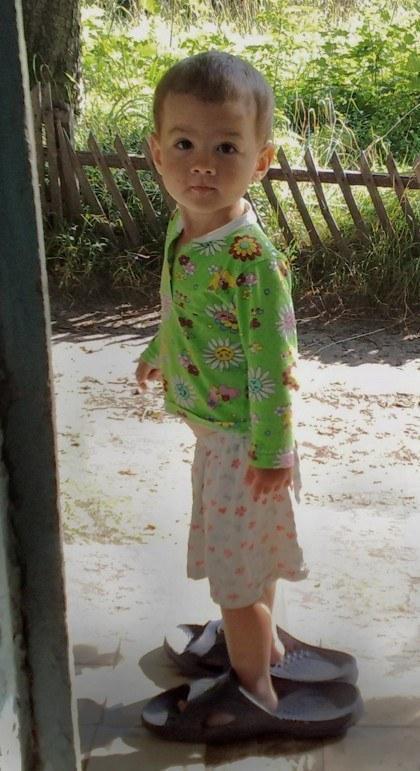
Do you think he was told: “You are a boy and therefore you should take a cue from men and act like them?” No one ever thought of that, and it is not certain that Roma would understand such a notion. But the father’s slippers are only one of many manifestations of his innate drive to imitate the most solid man in his environment. In his grandfather’s society, however, Roma switches to him: the grandfather speaks with a pressing, loud and low voice. Roma is simply fascinated, although no one taught him to recognize such signs of dominant behavior.
And here is a storyboard of the video. A guest arrived at Roma’s mother. Roma had seen her before but had somewhat forgotten her. Finding himself in the company of a smiling girl, he almost clings to her and tries to win her approval. See how he feeds her cherries? An archetypal situation: a man treats a woman he is courting with something tasty…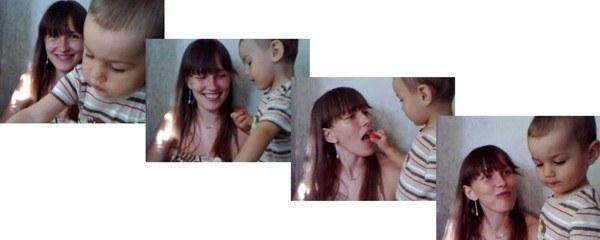
I repeat: he was not taught this. His mother never fed him in front of her (in a stable family the opposite situation usually materializes: a woman feeds a man, albeit less theatrically). The first cherry Roma gave to the guest without her asking—he simply wanted to! Naturally, when the offering was received with gratitude, inspiration struck the young man. The hardest part was convincing him that “Auntie” was full and no longer wanted cherries.
The drive to imitate men’s behavior and to court women forms in Roma a unified complex, based on hereditary programs and honed through interaction with the environment. That is the norm.
Don’t you think the column consists of two clearly distinct parts? First it talks about unhealthy mind games, then about real, natural life? Do real women and men, boys and girls seem to you more natural than homosexual giraffes with crocodile eggs? Rush to the gender research center for re‑education!