
Pansemia – a dead end or a hope? Column in ComputerreOnline #29
The study of living organisms and their fragments in material from space helps understand the patterns of the origin of life, but it is unlikely to explain its presence on Earth.
In the discussion of the latest columns, the topic of panspermia kept resurfacing. It concerns the transfer of living organisms or, at least, key biological molecules through space.
The idea is old. Already in the 5th century BC Anaxagoras argued that life arises from seeds that exist “always and everywhere.” In 1865 Hermann Richter hypothesized that life was brought to Earth by meteorites or cosmic dust. In 1884 Svante Arrhenius, the creator of the theory of electrolytic dissociation, suggested that the transfer of bacterial spores between stars occurs thanks to light pressure.
Are these views purely theoretical? No. In 1969 the Apollo 12 team found terrestrial bacteria on the lunar probe Surveyor 3. They survived a space journey and remained alive! In 1996, in the Antarctic meteorite ALH84001, which appears to have been ejected from the surface of Mars, researchers discovered something very reminiscent of bacterial remnants.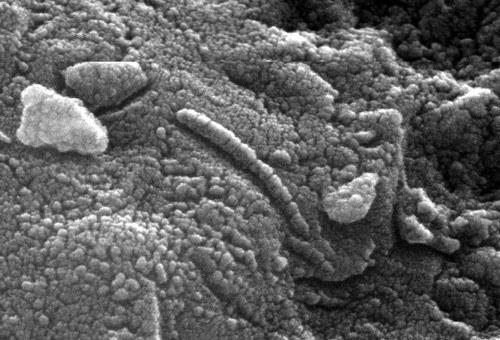
Electron micrograph of the surface of meteorite ALH84001. These structures look very much like bacteria, although they are much smaller in size.
Of course, even if they are bacteria, they are already dead. But ALH84001 floated in space for a long time. Perhaps some fragments ejected from Mars with it reached Earth quickly enough to preserve viable biological material?
Other Martian meteorites allow us to claim that conditions once observed there were quite similar to those on Earth.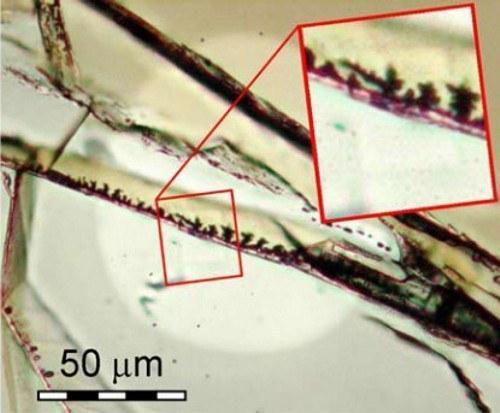
Exactly such tree‑like carbonaceous formations are found in volcanic structures on the floor of the Earth’s ocean! However, these photographs were taken on a fragment of the Martian meteorite Nakhla, which fell in Egypt in 1911. One can conclude that they formed on the floor of a Martian ocean!
Has life persisted on Mars today? The question remains open. Mars has cooled, and no developed life has been found there. Bacterial life is highly probable, and countless indirect indications have been obtained. Unfortunately, most of them are not indisputable. What to do: the results of the “Vikings” experiments conducted in 1976 still spark debate—whether they found signs of life or not.
I was pleased to read that photographs of Mars taken in 1997 by the Pathfinder mission recorded chlorophyll absorption spectra. If this is true, the detection of life on Mars is a matter of short time. I hope to live to see it. Will I ever learn about the results of paleontological excavations on the neighboring planet, describing remnants of ancient Martian flora and fauna? Probably not. A pity, of course.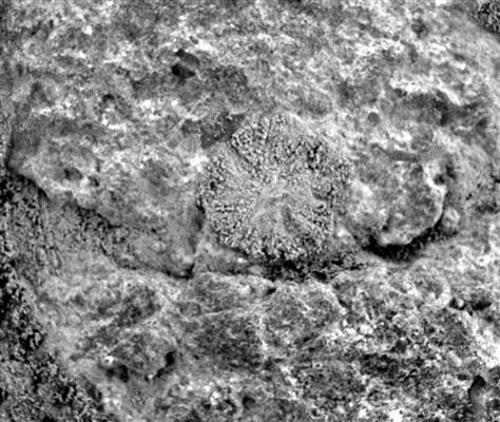
Photograph from the Spirit rover, which enthusiasts believe captures a Martian “lichen.”
Characteristic biomolecules (and sometimes structures resembling dead bacteria) have also been found in meteorites not linked to Mars. For example, in 1969 a meteorite rich in organic matter fell on the Australian town of Murchison, damaging a building. Interestingly, the mixture of amino acids in this carbonaceous chondrite is not optically neutral: left‑handed amino acids predominate over right‑handed ones.
We have not yet discussed this favorite creationist topic in depth: the chiral asymmetry of molecules in organisms. Compounds in which a single carbon atom is bonded to four different radicals can exist in two mirror‑symmetric forms, analogous to a right and a left hand. Enthusiasts of dizzying improbabilities have often entertained themselves by estimating the chance that all amino acids in a single protein would randomly be left‑handed. Clearly, it is not a matter of chance. Today a whole range of processes is known that shift the equilibrium of left‑ and right‑handed isomers in one direction. These include irradiation with polarized light and physicochemical phenomena occurring at phase boundaries. The form that gains the advantage would promote the preferential use of corresponding biocatalysts and eventually outcompete the “rivals.”
In any case, the Murchison meteorite is dominated by the needed form of amino acids. This was long explained by contamination with terrestrial substances, until chemists showed that both the amino‑acid composition and their isotopic signatures do not match Earth life. Two “Murchison” amino acids are virtually absent on Earth and cannot be local contaminants!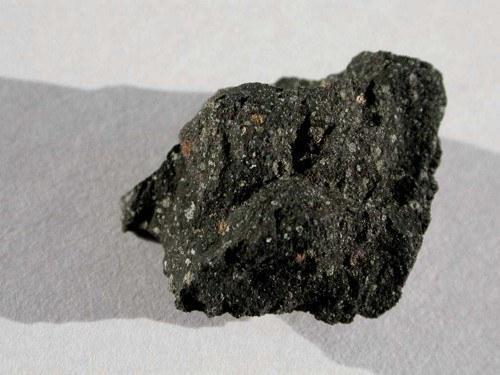
Murchison meteorite
Thus, the idea of transferring biomaterial, even viable, from one planet to another does not seem implausible. But does it fundamentally change our concepts of terrestrial life? Strangely enough, no.
It appears that during the epoch of life’s emergence on Earth, processes on Earth and on Mars proceeded in parallel. Exchange between these planets could have been a factor in the early evolution of their life. Yet even proof of such exchange does not mean we are Martians. Probably, nothing existed on Mars that did not exist on Earth, but Martian life would still have needed a cosmic voyage.
Does the notion of interstellar substance transfer rescue the situation? Not really. It requires special transport vehicles (comets, for example), extremely long travel times, and the probability of a cosmic traveler hitting a suitable target is exceedingly low. Can these hypotheses explain the origin of life?
Paradoxically for me, the panspermia idea in many people’s minds is linked to creationism. The most active commentator on my recent columns argues that if life arrived from elsewhere, that “elsewhere” can be considered God (why, I have no idea). Fred Hoyle and Chandra Vikramasinghe, noted for their futile calculations of the probability of molecules “jumping” into cells, claimed that panspermia explains the origin of life. Vikramasinghe emphasized that the mass of comets is incomparably larger than the mass of the pre‑Earth ocean, and therefore the emergence of life there is more likely.
From my point of view, a logical error is hidden here. The probability of life originating by random self‑assembly, not guided by selection, is cosmically low. Neither increasing the mass of primordial material nor extending time for repeated attempts will save this hopeless idea. A scientific explanation of life’s origin can only consist in describing factors that ensure the preferential reproduction of processes increasingly close to life. The path to such an explanation is briefly outlined in my two previous columns on “biological selection” and “prelife.”
Proponents of cometary origin of life insist that comets contain abundant organics, have zones with different temperatures, and also experience periodic environmental changes. That is true, but there are fundamental differences between periodic condition changes on a planet and on a comet. On a planet, the shift from synthesis reactions to decay reactions can be linked to the day‑night cycle; a typical planet can experience a very large number of days. Periodic changes on comets are tied to their orbit around a star. A cometary “year” can be very long, but each comet experiences only a limited number of such years in its lifetime.
Thus, it seems to me that the origin of life on a planet is more probable than in cometary material. Yet this is not the greatest difficulty of the cometary theory. Suppose life did arise on a comet and then reached Earth. Would it survive in fundamentally new conditions?
The adaptability of the life we observe is a consequence of evolution. In every detail of organismal construction “encoded” are the laws of nature and the specifics of Earth habitats. Without invoking miracles, this phenomenon can be explained only by evolution under appropriate conditions.
Vikramasinghe tries to explain influenza epidemic dynamics by claiming that Earth passes through comet tails containing viruses. How this astronomer reconciles the fact that influenza virus evolution mirrors the evolution of immunity in their terrestrial hosts is unknown to me.
Non‑biologists often think organismal properties are sufficiently random. To understand that a parasite is a mirror of its host, one must look more closely at their interaction.
And if we speak of organisms adapted to an unknown environment, a biologist does not always recognize them. Since the time of H. G. Wells, the arrival of alien life has been portrayed as the invasion of terrifying triplodons sowing death. Unfortunately (or fortunately?), more probable contacts with alien life will be far less dramatic.
The biggest quotation that Maryna Kravchenko and I inserted into our ecology textbook is a passage from Carl Sagan’s “Cosmos” devoted to Jupiter‑type life accustomed to floating in a dense methane‑ammonia mixture. Imagine a process that transports the dormant stages of syncers, floaters, and hunters from Jupiter to Earth. Even if they were merely associated microbial samples. And…
Nothing. They would fall to the surface, enter chemical reactions and die. That’s all. The greater the difference between the departure ecosystem and the arrival ecosystem, the more likely this outcome. By the way, has anything like this ever happened in our memory?
I still have not formed a final opinion on the history… Oh, can I squeeze everything readers need to form an attitude toward this mystery into this already overfilled column? I’ll leave the interesting story for next time.
And for the ending – the dry residue for today: