
Pre-life. Column in ComputerOnline #28
I conclude with confidence that the most complex phenomenon of life arose as a result of a regular process that ensures the already studied processes of increasing complexity of autocatalytic reactions due to selection.
I am sincerely grateful to readers interested in what I present. Since you asked, I continue the discussion on the origin of life. But, alas, before the specifics – some general reflections.
Do you remember Laplace’s demon – the hypothetical super‑mind that, knowing the coordinates and momenta of all particles in the Universe, could compute its entire future and past? I will not discuss why it is impossible. I will only say that at the level of analysis available to us, the same present can correspond to different possible pasts and different possible futures. Part of the information about the past disappears. Probably many details of the emergence of life on Earth are already unrecoverable.
In the debate surrounding the previous column, two creationists diverged in opinion. The first said that the possibility of life arising through chemical evolution could be convinced by life made in a test tube. The second declared in advance that he would not be convinced, unless it is proven to him that life on Earth originated exactly in the way he is shown. Well, the second hedged his bets: it is impossible to convince him of his error. Yet, most likely, the first will not be left behind either. Seeing “life from a test tube,” he will say that it is not what he expected…
Is the loss of information about prehistory catastrophic? Let us consider an analogy. In front of us stands a stranger. His past is unknown, there are no documentary records about him. How did he appear? He was born to a mother who conceived him with a father. How do we know this? Can we prove it absolutely reliably? All we can do is study the regularities of other people’s development, establish the role of fertilization and birth in their formation, and draw an analogy‑based conclusion about this person’s appearance. And absolute proof? In science it is unattainable; that is why science seeks not the absolute but reliable (trustworthy) knowledge. Absolute truth follows a different “department” (secretly, I will say that I consider it illusory, fundamentally unattainable for a human).
Probably, concrete information about the “conception” and “birth” of life on Earth is either lost or still inaccessible to us. We know about events in Earth’s history thanks to the geological record – the sequence of sedimentary rocks. By the time this “machine” started working, life on Earth already existed! Yet this gap is not a catastrophe, just as in the stranger example. We can study self‑organization and selection processes in the examples available to us and transfer the acquired knowledge to the origin of life by analogy. People who seek an absolute truth backed by divine authority will not be persuaded by these arguments. What can be done. The fault lies not in the inadequacy of science, but in the unscientific nature of their thinking.
Proponents of miracles rub their hands: but we have not seen the emergence of life, every living organism appears from something similar! However, the fact of life’s emergence is evident; and it must be understood not by analogy with reproductive processes, but by analogy with processes of self‑complexification, the emergence of new structures. Fortunately, we already know facts about transitional phenomena between non‑life and life (I will tell them now), and a mechanism that can create prelife and turn it into life (evolution based on selection).
Yes, I believe we can confidently assume that people, for whom there is no notarised proof of “sinful” parental intercourse, appeared as a result of the same regular process that generates other humans. Want to – believe in immaculate conception and motherless birth. Just as confidently I conclude that the most complex phenomenon of life arose from that very regular process that underlies the already studied processes of increasing complexity of autocatalytic reactions through evolution by selection.
One of the difficulties in studying abiogenesis is that we deal with a very mature, long‑refined life. Looking at its current perfection, we do not see the stages through which its formation passed. Creationists like to speak of the so‑called irreducible complexity (“irreducible complexity”). I will give a couple of examples.
Example 1. Protein synthesis on an RNA template is performed by ribosomes – the most complex molecular robots. The main part of such a robot in *Escherichia coli* (the classic research object) is the 23S rRNA molecule. Could such a perfect construction arise instantly in a single leap? Of course not.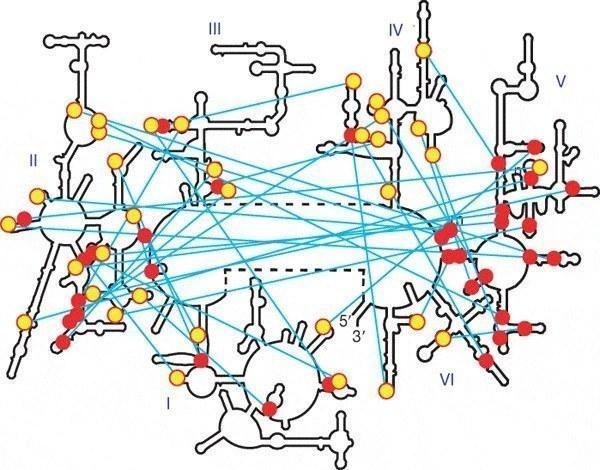
The secondary structure of *E. coli* 23S rRNA – a perfect molecular robot. Does it serve as an example of “irreducible complexity”?
Example 2. Cellular activity is based on the interaction of two classes of biopolymers – DNA and proteins. DNA encodes proteins, proteins build DNA – they create each other much like two hands in an Escher picture. Could one of these polymer classes arise and perform its functions without the other? Of course not.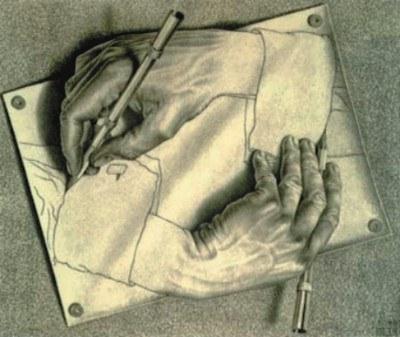
DNA creates proteins, proteins create DNA. Such a perfect construction could not arise by random coincidence.
Both examples are used as evidence of life’s creation. Indeed, solving both problems is non‑trivial. We would not have solved them if we had believed in a miracle and, instead of studying the regularities of chemical evolution, had turned to interpreting divine designs. Those who had immunity to creationist agitation solved these problems.
First, it has been found that the super‑molecule 23S rRNA has several structural levels that store a “memory” of its prehistory and gradual refinement.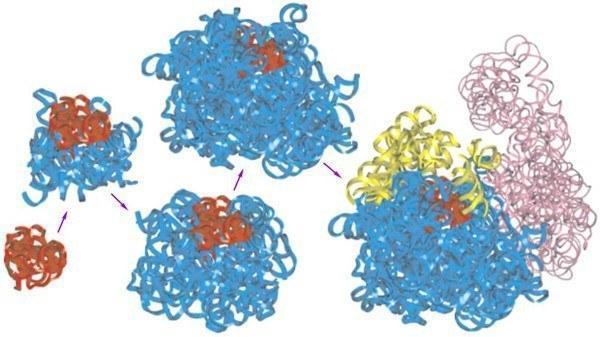
A small part of *E. coli* 23S rRNA (shown in red) possesses activity of the same type as the whole construct, but weaker. This is the evolutionarily oldest part of the molecule. Each subsequent addition increased the efficiency of this molecular machine.
The second problem is addressed by the hypothesis of the primacy of RNA. In key DNA‑protein interactions, RNA is always present between them. RNA can perform template copying like DNA and has enzymatic activity like a protein. Sometimes RNA molecules resemble prelife.
I will start with the experiments of A.B. Chetverin performed at the Institute of Protein (RAS). In a Petri dish (the kind used for bacterial cultures) a gel containing RNA nucleotides (RNA monomers) and a protein (RNA‑synthetase) capable of assembling them on a template is placed. It is enough to open the dish briefly, whether indoors or outdoors, so that over time colonies of replicating RNA appear on the gel surface… These molecules float in the air. When they reach a medium that allows self‑reproduction, they multiply and compete with each other! Under specific experimental conditions, one type of sequence will have an advantage over another. When new dishes are inoculated with cultures grown on the medium, these cultures will evolve toward sequences optimal for the given conditions.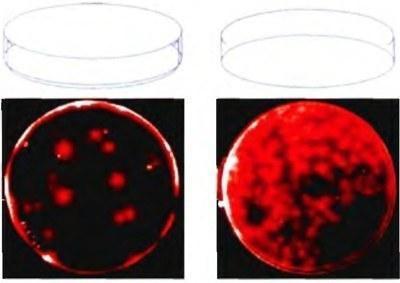
RNA colonies on the surface of two Petri dishes. Illustration from B. Chetverin’s article in the collection “Problems of the Origin of Life” (M.: PIN RAS, 2009. – 258 p.). The collection can be found online; highly recommended…
An interesting result obtained by Chetverin and his colleagues is the description of recombination (exchange of RNA fragments) that occurs spontaneously in the presence of Mg²⁺ ions. Moreover, the RNA‑colony method is promising for the diagnosis of many diseases…
In the West, RNA evolution is more often studied in liquid reactors. On one side, a “nutrient” mixture flows into the reactor; on the other, spent liquid containing RNA molecules flows out. Of course, the “food” for this RNA‑based prelife is very special: an important component is the protein of RNA‑synthetase. Yet under such conditions one can truly study selection and variability at the level of autocatalytic reactions.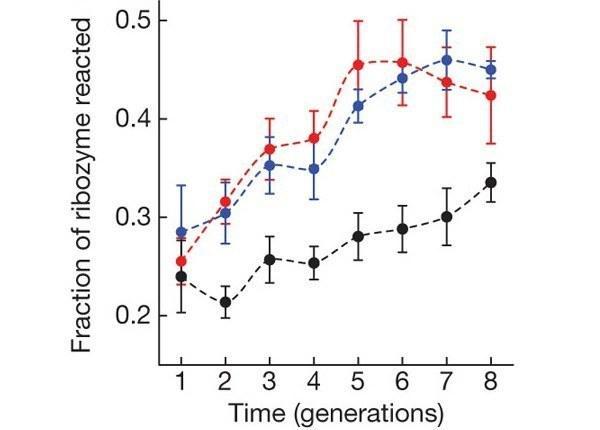
Example of the evolution of three RNA cultures toward higher efficiency in using a reagent that has been altered compared with previous cultivation conditions. Red and blue lines describe RNA populations that had a pre‑accumulated reservoir of variability due to mutations during self‑copying. The black line corresponds to a population of identical molecules.
Ribozymes that synthesize any RNA under any conditions are not yet known, but those that synthesize certain sequences under defined conditions have already been found (among other things – as a result of selection). Moreover, pairs of RNA molecules are known, each capable of assembling the other from its fragments. Think of it like the Dalai Lama and the Panchen Lama: the Dalai Lama seeks the reincarnation of the Panchen Lama and raises him in a new life; the Panchen Lama does the same for the Dalai Lama…
These and many other results support the concept of an “RNA world” – a stage of chemical evolution (or, if you prefer, prelife) based on RNA self‑replication.
Reconstruction of the “RNA world” is not yet complete. From time to time a researcher of abiogenesis reports some substantial inconsistency. Again and again, what seemed like contradictions finds an explanation (as in the example of cytidine synthesis in the previous column). Does criticism from creationists help in this work? No, of course: they are occupied with their own agenda. They calculate the probability of random atoms falling into a living cell, shout for the overthrow of scientific concepts of life’s origin, and report undeniable evidence of divine intervention.
Nevertheless, the “RNA world” is very complex. How could it have arisen? How could the components for RNA synthesis reach the necessary concentration?
One possible solution is the “PAU world” hypothesis, preceding the “RNA world.” In this hypothesis (and many of its alternatives) the factor that provides concentration and orderly placement of certain substances is their binding to ordered surfaces (such as crystalline mineral lattices). Abiogenesis researchers sought a substrate that would collect nitrogenous bases and position them at the distance they have in RNA and DNA – 0.34 nm. They found it.
Do you remember the Deep Impact mission that bombarded comet Tempel 1 in 2006? In the material ejected from the comet, compounds were detected that should have been abundant on the surface of the young Earth – polycyclic aromatic hydrocarbons, PAUs. In water, PAUs are chemically modified and form stacks capable of binding nitrogenous bases. According to this hypothesis, pre‑RNA synthesized on PAU stacks was linked not by a sugar‑phosphate backbone (as in RNA) but by polyformaldehyde. With changes in medium acidity, such pre‑RNA were released…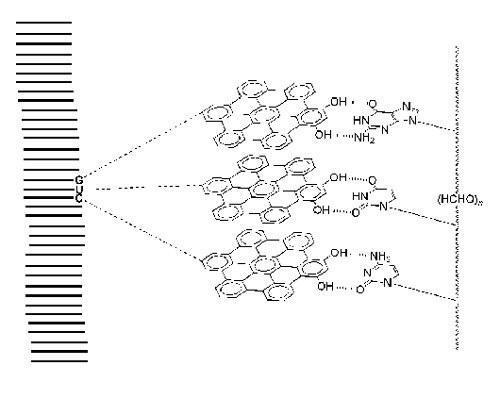
PAU stacks bind and orient nitrogenous bases, which can then be linked in pre‑RNA by formaldehyde chains. Thus the “RNA world” arose?
Research on the regularities of life’s origin continues. Propaganda aimed at undermining the scientifically based worldview does not weaken. What interests you more, reader: newly discovered self‑organization and evolution regularities, or demagogy about the impotence of science and the necessity of miracles?