
How Much Blood Does a Tree Cost?
An article published in "Chaskor" the day after the events described in the column. The editorial introduction read: "Kharkiv residents defend the central park against logging, risking their own safety. The confrontation between nature defenders and its «lexploiters» in Kharkiv has reached...
Kharkiv is a city of one and a half million people in northeastern Ukraine, near the border with Russia. The city's historical flourishing was in many ways predestined by the establishment of one of the first universities in the empire of that era. At the very beginning of the nineteenth century, Vasyl Nazarovych Karazin, an active figure of Alexandrine Russia, persuaded the tsar that if the latter permitted the founding of a university in Kharkiv, the Kharkiv merchants would find the money for it; and he persuaded the Kharkiv merchants that if they raised the money for the university, the tsar would permit its opening. The Soviet era added industrialisation, the role of the first capital of Soviet Ukraine (from which the artificial famine of the 1930s was administered), the bloody cauldron of the wartime years, and a gradual relegation to the background during the era of Kyiv bureaucratic ascendancy.
The Kharkiv city authorities became famous throughout the Russian-language internet when footage of a recorded campaign speech by the city's future mayor was widely circulated. The combination of profanity and expressiveness gave rise to an entire series of Kharkiv local sayings ("written like an idiot..."). Today, that footage is viewed with a degree of humour.
Recently, a colleague of mine helped a young woman who had previously stuttered during public presentations to read her report easily and naturally. He simply rehearsed with her the phrase "A significantly larger sum will enter the municipal budget..." from that very recording. The protagonists of that clip went on to lead Kharkiv, with the man on camera becoming the city mayor and the voice off-screen becoming secretary of the city council. After the victory of political forces that proclaimed a course toward rapprochement with Russia, the mayor became governor, and the former secretary became acting mayor. The previous, "orange" governor remained a deputy of the regional council and one of the main irritants to the regional authorities.
One of the city's landmarks is Gorky Park (which major Soviet city was without a Central Park of Culture and Recreation named after A. M. Gorky?), gradually transitioning into a forest park. This is a natural forested area that penetrates almost to the city centre and is connected to the woodland on the city's northern edge. Gorky Park and the forest park are intersected by only one road, which crosses the park on a substantial bridge.
In recent years, successive new parcels have been carved away from the park. Cottage-style developments have appeared along the park's periphery. However, the park had not witnessed such an assault on the remnants of the old forest as it did this year.
In May 2010, logging was begun to clear a swathe for a road that was to bisect the park. Regrettably, the author is unable to provide any definitive information regarding the necessity of this road. Ostensibly, the construction of this facility formed part of the city's preparations for Euro 2012 — Ukraine's priority sporting project at the time. The city authorities claimed that the road would alleviate congestion in the city centre.
Opponents of the city administration pointed out that a viaduct leading from a narrow, winding street at a right angle and connecting to a main artery could solve no traffic problems whatsoever. In any case, it is difficult to discuss the essence of the project when virtually nothing is known about it. Some of those who had seen the city master plan asserted that this road was provided for within it; others maintained that the road through the park was planned for a different location. Some claimed that the purpose of the measures being taken was to address transport problems; others asserted that the construction of hotels and a residential complex on parkland would be highly significant for Kharkiv's preparations for the international football celebration.
Regardless, when the logging began, those carrying it out showed little concern for proper documentation. In the very early stages, activists from civil society — including members of the environmental group Pechenegy — managed to halt the destruction of trees. When the logging resumed, the conservationists appealed to the public, and a significant number of city residents came out to defend the park (initially, for the most part, residents of the neighbouring districts). It seemed that the broad public resonance would compel the city authorities to reconsider their plans. However, on this occasion the city administration proved unyielding.
For several days, the author of these lines was learning about the confrontation in the park of his native city from reports of nationwide Ukrainian online news agencies. I have known the conservationists of the Pechenegy group for many years. How many times had the current authorities, and those before them, and those before those, declared them to be provocateurs who, for the money of enemies of the country and the region, were attempting to obstruct the lawful activities of state administration bodies! On minor matters the conservationists sometimes prevail, but on major ones they usually lose. Even in defeat, it seems to me, they nonetheless compel the authorities to treat their responsibilities more conscientiously. On the other hand, I am not sympathetic to their method of work, in which each successive campaign appears to them as almost the end of the world — a decisive battle against the forces of darkness. I consider sound biological education for all citizens and for biology students (and I am a lecturer at the Faculty of Biology) to be a more effective form of conservation work.
The final days of May turned out to be particularly hectic, yet a gradual awareness grew that something was occurring in Gorky Park that exceeded the usual conservation campaign in scale. Reports of the injured... Pickets outside the Ukrainian consulate in New York... Students conveying their classmates' apologies to me: those classmates could not attend classes, as they were living around the clock in the park...
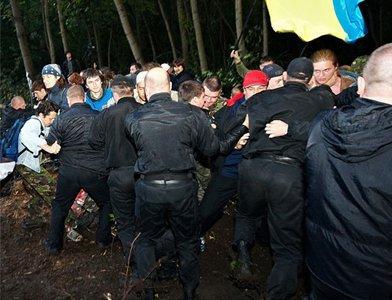
I come home in the evening. I sit down to work, and to ease myself in I begin reading the news. I come across a blog where I see photographs of a confrontation between conservationists and some strange formations — a "municipal guard." It was strange: judging by the photographs, they more closely resembled a gang of racketeers in uniform black attire. I see the faces of our former and current students among the park's defenders and understand that it is only a matter of time before there are casualties among them as well. I must go and see for myself what is happening there.
[IMG_1]
It is in order to attempt to convey the atmosphere that prevailed in the conservationists' camp on the evening before the night of its final assault that I am writing this article. I believe my perspective may be of interest to someone. Although I sympathised (and continue to sympathise) with the park's defenders, I was not one of them. I continue to disagree with them regarding their method of action. I shall not construct a coherent narrative, but shall describe only certain details that caught my attention.
...A wide clearing bisects the park. Along its edges — heavy construction machinery, police. In the middle section, between the two zones of felling that had not yet merged — an island of surviving trees and a tent camp. Many familiar faces.
...Campfires, young people singing. A Kharkiv poet reads her verses; a bard sings songs. They recount a recent concert to which groups had travelled from across Ukraine.
...There are no drunk persons; activists ensure that not even beer is present in the camp; those who have been drinking are asked to leave, so as to give the city authorities no pretext.
...Trees fitted with mountaineering equipment. On them — climbers known here as "birds." They even sleep at height so as to prevent the trees from being felled. Some of the "birds" descend, approach the campfire, eat, and then ascend again.
...It is said that residents of the surrounding districts and businessmen who leave expensive cars on the approaches to the park come, express sympathy, and leave food or money for it. The current governor declared that a handful of marginals financed by the previous governor were present in the camp; the absurdity of this accusation is visible to the naked eye.
...The trees are hung with placards and leaflets bearing verse. The defenders have given the trees names and dedicated poems to almost every one of them. They recount how some elderly woman wept: they had felled a century-old pine beneath which she had kissed her beloved for the first time in her life, when he was departing for the front from which he never returned.
...The chairman of the Pechenegy group has left the camp. I am told that he was either intimidated or bought off by the acting mayor. Strange. I call him (we are old acquaintances, co-authors of a school zoology textbook some time ago). He is at home. In his view, resistance should be continued in the information space, without putting people in danger. Those remaining in the camp regard him as a traitor.
...A group with children. They used to walk here in their own childhood, they bring their children here now, and they cannot comprehend how the park can be demolished.
...One of the activists explains to me the legal aspect of the matter. According to his account, the logging is entirely unlawful. Another maintains that all documents, by whatever means, not only for the construction of the road but also for the development of a substantial portion of the park, have already been obtained. In any case, the authorities do not see fit to explain anything, confining themselves to accusations against the park's defenders.
...One of the camp's organisers explains that the situation is developing outside familiar patterns. When the police beat an operator from a central television channel (belonging, among other things, to the wealthiest man in Ukraine), those in the know expected the police to be reined in. When, before the cameras, a senior police officer kicked a prone man, lawyers promised that within an hour that officer would be dismissed. Nothing of the sort! The situation received international publicity, and the resistance participants expected that the governor would attempt to defuse the confrontation. The governor fully endorsed the logging, and levelled sweeping accusations at the park's defenders. Well, citizens voted for strong authority — and so they have received it...
...It is precisely the former governor (the current leader of the Kharkiv opposition) who is accused of financing the camp. Being present in the camp, it is the simplest thing in the world to understand that this is not so: people are standing not for money but from the highest of motives. Yet all the same, it was the former governor who stopped the assault by the black-clad "municipal guard" in the early morning of 1 June. The assault came at four in the morning. The attackers attempted to drive the camp's defenders out, but thanks to the presence of an influential figure the attack was halted. When the "blacks" beat the camp's defenders, the police stand alongside and watch, and then convey the defenders away one by one — not the attackers.
...One of the students from our department approaches me. I assure her that her life, health, and future prospects matter no less than the fate of these trees. She agrees with me, but says that to leave the other defenders now would be an act of betrayal that she is incapable of committing.
...Flags and party symbols are prohibited in the camp. Around one campfire sit Ukrainian and Russian nationalists, debating. When the debate begins to "spark," those ready to quench it appear immediately.
...On a tree — chains. During attacks, the defenders shackle themselves to the trunks. "Yes, if need be, we will stop them with our bodies, with our blood."
...Someone recognises me whom I do not recall. Yes indeed, I am a lecturer. No, I have not come to stand alongside the students; I want to understand what threatens them. No, I do not support the logging; I simply believe that it must be resisted in ways that do not expose people to danger. "Lecturers should, like Janusz Korczak, go together with..." No, let us not push the situation toward human casualties!
When I was leaving, I was told in confidence when the next assault would take place. The forecast proved correct. During the second assault the former governor was absent. The camp was stormed by the black municipal guards and workers who advanced on the defenders with running chainsaws. If you are interested, look up the footage online. There are injured. There are those detained. Trees were felled in ways that placed the lives of the mountaineers aloft in serious danger. It is remarkable that in such chaos the number of casualties was relatively small. I am personally further relieved that among neither the injured nor the detained are students from the faculty where I work.
The former governor appeared afterwards. He persuaded the defenders to dismantle the camp that had become pointless and to march from the site of the confrontation to the regional council; and he walked at the head of the column himself. There was a picket outside the regional council; the police arrested its participants, while the former governor "framed" this event as his own meeting (in his role as deputy) with constituents. It seems that if the area of felling is not to be expanded, the confrontation will shift to the courts.
What is the bottom line?
I have no wish to discuss the actions of the city authorities. I understand perfectly well that a city must grow and develop, and that this development entails certain sacrifices. However, authorities that represent the city's residents must be maximally transparent and maximally persuasive. Publish the master plan, discuss the alternatives for the city's development, demonstrate what has been done to compensate for the damage — and then implement what is recognised as correct. Nocturnal assaults by the "blacks" and police beatings are actions of an entirely different order — drawn from the arsenal of occupiers.
I cannot form a settled view of the actions of the former governor. He is a politician. He made skilful use of the situation: he placed himself at the head of a protest that had begun without him, helped repel the penultimate attack, was absent during the final assault, yet went on to lead the camp participants' withdrawal and transformed it into a political campaign.
I am glad that there are no fatalities. Whose achievement is this? Perhaps that of the campaign's organisers — the conservationists. But among the organisers there were also those prepared to shed blood — both their own and others'. Perhaps that of the former governor. He had an interest in the confrontation, yet did not fan its flames. Perhaps the absence of fatalities was the result of the "blacks'" preparation and ultimately of the actions of the city authorities, who needed a cleared construction site, not a scandal involving corpses. Witnesses to the assault by the "municipal guard" report that the "blacks" were intent on frightening, not on maiming. However, a tree was deliberately brought down on one of the climbers — as a form of intimidation. And those detained were not those who had resisted desperately, but those who had acted calmly, withstanding a psychological assault. So, neither of the opposing sides played the game to its ultimate extreme — a game that could have led to human casualties. Yet this game had been started, and it proceeded according to its own logic, not always dependent on those who had set it in motion.
It is said that when the target of an attack adopts the behaviour of a victim, it increases the danger to which it is exposed. The idealistic, sincere nature defenders, poets, students, and ordinary citizens were provoking violence against themselves by chaining themselves to trees. Kharkiv was outraged that workers felled oaks between which "bird" climbers were suspended, placing human lives in danger. But did not those "birds" climb the trees precisely in order to expose themselves to danger?
And yet... Perhaps the logging in the park will be limited to the road. Perhaps the turn of the hotel complex will also come. What can restrain businessmen in power from felling the "heart of Kharkiv"? Only the apprehension of excesses and publicity.
So what was the right course of action? I do not know.
Published in the online publication "Chastniy Korrespondent" (Private Correspondent)