

Has the theory of evolution been disproved? 3. The problem of transitional forms
Part 3. The Problem of Transitional Forms (Is the Theory of Evolution Simplified? Part 3. The Problem of Transitional Forms // Biology. No. 7 (7), 2002 — pp. 1–4.)
{"translated_text":"What are transitional forms? No fossil remains generate as much controversy as those attributed to “transitional forms”: ichthyostega, Archaeopteryx, riniophytes, etc. For some, such finds are a vivid proof of the evolutionary process, bridging gaps between different groups. For others, they are a reason to doubt the possibility of transitions between major taxa. The concept “transitional form” can have two different interpretations: phylogenetic and comparative‑anatomical. From a phylogenetic point of view, transitional forms are descendants of one group that are ancestors of another. From a comparative‑anatomical point of view, transitional forms are organisms that combine characteristics of different groups. Such organisms may be not only extinct but also extant. Thus, by comparing existing species we can see reflections of the stages through which a particular trait could have evolved. Let us consider one example. Charles Darwin found it incredible that a complex organ such as the eye could arise gradually, because its parts are meaningless without each other. Studies of modern cnidarians and worms have shown the possibility of many transitional stages from pigment spots through pits without a lens to true eyes. Observed stages of eye complexity in modern animals [13].
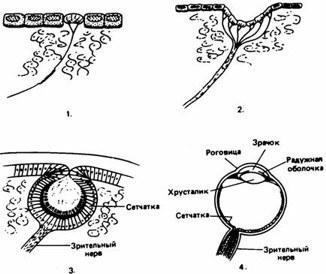
1. Single photoreceptive cell. 2. Eye pit. 3. Cup‑shaped eye without a lens. 4. Eye with a lens. Unfortunately, carriers of transitional states of particular traits have not been preserved in modern fauna in many cases. The first terrestrial vertebrates would not have withstood competition from highly developed tetrapods, and the first birds would not have withstood competition from modern species that have reached high degrees of perfection. In such cases, invaluable data are provided by the paleontological record. This is precisely the significance of finds such as ichthyostega, Archaeopteryx, riniophytes. One can assert that a particular organism is a transitional form in the phylogenetic sense only in exceptional cases, when the paleontological record preserves complete sequences of ancestors and descendants. This is possible when, in the habitat occupied by evolving populations of certain species, continuous deposition of sedimentary rocks containing organismal remains occurs. Why, then, are phylogenetic transitional forms so rarely preserved? The transition from one large group to another also entails a decisive change in lifestyle. Each large group occupies a characteristic set of ecological niches (an adaptive zone). Sometimes, during evolution, species appear that change their way of life. After passing through an unstable state, such species can move into another adaptive zone and give rise to a new taxon. Only groups that occupy sufficiently broad adaptive zones can be numerous and have a high chance of being preserved in the paleontological record.
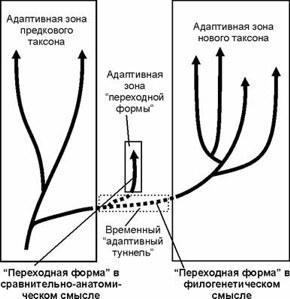
It is surprising not that we find few intermediate forms, but that we sometimes manage to find them! Usually this is because transitional forms occupied a specific ecological niche and achieved a fairly wide distribution. This means that the transitional forms known to us are most likely not the common ancestors of the emerging groups. “Transitional forms” were often associated with short‑lived adaptive zones. This feature made them few in number and temporally limited. So, is ichthyostega not the ancestor of all tetrapods, and Archaeopteryx not the ancestor of all birds?
Of course not!
Perhaps these transitional forms are in relatively close kinship with the common ancestors of new groups, or perhaps they are not. That is not the point.
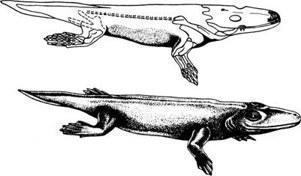
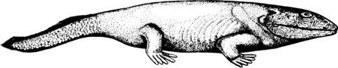
They show the possible pathways evolution could have taken, how traits of one group could have been combined with traits of another. Classic reconstruction of ichthyostega.
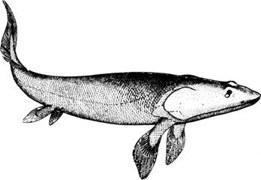
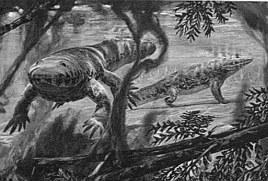
Here it is depicted as a clumsy terrestrial animal. It is now clear that the first tetrapods were predators inhabiting shallow waters. Both limbs and lungs originated as adaptations to aquatic life, but later proved advantageous for terrestrial life. Tulerpeton – another representative of Upper Devonian tetrapods, found in the Tula region. Tulerpeton and ichthyostega belong to different evolutionary branches of tetrapods. Panderichthys – an Upper Devonian lobe‑finned fish that, in some respects, was better adapted for crawling on land than the earliest tetrapods. How to entangle the “transitional forms” problem? The difficulty in understanding the problem of transitional forms is intensively used by opponents of evolution. The main tactic is to persuade laypeople that the existence of a full spectrum of transitional forms is a necessary consequence of evolution. To this end, the properties of both the evolutionary process and the paleontological record are deliberately distorted. “According to the generally accepted evolutionary theory, the paleontological record should lead us to expect: 1. the gradual appearance of the simplest life forms; 2. the gradual transformation of simple forms into more complex ones; 3. numerous intermediate ‘links’ between different species; 4. the beginnings of new organismal traits, such as limbs, bones and organs. According to the creation model, the paleontological record should lead us to expect: 1. the sudden appearance of complex life forms; 2. the multiplication of complex life forms ‘by kind’ (by biological families), not excluding variations; 3. the absence of intermediate ‘links’ between different biological families; 4. the absence of partially developed traits; complete wholeness of all body parts” [1, p. 55]. All theses attributed to evolutionists are based on the notion that evolution proceeds in small steps at a constant rate, and that the paleontological record diligently records every emerging form, both widespread and extremely rare. Incomplete fulfillment of the statements ascribed to evolutionists does not refute the fact of evolution, but merely refines our understanding of its mechanisms. Nevertheless, in broad outline the stated conditions are met. In the paleontological record, remains of unicellular organisms, primitive multicellular animals and then highly developed invertebrates appear sequentially, followed by successive groups of vertebrates (agnathans, fishes, the first terrestrial tetrapods, reptiles, etc.). Both in the fossil record and among modern forms one can find a significant number of intermediate links in terms of structure or lifestyle. Examining well‑documented phylogenetic lines, one can see the development of what the authors of the book called “the beginnings of new traits”. Shallow folds on the teeth of the first horses develop into a powerful system of grinding ridges. The rays of the fins of lobe‑finned fishes transform into the bones of vertebrate limbs. Small patches of new cortex in reptiles became a stage of the process that led to the development of the enormous human cerebral hemispheres. Were there transitional forms? “If evolution were based on facts, one would expect the paleontological record to reveal the beginnings of new structures in living organisms. At least some fossils should show developing arms, legs, wings, eyes and other bones and organs. For example, one should encounter fish fins turning into amphibian legs, and gills gradually turning into lungs. There should have been reptiles whose forelimbs turned into bird wings, hind limbs into clawed feet, scales into feathers, and mouths into horny beaks” [1, p. 56]. The quoted passage (as well as many similar statements scattered throughout anti‑evolutionary literature) testifies to the insufficient competence of its authors. It is unlikely that creationists making statements like those examined are so naïve as not to consult publicly available reference works and textbooks to verify the error of their opinion. More likely, their sole aim is to mislead naïve readers. Well‑known are the paddle‑like fins of lobe‑finned fishes. During studies of modern latimeriids, films were recorded from a submarine deck showing how successfully these fishes walk on a stony bottom with their fins. The conversion of gills into lungs was not envisaged by any sensible specialist. On the contrary, a number of fishes (including modern dipnoans) possess both gills and lungs. Lungs developed as an outpouching of the esophageal wall. The classic “transitional form” – Archaeopteryx (as well as Protoavis) – fits the latter description in the cited excerpt. The wings of these animals retain many common features with the forelimbs of typical reptiles. Embryological data show that bird feathers are transformed reptilian scales. How the hind limbs of reptiles become the clawed feet of birds is hard to grasp: the hind limbs of birds have not undergone a substantial restructuring. Interestingly, the evolution of hind limbs toward the formation of a zeugopod (an additional limb segment) began already in typical reptiles. Both toothed and toothless birds are known. There is nothing supernatural about the bird beak, contrary to the following claim: “…Birds differ from reptiles by their beaks. There are beaks that crack nuts or filter food from muddy water, that gouge food from trees, as well as crossed beaks that open pine cones – the variety seems endless. Yet the beak, having such utility, is said to have arisen accidentally from the nose of a reptile! Does such an explanation seem plausible to you?” [1, p. 79]. A beak is a horny covering located on the jaws. Beaks have arisen repeatedly in different reptile groups. The well‑known gatter (belonging to the order Beak‑headed) has both a small beak and teeth. All turtles have lost teeth and possess remarkable beaks adapted in shape to the characteristic diet of each species. Beaks were present in many extinct reptiles among the mammal‑like (e.g., anomalodonts), dinosaurs (psittacosaurids) and flying reptiles (pteranodons). Adaptation to flight in birds required body lightening, especially of the head. Jaws bearing teeth proved heavier than those covered by a horny sheath. In this respect, birds followed a path already trodden by many of their relatives. Various modifications of the beak described in the passage are the result of later adaptations to different lifestyles. One way to compromise an opponent in debate is to twist his views and then brilliantly refute his own fabrications. Polemics with a caricatured image of the opponent often indicate that the opponent’s actual arguments turned out to be irrefutable. “How is it that flight could evolve in four different groups: insects, birds, reptiles and mammals? Did all have transitional forms? Did all flying animals evolve from a single intermediate link and then continue to evolve into mammals (e.g., bats) and/or insects?” [14]. A reader who believes that evolutionists express such views will inevitably be outraged by their nonsense. The snag is that such ideas are voiced precisely by opponents of evolution. Of course, transitional forms existed in all the mentioned evolutionary lines; naturally, they were different. However, some similar traits among these forms (especially among different vertebrates) existed, and they are explained by the similarity of problems solved in each evolutionary branch. By the way, it is quite likely that flight arose not four but many more times. It is quite possible that birds and flying reptiles originated polyphyletically (by several branches). Gliding flight was mastered by marsupial and placental gliders, colugos, flying frogs, several groups of modern (flying dragons among agamas and gliding geckos) and extinct lizards, arboreal snakes, flying fishes and squids, and even spiders that use long silk threads for this purpose! In a short article it is impossible to examine in detail the origin of all groups whose emergence creationists consider miraculous. Some examples we have already discussed, others we will discuss later. In all cases, an unbiased examination of the facts turns miracles that require divine intervention into ordinary problems amenable to scientific study. Cited literature 13. Ichas M. On the nature of life: mechanisms and meaning. Moscow: Mir, 1994. 14. Harrub B., Thompson B. Archaeopteryx, archaeoraptor, and the “dinosaurs-to-birds” theory. Part I. https://www.apologeticspress.org/rr/rr2001/r&r0104a.htm Additional materials: Has the theory of evolution been refuted? 1. Is the choice between evolutionism and creationism scientific? Has the theory of evolution been refuted? 2. Is variability of scientific knowledge a drawback or an advantage? Has the theory of evolution been refuted? 4. What is a human? Creationism as a form of intellectual doublethink"}