

Subclass Archosauromorpha
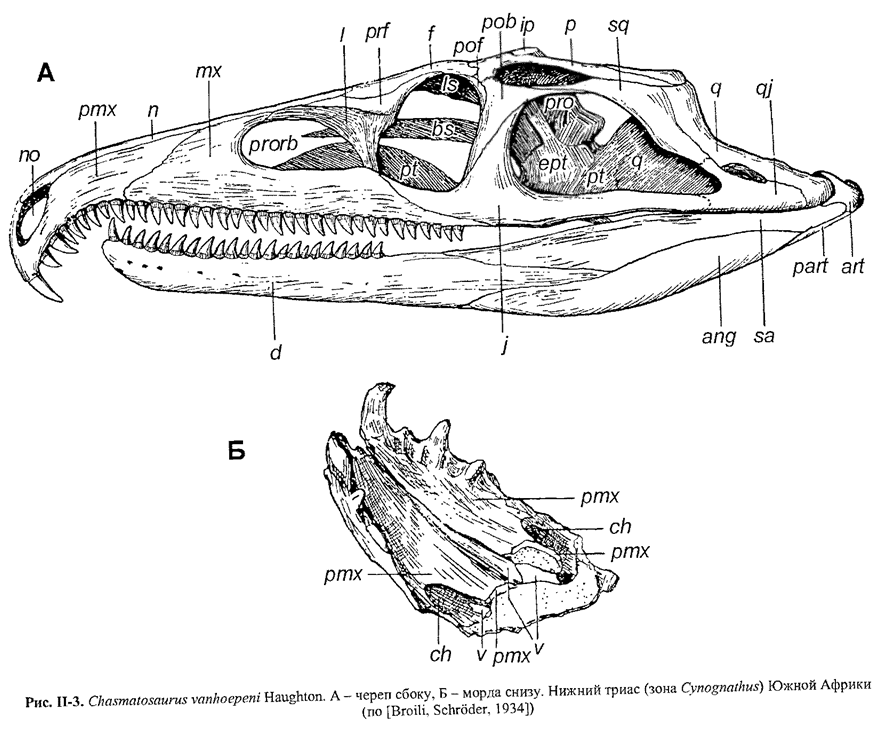
Archosaurs (Archosauria—“ruling reptiles”) are a taxonomically very diverse group that evolved from a stage only slightly different from that of the thyrosaurids to a stage “almost like birds.” Primitive archosaurs differ from archosauromorphs primarily in their pronounced tecodonty. Systematics The subclass Archosauromorpha is traditionally divided into five orders [. Subclass Archosauromorpha Order Tecodontia (Tecodonts) Order Crocodilia Order Saurischia Order Ornithischia Order Pterosauria Characteristics of the order Tecodontia. The systematics of the Tecodontia is very difficult, as the order encompasses highly diverse forms. Common features for all include metakinetic skulls and the absence of sutural connections between the parietal bones and the cupraoccipitale, and between the paroccipital processes and the squamosal bones. There are differing views on the systematics of primitive archosaurs; recently, there has been a trend toward dividing all thecoodonts, with the exception of the Proterozuchia, into two branches—the “dinosaur” (Ornithodira), leading to dinosaurs, and the “crocodilian” (Crurotarsi), leading to crocodiles [Sereno, 1991]. In this article, the systematics of primitive archosaurs is presented in the traditional framework, taking into account modern approaches. Order Tecodontia (Tecodonts) Suborder Archosauriformes (Proterosauria) Suborder Pseudosuchia (Pseudosuchia) Suborder Ornithosuchia (Ornithosuchia) Suborder Parasuchia (Phytosuchia) The Proterosuchia include the most archaic archosaurs that walk on four legs. This group had not yet developed the three-rayed pelvic girdle typical of higher archosaurs. The ankle joint was “double” : in addition to the archaic joint between the bones of the lower leg and foot, there was also a mesotarsal joint, but even together, these two joints did not allow for as complete a flexion of the foot as the main tarsal joint of higher tecodonts. There was no ossified sternum. The neck was elongated, consisting of 7–8 vertebrae. The sacrum consisted of two vertebrae. The sacral ribs were usually horizontal. The limb bones were usually short and massive. The pelvis was broad. The ischial bones are short. The skull is usually long, with the upper jaw longer than the lower jaw. The nostrils and eye sockets are usually oriented laterally. The occipital plane is usually inclined. The second palate is underdeveloped. Palatal teeth are well-developed. Metacinethetic mobility is present. Proterozuchii were carnivorous or piscivorous animals ranging in size from 75 cm to 5–6 m. They first appeared in the very late Permian of Eastern and Western Europe, China, Africa, India, and Australia, but are also found in the Middle Triassic of North and South America and, possibly, Western Europe, as well as in the Upper Triassic of South America. One of the richest faunas of protosuchians, comprising 10 genera with 11 species, has been described from the Lower and Middle Triassic of European Russia and the Urals (Orenburg Region), but this fauna is known almost exclusively from fragmentary remains (with the exception of Garjania). Within the family Erythrosuchidae, the largest member was Erythrosuchus from the upper part of the Lower Triassic of South Africa, with a relatively short and tall skull, a slightly protruding snout, and a relatively short neck. Fig. 1.1–1.3 Fig. 1.1 Fig. 1–2 Fig. 1.3 Chasmatosaurus had an unusual structure—a large (up to 1.5 m long) crocodilian semi-aquatic predator with a flattened skull and an elongated snout sharply curved downward. The unusual anterior position of the choanae in Chasmatosaurus leaves a strange impression: the anterior end of the choanal slit opens beneath the external nostrils.
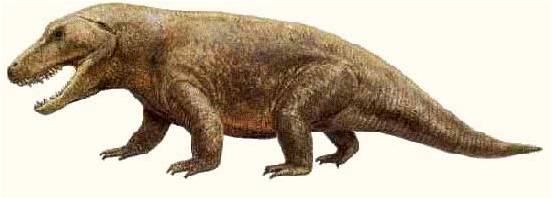
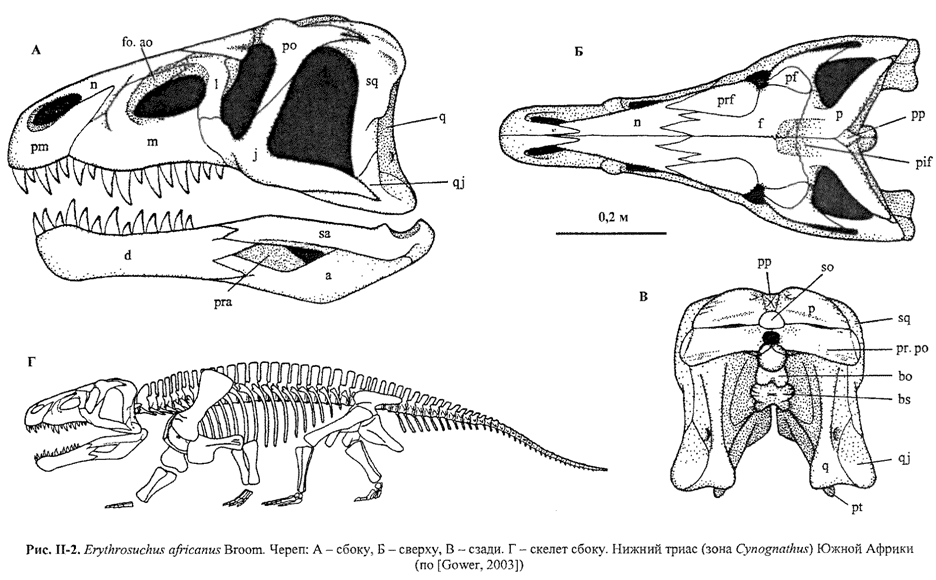
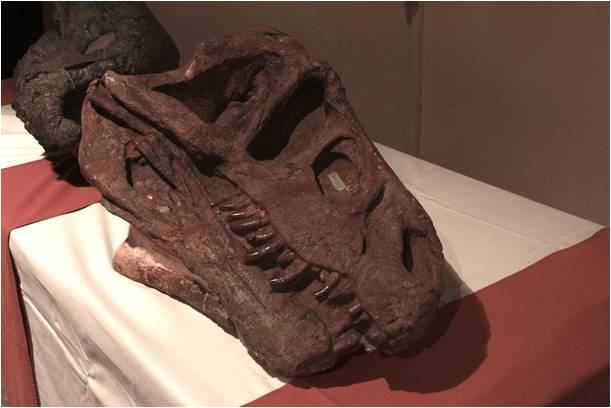
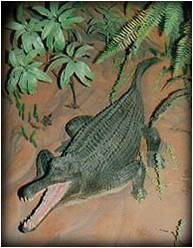
Fig. 2.1–2.2 Chasmatosaurus was originally described from the Lower Triassic of South Africa and was later discovered in the Lower Triassic of India and China as well. Fig. 2.1 Fig. 2.2 Computer reconstruction of Phytosaurus or Parazuchia. These include crocodilian-like aquatic archosaurs (coastal marine or partly freshwater) with strongly posteriorly displaced and closely spaced nostrils. These reptiles reached lengths ranging from one and a half to five or six meters; the skulls of large individuals could reach up to 1.4 m in length.
The snout is very long and narrow, with the upper jaw usually slightly longer than the lower.
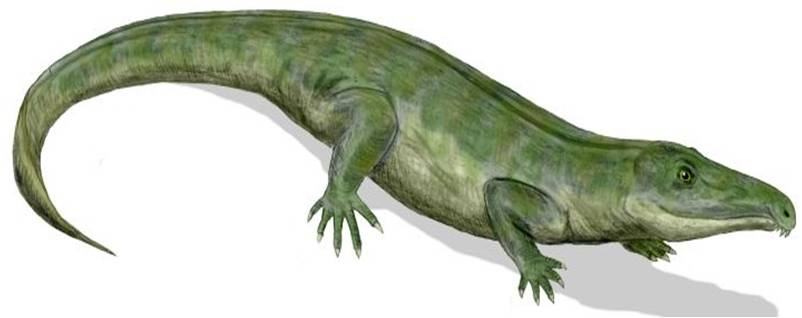
The choanae are located approximately at the level of the nostrils, so that a true secondary palate is not formed. There are no palatal teeth, and the pelvis is very primitive, almost plate-like (the pubic and ischial bones are separated only by a faintly defined process). There are two vertebrae in the sacrum. The tarsal joint is structurally identical to that of a crocodile, but differs in the direction of the joint (in crocodiles, the joint points backward, while in parazuchians, it points backward and outward). The dorsal armor is well-developed, consisting of a central row of rectangular, interconnected, sculpted bony plates. The central row is supplemented by irregularly shaped plates. The throat may be protected by interconnected plates. Phytosaurs were quadrupedal reptiles. They are known primarily from the Upper Triassic of Western Europe, North America, North Africa, Madagascar, India, Thailand, and China, from which up to a dozen genera of these reptiles have been described. Two genera are recorded for Western Europe. Typical representatives include the Indian Parasuchus and the high-nosed Nicrosaurus (Fig.
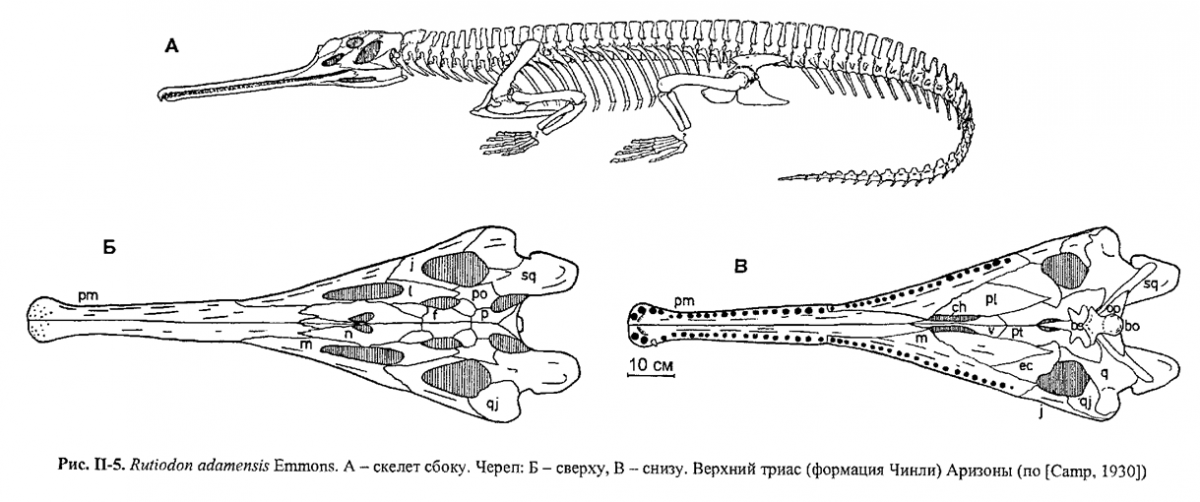
3), known from North America, Western Europe, and India. Fig. 3 Pseudozuchia Specialized cheteropod thecodonts With parasagittal limb posture, plantigrade or facultatively digitigrade. The skull is of medium length; the upper jaw is equal in length to the lower jaw, and the premaxillary bones do not form a hook-shaped downward bend.
The nostrils and eye sockets are oriented in the lateral plane. The secondary palate is moderately developed—the medial processes of the maxillary bones are small, and the choanae are slightly shifted backward. Palatal teeth are absent. Metacinethetic mobility is limited. Usually two, less commonly three or four sacral vertebrae. The sacral ribs are curved downward, less commonly horizontal. The limb bones are usually long and gracile. The pelvis is narrow; the pubic and ischial bones are usually elongated. Many groups occupy an uncertain position in the system [Ivakhnenko 2008]. The group comprises three infraorders; in the Triassic of Eastern Europe, Rauisuchia is represented. Infraorder Rauisuchia. Represented by medium-sized, large, and giant carnivorous or omnivorous pseudosuchians (body length 2–10 m), facultatively digitigrade. The skull is quite large, narrow, and high, with almost no rostral depression. They are found in the Early Triassic of South America, the Middle Triassic of Western Europe, South America, China, East Africa, and India, as well as in the Late Triassic of South America, North America, and India.