
On the differences between sexes. Column in ComputerreOnline #7
The prerogative of dioecious organisms is not sexual selection but sexual dimorphism. Males (and men) are representatives of the sex that, from an evolutionary perspective, is not spared.
Recently I compared three main types of reproduction and briefly examined why reproduction with recombination through the sexual process is “better” (evolutionarily more promising) than clonal. Do not think that everything is crystal‑clear in this problem, but the ways to solve it are fairly well developed. The more interesting part is the second: understanding why we are dioecious rather than hermaphroditic.
The very formulation of this question provoked disagreement among several readers. In their view, dioecy surprises only those who know nothing about sexual selection. Let’s examine it.
Sexual selection is a non‑random (dependent on individual traits) choice of partners for reproduction. Sexual selection can also occur among hermaphrodites. The difference is that in hermaphrodites, during sexual selection each individual is selected in both of its roles – female and male. I am not aware of such studies, but I assume that for most hermaphrodites the larger the partner, the more attractive it is. It is more promising in the female role (can invest more in offspring) and in the male role (having reached a large size means it is viable and carries “good” genes).
The prerogative of dioecious organisms is not sexual selection but sexual dimorphism. It concerns differences between the sexes that are not directly linked to reproduction (do not provide the main functions of the female or male reproductive systems). The concept of sexual dimorphism can be interpreted narrowly (considering only anatomy) and broadly (including all sex differences, from structure to behavior, except those that directly ensure reproduction).
A brighter example? Ceratioid anglerfishes. Females far outsize males. In many species males attach to females, grow onto them and become something like a second gonad. This situation is very different from hermaphroditism, because the male retains his genetic individuality.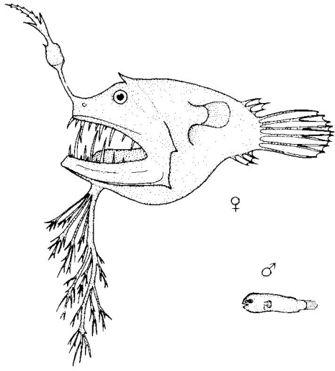
Anglerfishes Linophryne arborifera (source: Wikipedia)
But let us discuss the most important species for us. The whole complex of differences between men and women that is observable in everyday life (apart from intimate anatomical details) can serve as an example of sexual dimorphism. Men are larger, stronger, hairier‑bearded, more resistant to short, intense loads, adapt worse to prolonged adverse conditions, and are more suited to conflicts. Women please the male eye with roundness, are much weaker under peak loads and more tolerant of adverse environmental conditions.
Does the phrasing “pleases the male eye” sound sexist? That is a serious accusation. By the way, public sources accuse (see “Sexism” in Wikipedia) of this sin not only those who think one sex is better than the other, but also those who stereotypically judge people on the basis of sex. Framing the question as “better‑worse” is, of course, unusually foolish. I also reject the stereotype. The indicated differences between the sexes are statistical. Some women can be taller, stronger, more conflict‑prone (and even bearded!) than some men, but average‑based comparisons do not eliminate that.
Nevertheless, a reference to the male gaze is needed to explain female roundness. In other modern representatives of the family Hominidae, and indeed other mammals, female mammary glands enlarge during offspring feeding and then shrink again. You cannot explain “directly” why the breast of a non‑lactating woman is often even larger than needed for nursing. Yet it is easy to explain by the fact that the very sight of female breasts is an important stimulus for men.
Thus, the described sex differences are the result of simple facts. A woman can leave relatively few offspring, a man many more. And to explain the reasons for sexual dimorphism it is timely to recall the popular among readers “KT” evolutionary theory of sex by Vigen Geodakyan. Its latest exposition is titled “Two Sexes. Why and How?”. It is a very interesting set of ideas. I disagree with many details, but the main idea is good. However, Geodakyan considers only the consequences of dioecy, not its causes. In other words, the “why” placed in the book title remains unrevealed.
Do not rush: there is no paradox here. For example, in Charles Darwin’s great book *On the Origin of Species…* there was precisely no talk about the origin of species. The mechanisms of speciation began to be studied much later; Darwin’s main contribution lies in developing the idea of natural selection (although that idea existed before him).
Let me elaborate. We are extremely complex biosystems that develop through individual ontogeny. Development is influenced by a hereditary program. The set of switches contained in it “takes into account” the properties of our physical, biological and social environment. Where did this information come from? It was gathered by a fundamental mechanism of creating new information: memorizing the consequences of random choice. In biological evolution this mechanism is called natural selection.
In a population individuals with different genotypes arise. Some of them leave offspring, some do not. The genotypes of those who left offspring are favored by the environment. The genes of those who did not are rejected. In conditions where everyone maximizes reproduction, selection can only increase fecundity. And for a population to adapt to changing conditions, some individuals must be removed from reproduction. Within certain limits, the more individuals are excluded from reproduction because of their “unsuccessful” heredity, the more intensely information about environmental demands can be transmitted into the population’s gene pool.
Without retelling Geodakyan, consider an example that reflects the key idea of his theory. Compare three populations. A – hermaphrodites with cross‑fertilization. B – dioecious without sexual dimorphism. C – dioecious with dimorphism, where males are more variable than females and have much higher mortality. The sex ratio in B and C is 1:1.
The environment changed. To track the change and persist, a forty‑percent mortality is needed. In A and B, 40 % of all individuals will die and offspring will decrease by 40 %. But if sexual dimorphism in species C causes all 40 % of the dead to be males, then all females (50 % of the original number) plus another 10 % (of the original) of males remain. The remaining males are enough to fertilize all females, selection will proceed, the population will change, and the number of offspring will stay constant! Males (and men) are representatives of the sex that evolution does not regret.
This circumstance explains the advantage of species C over species B. Yet both C and B still lose to species A. Even with forty‑percent mortality, 60 % of individuals of species A will leave offspring, versus only 50 % of individuals of species C. Thus, sexual dimorphism can significantly mitigate (but not eliminate) the so‑called “double cost of sex” that dioecious species have to pay.
An analogy. Since Darwin’s time it has been debated whether the evolution of the eye can be explained. Such an explanation is not a proof of the advantages that eyes provide. Researchers (and find) explanations of the transitions that led from eyelessness to eyes. To explain dioecy it is insufficient to show how dioecy with sophisticated sexual dimorphism outperforms hermaphroditism. Geodakyan himself considers hermaphroditism primary. Therefore, to explain the origin of dioecy one must explain the transition to it from hermaphroditism. Dioecy in its early stages was imperfect (like the first eyes) and was not accompanied by sexual dimorphism. Why, then, did evolution (which cannot look ahead) repeatedly take this path? Unfortunately, V.A. Geodakyan’s evolutionary theory of sex provides no answer. Don’t believe it? Look it up: geodakian.com !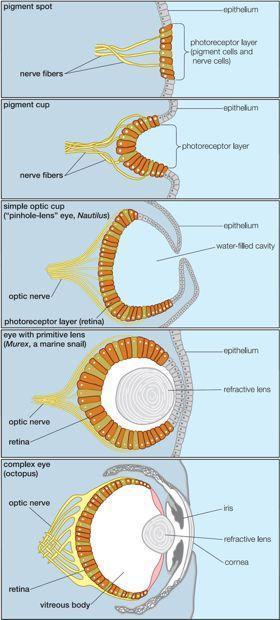
The development of the mollusk eye. What were the stages in the development of dioecy? (Click the picture to enlarge; source: evolbiol.ru)
So, is the emergence of dioecy inexplicable? Dear readers, I have an explanation for you! I will propose it in one of the next columns.