
Ecology: The Biology of Interactions. 1.07. Regulation of Biosystems
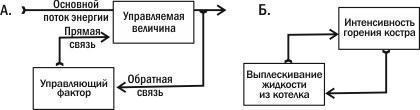
A direct link is the effect of some factor on the system under study, its control (example: turning the wheel, the driver changes the car's direction of movement). Feedback is the dependence of the controlling effect on the state of the system itself (example: a change in the car's movement affects...
Ukrainian (latest version) / Russian version (updates discontinued)
1.06. Approaches to studying biosystems
D. Shabanov, M. Kravchenko. Ecology: the biology of interaction
Chapter 1. Ecology and the biosystems it studies
1.08. Properties of complex systems
1.07. Regulation of biosystems
Life is based on continuous change, in which, nevertheless, most of the important properties of living systems remain constant. Thus, over the course of a year most of the atoms in each person's body are replaced, yet the person themselves remains practically the same as they were. Over the centuries, all of a forest's inhabitants change, but the forest's important properties remain constant. What properties of biosystems ensure such stability amid change?
To answer this question, the cybernetic (pertaining to the science of control) concepts of forward and feedback links are important. A forward link is the influence of some factor on the system under study (example: by turning the steering wheel, the driver changes the direction of the car's movement). A feedback link is the dependence of a controlling influence on the state of the system itself (example: a change in the car's movement affects the driver's turning of the wheel). Thus, feedback is control of a system that takes its state into account, a dependence of the controlling influence on its own results (fig. 1.7.1, A).

Fig. 1.7.1. Explanation of the concept of feedback. A. Forward and feedback links. B. Example of a feedback link
Two types of feedback are distinguished. Positive feedback amplifies the deviation of the controlled quantity from its initial state, while negative feedback returns the system to its previous state. In other words, positive feedback is the mutual stimulation of two processes, while negative feedback is the suppression of deviations in the controlled process.
Let's consider a simple example: a pot of water boils over a hot fire. If the fire burns too strongly, some of the water spills over, partly dousing the fire and reducing the intensity of burning. When the fire dies down, the spilling stops, and the fire gradually flares up again. In this example, a deviation of the controlled quantity (the intensity of burning) causes such a change in the action of the controlling factor (the spilling) that it exerts an effect on the controlled quantity opposite (negative in sign) to the initial deviation. Hence, in this case we're dealing with negative feedback.
And in what case would feedback in a similar example turn out to be positive? If there were kerosene in the pot instead of water! In that case, the more brightly the fire burns, the more strongly the kerosene will spill out, which will further intensify the burning of the fire.
It's essential that in the example with the pot, positive feedback would quickly drive the system out of its initial state (the pot of kerosene would empty out), while negative feedback (if there's water in the pot) leads to the system's properties remaining relatively constant. Negative feedback stabilizes a system, while positive feedback shifts it into another state (that is, destroys the previous structure of interconnections). The existence of alternative modes of biosystem functioning is determined by combinations of the two types of feedback: negative feedback stabilizes each mode, while positive feedback ensures switching between such modes.
For example, changes in the course of ontogenesis are regulated by positive feedback. This is how, for example, the development of falling in love proceeds (a switch from one behavioral program to another): a stimulus evokes interest, interest amplifies the effect of the stimulus. Interest evokes certain actions, which in turn lead to growth of the stimulus and growth of interest, and so on. The process of courtship and rapprochement reaches a culmination, after which the system transitions into another state…
Usually negative feedback can operate within a certain range of regulation. When this range is exceeded, positive feedback that destroys the system comes into play. Returning to the example of the pot on the fire, one can confirm that both a sharp increase in the strength of the flame and the dying down of the fire will drive the system beyond the limits of the "corridor" within which its state is regulated by negative feedback. Let's give a more topical example: an increase in the concentration of carbon dioxide in the atmosphere activates reactions that reduce it (intensifies photosynthesis, increases binding in the form of calcium carbonate in the World Ocean). When the concentration of carbon dioxide goes beyond certain limits (for example, with excessive increase), mechanisms switch on that shift the system into another state. A rise in temperature due to the greenhouse effect causes a decrease in photosynthesizing green mass, an acceleration of the release of carbon dioxide from the soil, and so on, which can lead to a further increase in CO₂ concentration (and a transition of the system to another state with different negative feedback loops stabilizing it).
Biological systems can be viewed as cybernetic systems characterized by ordered internal interactions. In organisms the control system is internal and specialized; in technical devices with negative feedback (servomechanisms) it is external and specialized; in ecosystems it is internal and non-specialized (fig. 1.7.2). A typical feature of all cybernetic systems is that low-energy processes in them control high-energy ones (moving your hand on a switch stops a factory). At the organismal level, substantial restructurings of metabolism can be triggered by just a few hormone molecules. In ecosystems, the greatest regulatory influence on a community can be exerted by apex predators, who account for only a small fraction of the matter and energy flow passing through the ecosystem. Flatworm parasitoids (see item 4.06) transform only a small fraction of the energy flow passing through the biocenosis, but effectively regulate its net production via herbivorous insects.

Fig. 1.7.2. Features of negative feedback in a technical device (A.) and an ecosystem (B.)
Regulation at various levels of biosystems is often carried out thanks to negative feedback, which gives many biosystems similar properties. Let's give a few examples of regulation on the principle of negative feedback at various levels of biosystems.
Table 1.7.1. Examples of regulation on the principle of negative feedback for different levels of organization of biosystems
Level
Example of regulation on the principle of negative feedback
Process
Forward link
Feedback link
Molecular
Regulation of enzyme activity
The enzyme synthesizes a certain product
A shortage of the product leads to activation of the enzyme and increased synthesis of this enzyme by the cell, while an excess leads to its inhibition and a slowdown of synthesis
Cellular
The relationship between assimilation and dissimilation
By breaking down organic substances, an animal cell obtains energy
An increase in the cell's energy consumption leads to intensification of the processes by which it obtains this energy; a decrease in consumption leads to a slowdown of dissimilation
Organ-tissue
Regulation of cell division in a tissue
New cells are formed as a result of the division of existing ones
Contacts between neighboring cells in tissues inhibit their proliferation; the absence of neighboring cells and contacts with them stimulates a cell to multiply
Organismal
Maintaining body surface temperature in homoiothermic organisms
Increased peripheral blood circulation leads to warming of the body's surface
Cooling of the body's surface leads to increased blood circulation and restoration of the necessary temperature, while moderate warming leads to a decrease in blood supply to the surface
Population
Regulation of reproduction through territoriality
In many species, only individuals holding an individual territory take part in reproduction
With excessive population density, a significant part of individuals' energy is spent on territorial conflicts, and the number of offspring does not grow or even decreases; when the population declines, the reverse reaction is observed
Biogeocenotic
Biocenotic regulation of population numbers
Predators, parasites, and resource scarcity affect population numbers
When a population's numbers decline, predators switch to other prey, the spread of parasites becomes harder, resources become more accessible; a growth in numbers causes the opposite processes
Biospheric
Regulation of carbon dioxide content in the atmosphere
Photosynthesis and binding reduce the concentration of CO₂
As CO₂ concentration grows, photosynthesis and the binding of carbon dioxide in the form of limestone in ocean water intensify
Supplementary materials:
Column: The Pendulum
Lecture: Biosystems, their properties and regulation
Ukrainian / Russian
1.06. Approaches to studying biosystems
D. Shabanov, M. Kravchenko. Ecology: the biology of interaction
Chapter 1. Ecology and the biosystems it studies
1.08. Properties of complex systems