

Shyshkin, 2010. Эволюционная теория и научное мышление
Shchyshkin M.A. Evolutionary Theory and Scientific Thinking. // Paleontological Journal, 2010. — No. 6. — pp. 3-17
Shishkin M.A. Evolutionary Theory and Scientific Thinking. // Paleontological Journal, 2010. — No. 6. — pp. 3-17 UDC 576.12:001.8 EVOLUTIONARY THEORY AND SCIENTIFIC THINKING © 2010 M.A. Shishkin Paleontological Institute of A.A. Borisyak RAS e-mail: shishkin@paleo.ru Received by the editorial board on 25.12.2009 Accepted for publication on 29.01.2010 Progress in theoretical thought and the growth of factual knowledge in the natural sciences are not directly interdependent. The state of theory is for a long time determined by the peculiarities of collective thinking that have formed in a given field of knowledge. This applies especially to the concept of natural selection, known in the form of two polar interpretations — the genetic theory of evolution and the epigenetic theory. The predictable outcome of their confrontation will not be connected with "decisive arguments" in favor of one of them. Its arrival depends on how quickly evolutionary biology frees itself from the tradition of mosaic thinking, which allows combining mutually exclusive concepts. Key to this will be the recognition of the incompatibility of the idea of particulate determination of development with the principle of systemic conditionality of the same process. INTRODUCTION Progress in theoretical thought and the growth of factual knowledge in the natural sciences agree with each other only in general outline. Moreover, the extensive accumulation of empirical observations may push theoretical thought backward. At specific historical stages, quite different factors may be decisive for the state of theory. First of all, these are the peculiarities and traditions of collective scientific thinking that have formed in a given field of knowledge. All this applies to the theory of biological evolution based on natural selection. In Darwin's exposition of the theory, its basic concepts (selection, variability, and heredity) are poorly specified, which was natural given the then-current level of biological understanding and Darwin's lack of inclination for speculative constructs. He largely only outlined what was recognized much later. We should especially note the proximity of the creator of the theory to an intuitive understanding of the role of natural selection as a mechanism for stabilizing historical changes: "selection in these cases has not yet managed to overcome the tendency toward further variability..."; or: "...selection has already managed to impart... a constant character to the organ" (see Darwin 2003, p. 166). From this also logically followed his explanation of variability of rudimentary organs as a result of the absence of selective control (same source, p. 165). The profound meaning of these generalizations could not be understood at that time due to the absence of concepts of systemic processes. Subsequently, Darwin's theory received two diametrically polar interpretations, originally associated with the names of A. Weismann (neodarwinism, or genetic theory of evolution — GTE) and I.I. Shmalhausen—K. Waddington (the theory of stabilizing selection, or epigenetic theory — ETE). They are based on alternative concepts of individual development, i.e., respectively, on preformationist (explicit or implicit) and epigenetic models. The first of these assumes some form of ordered correspondence between the elements of the germ cell and the parts of the adult organism. Conversely, within the second model, these categories belong to different hierarchical levels of the developmental system and are not connected by direct dependencies. In the concepts of GTE, the substrate of selection is a mosaic of independent hereditary factors (genes) in the sex cells. The stability (heritability) of traits of the adult phenotype is an expression of the immanent properties of these factors, not requiring evolutionary explanation. The evolution of the organism and its ontogenesis is a result of gene selection; therefore it proceeds, like ontogenesis itself, in the direction from zygote to adult state. Hereditary changes (mutations) and natural selection (as a sieve for them) interact in evolution as independent factors. Hereditary and non-hereditary changes of the phenotype are qualitatively different. The basis of this worldview is clearly expressed in Weismann's words: "Natural selection only appears to deal with the qualitative peculiarities of the finished organism; in reality, however, it deals only with the rudiments of these peculiarities hidden in the sex cells" (Weissmann, 1883; cited after Filipchenko, 1977, p. 148). Conversely, for ETE, the object of evolution is individual development as a whole, i.e., ontogenesis is considered as a dynamic system directed toward final equilibrium (the adult norm). Evolution is a chain of repair acts of such system, following each disturbance of its stability. Selection is a mechanism of self-organization, i.e., the search for a new equilibrium by the disturbed system through stabilization of one of the realizable deviations of development. The material of selection is heterogeneous isoaberrant individuals, not carriers of the "selected mutation." Evolutionary changes begin from the adult phenotype and spread in the direction of the genotype of subsequent generations1. Heredity (stability) is not a partner of natural selection but its product, appearing as a systemic property of development. All changes of the phenotype are expressions of the norm of reaction and as such are homogeneous. These principles are reflected, in particular, in the following generalizations: "Although genotype change is a necessary basis for the evolutionary process, it does not determine evolution... On the contrary, the evolution of the organism determines changes of its genotype..." (Shmalhausen, 1940, p. 57). "The theory of natural selection is... a theory explaining the origin and transformation of hereditary mechanisms... The stability of a trait... is not a property of the gene but an expression of the interdependence of... parts of the developing organism" (Shmalhausen, 1982, p. 110, 174) (italics ours — MSH). According to ETE, the space of possible developmental aberrations in a given system constitutes its species-specific characteristic. Any deviation from the normal outcome of development remains within this limited space and represents the integral response of the system to the disturbance of proper coordination of events in it (Fig. 1). It thus reflects the properties of the system itself, not the specificity of any internal or external damaging factor (cf. Goldschmidt, 1938, 1940). In sum, this response space is described as a set of ontogenetic trajectories realizable in a given type of development with some probability. Its vivid three-dimensional model is K. Waddington's epigenetic landscape as a network of diverging valleys denoting possible developmental variants (Fig. 2, a). The relatively simple structure demonstrated by this model "is a property of a higher order, based on an underlying network of much more complex interactions" (Waddington, 1957, p. 34, Fig. 5), i.e., processes occurring at the levels of gene expression and elementary morphogenetic acts (Fig. 2, b). [IMG_1] Fig. 1. Species-specific limitation of the space of developmental outcomes, independent of the nature of disturbing factors (after Shishkin, 1987, with modifications). Designations: N — area of variations of the adult phenotypic norm; the fields around it are areas of abnormal morphogenesis; n1—n3 — zygotes with high resistance to interference of normal development, m — zygote with destabilized development; solid lines — stable (for individual zygotes) developmental trajectories, broken — unstable trajectories.
## INTRODUCTION The progress of theoretical thought and the growth of factual knowledge in the natural sciences are in agreement with each other only in general terms. Moreover, the extensive accumulation of empirical observations can push theoretical thought backward. At specific historical stages, quite different factors can be decisive for the state of theory. First of all, these are the peculiarities and traditions of collective scientific thinking that have developed in a given field of knowledge. All this also applies to the theory of biological evolution based on natural selection.
Shishkin M.A. Evolutionary Theory and Scientific Thinking. // Paleontological Journal, 2010. — No. 6. — pp. 3-17 UDC 576.12:001.8 EVOLUTIONARY THEORY AND SCIENTIFIC THINKING © 2010 M.A. Shishkin Paleontological Institute of A.A. Borisyak RAS e-mail: shishkin@paleo.ru Received by the editorial board on 25.12.2009 Accepted for publication on 29.01.2010 Progress in theoretical thought and the growth of factual knowledge in the natural sciences are not directly interdependent. The state of theory is for a long time determined by the peculiarities of collective thinking that have formed in a given field of knowledge. This applies especially to the concept of natural selection, known in the form of two polar interpretations — the genetic theory of evolution and the epigenetic theory. The predictable outcome of their confrontation will not be connected with "decisive arguments" in favor of one of them. Its arrival depends on how quickly evolutionary biology frees itself from the tradition of mosaic thinking, which allows combining mutually exclusive concepts. Key to this will be the recognition of the incompatibility of the idea of particulate determination of development with the principle of systemic conditionality of the same process. INTRODUCTION Progress in theoretical thought and the growth of factual knowledge in the natural sciences agree with each other only in general outline. Moreover, the extensive accumulation of empirical observations may push theoretical thought backward. At specific historical stages, quite different factors may be decisive for the state of theory. First of all, these are the peculiarities and traditions of collective scientific thinking that have formed in a given field of knowledge. All this applies to the theory of biological evolution based on natural selection. In Darwin's exposition of the theory, its basic concepts (selection, variability, and heredity) are poorly specified, which was natural given the then-current level of biological understanding and Darwin's lack of inclination for speculative constructs. He largely only outlined what was recognized much later. We should especially note the proximity of the creator of the theory to an intuitive understanding of the role of natural selection as a mechanism for stabilizing historical changes: "selection in these cases has not yet managed to overcome the tendency toward further variability..."; or: "...selection has already managed to impart... a constant character to the organ" (see Darwin 2003, p. 166). From this also logically followed his explanation of variability of rudimentary organs as a result of the absence of selective control (same source, p. 165). The profound meaning of these generalizations could not be understood at that time due to the absence of concepts of systemic processes. Subsequently, Darwin's theory received two diametrically polar interpretations, originally associated with the names of A. Weismann (neodarwinism, or genetic theory of evolution — GTE) and I.I. Shmalhausen—K. Waddington (the theory of stabilizing selection, or epigenetic theory — ETE). They are based on alternative concepts of individual development, i.e., respectively, on preformationist (explicit or implicit) and epigenetic models. The first of these assumes some form of ordered correspondence between the elements of the germ cell and the parts of the adult organism. Conversely, within the second model, these categories belong to different hierarchical levels of the developmental system and are not connected by direct dependencies. In the concepts of GTE, the substrate of selection is a mosaic of independent hereditary factors (genes) in the sex cells. The stability (heritability) of traits of the adult phenotype is an expression of the immanent properties of these factors, not requiring evolutionary explanation. The evolution of the organism and its ontogenesis is a result of gene selection; therefore it proceeds, like ontogenesis itself, in the direction from zygote to adult state. Hereditary changes (mutations) and natural selection (as a sieve for them) interact in evolution as independent factors. Hereditary and non-hereditary changes of the phenotype are qualitatively different. The basis of this worldview is clearly expressed in Weismann's words: "Natural selection only appears to deal with the qualitative peculiarities of the finished organism; in reality, however, it deals only with the rudiments of these peculiarities hidden in the sex cells" (Weissmann, 1883; cited after Filipchenko, 1977, p. 148). Conversely, for ETE, the object of evolution is individual development as a whole, i.e., ontogenesis is considered as a dynamic system directed toward final equilibrium (the adult norm). Evolution is a chain of repair acts of such system, following each disturbance of its stability. Selection is a mechanism of self-organization, i.e., the search for a new equilibrium by the disturbed system through stabilization of one of the realizable deviations of development. The material of selection is heterogeneous isoaberrant individuals, not carriers of the "selected mutation." Evolutionary changes begin from the adult phenotype and spread in the direction of the genotype of subsequent generations1. Heredity (stability) is not a partner of natural selection but its product, appearing as a systemic property of development. All changes of the phenotype are expressions of the norm of reaction and as such are homogeneous. These principles are reflected, in particular, in the following generalizations: "Although genotype change is a necessary basis for the evolutionary process, it does not determine evolution... On the contrary, the evolution of the organism determines changes of its genotype..." (Shmalhausen, 1940, p. 57). "The theory of natural selection is... a theory explaining the origin and transformation of hereditary mechanisms... The stability of a trait... is not a property of the gene but an expression of the interdependence of... parts of the developing organism" (Shmalhausen, 1982, p. 110, 174) (italics ours — MSH). According to ETE, the space of possible developmental aberrations in a given system constitutes its species-specific characteristic. Any deviation from the normal outcome of development remains within this limited space and represents the integral response of the system to the disturbance of proper coordination of events in it (Fig. 1). It thus reflects the properties of the system itself, not the specificity of any internal or external damaging factor (cf. Goldschmidt, 1938, 1940). In sum, this response space is described as a set of ontogenetic trajectories realizable in a given type of development with some probability. Its vivid three-dimensional model is K. Waddington's epigenetic landscape as a network of diverging valleys denoting possible developmental variants (Fig. 2, a). The relatively simple structure demonstrated by this model "is a property of a higher order, based on an underlying network of much more complex interactions" (Waddington, 1957, p. 34, Fig. 5), i.e., processes occurring at the levels of gene expression and elementary morphogenetic acts (Fig. 2, b). [IMG_1] Fig. 1. Species-specific limitation of the space of developmental outcomes, independent of the nature of disturbing factors (after Shishkin, 1987, with modifications). Designations: N — area of variations of the adult phenotypic norm; the fields around it are areas of abnormal morphogenesis; n1—n3 — zygotes with high resistance to interference of normal development, m — zygote with destabilized development; solid lines — stable (for individual zygotes) developmental trajectories, broken — unstable trajectories.
Further, Darwin's theory received two diametrically opposed interpretations, initially associated with the names of A. Weismann (neo-Darwinism, or genetic theory of evolution - GTE) and I.I. Schmalhausen-K. Waddington (doctrine of stabilizing selection, or epigenetic theory - ETE). They rely on alternative concepts of individual development, i.e., on preformation (direct or by default) and epigenetic models, respectively. The first of these assumes some form of ordered correspondence between the elements of the germ cell and the parts of the adult organism. On the contrary, within the framework of the second model, these categories belong to different hierarchical levels of the developmental system and are not related by direct dependencies.
In the GTE view, the substrate of selection is a mosaic of independent inherited factors (genes) in germ cells. The stability (heritability) of adult phenotype traits is an expression of the inherent properties of these factors, which does not require evolutionary explanation. The evolution of the organism and its ontogeny is the result of gene selection; therefore, it proceeds, like ontogeny itself, in the direction from zygote to adult state. Inherited changes (mutations) and natural selection (as a sieve for them) interact in evolution as independent factors. Inherited and non-inherited phenotypic changes are qualitatively different.
Shishkin M.A. Evolutionary Theory and Scientific Thinking. // Paleontological Journal, 2010. — No. 6. — pp. 3-17 UDC 576.12:001.8 EVOLUTIONARY THEORY AND SCIENTIFIC THINKING © 2010 M.A. Shishkin Paleontological Institute of A.A. Borisyak RAS e-mail: shishkin@paleo.ru Received by the editorial board on 25.12.2009 Accepted for publication on 29.01.2010 Progress in theoretical thought and the growth of factual knowledge in the natural sciences are not directly interdependent. The state of theory is for a long time determined by the peculiarities of collective thinking that have formed in a given field of knowledge. This applies especially to the concept of natural selection, known in the form of two polar interpretations — the genetic theory of evolution and the epigenetic theory. The predictable outcome of their confrontation will not be connected with "decisive arguments" in favor of one of them. Its arrival depends on how quickly evolutionary biology frees itself from the tradition of mosaic thinking, which allows combining mutually exclusive concepts. Key to this will be the recognition of the incompatibility of the idea of particulate determination of development with the principle of systemic conditionality of the same process. INTRODUCTION Progress in theoretical thought and the growth of factual knowledge in the natural sciences agree with each other only in general outline. Moreover, the extensive accumulation of empirical observations may push theoretical thought backward. At specific historical stages, quite different factors may be decisive for the state of theory. First of all, these are the peculiarities and traditions of collective scientific thinking that have formed in a given field of knowledge. All this applies to the theory of biological evolution based on natural selection. In Darwin's exposition of the theory, its basic concepts (selection, variability, and heredity) are poorly specified, which was natural given the then-current level of biological understanding and Darwin's lack of inclination for speculative constructs. He largely only outlined what was recognized much later. We should especially note the proximity of the creator of the theory to an intuitive understanding of the role of natural selection as a mechanism for stabilizing historical changes: "selection in these cases has not yet managed to overcome the tendency toward further variability..."; or: "...selection has already managed to impart... a constant character to the organ" (see Darwin 2003, p. 166). From this also logically followed his explanation of variability of rudimentary organs as a result of the absence of selective control (same source, p. 165). The profound meaning of these generalizations could not be understood at that time due to the absence of concepts of systemic processes. Subsequently, Darwin's theory received two diametrically polar interpretations, originally associated with the names of A. Weismann (neodarwinism, or genetic theory of evolution — GTE) and I.I. Shmalhausen—K. Waddington (the theory of stabilizing selection, or epigenetic theory — ETE). They are based on alternative concepts of individual development, i.e., respectively, on preformationist (explicit or implicit) and epigenetic models. The first of these assumes some form of ordered correspondence between the elements of the germ cell and the parts of the adult organism. Conversely, within the second model, these categories belong to different hierarchical levels of the developmental system and are not connected by direct dependencies. In the concepts of GTE, the substrate of selection is a mosaic of independent hereditary factors (genes) in the sex cells. The stability (heritability) of traits of the adult phenotype is an expression of the immanent properties of these factors, not requiring evolutionary explanation. The evolution of the organism and its ontogenesis is a result of gene selection; therefore it proceeds, like ontogenesis itself, in the direction from zygote to adult state. Hereditary changes (mutations) and natural selection (as a sieve for them) interact in evolution as independent factors. Hereditary and non-hereditary changes of the phenotype are qualitatively different. The basis of this worldview is clearly expressed in Weismann's words: "Natural selection only appears to deal with the qualitative peculiarities of the finished organism; in reality, however, it deals only with the rudiments of these peculiarities hidden in the sex cells" (Weissmann, 1883; cited after Filipchenko, 1977, p. 148). Conversely, for ETE, the object of evolution is individual development as a whole, i.e., ontogenesis is considered as a dynamic system directed toward final equilibrium (the adult norm). Evolution is a chain of repair acts of such system, following each disturbance of its stability. Selection is a mechanism of self-organization, i.e., the search for a new equilibrium by the disturbed system through stabilization of one of the realizable deviations of development. The material of selection is heterogeneous isoaberrant individuals, not carriers of the "selected mutation." Evolutionary changes begin from the adult phenotype and spread in the direction of the genotype of subsequent generations1. Heredity (stability) is not a partner of natural selection but its product, appearing as a systemic property of development. All changes of the phenotype are expressions of the norm of reaction and as such are homogeneous. These principles are reflected, in particular, in the following generalizations: "Although genotype change is a necessary basis for the evolutionary process, it does not determine evolution... On the contrary, the evolution of the organism determines changes of its genotype..." (Shmalhausen, 1940, p. 57). "The theory of natural selection is... a theory explaining the origin and transformation of hereditary mechanisms... The stability of a trait... is not a property of the gene but an expression of the interdependence of... parts of the developing organism" (Shmalhausen, 1982, p. 110, 174) (italics ours — MSH). According to ETE, the space of possible developmental aberrations in a given system constitutes its species-specific characteristic. Any deviation from the normal outcome of development remains within this limited space and represents the integral response of the system to the disturbance of proper coordination of events in it (Fig. 1). It thus reflects the properties of the system itself, not the specificity of any internal or external damaging factor (cf. Goldschmidt, 1938, 1940). In sum, this response space is described as a set of ontogenetic trajectories realizable in a given type of development with some probability. Its vivid three-dimensional model is K. Waddington's epigenetic landscape as a network of diverging valleys denoting possible developmental variants (Fig. 2, a). The relatively simple structure demonstrated by this model "is a property of a higher order, based on an underlying network of much more complex interactions" (Waddington, 1957, p. 34, Fig. 5), i.e., processes occurring at the levels of gene expression and elementary morphogenetic acts (Fig. 2, b). [IMG_1] Fig. 1. Species-specific limitation of the space of developmental outcomes, independent of the nature of disturbing factors (after Shishkin, 1987, with modifications). Designations: N — area of variations of the adult phenotypic norm; the fields around it are areas of abnormal morphogenesis; n1—n3 — zygotes with high resistance to interference of normal development, m — zygote with destabilized development; solid lines — stable (for individual zygotes) developmental trajectories, broken — unstable trajectories.
Conversely, for ETE, the object of evolution is individual development as a whole, i.e., ontogeny is considered as a dynamic system directed towards final equilibrium (adult norm). Evolution is a chain of repair acts of such a system following each disturbance of its stability. Selection is a mechanism of self-organization, i.e., the search by the disturbed system for a new equilibrium by stabilizing one of the realized developmental deviations. The material of selection is heterogeneous individuals-aberrants, not carriers of a 'selected mutation'. Evolutionary changes begin with the adult phenotype and spread towards the genotype of subsequent generations¹. Heritability (stability) is not a partner of natural selection, but its product, acting as a systemic property of development. All phenotypic changes are expressions of the norm of reaction and are homogeneous in this quality.
Shishkin M.A. Evolutionary Theory and Scientific Thinking. // Paleontological Journal, 2010. — No. 6. — pp. 3-17 UDC 576.12:001.8 EVOLUTIONARY THEORY AND SCIENTIFIC THINKING © 2010 M.A. Shishkin Paleontological Institute of A.A. Borisyak RAS e-mail: shishkin@paleo.ru Received by the editorial board on 25.12.2009 Accepted for publication on 29.01.2010 Progress in theoretical thought and the growth of factual knowledge in the natural sciences are not directly interdependent. The state of theory is for a long time determined by the peculiarities of collective thinking that have formed in a given field of knowledge. This applies especially to the concept of natural selection, known in the form of two polar interpretations — the genetic theory of evolution and the epigenetic theory. The predictable outcome of their confrontation will not be connected with "decisive arguments" in favor of one of them. Its arrival depends on how quickly evolutionary biology frees itself from the tradition of mosaic thinking, which allows combining mutually exclusive concepts. Key to this will be the recognition of the incompatibility of the idea of particulate determination of development with the principle of systemic conditionality of the same process. INTRODUCTION Progress in theoretical thought and the growth of factual knowledge in the natural sciences agree with each other only in general outline. Moreover, the extensive accumulation of empirical observations may push theoretical thought backward. At specific historical stages, quite different factors may be decisive for the state of theory. First of all, these are the peculiarities and traditions of collective scientific thinking that have formed in a given field of knowledge. All this applies to the theory of biological evolution based on natural selection. In Darwin's exposition of the theory, its basic concepts (selection, variability, and heredity) are poorly specified, which was natural given the then-current level of biological understanding and Darwin's lack of inclination for speculative constructs. He largely only outlined what was recognized much later. We should especially note the proximity of the creator of the theory to an intuitive understanding of the role of natural selection as a mechanism for stabilizing historical changes: "selection in these cases has not yet managed to overcome the tendency toward further variability..."; or: "...selection has already managed to impart... a constant character to the organ" (see Darwin 2003, p. 166). From this also logically followed his explanation of variability of rudimentary organs as a result of the absence of selective control (same source, p. 165). The profound meaning of these generalizations could not be understood at that time due to the absence of concepts of systemic processes. Subsequently, Darwin's theory received two diametrically polar interpretations, originally associated with the names of A. Weismann (neodarwinism, or genetic theory of evolution — GTE) and I.I. Shmalhausen—K. Waddington (the theory of stabilizing selection, or epigenetic theory — ETE). They are based on alternative concepts of individual development, i.e., respectively, on preformationist (explicit or implicit) and epigenetic models. The first of these assumes some form of ordered correspondence between the elements of the germ cell and the parts of the adult organism. Conversely, within the second model, these categories belong to different hierarchical levels of the developmental system and are not connected by direct dependencies. In the concepts of GTE, the substrate of selection is a mosaic of independent hereditary factors (genes) in the sex cells. The stability (heritability) of traits of the adult phenotype is an expression of the immanent properties of these factors, not requiring evolutionary explanation. The evolution of the organism and its ontogenesis is a result of gene selection; therefore it proceeds, like ontogenesis itself, in the direction from zygote to adult state. Hereditary changes (mutations) and natural selection (as a sieve for them) interact in evolution as independent factors. Hereditary and non-hereditary changes of the phenotype are qualitatively different. The basis of this worldview is clearly expressed in Weismann's words: "Natural selection only appears to deal with the qualitative peculiarities of the finished organism; in reality, however, it deals only with the rudiments of these peculiarities hidden in the sex cells" (Weissmann, 1883; cited after Filipchenko, 1977, p. 148). Conversely, for ETE, the object of evolution is individual development as a whole, i.e., ontogenesis is considered as a dynamic system directed toward final equilibrium (the adult norm). Evolution is a chain of repair acts of such system, following each disturbance of its stability. Selection is a mechanism of self-organization, i.e., the search for a new equilibrium by the disturbed system through stabilization of one of the realizable deviations of development. The material of selection is heterogeneous isoaberrant individuals, not carriers of the "selected mutation." Evolutionary changes begin from the adult phenotype and spread in the direction of the genotype of subsequent generations1. Heredity (stability) is not a partner of natural selection but its product, appearing as a systemic property of development. All changes of the phenotype are expressions of the norm of reaction and as such are homogeneous. These principles are reflected, in particular, in the following generalizations: "Although genotype change is a necessary basis for the evolutionary process, it does not determine evolution... On the contrary, the evolution of the organism determines changes of its genotype..." (Shmalhausen, 1940, p. 57). "The theory of natural selection is... a theory explaining the origin and transformation of hereditary mechanisms... The stability of a trait... is not a property of the gene but an expression of the interdependence of... parts of the developing organism" (Shmalhausen, 1982, p. 110, 174) (italics ours — MSH). According to ETE, the space of possible developmental aberrations in a given system constitutes its species-specific characteristic. Any deviation from the normal outcome of development remains within this limited space and represents the integral response of the system to the disturbance of proper coordination of events in it (Fig. 1). It thus reflects the properties of the system itself, not the specificity of any internal or external damaging factor (cf. Goldschmidt, 1938, 1940). In sum, this response space is described as a set of ontogenetic trajectories realizable in a given type of development with some probability. Its vivid three-dimensional model is K. Waddington's epigenetic landscape as a network of diverging valleys denoting possible developmental variants (Fig. 2, a). The relatively simple structure demonstrated by this model "is a property of a higher order, based on an underlying network of much more complex interactions" (Waddington, 1957, p. 34, Fig. 5), i.e., processes occurring at the levels of gene expression and elementary morphogenetic acts (Fig. 2, b). [IMG_1] Fig. 1. Species-specific limitation of the space of developmental outcomes, independent of the nature of disturbing factors (after Shishkin, 1987, with modifications). Designations: N — area of variations of the adult phenotypic norm; the fields around it are areas of abnormal morphogenesis; n1—n3 — zygotes with high resistance to interference of normal development, m — zygote with destabilized development; solid lines — stable (for individual zygotes) developmental trajectories, broken — unstable trajectories.
According to ETE, the space of possible developmental aberrations in a given system is its species-specific characteristic. Any deviation from the normal outcome of development remains within this limited space and represents a holistic response of the system to a disturbance of proper coordination of events within it (Fig. 1). It thus reflects the properties of the system itself, rather than the specifics of a particular internal or external damaging factor (cf. Goldschmidt, 1938, 1940). In sum, this response space is described as the set of ontogenetic trajectories realized with a certain probability in a given type of development. Its visual three-dimensional model is K. Waddington's epigenetic landscape in the form of a network of divergent valleys denoting possible developmental pathways (Fig. 2, a). The relative simplicity of the structure demonstrated by this model 'is a higher-order property based on an underlying network of much more complex interactions' (Waddington, 1957, p. 34, Fig. 5), i.e., processes occurring at the levels of gene expression and elementary morphogenetic acts (Fig. 2, b).
Fig. 1. Species-specific limitation of the space of developmental outcomes, independent of the nature of disturbing factors (after Shishkin, 1987, with modifications). Notation: N — area of variation of the adult phenotypic norm; fields around it — areas of abnormal morphogenesis; n1—n3 — zygotes with high resistance to normal development, m — zygote with destabilized development; solid lines — stable (for individual zygotes) developmental trajectories, dashed lines — unstable trajectories.
[IMG_2] Fig. 2. a — developmental system in the form of an "epigenetic landscape" showing possible ontogenetic trajectories; b — the nonlinear nature of the relationships between the role of individual genes functioning during development and the structure of the epigenetic landscape (after Waddington, 1957).
From the above, it is clear that in the concepts of ETE there are no phenotypic innovations introduced by mutations. "Natural selection... creates an epigenetic landscape that... makes phenotypic effects of mutations possible. In this light, the familiar assertion that the raw material of evolution is created by random mutations is empty" (Waddington, 1957, p. 188). In other words, "mutational" changes of the phenotype realize only some of the existing possibilities for response inherent in this developmental system (Shishkin, 2006). The actual evolutionary change of such a system, according to ETE, means a reorganization of its epigenetic landscape, i.e., the creation of a new canalized trajectory in it, and, correspondingly, a change in the general spectrum of developmental aberrations (Fig. 3). [IMG_3] Fig. 3. Elementary evolutionary change (a—g) as a reorganization of the developmental system during stabilization of one of its former aberrative trajectories (after Shishkin, 1987, with modifications): a — initial state; b, c — partial destabilization of the former phenotypic norm and transition to a state with two predominant developmental pathways; d — fixation of the new norm as the only one. Designations: N — former norm, N1 — newly arisen norm; normal developmental pathways (creodes) at different stages of their stabilization or loss are highlighted with bold lines. The essence of the difference between the two considered alternatives of Darwinism can be expressed as follows. For GTE (Fig. 4, a) each elementary evolutionary event is a product of a single ontogenetic cycle, realized on the basis of a changed (mutant) germ cell. Thereby this is by definition a saltationist theory. Conversely, for ETE (Fig. 4, b) each evolutionary event is always a process covering a succession of generations, where the initial phenotypic deviation manifests earlier than the stabilized (hereditarily stable) mechanism of its realization is formed. [IMG_4] Fig. 4. The mechanism of evolution as understood by two alternative versions of selectionism: a — genetic theory (GTE), b — epigenetic theory (ETE). GTE: an elementary evolutionary event is equivalent to a mutation contained in the germ cell and is realized during one ontogenetic cycle. ETE: the formation of an elementary novelty is a process of its stabilization, spreading in generations from the adult stage to the germ cell. Designations: A—D — ontogenetic cycles associated with the appearance of successive evolutionary changes (in GTE); F1—F4 — stages of formation of one evolutionary change (in ETE). The final outcome of the confrontation of these concepts seems quite predetermined, but the basis for it will obviously not be the presentation of "decisive arguments" convincing to both sides. The fate of theories, as well as the circumstances of their origin, is usually determined otherwise (see Section VI). Let us consider some factors significant in this case. I. THEORIES AND INTERPRETATION OF FACTS The origin of a theory is a heuristic act not reducible to logical operations. Theories are not constructed directly from facts; on the contrary, the latter receive illumination in the light of theory (Lyubishchev, 1925). From the choice of postulates of a theory (not necessarily conscious) depends which facts are essential and predictable for it, and which belong to informational noise obscuring the proper course of events. For example, all the main "noise" of GTE is precisely the area of predictable phenomena for ETE (Table 1). Table 1. Phenomena Predictable for ETE and Possibilities of Their Interpretation within GTE
Fig. 3. Elementary evolutionary change (a-g) as a reorganization of the developmental system in the process of stabilizing one of its previous aberrant trajectories (after Shishkin, 1987, with modifications): a - initial state; b, c - partial destabilization of the previous phenotypic norm and transition to a state with two prevailing developmental pathways; d - fixation of the new norm as the sole one. Notations: N - previous norm, N1 - newly formed norm; bold lines highlight normal developmental pathways (creodes) at different stages of their stabilization or loss.
The essence of the difference between the two considered alternatives to Darwinism can be expressed as follows. For GTE (Fig. 4, a), each elementary evolutionary event is a product of a single ontogenetic cycle, realized on the basis of a modified (mutant) germ cell. Thus, it is by definition a saltationist theory. Conversely, for ETE (Fig. 4, b), each evolutionary event is always a process that spans generations, where the initial phenotypic deviation manifests itself before a stabilized (hereditarily stable) mechanism for its realization is formed.
Fig. 4. The mechanism of evolution according to two alternative versions of selectionism: a - genetic theory (GTE), b - epigenetic theory (ETE). GTE: an elementary evolutionary event is equivalent to a mutation contained in the germ cell and is realized during one ontogenetic cycle. ETE: the formation of an elementary innovation is a process of its stabilization, spreading across generations from the adult stage to the germ cell. Notation: A-D - ontogenetic cycles associated with the appearance of successive evolutionary changes (in GTE); F1-F4 - stages of formation of one evolutionary change (in ETE).
The final outcome of the confrontation between these concepts seems quite predictable, however, the basis for it will clearly not be the presentation of "decisive arguments" that are convincing to both sides. The fate of theories, like the circumstances of their origin, is usually determined differently (see Section VI). Let's consider some significant factors in this case.
I. THEORIES AND INTERPRETATION OF FACTS The emergence of a theory is a heuristic act that cannot be reduced to logical operations. Theories are not built directly from facts; on the contrary, the latter are illuminated in the light of theory (Lyubishchev, 1925). The choice of a theory's postulates (not necessarily conscious) determines which facts are essential and predictable for it, and which belong to informational noise that obscures the proper course of events. For example, all the main "noises" of GTE are precisely the area of predictable phenomena for ETE (Table 1).
Table 1. Phenomena predicted for ETE and possibilities for their interpretation within the framework of HTE
| Phenomena predicted for ETE | Possible interpretations within the framework of GTE | |---|---| | Stability of the normal (“wild”) phenotype | “genetic homeostasis”? | | Heterogeneity of natural populations | “frequency-dependent selection”? | | Non-Mendelian inheritance of anomalies prevails in populations | influence of “genotypic environment”? | | Possibility of changing the “genetic determination” of a trait | ? | | Parallelism of mutational and modificational variability | ?The same choice of postulates also implies the working concepts (language) of the theory. Outside of it, they are either meaningless or may have a completely different meaning. For example, the concepts of mutation selection or genetic drift are meaningless outside the scope of GTE; and, conversely, the idea of developmental stabilization is irrelevant to this theory. Similarly, natural selection means diametrically different things for the two versions of Darwinism: for GTE it is a sieve for mutations, and for ETE it is a mechanism for transforming the holistic properties of a living organization. Heritability (see above) is, in the first case, an immanent property of material particles, and in the second, an epiphenomenon of intrasystem regulation created by selection.
For the same reason, one of the key concepts of neo-Darwinism – 'hereditary variability', which denotes variations introduced by mutations, is meaningless within the framework of ETE, as for it, heritability is stability, and variability is its absence. Variations here are consequential exclusively as a whole, i.e., as a specific spectrum of variability that characterizes a given norm of reaction and is therefore passed down through generations with an uncertain probability of individual inheritance. But in this quality, all variations (ontogenetic trajectories) are equivalent for ETE and differ only in the frequency of their realization.
Finally, the basic postulates of the theory also give rise to its characteristic notions of "space of possibilities," conceivable for alternative (rejected by it) theoretical positions. Thus, for the STE the fundamental watershed passes between its conception that evolutionary changes begin from the germ cell and the alternative opinion that they begin from adult organization. The second position is automatically identified by the STE with Lamarckism, to the varieties of which, naturally, Shmalhausen's theory is in this case counted. Conversely, for the latter (ETE) the main watershed lies between the explanation of organic purposefulness (hereditary stability, cf. Shchishkin, 2006) as a product of the evolutionary process and the actual rejection of such an approach. From this point of view, both Lamarckism and genetic theory fall for the ETE into the second category. For if in the eyes of Lamarckism heredity is "created" by the usefulness of a new acquisition, then within the STE it is similarly explained in a tautological manner by the action of the corresponding hereditary factor.
All these properties of the theory demonstrate a partial example of the general rule that the nature and evaluation of the information received are always determined by the peculiarities of the recipient's perception (in this case, the specifics of their worldview). In this regard, the views of Charles Darwin himself provide a clear example. If we consider that he is deservedly considered a model of scientific impartiality, then his perception of certain biological generalizations is of value to us as a kind of "control experiment." This concerns Darwin's assessment of two phenomena already known during his lifetime: (1) the appearance of ancestral traits during hybridization and (2) the return of cultivated forms to their original type when they become feral in nature.
From the perspective of current understanding of the developmental system, the cause of these phenomena is ultimately one and the same. It is related to the preservation of not fully erased ancestral developmental trajectories in the epigenetic space of the studied forms. Their realization can still be provoked - either immediately, due to developmental instability in the hybrid (1), or by re-stabilizing such a trajectory as a result of the restoration of selection in favor of the former natural norm (2).
Considered from these positions, both phenomena are equally consistent with Darwin's theory. But for Darwin himself, given the level of natural-scientific understanding at that time, this was far from obvious. He supported the evolutionary interpretation of the first phenomenon, seeing in it a manifestation of traits of a distant ancestor, but expressed restrained doubts about the reliability of the second, i.e., examples of feralization (Darwin, 2003, pp. 31, 32, 160—164). One reason for this skepticism was that such facts were at that time used against Darwin's theory (ibid., p. 31) — as evidence that processes of organismal change in nature are not described by the mechanism of artificial selection (which in itself, undoubtedly, is true). This example illustrates what was said above: the researcher's evaluation of facts is objectively determined by how compatible they seem to him with his own system of views.
II. MUTUAL PERCEPTION AND REPLACEMENT OF ALTERNATIVE THEORIES In theories constructed on qualitatively different foundations, understanding of causal connections between phenomena is generally incomparable, as a result of which the judgments of one cannot be translated into the language of the other. Therefore, the possibility of meaningful dialogue between them is usually excluded. In a broad sense, this applies not only to scientific generalizations but also to any different-quality types of world perception inherent in living beings. The carriers of each such variant are capable of reflecting phenomena of the surrounding world only within the limits of informational signals available to them. This situation is vividly conveyed in V. Mayakovsky's (1928) aphoristic parable about the horse and the camel, where each of these animals sees in the other only a grotesque ("incorrect") specimen of its own species.
This inability of communication between alternative perceptual systems is objective. That is, speaking in terms of theories, the understanding of one of them about the content of another is always refracted through the specifics of its own vision. Misunderstanding in this case can also be one-sided, if one of the competing concepts, being a higher-order generalization, is capable of showing in its own language the real place of causal relationships absolutized by its opponent. But it is precisely one-sided blindness that has a fatal impact on the progress of theoretical knowledge if it is inherent in the dominant system of views. Examples of this kind make one think that the progress of theoretical thought is determined not even by the struggle of ideas itself. A decisive role is played by the readiness of the scientific community to realize that the dominant postulates are not the only possible choice.
One of the vivid illustrations of the above is the perception by evolutionism of R. Goldschmidt's concept of the reacting (developmental) system as an object of evolution. This idea underlies the conceptions of the ETE. Its future recognition as a key position of an integral evolutionary theory appears to us inevitable. Essentially, Goldschmidt showed that analysis of development by genetic methods confirms the integrity of the ontogenetic process, uncovered earlier by experimental embryology. This identity of results opens the way to interpretation of genetic generalizations in the light of the general laws of development, i.e., to solving the task that appears most urgent for evolutionary theory (cf. Shchishkin, 1987, 2006).
However, the idea mentioned remained outside the scope of interest of the dominant trend in evolutionary thought of the 20th century. For several generations of researchers, the Goldschmidt hypothesis of "systemic mutations" has been discussed, obviously not noticing the reason that gave rise to it. Meanwhile, it consisted precisely in the realization that evolutionary changes are not reduced to the effects of independent genes. But such a position is incompatible with genetic thinking and therefore is simply not perceived by it. For the same reason, today's attempts by this way of thinking to find a place for holistic developmental mechanisms in the "new evolutionary synthesis" have changed little in its views on evolution (see section VI).
This situation is illustrated, in particular, by the book by R. Raff and T. Koffman (1986) "Embryos, Genes and Evolution" — one of the first major generalizations in the direction of the "new synthesis." The book is devoted to R. Goldschmidt, and the authors consider themselves followers of his idea of evolution as a systemic transformation of development. But they are convinced that Goldschmidt meant by this "changes in genes regulating ontogenesis" (Raff, Koffman, 1986, p. 13), i.e., processes of the homeotic mutation type. How far this is from Goldschmidt's position can be understood from at least the following words of his: "The facts of genetics, of course, can be described in terms of genes, but the theory of the germ plasm must be completely freed from the concept of genes as units" (Goldschmidt, 1938, p. 311). "The germ plasm as a whole controls a certain reactive system which is a single developmental system" (Goldschmidt, 1940, p. 218). Characteristically, the author of these conclusions entertained no illusions about how they would be received: "For many geneticists it is evidently difficult to think in such concepts, since most of them are so bound by axiomatic belief in the atomic gene theory that they are unable to think otherwise" (ibid.).
The transition from reductionist vision of the laws of evolution to the organismic (systemic) model of the ETE was not simple even for its creators. In I.I. Shmalhausen and C. Waddington we find many eclectic judgments where both approaches are mixed (cf. Shchishkin, 1987, p. 99; 2006, p. 184). Where these contradictions were overcome, this was achieved far from immediately. A characteristic example is Shmalhausen's understanding of the stabilizing function of selection. The concept he advanced from the very beginning implied a fundamentally new understanding of hereditary stability — as an integral expression of developmental correlations created by selection. This approach logically excluded the separation of phenotypic properties into products of mutations and exogenous influences. And yet, in early works on this question, Shmalhausen (1940, 1941) describes the mechanism of selective stabilization precisely in these reductionist terms — as the accumulation of "coincident mutations" under the cover of non-hereditary "phenocopy," i.e., in agreement with the Morgan-Baldwin hypothesis of coincident (organic) selection! This example shows that the formation of a qualitatively new worldview is a multi-stage process, and that the key idea here may appear much earlier than its consistent justification.
The foregoing can be summarized as follows. A stable system of scientific views, like any effectively regulated system, is insensitive to radical innovations, i.e., it reacts to the disturbances caused by them as to reversible (relaxable) fluctuations, in other words, it "does not notice" them. And only a decrease in the theory's self-sustaining capacity (as its explanatory potential is exhausted) makes it increasingly susceptible to change. In other words, between two stable states of the system during its qualitative transformation, there is always an unstable region of phase transition, where periods of suppression of fluctuations of the previous state last longer, to the point where their "memorization" becomes possible. This is ultimately related to the well-known observation that a change in theoretical beliefs usually occurs only with a change of generations, when the old paradigm has not yet fully established itself in the minds of its new carriers.
III. THE PROCESS OF COGNITION The specificity of the reflection of reality by any recipient means the incompleteness of this reflection. For human perception, this feature is complicated by the predominant use of linguistic symbols. The space of dependencies in the real world is boundless and interconnected, while the available means of language are limited and discrete. As a result, any scientific thesis is always a product of abstraction from an infinite set of uncaptured causal relationships that determined the event under study. Any conclusion only conditionally reflects reality, according to the poet's statement that "a thought expressed is a lie." This abstraction reaches its maximum in conclusions obtained from direct observation or experience.
Objectively, the goal of cognition is the comprehension of the general laws of being; but it is concrete empirical knowledge that is the necessary basis of this process in the natural sciences. At the same time, the seeming incontestability of causal dependencies directly uncovered by experiment has long fetishized this approach in the eyes of naturalists as the very goal of cognition. The path to it was understood as the dissection of the phenomenon under study into constituent elements and the search (localization) of the immediate cause for each of them (Bertalanffy, 1969). In particular, the history of experimental embryology, which at the turn of the XIX—XX centuries was called "developmental mechanics," began with such a deterministic program. This approach, as the true path to knowledge of the driving forces of ontogenesis, was contrasted with naturphilosophical explanations of the Haeckelian biogenetic law type (Gould, 1977). The search for mechanisms of heredity also proceeded in the same groove, from the speculative reductionist concepts of Naegeli and Weismann to the emergence of chromosomal genetics.
But, as already stated, any conclusions obtained from experiment always simplify real relationships. This is usually discovered already with the expansion or change of experimental conditions. The initial explanatory scheme, in which a separate cause was discerned for each property of the object (Fig. 5, a), loses its effectiveness as it becomes clear that the same property can have different causes and vice versa (Fig. 1; 5, b). Such asymmetry of visible causes and effects clearly indicates that there are no linear dependencies between them in reality and that these two categories of properties are connected only indirectly, through systemic relations (Waddington, 1957; Belousov, 1979). In other words, they belong to two different hierarchical levels of the system, in which changes proceed in different modes and do not correlate directly. It is precisely such relationships between the space of developmental pathways and the genome structure underlying it that are embedded in the concept of the epigenetic landscape (Fig. 2, b).
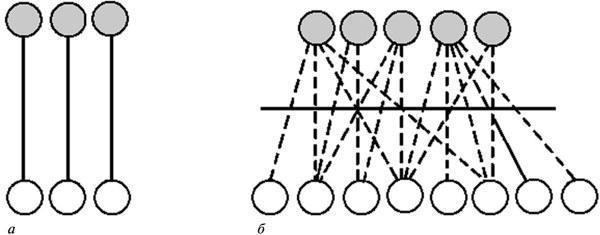
Fig. 5. Stages of assessing causal relationships between two categories of factors observed in an experiment: a - initial hypothesis postulating simple linear causal relationships; b - detection of asymmetry of "causes" and "effects" (as experimental data expands), leading to the conclusion of their nonlinear relationships and belonging to two different systemic levels.
In theoretical biology, individual development has always been the main source of such difficulties for linear-determinist thinking. Their increase as empirical data accumulate and the search for their consistent agreement inevitably pushed thought toward the idea of the integrity of the ontogenetic mechanism. In embryology, this paradigm shift was expressed in G. Driesch's concept (Driesch, 1908) of development as a "harmonic equipotential system," and in physiological genetics — in Goldschmidt's idea of the reacting system touched upon above. The absence of a general correspondence between the concrete outcome of development and a definite variant of its initial state was invariably emphasized as a key argument.
In general, the more meaningful the experience of science in understanding its observations, the more it tends to move away from reductionist explanations towards systemic interpretations. Conversely, every breakthrough of science into a previously unknown area of factual knowledge is usually accompanied in the first stage by a revival of mechanistic causal interpretations. In the history of genetics' views on the determination of organismal traits, a similar course of events has been repeated at least twice, characterized first by the declaration of linear causal relationships and then by a departure from them (Table 2). The current revival of genetics' hopes for the possibility of a reductionist interpretation of morphogenesis, associated with the discovery of Nox genes, will likely share the same fate.
Table 2. "Cyclical evolution" of genetics' views on development determination
Area of research
Assessment of causal relationships
Initial
Further
I. Chromosomal Genetics
traits are determined by independent genes
a trait is the product of the interaction of all genes
I. Molecular Genetics
one gene–one enzyme
all stages of matrix synthesis are polyvariant
III. Discovery of Homeobox Sequences
general Nox genes control homologous processes in different organisms
II. Molecular genetics "one gene — one enzyme" all stages of template synthesis are polyvariant III. Discovery of homeobox sequences common Hox genes control homologous processes in different organisms ?In sum, it can be concluded that the limitations of subjective reflection of reality do not allow us to know it otherwise than through approximation, i.e., through the sequential revision of temporary explanatory models. This advanced knowledge cannot be obtained directly from experience. Thinkers of the past understood this long ago. According to Galileo (1948, p. 89), if "the divine mind by simple perception of the essence... [of an object] encompasses... the whole infinity of its properties," then "our method consists in reasoning and moving from conclusion to conclusion."
IV. THE ACHILLES' HEEL OF EVOLUTIONARY THINKING Thus, the self-evidence of explanations obtained from direct observation is an illusion. In fact, their character is always conditioned by generalizations from prior experience, which in turn rely on a certain conceptual framework. For example, if for chromosomal genetics Mendelian segregation became the sought-after confirmation of the corpuscular nature of heredity, for ETE (and partly classical Mendelism) it expresses the difference between two holistic genotypes, revealed in crossing as a threshold developmental effect (Kamshylov, 1937; Shyshkin, 1987). Ultimately, understanding of the operative causes of a phenomenon is determined by the level and method of our abstraction from the fullness of actual interrelations.
Nevertheless, in any case, the primary representation of causes is a necessary stage of the cognitive process. As stated, this initial explanatory model should serve as the basis for further correction and revision as it is tested (verification-falsification procedures according to K. Popper) in light of new observations. In principle, its initial concepts may retain their value as a working language for describing experiments even after this. However, as basic propositions providing a consistent interpretation of facts, they may prove to be untenable (Shyshkin, 2006, p. 188).
Here we come to a problem that seems key to the methodology of modern evolutionism and, ultimately, is related to its predominant reliance on genetic thinking. The collision of theory with regularities that cannot be explained within its framework is a signal that the level of reality simplification adopted by the theory does not reflect the completeness of our factual knowledge. That is, the principles of the theory must be revised in one way or another. This is the only possible path of theoretical progress.
Meanwhile, an assessment of the main direction of evolutionary thought of the last century allows us to speak of a fundamental violation of this rule. The path that was chosen instead can actually be characterized as a duality of collective scientific consciousness. It consists in the fact that in biology, two mutually exclusive interpretations are recognized for the same phenomenon (namely, development). Moreover, the use of one of them by genetics as a basis for evolutionary theory was not accompanied by any attempts to prove the irrelevance of the alternative option.
This situation can be generalized in two main points. (1) In the reductionist ideology of genetics, the mechanism of normal reproduction (inheritance) is reduced to a preformationist model, where the result is the aggregate of the action of independent causes. Conversely, for embryology, the determination of development has a holistic (systemic) nature that cannot be reduced to elementary causes. (2) Genetics' own experience in studying development has long forced it to formally reject the preformationist model. But it is precisely the latter that underlies the GTE (Shyshkin, 1987, 2006).
The same contradiction is revealed between the indicated declarative correction of genetics' views and the principles underlying its actual practice (Table 3). Finally, a similar discrepancy often occurs in the individual views of GTE authorities, reflecting hidden differences between the researcher's own experience and the requirements of the indicated theory (Table 4).
Table 3. Discrepancies between the working postulates of genetics (left column) and the positions it recognizes declaratively or by default. The former are based on the absolutization of typical experimental dependencies, the latter on generalizations with a broader basis.
Conclusions extrapolated from the hybrid analysis of pure lines
Positions shared by genetics, based on broader (theoretical and empirical) knowledge
Traits are divided into genetically determined (inherited) and exogenous (non-inherited)
All traits are expressions of a genotypically determined norm of reaction
Traits are determined by independent genes
Each trait is determined by the entire genotype
Inheritance of traits follows Mendelian laws
Mendelian inheritance is not characteristic of "raw" natural variability
Table 4. Examples of discrepancies between the researcher's own generalizations and the theory supported by them (GTE)
E. Mayr (1968)
Genetic Theory of Evolution
Evolution begins with behavior
Evolution begins with changes in genes
All mutations with phenotypic effects are harmful
Mutations with beneficial effects are preserved by selection
Mutations themselves do not change the species affiliation of an individual
Mutations with beneficial expression are preserved by selection Mutations by themselves do not change the species affiliation of an individual Mutations underlie species changes{"translated_text": "Such duality in the assessment of development and evolution mechanisms exposes the main problem of genetic thinking, connected with its reductionist understanding of the phenomenon of heredity. As already pointed out repeatedly by embryologists, it actually assumes that heredity is something separate from the ontogenetic realization and therefore can be explained independently of it, i.e., outside the framework of real knowledge of developmental regularities (Gurwitsch, 1912; Gurvich, 1944; Svetlov, 1964). But these warnings had no influence on the prevailing evolutionary doctrine (GET), except for the acknowledgment that it allows significant simplifications. Contemporary attempts to reconcile the genetic understanding of hereditary determination with the principle of morphogenetic fields, derived from embryology, remain within the same initial preformationist concepts (Shishkin, 2006, p. 193). Similarly, attempts to achieve a \"new evolutionary synthesis\" by combining GET with embryogenesis patterns do not aim to revise neo-Darwinism's postulates (see Section VI). The fundamental contradiction remains unresolved.\nIn conclusion, it is important to emphasize the following. The extension of causal explanation beyond the experimental conditions in which it was obtained is itself an inevitable step in the cognitive process. But from the moment when the inadequacy of this explanation for new or expanded conditions becomes evident, it must be changed. The idea of mosaic determination of traits, constituting the basis of genetics, has in fact avoided such revision, despite its obvious unsuitability for explaining development (cf. Svetlov, 1978). This initial violation of the logic of the cognitive process underlies all the major difficulties of the genetic theory of evolution that have been revealed over time.\nThe reasons for such a course of events, i.e., the prolonged implicit coexistence of two incompatible concepts of development, lie largely on the surface. A real rejection of the principle of mosaic determination by genetics would by definition make impossible the description of evolution in terms of genes, constituting the basis of GET. This would mean too radical a turn in prevailing evolutionary thinking to expect its historically rapid implementation.\nOther reasons have even deeper roots in natural science. This is primarily the tradition of reductionist understanding of causality, which gives preference to mechanistic explanations and channels the search for solutions in their direction (see above, Section III). And, finally, it is necessary to point to the low level of requirements of theoretical biology for reconciling its generalizations. The latter is historically connected with the diversity of the organic world and the difficulty of revealing universal patterns in it. Therefore, in particular, typical for evolutionism is not the striving to create a holistic theory, but the \"synthesis\" of various factors understood as independent participants in the evolutionary process (Shishkin, 2006, 2009).\nV. ILLUSIONS OF EVOLUTIONARY RECONSTRUCTIONS\nThe absolutization of dependencies obtained directly from experiment or comparison, without assessing their real significance in the light of other biological generalizations, constitutes the typical practice of interpreting evolutionary processes on the basis of empirical knowledge. This approach is characteristic of both embryology and genetics (Shishkin, 2006; 2007, p. 180).\nThe subject of study for both named disciplines is the space of developmental variants and the mechanisms controlling them. And both of them most often (in the case of genetics — always) judge the evolutionary significance of observed phenomena, relying by default on two presumptions. (1) Historical changes proceed in the same direction as ontogenetic ones (from early developmental stages to later); therefore the latter can be a direct reflection of the former. (2) The connections between adult structures and their causes in early development or germ cell can be simplified to linear relations, i.e., to a preformationist model.\nAs already stated, the second of these assumptions is rejected by both disciplines in theory, i.e., reliance on it is inherently illogical. As for assumption (1), in embryology it has no special justification (except for an expansive interpretation of the biogenetic law) and is accepted rather empirically — as the simplest of possible ones (Shishkin, 2007). Conversely, for genetics this assumption directly follows from its ideology, which holds that the properties of an organism are determined by genes, and changes in these properties — by gene mutations. This circumstance, together with the fact that genetics is the basis of prevailing evolutionary views, determines our main attention to the practice of historical reconstructions on the basis of genetic data.\nAs already stated (see Introduction), the genetic understanding of evolution is opposed by the position of ETE, according to which evolutionary changes spread in generations from the adult stage to the beginning of development. In other words, according to this theory, changes manifest earlier than the organization of the germ cell ensuring their stable reproduction is formed (Fig. 4, b: F1—F4). If GET directly projects onto evolution the results of experiments determining, in its understanding, the connections between genes and traits (in the classic case — on the basis of hybrid analysis), then the position of ETE is based on comprehending the general diversity of empirical dependencies observed in ontogenesis that do not fit as a whole into linear schemes. The differences between these two approaches play a decisive role in assessing the possibilities of evolutionary reconstructions.\nIt was emphasized above that comparison of the course of development under different experimental conditions reveals a general asymmetry of causes and consequences (Fig. 1; 2, b; 5, b). And what is especially important, the limitedness of the space of the latter in relation to the diversity of the former is revealed. The main conclusion from this phenomenon (especially as applied to the normal phenotype), known since the end of the 19th century, reduces to the rule: \"The result of development is more stable than the way of its realization.\" This conclusion is contained in generalizations known in embryology as the \"Rule of Roux,\" Driesch's principle of equipotentiality, Gurvich's principle of normalization, as well as in numerous generalizations denoting evolutionary compression and simplification of development while preserving its former result, revealed by comparative means (Shishkin, 2006, p. 182). In genetics, the same regularities are expressed in Chetverikov's rule (genetic heterogeneity under the cover of the \"wild\" phenotype), in Goldschmidt's conceptions of the developmental system, in the fact of heterogeneity of typical natural aberrations, and in countless examples of realization of the same properties on different genetic bases (see, for example, Shmalgauzen, 1968; Dubinin, 1966). One of the striking examples of this rule is sex determination, realized in the organic world on the basis of the most various mechanisms — from male or female heterogamety to determination by environmental factors, and sometimes by different methods in extremely close taxa.\nAs a result, even without relation to the postulates of ETE, all the experience of experimental knowledge about development, taken into account by this theory, can be generalized in the form of one basic principle, shedding light on the evolutionary assessment of ontogenetic events. Namely, that the developmental program enclosed in the germ cell is always historically younger than the definitive result realized by this program. The latter characterizes only one variant of such realization, along with many others — as often existing in parallel, as well as necessarily having preceded this variant in the course of its formation. In other words, the history of each new elementary feature begins with its appearance on the basis of imperfect morphogenesis, which is subsequently transformed more and more deeply. (In the conceptions of ETE, this process is described as stabilization of the novelty; see Fig. 4, b: F1—F4). We repeat that such a view of the evolution of the developmental course is not only one of the key positions of ETE, but also a conclusion from the general assessment of the properties of ontogenesis as a system. According to embryologist L.B. Belousov (1979), evolution is the amplification and spreading to lower systemic levels of those changes (\"instabilities\") of ontogenesis which were initially predetermined at the upper (morphological) level.\nFrom the foregoing, it is clear that seeking in the functional properties of the genome or germ cell direct indications of the manner of historical origin of the adult features they realize is an extremely naive expectation. In fact, everything we observe in modern ontogenesis, creating a given adult body plan, is a maximally transformed model of its development (up to the zygote), which has passed a long path of stabilization. It is far from the initial model (cf. Fig. 4, b: F1, F4), which was relatively unstable, weakly integrated (deprived of many correlations revealed in modern ontogenesis), and dependent on external factors. Therefore, the developmental features of any structure, recorded by the experimenter, are the product of the entire history of its existence, not an indication of the mechanism of its appearance in evolution. To assume the opposite means to take consequences for causes. In reality, speaking in the words of S.G. Kryzhanovsky (1939), development does not directly contain a method for its historical interpretation.\nMeanwhile, practically all judgments about the nature of evolutionary novelties, based on genetic data, are founded precisely on the aforementioned identification of causes and consequences of the historical process. These are, first of all, the countless hypotheses about the origin of various phenotypic properties due to the effects of mutations understood as one-time stable changes of phenotype (for example, in the case of melanism or albinism of mammals, wing reduction in insects, torsion process in gastropod mollusks, etc.). These hypotheses, not providing for any historical change of initial developmental factors in relation to its concrete result (cf. Fig. 4, a), inevitably imply other untenable assumptions. First, they rely on the preformationist model of development, mechanically transferring it further to evolution. Second (in accordance with the first assumption), they proceed from the conviction that the \"genetic basis\" of a trait, revealed by hybrid analysis, is its historical \"determining factor.\" In reality, however, it is only a threshold function of this factor (when switching parental ontogenetic trajectories in hybrids), arising exclusively in this particular combination of crossing (see more in Shishkin, 1987, pp. 95-98, 101).\nThe same understanding of the evolutionary process is contained in more complex reconstructions, for example, when illuminating the evolution of insects from ancestors close to myriapods in the direction of dipterans (Lewis, 1985; Raff and Kofmen, 1986). This transformation is described as the result of sequential mutations (or duplications with subsequent divergence of gene functions), which led first to the loss of limbs in abdominal segments in early winged insects, and later (in Diptera) also to the reduction of wings in the metathorax. The entire scheme is built on the analysis of homeotic switches in imaginal discs of higher insects during mutations or sequential deletions in the corresponding gene complexes. That is, we are dealing with features of a historically deeply transformed type of morphogenesis. Further, they are extrapolated to the early stages of insect evolution, at which there was neither development with complete metamorphosis, nor the anticipatory separation of adult tissue primordia (imaginal discs) characteristic of it, nor, accordingly, the highly integrated formative dependencies revealing alternative developmental programs of these primordia. Thus, the morphogenetic homeotic reactions, characterizing higher insects, in this reconstruction of events (a) are attributed to specific genes, (b) are transferred to primitive types of development not having such properties, and (c) are directly identified with evolutionary mechanisms. This is another example of mixing causes and consequences of the evolutionary process, based on the representation that the causal connections of the developmental course, observed in experiment, and evolution are in principle the same thing (cf. Fig. 4, a: A—D).\nIn the final analysis, the entire logic of reasoning in these reconstructions objectively proceeds from the conviction that mosaic determinateness of development is the only possible conclusion from genetic data — regardless of how compatible it is with the generalizations of embryology.\nVI. SYMPTOMS OF THEORY CRISIS\nLet us return to the question of factors determining the loss by a theory of the status of a reliable explanation of reality. Using evolutionary doctrine as a model object again, we come to a partially unexpected conclusion that such a course of events generally does not require the emergence of an opposing alternative concept, at least in a formulated form.\nAny functioning model characteristic of living organisms, including human activity, implies a certain system of reality reflection, to which all performed actions conform. A scientific theory is such a system organizing the cognitive process, regardless of whether its bearer realizes this. Usually, it includes a small number of initial assumptions. Its value for cognition is higher, the broader range of phenomena it allows to explain on this basis, showing their common causal connections. Thus, a substantive theory is maximally economical (Fig. 6, b). It does not replace empirical knowledge, but greatly facilitates the choice of possible directions for it to search, cutting off paths that are clearly unpromising in the light of its representations. This is the essence of the known generalization that there is nothing more practical than a good theory.\n[IMG_6]\nFig. 6. Symptoms of theory crisis: a — initial stage of cognition (absence of a general explanation for observed phenomena); b — appearance of theory (transition to interpretation of facts on a unified basis); c — discovery of facts not explainable by theory without additional particular assumptions; d — intensification of the situation that arose at stage (c). Explanatory possibilities of theory shrink, bringing it closer to the state that existed at stage (a). Designations: C — conceptual basis of theory; S1, Sn, Sx — additional assumptions.\nProgress in the sphere of knowledge to which the theory relates can be an incentive for its improvement and specification of its concepts. For neo-Darwinism, such a step was the discovery of chromosomes and their combination along with the mutational process, and for classical Darwinism (with great delay) — the discovery of systemic properties of ontogenesis. These changes can greatly alter the language of the theory, but do not affect its postulates and do not violate its explanatory logic.\nThe situation becomes different when the theory encounters facts and generalizations contradicting its expectations. Its awareness of such obstacles does not mean that they were not known to science long before this. However, the mode of their perception, if we speak about biology, changes over time and depends on many reasons. First, the need for reconciling generalizations obtained in different areas of biological knowledge is little characteristic of collective scientific consciousness (Shishkin, 2006; cf. above, Section IV) — until it becomes self-evident. Second, in its evaluation of \"inconvenient\" facts, theoretical thinking tends to be guided not so much by the general requirements of logic as by the inertia of its conceptual choice, implying the correctness and inviolability of the theory being defended. Obviously, for these reasons the radical contradiction between the principle of mosaic determination and the evidence of integrity of development remained for many years outside the field of view of neo-Darwinism (GET) in the post-Weismann era. Otherwise, this doctrine could never have become the dominant doctrine in 20th-century biology. Historians of science name a more concrete reason for such a course of events (essentially including both previous ones). They point out that the idea of a morphogenetic field determining the course of development was rejected by Morganian genetics as a dangerous alternative to the representation of the gene as a determination factor (Gilbert et al., 1997, pp. 327—330).\nThe assessment of GET adequacy began to change in collective consciousness only as detailed analysis of developmental mechanisms (both regarding synthesis products and morphological features) became one of the main tasks of genetics. As might be expected, it brought new confirmation of the known rule that the relationships between causes and their results in development are ambiguous at all its levels, starting from gene expression (cf. Table 2). Clearly, for a theory reducing the explanation of evolution to change in the gene composition of populations, this means insolvable problems. This uncertainty became a stimulus for searching a \"new synthesis,\" in which place would be found for causal relationships and mechanisms revealed by embryology.\nThe main difficulty was outlined by the initiators of this new program as follows. To understand the connection between genomic changes and evolution, it is necessary to know how genome structure is transformed into a specific morphology. But between the signal and the response there exists a \"black box.\" Processes isomorphic to the genome end with the determination of the primary structure of proteins and are far from the processes of development forming the organism (Evolution..., 1982). Consequently, explanations of these latter must be sought by other paths, i.e., turning to the embryological understanding of the regularities of morphogenesis.\nThis plan of theory reorganization actually places hopes for its improvement at the expense of an alternative principle (systemic explanation of development), without reviewing its former basis. The new synthesis is usually conceived as \"addition\" of these heterogeneous premises. It is accepted that today's GET is still adequate for interpreting microevolutionary processes, but that changes of the macroevolutionary level must be described on the basis of knowledge of the laws of ontogenesis (Gould, 1982; Maderson et al., 1982)."}{"title":"Evolutionary Theory and Scientific Thinking M. A. Shishkin","content":"The same approach underlies attempts to construct a development concept based on synthesizing genetics and embryology — as a series of stages of cascade gene expression during stepwise determination. It boils down to the idea of alternation of gene activity and morphogenetic fields controlled by genes, with the entire sequence of events to be initiated by genes of the highest hierarchical order (Gilbert et al., 1997). In essence, this is merely a greatly complicated version of the preformationist model of development, in which the role of systemic factors is strictly subordinate (Shishkin, 2006). In summary, these are attempts to restore the explanatory value of genetic theory by incorporating alien principles, the scope of which is arbitrarily limited.\n\nThe difficulties of genetic explanation of evolution are not only directly focused on its key postulate (selection of mosaic developmental determinants), but also have many other related manifestations. Many of these have still not been absorbed into collective consciousness, although they seem to lie on the surface. Thus, it is not recognized that the genetic (\"evolutionarily significant\") conditioning of traits, attributed by neo-Darwinism to the action of mutations, is in fact a property of any realizable characteristic, since all of them are expressions of the norm of reaction (Table 3; cf. Shishkin, 2006, p. 183, 188). Or that the effect of Mendelian inheritance, observed in hybrid analysis, is created by the researcher's own efforts, who first stabilizes pure parental lines. And therefore, seeing in this phenomenon an evolutionary factor controlling natural variability means taking the product of selection for its raw material (Shishkin, 1987, p. 117).\n\nWhere such difficulties are obvious for the theory, it tries to explain them through additional ad hoc assumptions (cf. Table 1). But these attempts only denote the problem, without allowing it to be eliminated. If, for example, the effects of mutations are always inherited worse than the norm, then, however this is explained, they inherently do not possess the historical stability attributed to them by neo-Darwinism. Or, if the relationships between genome and phenotype are fundamentally ambiguous, then it is unclear how in this case one can explain the mechanism of mutation selection on which the stated theory rests.\n\nSchematically, the entire examined course of events in the history of the theory's existence is described as follows. The more the domain of facts difficult to reconcile with it grows, the wider it is forced to resort to explanations requiring particular additional hypotheses (cf. Table 1). As a result, the \"explanatory structure\" of the theory increasingly approaches the state that preceded its appearance (Fig. 6, a). In other words, the early stage, at which a general fundamental answer to a multitude of heterogeneous questions was proposed (Fig. 6, b), is replaced by stages at which symmetry increases between the number of questions arising before the theory and the number of proposed answers (Fig. 6, c, d). Ultimately, this explanatory scheme as a whole ceases to be economical and predictive, i.e., it increasingly loses the status of a theory. Trying to defend itself, the theory destroys itself.\n\nIf such a course of events has manifested in the evolution of the theory, then its end is predictable regardless of whether a established alternative exists for this theory. The latter must eventually arise sooner or later in search of answers to those questions for which no explanation was found within the existing framework. In the case of the development of the idea of evolution based on natural selection, this is actually what happens. Although a systemic alternative to neo-Darwinism in the form of the Shmalgauzen-Waddington epigenetic theory (ETE) has existed for over half a century, its influence on collective evolutionary thought has been fairly limited for many reasons (cf. Shishkin, 2006, p. 184). Nevertheless, the dissatisfaction of GTE supporters with its current state stimulates the search for a new, broader \"synthetic\" generalization along the same paths on which ETE developed. Despite the opportunistic nature of most such attempts, striving to preserve the central dogma of neo-Darwinism in the new theory, their direction itself is indicative. It speaks in favor of the ultimate inevitability of recognizing the principles underlying ETE.\n\nCONCLUSION (PROSPECTS OF EVOLUTIONISM)\n\nFrom the foregoing, the most probable forecast regarding the further development of evolutionary theory is clear. It is based on the conviction that, despite its traditional mosaic nature, theoretical thinking in biology is nonetheless a single system with internal feedback. Therefore, it is ultimately capable of gradual self-correction based on critical comparison and reconciliation of its own generalizations. This process must inevitably lead collective evolutionary thought to realize the incompatibility of systemic properties of development with the principle of corpuscular heredity. In accordance with this, tomorrow's evolutionary theory will regard the replacement of organic forms as a transformation of holistic developmental systems. All properties of development revealed by embryology and genetics will be interpreted in this context. Attempts to fetishize any structures of living organisms as independent factors of evolution, arising and acting apart from natural selection, will remain in the theory's past.\n\nREFERENCES\n\nBelousov L.V. Holistic and structural-dynamic approaches to ontogenesis // Zhurn. obshch. biol. 1979. Vol. 40. No. 4. P. 514-529.\nGalilei G. Dialog on the Two Chief World Systems — Ptolemaic and Copernican. Moscow-Leningrad: OGIZ — Gos. izd-vo Tekhn.-teor. lit., 1948. 379 p.\nGilbert S.F., Opitz D.M., Raff R.A. A new synthesis of evolutionary biology and developmental biology // Ontogenez. 1997. Vol. 28. No. 5. P. 325-343.\nGurwitsch A.G. Theory of the biological field. Moscow: Sov. nauka, 1944. 156 p.\nDarwin Ch. The Origin of Species by Means of Natural Selection. Moscow: Taideks Ko, 2003. 495 p.\nDubin N.P. Evolution of populations and radiation. Moscow: Atomizdat, 1966. 743 p.\nKamshilov M.M. Is pleiotropy a property of the gene? // Biol. zhurn. 1935. Vol. 4. No. 1. P. 113-144.\nKryzhanovsky S.G. The principle of recapitulation and conditions of historical understanding of development // In memory of Academician A.N. Severtsov. Moscow; Leningrad: Izd-vo AN SSSR, 1939. P. 281-366.\nLyubishchev A.A. On the nature of hereditary factors // Izv. Biol. nauch.-issled. in-ta pri Permskom universitete. 1925. Vol. 4. Appendix 1. P. 1-142.\nMayakovsky V. Poems about the difference in tastes // Collected works in 3 volumes. Vol. 2 (1928). Moscow: Khud. lit-ra, 1978. P. 358.\nMayr E. Zoological species and evolution. Moscow: Mir, 1968. 597 p.\nRaff R., Kofmen T. Embryos, genes and evolution. Moscow: Mir, 1986. 402 p.\nSvetlov P.G. On holistic and elementaristic methods in embryology // Arkh. anatomii, gistologii i embryologii. 1964. Vol. 46. No. 4. P. 3-26.\nSvetlov P.G. Physiology (mechanics) of development. Leningrad: Nauka, 1978. Vol. 1. 279 p.; Vol. 2. 262 p.\nFilipchenko Yu.A. Evolutionary idea in biology. Moscow: Nauka, 1977. 227 p.\nShishkin M.A. Ontogenesis and evolutionary theory // Evolution and biocenotic crises / Ed. L.P. Tatarinov, A.P. Rasnitsyn. Moscow: Nauka, 1987. P. 76-123.\nShishkin M.A. Patterns of ontogenesis evolution // Modern paleontology / Ed. V.V. Menner, V.P. Makridin. Vol. 2. Moscow: Nedra, 1988. P. 169-209.\nShishkin M.A. Individual development and lessons of evolutionism // Ontogenez. 2006. Vol. 37. No. 3. P. 179-198.\nShishkin M.A. Morphogenesis as an object of historical reading: product of evolution or its record? // Cellular, molecular and evolutionary aspects of morphogenesis. Symposium with international participation / Ed. L.V. Belousov. Moscow: KMK, 2007. P. 179-183.\nShishkin M.A. Evolutionary theory and features of scientific thinking // Scientific legacy of Shmalgauzen and its development. Conference devoted to the 125th anniversary of the birth of Academician I.I. Shmalgauzen. Moscow: IPEE RAN im. A.N. Severtsova, 2009. P. 46-50.\nShmalgauzen I.I. Pathways and patterns of evolutionary process. Moscow-Leningrad: Izd-vo AN SSSR, 1940. 231 p.\nShmalgauzen I.I. Stabilizing selection and its place among factors of evolution // Zhurn. obshch. biol. 1941. Vol. 2. No. 3. P. 307-354.\nShmalgauzen I.I. Organism as a whole in individual and historical development. Moscow: Nauka, 1982. 228 p.\nBertalanffy L. General system theory. N.Y.: Braziller, 1969. 289 p.\nDriesch H. The science and philosophy of the organism. L.: Black, 1908. V. 1. 329 p.; V. 2. 381 p.\nEvolution and development // Report of the Dahlem Workshop / Ed. J.T Bonner. Berlin, Heidelberg, N.Y.: Springer, 1982. 357 p.\nGoldschmidt R. Physiological genetics. N.Y.: L. McGraw Hill Book Co., 1938. 375 p.\nGoldschmidt R. The material basis of evolution. New Haven: Yale Univ. Press, 1940. 436 p.\nGould S.J. Ontogeny and phylogeny. Cambridge: Belknap Press, 1977. 501 p.\nGould S.J. The meaning of punctuated equilibrium and its role in validating a hierarchical approach to macroevolution // Perspectives in evolution / Ed. R. Milkman. Sunderland, MA: Sinauer, 1982. P. 83-104.\nGurwitsch A. Die Vsrerbung als Vsrwirklichungsvorgang // Biol. Zbl. 1912. Bd 32. S. 458-486.\nLewis E.B. Regulation of the genes of the bithorax complex in Drosophila // Cold Spring Harbor Symp. Quant. Biol. 1985. Vol. 50. P. 155-164.\nMaderson P.F.A., Alberch P., Goodwin B.C. et al. The role of development in macroevolutionary change // Evolution and development. Dahlem Konferenzen / Ed. J.T. Bonner. Berlin: Springer, 1982. P. 279-312.\nWaddington C.H. The strategy of the genes: a discussion on some aspects of theoretical biology. L.: Allen and Unwin, 1957. 262 p.\n\nIn natural sciences, the advance of evolutionary thought and growth of empirical knowledge are not strictly correlated. The state of theory primarily tends to be controlled by a mode of collective thinking that historically dominates a given branch of science. This particularly holds true for the natural selection concept, which has two alternative interpretations known as the genetic and epigenetic theories of evolution. The final result of their competition, albeit predictable, will not be based upon any kind of \"crucial evidence\" giving advantage to either of them. The above result will be in fact attained as soon as the evolutionary biology can overcome the tradition of mosaic thinking which enables the incompatible concepts to be combined. In this respect, the key point to be realized is that the idea of corpuscular determination of the ontogeny is incompatible with understanding the development as a systemically controlled process.\n\nKey words: evolution, genetics, epigenetic theory, ontogeny.\n\n^1Such a pathway of evolution is also postulated for provisional adaptations realized during development (Shishkin, 1988, p. 183-186)."}
**CONCLUSIONS (PROSPECTS OF EVOLUTIONISM)** From the foregoing, the most likely forecast regarding the further development of evolutionary theory is clear. It is based on the conviction that, despite all its traditional mosaic nature, theoretical thinking in biology is still a single system with internal feedback loops. Therefore, it is ultimately capable of gradual self-correction based on critical comparison and reconciliation of its own generalizations. This process must inevitably lead collective evolutionary thought to an awareness of the incompatibility of systemic properties of development with the principle of corpuscular inheritance. Accordingly, tomorrow's evolutionary theory will consider the change in organic forms as a transformation of holistic developmental systems. All properties of development revealed by embryology and genetics will be interpreted in this context. Attempts to fetishize any structures of the living as independent factors of evolution, arising and acting outside of natural selection, will remain in the past for the theory.
Mutations underlie species changes{"translated_text": "Such duality in the assessment of development and evolution mechanisms exposes the main problem of genetic thinking, connected with its reductionist understanding of the phenomenon of heredity. As already pointed out repeatedly by embryologists, it actually assumes that heredity is something separate from the ontogenetic realization and therefore can be explained independently of it, i.e., outside the framework of real knowledge of developmental regularities (Gurwitsch, 1912; Gurvich, 1944; Svetlov, 1964). But these warnings had no influence on the prevailing evolutionary doctrine (GET), except for the acknowledgment that it allows significant simplifications. Contemporary attempts to reconcile the genetic understanding of hereditary determination with the principle of morphogenetic fields, derived from embryology, remain within the same initial preformationist concepts (Shishkin, 2006, p. 193). Similarly, attempts to achieve a \"new evolutionary synthesis\" by combining GET with embryogenesis patterns do not aim to revise neo-Darwinism's postulates (see Section VI). The fundamental contradiction remains unresolved.\nIn conclusion, it is important to emphasize the following. The extension of causal explanation beyond the experimental conditions in which it was obtained is itself an inevitable step in the cognitive process. But from the moment when the inadequacy of this explanation for new or expanded conditions becomes evident, it must be changed. The idea of mosaic determination of traits, constituting the basis of genetics, has in fact avoided such revision, despite its obvious unsuitability for explaining development (cf. Svetlov, 1978). This initial violation of the logic of the cognitive process underlies all the major difficulties of the genetic theory of evolution that have been revealed over time.\nThe reasons for such a course of events, i.e., the prolonged implicit coexistence of two incompatible concepts of development, lie largely on the surface. A real rejection of the principle of mosaic determination by genetics would by definition make impossible the description of evolution in terms of genes, constituting the basis of GET. This would mean too radical a turn in prevailing evolutionary thinking to expect its historically rapid implementation.\nOther reasons have even deeper roots in natural science. This is primarily the tradition of reductionist understanding of causality, which gives preference to mechanistic explanations and channels the search for solutions in their direction (see above, Section III). And, finally, it is necessary to point to the low level of requirements of theoretical biology for reconciling its generalizations. The latter is historically connected with the diversity of the organic world and the difficulty of revealing universal patterns in it. Therefore, in particular, typical for evolutionism is not the striving to create a holistic theory, but the \"synthesis\" of various factors understood as independent participants in the evolutionary process (Shishkin, 2006, 2009).\nV. ILLUSIONS OF EVOLUTIONARY RECONSTRUCTIONS\nThe absolutization of dependencies obtained directly from experiment or comparison, without assessing their real significance in the light of other biological generalizations, constitutes the typical practice of interpreting evolutionary processes on the basis of empirical knowledge. This approach is characteristic of both embryology and genetics (Shishkin, 2006; 2007, p. 180).\nThe subject of study for both named disciplines is the space of developmental variants and the mechanisms controlling them. And both of them most often (in the case of genetics — always) judge the evolutionary significance of observed phenomena, relying by default on two presumptions. (1) Historical changes proceed in the same direction as ontogenetic ones (from early developmental stages to later); therefore the latter can be a direct reflection of the former. (2) The connections between adult structures and their causes in early development or germ cell can be simplified to linear relations, i.e., to a preformationist model.\nAs already stated, the second of these assumptions is rejected by both disciplines in theory, i.e., reliance on it is inherently illogical. As for assumption (1), in embryology it has no special justification (except for an expansive interpretation of the biogenetic law) and is accepted rather empirically — as the simplest of possible ones (Shishkin, 2007). Conversely, for genetics this assumption directly follows from its ideology, which holds that the properties of an organism are determined by genes, and changes in these properties — by gene mutations. This circumstance, together with the fact that genetics is the basis of prevailing evolutionary views, determines our main attention to the practice of historical reconstructions on the basis of genetic data.\nAs already stated (see Introduction), the genetic understanding of evolution is opposed by the position of ETE, according to which evolutionary changes spread in generations from the adult stage to the beginning of development. In other words, according to this theory, changes manifest earlier than the organization of the germ cell ensuring their stable reproduction is formed (Fig. 4, b: F1—F4). If GET directly projects onto evolution the results of experiments determining, in its understanding, the connections between genes and traits (in the classic case — on the basis of hybrid analysis), then the position of ETE is based on comprehending the general diversity of empirical dependencies observed in ontogenesis that do not fit as a whole into linear schemes. The differences between these two approaches play a decisive role in assessing the possibilities of evolutionary reconstructions.\nIt was emphasized above that comparison of the course of development under different experimental conditions reveals a general asymmetry of causes and consequences (Fig. 1; 2, b; 5, b). And what is especially important, the limitedness of the space of the latter in relation to the diversity of the former is revealed. The main conclusion from this phenomenon (especially as applied to the normal phenotype), known since the end of the 19th century, reduces to the rule: \"The result of development is more stable than the way of its realization.\" This conclusion is contained in generalizations known in embryology as the \"Rule of Roux,\" Driesch's principle of equipotentiality, Gurvich's principle of normalization, as well as in numerous generalizations denoting evolutionary compression and simplification of development while preserving its former result, revealed by comparative means (Shishkin, 2006, p. 182). In genetics, the same regularities are expressed in Chetverikov's rule (genetic heterogeneity under the cover of the \"wild\" phenotype), in Goldschmidt's conceptions of the developmental system, in the fact of heterogeneity of typical natural aberrations, and in countless examples of realization of the same properties on different genetic bases (see, for example, Shmalgauzen, 1968; Dubinin, 1966). One of the striking examples of this rule is sex determination, realized in the organic world on the basis of the most various mechanisms — from male or female heterogamety to determination by environmental factors, and sometimes by different methods in extremely close taxa.\nAs a result, even without relation to the postulates of ETE, all the experience of experimental knowledge about development, taken into account by this theory, can be generalized in the form of one basic principle, shedding light on the evolutionary assessment of ontogenetic events. Namely, that the developmental program enclosed in the germ cell is always historically younger than the definitive result realized by this program. The latter characterizes only one variant of such realization, along with many others — as often existing in parallel, as well as necessarily having preceded this variant in the course of its formation. In other words, the history of each new elementary feature begins with its appearance on the basis of imperfect morphogenesis, which is subsequently transformed more and more deeply. (In the conceptions of ETE, this process is described as stabilization of the novelty; see Fig. 4, b: F1—F4). We repeat that such a view of the evolution of the developmental course is not only one of the key positions of ETE, but also a conclusion from the general assessment of the properties of ontogenesis as a system. According to embryologist L.B. Belousov (1979), evolution is the amplification and spreading to lower systemic levels of those changes (\"instabilities\") of ontogenesis which were initially predetermined at the upper (morphological) level.\nFrom the foregoing, it is clear that seeking in the functional properties of the genome or germ cell direct indications of the manner of historical origin of the adult features they realize is an extremely naive expectation. In fact, everything we observe in modern ontogenesis, creating a given adult body plan, is a maximally transformed model of its development (up to the zygote), which has passed a long path of stabilization. It is far from the initial model (cf. Fig. 4, b: F1, F4), which was relatively unstable, weakly integrated (deprived of many correlations revealed in modern ontogenesis), and dependent on external factors. Therefore, the developmental features of any structure, recorded by the experimenter, are the product of the entire history of its existence, not an indication of the mechanism of its appearance in evolution. To assume the opposite means to take consequences for causes. In reality, speaking in the words of S.G. Kryzhanovsky (1939), development does not directly contain a method for its historical interpretation.\nMeanwhile, practically all judgments about the nature of evolutionary novelties, based on genetic data, are founded precisely on the aforementioned identification of causes and consequences of the historical process. These are, first of all, the countless hypotheses about the origin of various phenotypic properties due to the effects of mutations understood as one-time stable changes of phenotype (for example, in the case of melanism or albinism of mammals, wing reduction in insects, torsion process in gastropod mollusks, etc.). These hypotheses, not providing for any historical change of initial developmental factors in relation to its concrete result (cf. Fig. 4, a), inevitably imply other untenable assumptions. First, they rely on the preformationist model of development, mechanically transferring it further to evolution. Second (in accordance with the first assumption), they proceed from the conviction that the \"genetic basis\" of a trait, revealed by hybrid analysis, is its historical \"determining factor.\" In reality, however, it is only a threshold function of this factor (when switching parental ontogenetic trajectories in hybrids), arising exclusively in this particular combination of crossing (see more in Shishkin, 1987, pp. 95-98, 101).\nThe same understanding of the evolutionary process is contained in more complex reconstructions, for example, when illuminating the evolution of insects from ancestors close to myriapods in the direction of dipterans (Lewis, 1985; Raff and Kofmen, 1986). This transformation is described as the result of sequential mutations (or duplications with subsequent divergence of gene functions), which led first to the loss of limbs in abdominal segments in early winged insects, and later (in Diptera) also to the reduction of wings in the metathorax. The entire scheme is built on the analysis of homeotic switches in imaginal discs of higher insects during mutations or sequential deletions in the corresponding gene complexes. That is, we are dealing with features of a historically deeply transformed type of morphogenesis. Further, they are extrapolated to the early stages of insect evolution, at which there was neither development with complete metamorphosis, nor the anticipatory separation of adult tissue primordia (imaginal discs) characteristic of it, nor, accordingly, the highly integrated formative dependencies revealing alternative developmental programs of these primordia. Thus, the morphogenetic homeotic reactions, characterizing higher insects, in this reconstruction of events (a) are attributed to specific genes, (b) are transferred to primitive types of development not having such properties, and (c) are directly identified with evolutionary mechanisms. This is another example of mixing causes and consequences of the evolutionary process, based on the representation that the causal connections of the developmental course, observed in experiment, and evolution are in principle the same thing (cf. Fig. 4, a: A—D).\nIn the final analysis, the entire logic of reasoning in these reconstructions objectively proceeds from the conviction that mosaic determinateness of development is the only possible conclusion from genetic data — regardless of how compatible it is with the generalizations of embryology.\nVI. SYMPTOMS OF THEORY CRISIS\nLet us return to the question of factors determining the loss by a theory of the status of a reliable explanation of reality. Using evolutionary doctrine as a model object again, we come to a partially unexpected conclusion that such a course of events generally does not require the emergence of an opposing alternative concept, at least in a formulated form.\nAny functioning model characteristic of living organisms, including human activity, implies a certain system of reality reflection, to which all performed actions conform. A scientific theory is such a system organizing the cognitive process, regardless of whether its bearer realizes this. Usually, it includes a small number of initial assumptions. Its value for cognition is higher, the broader range of phenomena it allows to explain on this basis, showing their common causal connections. Thus, a substantive theory is maximally economical (Fig. 6, b). It does not replace empirical knowledge, but greatly facilitates the choice of possible directions for it to search, cutting off paths that are clearly unpromising in the light of its representations. This is the essence of the known generalization that there is nothing more practical than a good theory.\n[IMG_6]\nFig. 6. Symptoms of theory crisis: a — initial stage of cognition (absence of a general explanation for observed phenomena); b — appearance of theory (transition to interpretation of facts on a unified basis); c — discovery of facts not explainable by theory without additional particular assumptions; d — intensification of the situation that arose at stage (c). Explanatory possibilities of theory shrink, bringing it closer to the state that existed at stage (a). Designations: C — conceptual basis of theory; S1, Sn, Sx — additional assumptions.\nProgress in the sphere of knowledge to which the theory relates can be an incentive for its improvement and specification of its concepts. For neo-Darwinism, such a step was the discovery of chromosomes and their combination along with the mutational process, and for classical Darwinism (with great delay) — the discovery of systemic properties of ontogenesis. These changes can greatly alter the language of the theory, but do not affect its postulates and do not violate its explanatory logic.\nThe situation becomes different when the theory encounters facts and generalizations contradicting its expectations. Its awareness of such obstacles does not mean that they were not known to science long before this. However, the mode of their perception, if we speak about biology, changes over time and depends on many reasons. First, the need for reconciling generalizations obtained in different areas of biological knowledge is little characteristic of collective scientific consciousness (Shishkin, 2006; cf. above, Section IV) — until it becomes self-evident. Second, in its evaluation of \"inconvenient\" facts, theoretical thinking tends to be guided not so much by the general requirements of logic as by the inertia of its conceptual choice, implying the correctness and inviolability of the theory being defended. Obviously, for these reasons the radical contradiction between the principle of mosaic determination and the evidence of integrity of development remained for many years outside the field of view of neo-Darwinism (GET) in the post-Weismann era. Otherwise, this doctrine could never have become the dominant doctrine in 20th-century biology. Historians of science name a more concrete reason for such a course of events (essentially including both previous ones). They point out that the idea of a morphogenetic field determining the course of development was rejected by Morganian genetics as a dangerous alternative to the representation of the gene as a determination factor (Gilbert et al., 1997, pp. 327—330).\nThe assessment of GET adequacy began to change in collective consciousness only as detailed analysis of developmental mechanisms (both regarding synthesis products and morphological features) became one of the main tasks of genetics. As might be expected, it brought new confirmation of the known rule that the relationships between causes and their results in development are ambiguous at all its levels, starting from gene expression (cf. Table 2). Clearly, for a theory reducing the explanation of evolution to change in the gene composition of populations, this means insolvable problems. This uncertainty became a stimulus for searching a \"new synthesis,\" in which place would be found for causal relationships and mechanisms revealed by embryology.\nThe main difficulty was outlined by the initiators of this new program as follows. To understand the connection between genomic changes and evolution, it is necessary to know how genome structure is transformed into a specific morphology. But between the signal and the response there exists a \"black box.\" Processes isomorphic to the genome end with the determination of the primary structure of proteins and are far from the processes of development forming the organism (Evolution..., 1982). Consequently, explanations of these latter must be sought by other paths, i.e., turning to the embryological understanding of the regularities of morphogenesis.\nThis plan of theory reorganization actually places hopes for its improvement at the expense of an alternative principle (systemic explanation of development), without reviewing its former basis. The new synthesis is usually conceived as \"addition\" of these heterogeneous premises. It is accepted that today's GET is still adequate for interpreting microevolutionary processes, but that changes of the macroevolutionary level must be described on the basis of knowledge of the laws of ontogenesis (Gould, 1982; Maderson et al., 1982)."}{"title":"Evolutionary Theory and Scientific Thinking M. A. Shishkin","content":"The same approach underlies attempts to construct a development concept based on synthesizing genetics and embryology — as a series of stages of cascade gene expression during stepwise determination. It boils down to the idea of alternation of gene activity and morphogenetic fields controlled by genes, with the entire sequence of events to be initiated by genes of the highest hierarchical order (Gilbert et al., 1997). In essence, this is merely a greatly complicated version of the preformationist model of development, in which the role of systemic factors is strictly subordinate (Shishkin, 2006). In summary, these are attempts to restore the explanatory value of genetic theory by incorporating alien principles, the scope of which is arbitrarily limited.\n\nThe difficulties of genetic explanation of evolution are not only directly focused on its key postulate (selection of mosaic developmental determinants), but also have many other related manifestations. Many of these have still not been absorbed into collective consciousness, although they seem to lie on the surface. Thus, it is not recognized that the genetic (\"evolutionarily significant\") conditioning of traits, attributed by neo-Darwinism to the action of mutations, is in fact a property of any realizable characteristic, since all of them are expressions of the norm of reaction (Table 3; cf. Shishkin, 2006, p. 183, 188). Or that the effect of Mendelian inheritance, observed in hybrid analysis, is created by the researcher's own efforts, who first stabilizes pure parental lines. And therefore, seeing in this phenomenon an evolutionary factor controlling natural variability means taking the product of selection for its raw material (Shishkin, 1987, p. 117).\n\nWhere such difficulties are obvious for the theory, it tries to explain them through additional ad hoc assumptions (cf. Table 1). But these attempts only denote the problem, without allowing it to be eliminated. If, for example, the effects of mutations are always inherited worse than the norm, then, however this is explained, they inherently do not possess the historical stability attributed to them by neo-Darwinism. Or, if the relationships between genome and phenotype are fundamentally ambiguous, then it is unclear how in this case one can explain the mechanism of mutation selection on which the stated theory rests.\n\nSchematically, the entire examined course of events in the history of the theory's existence is described as follows. The more the domain of facts difficult to reconcile with it grows, the wider it is forced to resort to explanations requiring particular additional hypotheses (cf. Table 1). As a result, the \"explanatory structure\" of the theory increasingly approaches the state that preceded its appearance (Fig. 6, a). In other words, the early stage, at which a general fundamental answer to a multitude of heterogeneous questions was proposed (Fig. 6, b), is replaced by stages at which symmetry increases between the number of questions arising before the theory and the number of proposed answers (Fig. 6, c, d). Ultimately, this explanatory scheme as a whole ceases to be economical and predictive, i.e., it increasingly loses the status of a theory. Trying to defend itself, the theory destroys itself.\n\nIf such a course of events has manifested in the evolution of the theory, then its end is predictable regardless of whether a established alternative exists for this theory. The latter must eventually arise sooner or later in search of answers to those questions for which no explanation was found within the existing framework. In the case of the development of the idea of evolution based on natural selection, this is actually what happens. Although a systemic alternative to neo-Darwinism in the form of the Shmalgauzen-Waddington epigenetic theory (ETE) has existed for over half a century, its influence on collective evolutionary thought has been fairly limited for many reasons (cf. Shishkin, 2006, p. 184). Nevertheless, the dissatisfaction of GTE supporters with its current state stimulates the search for a new, broader \"synthetic\" generalization along the same paths on which ETE developed. Despite the opportunistic nature of most such attempts, striving to preserve the central dogma of neo-Darwinism in the new theory, their direction itself is indicative. It speaks in favor of the ultimate inevitability of recognizing the principles underlying ETE.\n\nCONCLUSION (PROSPECTS OF EVOLUTIONISM)\n\nFrom the foregoing, the most probable forecast regarding the further development of evolutionary theory is clear. It is based on the conviction that, despite its traditional mosaic nature, theoretical thinking in biology is nonetheless a single system with internal feedback. Therefore, it is ultimately capable of gradual self-correction based on critical comparison and reconciliation of its own generalizations. This process must inevitably lead collective evolutionary thought to realize the incompatibility of systemic properties of development with the principle of corpuscular heredity. In accordance with this, tomorrow's evolutionary theory will regard the replacement of organic forms as a transformation of holistic developmental systems. All properties of development revealed by embryology and genetics will be interpreted in this context. Attempts to fetishize any structures of living organisms as independent factors of evolution, arising and acting apart from natural selection, will remain in the theory's past.\n\nREFERENCES\n\nBelousov L.V. Holistic and structural-dynamic approaches to ontogenesis // Zhurn. obshch. biol. 1979. Vol. 40. No. 4. P. 514-529.\nGalilei G. Dialog on the Two Chief World Systems — Ptolemaic and Copernican. Moscow-Leningrad: OGIZ — Gos. izd-vo Tekhn.-teor. lit., 1948. 379 p.\nGilbert S.F., Opitz D.M., Raff R.A. A new synthesis of evolutionary biology and developmental biology // Ontogenez. 1997. Vol. 28. No. 5. P. 325-343.\nGurwitsch A.G. Theory of the biological field. Moscow: Sov. nauka, 1944. 156 p.\nDarwin Ch. The Origin of Species by Means of Natural Selection. Moscow: Taideks Ko, 2003. 495 p.\nDubin N.P. Evolution of populations and radiation. Moscow: Atomizdat, 1966. 743 p.\nKamshilov M.M. Is pleiotropy a property of the gene? // Biol. zhurn. 1935. Vol. 4. No. 1. P. 113-144.\nKryzhanovsky S.G. The principle of recapitulation and conditions of historical understanding of development // In memory of Academician A.N. Severtsov. Moscow; Leningrad: Izd-vo AN SSSR, 1939. P. 281-366.\nLyubishchev A.A. On the nature of hereditary factors // Izv. Biol. nauch.-issled. in-ta pri Permskom universitete. 1925. Vol. 4. Appendix 1. P. 1-142.\nMayakovsky V. Poems about the difference in tastes // Collected works in 3 volumes. Vol. 2 (1928). Moscow: Khud. lit-ra, 1978. P. 358.\nMayr E. Zoological species and evolution. Moscow: Mir, 1968. 597 p.\nRaff R., Kofmen T. Embryos, genes and evolution. Moscow: Mir, 1986. 402 p.\nSvetlov P.G. On holistic and elementaristic methods in embryology // Arkh. anatomii, gistologii i embryologii. 1964. Vol. 46. No. 4. P. 3-26.\nSvetlov P.G. Physiology (mechanics) of development. Leningrad: Nauka, 1978. Vol. 1. 279 p.; Vol. 2. 262 p.\nFilipchenko Yu.A. Evolutionary idea in biology. Moscow: Nauka, 1977. 227 p.\nShishkin M.A. Ontogenesis and evolutionary theory // Evolution and biocenotic crises / Ed. L.P. Tatarinov, A.P. Rasnitsyn. Moscow: Nauka, 1987. P. 76-123.\nShishkin M.A. Patterns of ontogenesis evolution // Modern paleontology / Ed. V.V. Menner, V.P. Makridin. Vol. 2. Moscow: Nedra, 1988. P. 169-209.\nShishkin M.A. Individual development and lessons of evolutionism // Ontogenez. 2006. Vol. 37. No. 3. P. 179-198.\nShishkin M.A. Morphogenesis as an object of historical reading: product of evolution or its record? // Cellular, molecular and evolutionary aspects of morphogenesis. Symposium with international participation / Ed. L.V. Belousov. Moscow: KMK, 2007. P. 179-183.\nShishkin M.A. Evolutionary theory and features of scientific thinking // Scientific legacy of Shmalgauzen and its development. Conference devoted to the 125th anniversary of the birth of Academician I.I. Shmalgauzen. Moscow: IPEE RAN im. A.N. Severtsova, 2009. P. 46-50.\nShmalgauzen I.I. Pathways and patterns of evolutionary process. Moscow-Leningrad: Izd-vo AN SSSR, 1940. 231 p.\nShmalgauzen I.I. Stabilizing selection and its place among factors of evolution // Zhurn. obshch. biol. 1941. Vol. 2. No. 3. P. 307-354.\nShmalgauzen I.I. Organism as a whole in individual and historical development. Moscow: Nauka, 1982. 228 p.\nBertalanffy L. General system theory. N.Y.: Braziller, 1969. 289 p.\nDriesch H. The science and philosophy of the organism. L.: Black, 1908. V. 1. 329 p.; V. 2. 381 p.\nEvolution and development // Report of the Dahlem Workshop / Ed. J.T Bonner. Berlin, Heidelberg, N.Y.: Springer, 1982. 357 p.\nGoldschmidt R. Physiological genetics. N.Y.: L. McGraw Hill Book Co., 1938. 375 p.\nGoldschmidt R. The material basis of evolution. New Haven: Yale Univ. Press, 1940. 436 p.\nGould S.J. Ontogeny and phylogeny. Cambridge: Belknap Press, 1977. 501 p.\nGould S.J. The meaning of punctuated equilibrium and its role in validating a hierarchical approach to macroevolution // Perspectives in evolution / Ed. R. Milkman. Sunderland, MA: Sinauer, 1982. P. 83-104.\nGurwitsch A. Die Vsrerbung als Vsrwirklichungsvorgang // Biol. Zbl. 1912. Bd 32. S. 458-486.\nLewis E.B. Regulation of the genes of the bithorax complex in Drosophila // Cold Spring Harbor Symp. Quant. Biol. 1985. Vol. 50. P. 155-164.\nMaderson P.F.A., Alberch P., Goodwin B.C. et al. The role of development in macroevolutionary change // Evolution and development. Dahlem Konferenzen / Ed. J.T. Bonner. Berlin: Springer, 1982. P. 279-312.\nWaddington C.H. The strategy of the genes: a discussion on some aspects of theoretical biology. L.: Allen and Unwin, 1957. 262 p.\n\nIn natural sciences, the advance of evolutionary thought and growth of empirical knowledge are not strictly correlated. The state of theory primarily tends to be controlled by a mode of collective thinking that historically dominates a given branch of science. This particularly holds true for the natural selection concept, which has two alternative interpretations known as the genetic and epigenetic theories of evolution. The final result of their competition, albeit predictable, will not be based upon any kind of \"crucial evidence\" giving advantage to either of them. The above result will be in fact attained as soon as the evolutionary biology can overcome the tradition of mosaic thinking which enables the incompatible concepts to be combined. In this respect, the key point to be realized is that the idea of corpuscular determination of the ontogeny is incompatible with understanding the development as a systemically controlled process.\n\nKey words: evolution, genetics, epigenetic theory, ontogeny.\n\n^1Such a pathway of evolution is also postulated for provisional adaptations realized during development (Shishkin, 1988, p. 183-186)."}
Mutations underlie species changes{"translated_text": "Such duality in the assessment of development and evolution mechanisms exposes the main problem of genetic thinking, connected with its reductionist understanding of the phenomenon of heredity. As already pointed out repeatedly by embryologists, it actually assumes that heredity is something separate from the ontogenetic realization and therefore can be explained independently of it, i.e., outside the framework of real knowledge of developmental regularities (Gurwitsch, 1912; Gurvich, 1944; Svetlov, 1964). But these warnings had no influence on the prevailing evolutionary doctrine (GET), except for the acknowledgment that it allows significant simplifications. Contemporary attempts to reconcile the genetic understanding of hereditary determination with the principle of morphogenetic fields, derived from embryology, remain within the same initial preformationist concepts (Shishkin, 2006, p. 193). Similarly, attempts to achieve a \"new evolutionary synthesis\" by combining GET with embryogenesis patterns do not aim to revise neo-Darwinism's postulates (see Section VI). The fundamental contradiction remains unresolved.\nIn conclusion, it is important to emphasize the following. The extension of causal explanation beyond the experimental conditions in which it was obtained is itself an inevitable step in the cognitive process. But from the moment when the inadequacy of this explanation for new or expanded conditions becomes evident, it must be changed. The idea of mosaic determination of traits, constituting the basis of genetics, has in fact avoided such revision, despite its obvious unsuitability for explaining development (cf. Svetlov, 1978). This initial violation of the logic of the cognitive process underlies all the major difficulties of the genetic theory of evolution that have been revealed over time.\nThe reasons for such a course of events, i.e., the prolonged implicit coexistence of two incompatible concepts of development, lie largely on the surface. A real rejection of the principle of mosaic determination by genetics would by definition make impossible the description of evolution in terms of genes, constituting the basis of GET. This would mean too radical a turn in prevailing evolutionary thinking to expect its historically rapid implementation.\nOther reasons have even deeper roots in natural science. This is primarily the tradition of reductionist understanding of causality, which gives preference to mechanistic explanations and channels the search for solutions in their direction (see above, Section III). And, finally, it is necessary to point to the low level of requirements of theoretical biology for reconciling its generalizations. The latter is historically connected with the diversity of the organic world and the difficulty of revealing universal patterns in it. Therefore, in particular, typical for evolutionism is not the striving to create a holistic theory, but the \"synthesis\" of various factors understood as independent participants in the evolutionary process (Shishkin, 2006, 2009).\nV. ILLUSIONS OF EVOLUTIONARY RECONSTRUCTIONS\nThe absolutization of dependencies obtained directly from experiment or comparison, without assessing their real significance in the light of other biological generalizations, constitutes the typical practice of interpreting evolutionary processes on the basis of empirical knowledge. This approach is characteristic of both embryology and genetics (Shishkin, 2006; 2007, p. 180).\nThe subject of study for both named disciplines is the space of developmental variants and the mechanisms controlling them. And both of them most often (in the case of genetics — always) judge the evolutionary significance of observed phenomena, relying by default on two presumptions. (1) Historical changes proceed in the same direction as ontogenetic ones (from early developmental stages to later); therefore the latter can be a direct reflection of the former. (2) The connections between adult structures and their causes in early development or germ cell can be simplified to linear relations, i.e., to a preformationist model.\nAs already stated, the second of these assumptions is rejected by both disciplines in theory, i.e., reliance on it is inherently illogical. As for assumption (1), in embryology it has no special justification (except for an expansive interpretation of the biogenetic law) and is accepted rather empirically — as the simplest of possible ones (Shishkin, 2007). Conversely, for genetics this assumption directly follows from its ideology, which holds that the properties of an organism are determined by genes, and changes in these properties — by gene mutations. This circumstance, together with the fact that genetics is the basis of prevailing evolutionary views, determines our main attention to the practice of historical reconstructions on the basis of genetic data.\nAs already stated (see Introduction), the genetic understanding of evolution is opposed by the position of ETE, according to which evolutionary changes spread in generations from the adult stage to the beginning of development. In other words, according to this theory, changes manifest earlier than the organization of the germ cell ensuring their stable reproduction is formed (Fig. 4, b: F1—F4). If GET directly projects onto evolution the results of experiments determining, in its understanding, the connections between genes and traits (in the classic case — on the basis of hybrid analysis), then the position of ETE is based on comprehending the general diversity of empirical dependencies observed in ontogenesis that do not fit as a whole into linear schemes. The differences between these two approaches play a decisive role in assessing the possibilities of evolutionary reconstructions.\nIt was emphasized above that comparison of the course of development under different experimental conditions reveals a general asymmetry of causes and consequences (Fig. 1; 2, b; 5, b). And what is especially important, the limitedness of the space of the latter in relation to the diversity of the former is revealed. The main conclusion from this phenomenon (especially as applied to the normal phenotype), known since the end of the 19th century, reduces to the rule: \"The result of development is more stable than the way of its realization.\" This conclusion is contained in generalizations known in embryology as the \"Rule of Roux,\" Driesch's principle of equipotentiality, Gurvich's principle of normalization, as well as in numerous generalizations denoting evolutionary compression and simplification of development while preserving its former result, revealed by comparative means (Shishkin, 2006, p. 182). In genetics, the same regularities are expressed in Chetverikov's rule (genetic heterogeneity under the cover of the \"wild\" phenotype), in Goldschmidt's conceptions of the developmental system, in the fact of heterogeneity of typical natural aberrations, and in countless examples of realization of the same properties on different genetic bases (see, for example, Shmalgauzen, 1968; Dubinin, 1966). One of the striking examples of this rule is sex determination, realized in the organic world on the basis of the most various mechanisms — from male or female heterogamety to determination by environmental factors, and sometimes by different methods in extremely close taxa.\nAs a result, even without relation to the postulates of ETE, all the experience of experimental knowledge about development, taken into account by this theory, can be generalized in the form of one basic principle, shedding light on the evolutionary assessment of ontogenetic events. Namely, that the developmental program enclosed in the germ cell is always historically younger than the definitive result realized by this program. The latter characterizes only one variant of such realization, along with many others — as often existing in parallel, as well as necessarily having preceded this variant in the course of its formation. In other words, the history of each new elementary feature begins with its appearance on the basis of imperfect morphogenesis, which is subsequently transformed more and more deeply. (In the conceptions of ETE, this process is described as stabilization of the novelty; see Fig. 4, b: F1—F4). We repeat that such a view of the evolution of the developmental course is not only one of the key positions of ETE, but also a conclusion from the general assessment of the properties of ontogenesis as a system. According to embryologist L.B. Belousov (1979), evolution is the amplification and spreading to lower systemic levels of those changes (\"instabilities\") of ontogenesis which were initially predetermined at the upper (morphological) level.\nFrom the foregoing, it is clear that seeking in the functional properties of the genome or germ cell direct indications of the manner of historical origin of the adult features they realize is an extremely naive expectation. In fact, everything we observe in modern ontogenesis, creating a given adult body plan, is a maximally transformed model of its development (up to the zygote), which has passed a long path of stabilization. It is far from the initial model (cf. Fig. 4, b: F1, F4), which was relatively unstable, weakly integrated (deprived of many correlations revealed in modern ontogenesis), and dependent on external factors. Therefore, the developmental features of any structure, recorded by the experimenter, are the product of the entire history of its existence, not an indication of the mechanism of its appearance in evolution. To assume the opposite means to take consequences for causes. In reality, speaking in the words of S.G. Kryzhanovsky (1939), development does not directly contain a method for its historical interpretation.\nMeanwhile, practically all judgments about the nature of evolutionary novelties, based on genetic data, are founded precisely on the aforementioned identification of causes and consequences of the historical process. These are, first of all, the countless hypotheses about the origin of various phenotypic properties due to the effects of mutations understood as one-time stable changes of phenotype (for example, in the case of melanism or albinism of mammals, wing reduction in insects, torsion process in gastropod mollusks, etc.). These hypotheses, not providing for any historical change of initial developmental factors in relation to its concrete result (cf. Fig. 4, a), inevitably imply other untenable assumptions. First, they rely on the preformationist model of development, mechanically transferring it further to evolution. Second (in accordance with the first assumption), they proceed from the conviction that the \"genetic basis\" of a trait, revealed by hybrid analysis, is its historical \"determining factor.\" In reality, however, it is only a threshold function of this factor (when switching parental ontogenetic trajectories in hybrids), arising exclusively in this particular combination of crossing (see more in Shishkin, 1987, pp. 95-98, 101).\nThe same understanding of the evolutionary process is contained in more complex reconstructions, for example, when illuminating the evolution of insects from ancestors close to myriapods in the direction of dipterans (Lewis, 1985; Raff and Kofmen, 1986). This transformation is described as the result of sequential mutations (or duplications with subsequent divergence of gene functions), which led first to the loss of limbs in abdominal segments in early winged insects, and later (in Diptera) also to the reduction of wings in the metathorax. The entire scheme is built on the analysis of homeotic switches in imaginal discs of higher insects during mutations or sequential deletions in the corresponding gene complexes. That is, we are dealing with features of a historically deeply transformed type of morphogenesis. Further, they are extrapolated to the early stages of insect evolution, at which there was neither development with complete metamorphosis, nor the anticipatory separation of adult tissue primordia (imaginal discs) characteristic of it, nor, accordingly, the highly integrated formative dependencies revealing alternative developmental programs of these primordia. Thus, the morphogenetic homeotic reactions, characterizing higher insects, in this reconstruction of events (a) are attributed to specific genes, (b) are transferred to primitive types of development not having such properties, and (c) are directly identified with evolutionary mechanisms. This is another example of mixing causes and consequences of the evolutionary process, based on the representation that the causal connections of the developmental course, observed in experiment, and evolution are in principle the same thing (cf. Fig. 4, a: A—D).\nIn the final analysis, the entire logic of reasoning in these reconstructions objectively proceeds from the conviction that mosaic determinateness of development is the only possible conclusion from genetic data — regardless of how compatible it is with the generalizations of embryology.\nVI. SYMPTOMS OF THEORY CRISIS\nLet us return to the question of factors determining the loss by a theory of the status of a reliable explanation of reality. Using evolutionary doctrine as a model object again, we come to a partially unexpected conclusion that such a course of events generally does not require the emergence of an opposing alternative concept, at least in a formulated form.\nAny functioning model characteristic of living organisms, including human activity, implies a certain system of reality reflection, to which all performed actions conform. A scientific theory is such a system organizing the cognitive process, regardless of whether its bearer realizes this. Usually, it includes a small number of initial assumptions. Its value for cognition is higher, the broader range of phenomena it allows to explain on this basis, showing their common causal connections. Thus, a substantive theory is maximally economical (Fig. 6, b). It does not replace empirical knowledge, but greatly facilitates the choice of possible directions for it to search, cutting off paths that are clearly unpromising in the light of its representations. This is the essence of the known generalization that there is nothing more practical than a good theory.\n[IMG_6]\nFig. 6. Symptoms of theory crisis: a — initial stage of cognition (absence of a general explanation for observed phenomena); b — appearance of theory (transition to interpretation of facts on a unified basis); c — discovery of facts not explainable by theory without additional particular assumptions; d — intensification of the situation that arose at stage (c). Explanatory possibilities of theory shrink, bringing it closer to the state that existed at stage (a). Designations: C — conceptual basis of theory; S1, Sn, Sx — additional assumptions.\nProgress in the sphere of knowledge to which the theory relates can be an incentive for its improvement and specification of its concepts. For neo-Darwinism, such a step was the discovery of chromosomes and their combination along with the mutational process, and for classical Darwinism (with great delay) — the discovery of systemic properties of ontogenesis. These changes can greatly alter the language of the theory, but do not affect its postulates and do not violate its explanatory logic.\nThe situation becomes different when the theory encounters facts and generalizations contradicting its expectations. Its awareness of such obstacles does not mean that they were not known to science long before this. However, the mode of their perception, if we speak about biology, changes over time and depends on many reasons. First, the need for reconciling generalizations obtained in different areas of biological knowledge is little characteristic of collective scientific consciousness (Shishkin, 2006; cf. above, Section IV) — until it becomes self-evident. Second, in its evaluation of \"inconvenient\" facts, theoretical thinking tends to be guided not so much by the general requirements of logic as by the inertia of its conceptual choice, implying the correctness and inviolability of the theory being defended. Obviously, for these reasons the radical contradiction between the principle of mosaic determination and the evidence of integrity of development remained for many years outside the field of view of neo-Darwinism (GET) in the post-Weismann era. Otherwise, this doctrine could never have become the dominant doctrine in 20th-century biology. Historians of science name a more concrete reason for such a course of events (essentially including both previous ones). They point out that the idea of a morphogenetic field determining the course of development was rejected by Morganian genetics as a dangerous alternative to the representation of the gene as a determination factor (Gilbert et al., 1997, pp. 327—330).\nThe assessment of GET adequacy began to change in collective consciousness only as detailed analysis of developmental mechanisms (both regarding synthesis products and morphological features) became one of the main tasks of genetics. As might be expected, it brought new confirmation of the known rule that the relationships between causes and their results in development are ambiguous at all its levels, starting from gene expression (cf. Table 2). Clearly, for a theory reducing the explanation of evolution to change in the gene composition of populations, this means insolvable problems. This uncertainty became a stimulus for searching a \"new synthesis,\" in which place would be found for causal relationships and mechanisms revealed by embryology.\nThe main difficulty was outlined by the initiators of this new program as follows. To understand the connection between genomic changes and evolution, it is necessary to know how genome structure is transformed into a specific morphology. But between the signal and the response there exists a \"black box.\" Processes isomorphic to the genome end with the determination of the primary structure of proteins and are far from the processes of development forming the organism (Evolution..., 1982). Consequently, explanations of these latter must be sought by other paths, i.e., turning to the embryological understanding of the regularities of morphogenesis.\nThis plan of theory reorganization actually places hopes for its improvement at the expense of an alternative principle (systemic explanation of development), without reviewing its former basis. The new synthesis is usually conceived as \"addition\" of these heterogeneous premises. It is accepted that today's GET is still adequate for interpreting microevolutionary processes, but that changes of the macroevolutionary level must be described on the basis of knowledge of the laws of ontogenesis (Gould, 1982; Maderson et al., 1982)."}{"title":"Evolutionary Theory and Scientific Thinking M. A. Shishkin","content":"The same approach underlies attempts to construct a development concept based on synthesizing genetics and embryology — as a series of stages of cascade gene expression during stepwise determination. It boils down to the idea of alternation of gene activity and morphogenetic fields controlled by genes, with the entire sequence of events to be initiated by genes of the highest hierarchical order (Gilbert et al., 1997). In essence, this is merely a greatly complicated version of the preformationist model of development, in which the role of systemic factors is strictly subordinate (Shishkin, 2006). In summary, these are attempts to restore the explanatory value of genetic theory by incorporating alien principles, the scope of which is arbitrarily limited.\n\nThe difficulties of genetic explanation of evolution are not only directly focused on its key postulate (selection of mosaic developmental determinants), but also have many other related manifestations. Many of these have still not been absorbed into collective consciousness, although they seem to lie on the surface. Thus, it is not recognized that the genetic (\"evolutionarily significant\") conditioning of traits, attributed by neo-Darwinism to the action of mutations, is in fact a property of any realizable characteristic, since all of them are expressions of the norm of reaction (Table 3; cf. Shishkin, 2006, p. 183, 188). Or that the effect of Mendelian inheritance, observed in hybrid analysis, is created by the researcher's own efforts, who first stabilizes pure parental lines. And therefore, seeing in this phenomenon an evolutionary factor controlling natural variability means taking the product of selection for its raw material (Shishkin, 1987, p. 117).\n\nWhere such difficulties are obvious for the theory, it tries to explain them through additional ad hoc assumptions (cf. Table 1). But these attempts only denote the problem, without allowing it to be eliminated. If, for example, the effects of mutations are always inherited worse than the norm, then, however this is explained, they inherently do not possess the historical stability attributed to them by neo-Darwinism. Or, if the relationships between genome and phenotype are fundamentally ambiguous, then it is unclear how in this case one can explain the mechanism of mutation selection on which the stated theory rests.\n\nSchematically, the entire examined course of events in the history of the theory's existence is described as follows. The more the domain of facts difficult to reconcile with it grows, the wider it is forced to resort to explanations requiring particular additional hypotheses (cf. Table 1). As a result, the \"explanatory structure\" of the theory increasingly approaches the state that preceded its appearance (Fig. 6, a). In other words, the early stage, at which a general fundamental answer to a multitude of heterogeneous questions was proposed (Fig. 6, b), is replaced by stages at which symmetry increases between the number of questions arising before the theory and the number of proposed answers (Fig. 6, c, d). Ultimately, this explanatory scheme as a whole ceases to be economical and predictive, i.e., it increasingly loses the status of a theory. Trying to defend itself, the theory destroys itself.\n\nIf such a course of events has manifested in the evolution of the theory, then its end is predictable regardless of whether a established alternative exists for this theory. The latter must eventually arise sooner or later in search of answers to those questions for which no explanation was found within the existing framework. In the case of the development of the idea of evolution based on natural selection, this is actually what happens. Although a systemic alternative to neo-Darwinism in the form of the Shmalgauzen-Waddington epigenetic theory (ETE) has existed for over half a century, its influence on collective evolutionary thought has been fairly limited for many reasons (cf. Shishkin, 2006, p. 184). Nevertheless, the dissatisfaction of GTE supporters with its current state stimulates the search for a new, broader \"synthetic\" generalization along the same paths on which ETE developed. Despite the opportunistic nature of most such attempts, striving to preserve the central dogma of neo-Darwinism in the new theory, their direction itself is indicative. It speaks in favor of the ultimate inevitability of recognizing the principles underlying ETE.\n\nCONCLUSION (PROSPECTS OF EVOLUTIONISM)\n\nFrom the foregoing, the most probable forecast regarding the further development of evolutionary theory is clear. It is based on the conviction that, despite its traditional mosaic nature, theoretical thinking in biology is nonetheless a single system with internal feedback. Therefore, it is ultimately capable of gradual self-correction based on critical comparison and reconciliation of its own generalizations. This process must inevitably lead collective evolutionary thought to realize the incompatibility of systemic properties of development with the principle of corpuscular heredity. In accordance with this, tomorrow's evolutionary theory will regard the replacement of organic forms as a transformation of holistic developmental systems. All properties of development revealed by embryology and genetics will be interpreted in this context. Attempts to fetishize any structures of living organisms as independent factors of evolution, arising and acting apart from natural selection, will remain in the theory's past.\n\nREFERENCES\n\nBelousov L.V. Holistic and structural-dynamic approaches to ontogenesis // Zhurn. obshch. biol. 1979. Vol. 40. No. 4. P. 514-529.\nGalilei G. Dialog on the Two Chief World Systems — Ptolemaic and Copernican. Moscow-Leningrad: OGIZ — Gos. izd-vo Tekhn.-teor. lit., 1948. 379 p.\nGilbert S.F., Opitz D.M., Raff R.A. A new synthesis of evolutionary biology and developmental biology // Ontogenez. 1997. Vol. 28. No. 5. P. 325-343.\nGurwitsch A.G. Theory of the biological field. Moscow: Sov. nauka, 1944. 156 p.\nDarwin Ch. The Origin of Species by Means of Natural Selection. Moscow: Taideks Ko, 2003. 495 p.\nDubin N.P. Evolution of populations and radiation. Moscow: Atomizdat, 1966. 743 p.\nKamshilov M.M. Is pleiotropy a property of the gene? // Biol. zhurn. 1935. Vol. 4. No. 1. P. 113-144.\nKryzhanovsky S.G. The principle of recapitulation and conditions of historical understanding of development // In memory of Academician A.N. Severtsov. Moscow; Leningrad: Izd-vo AN SSSR, 1939. P. 281-366.\nLyubishchev A.A. On the nature of hereditary factors // Izv. Biol. nauch.-issled. in-ta pri Permskom universitete. 1925. Vol. 4. Appendix 1. P. 1-142.\nMayakovsky V. Poems about the difference in tastes // Collected works in 3 volumes. Vol. 2 (1928). Moscow: Khud. lit-ra, 1978. P. 358.\nMayr E. Zoological species and evolution. Moscow: Mir, 1968. 597 p.\nRaff R., Kofmen T. Embryos, genes and evolution. Moscow: Mir, 1986. 402 p.\nSvetlov P.G. On holistic and elementaristic methods in embryology // Arkh. anatomii, gistologii i embryologii. 1964. Vol. 46. No. 4. P. 3-26.\nSvetlov P.G. Physiology (mechanics) of development. Leningrad: Nauka, 1978. Vol. 1. 279 p.; Vol. 2. 262 p.\nFilipchenko Yu.A. Evolutionary idea in biology. Moscow: Nauka, 1977. 227 p.\nShishkin M.A. Ontogenesis and evolutionary theory // Evolution and biocenotic crises / Ed. L.P. Tatarinov, A.P. Rasnitsyn. Moscow: Nauka, 1987. P. 76-123.\nShishkin M.A. Patterns of ontogenesis evolution // Modern paleontology / Ed. V.V. Menner, V.P. Makridin. Vol. 2. Moscow: Nedra, 1988. P. 169-209.\nShishkin M.A. Individual development and lessons of evolutionism // Ontogenez. 2006. Vol. 37. No. 3. P. 179-198.\nShishkin M.A. Morphogenesis as an object of historical reading: product of evolution or its record? // Cellular, molecular and evolutionary aspects of morphogenesis. Symposium with international participation / Ed. L.V. Belousov. Moscow: KMK, 2007. P. 179-183.\nShishkin M.A. Evolutionary theory and features of scientific thinking // Scientific legacy of Shmalgauzen and its development. Conference devoted to the 125th anniversary of the birth of Academician I.I. Shmalgauzen. Moscow: IPEE RAN im. A.N. Severtsova, 2009. P. 46-50.\nShmalgauzen I.I. Pathways and patterns of evolutionary process. Moscow-Leningrad: Izd-vo AN SSSR, 1940. 231 p.\nShmalgauzen I.I. Stabilizing selection and its place among factors of evolution // Zhurn. obshch. biol. 1941. Vol. 2. No. 3. P. 307-354.\nShmalgauzen I.I. Organism as a whole in individual and historical development. Moscow: Nauka, 1982. 228 p.\nBertalanffy L. General system theory. N.Y.: Braziller, 1969. 289 p.\nDriesch H. The science and philosophy of the organism. L.: Black, 1908. V. 1. 329 p.; V. 2. 381 p.\nEvolution and development // Report of the Dahlem Workshop / Ed. J.T Bonner. Berlin, Heidelberg, N.Y.: Springer, 1982. 357 p.\nGoldschmidt R. Physiological genetics. N.Y.: L. McGraw Hill Book Co., 1938. 375 p.\nGoldschmidt R. The material basis of evolution. New Haven: Yale Univ. Press, 1940. 436 p.\nGould S.J. Ontogeny and phylogeny. Cambridge: Belknap Press, 1977. 501 p.\nGould S.J. The meaning of punctuated equilibrium and its role in validating a hierarchical approach to macroevolution // Perspectives in evolution / Ed. R. Milkman. Sunderland, MA: Sinauer, 1982. P. 83-104.\nGurwitsch A. Die Vsrerbung als Vsrwirklichungsvorgang // Biol. Zbl. 1912. Bd 32. S. 458-486.\nLewis E.B. Regulation of the genes of the bithorax complex in Drosophila // Cold Spring Harbor Symp. Quant. Biol. 1985. Vol. 50. P. 155-164.\nMaderson P.F.A., Alberch P., Goodwin B.C. et al. The role of development in macroevolutionary change // Evolution and development. Dahlem Konferenzen / Ed. J.T. Bonner. Berlin: Springer, 1982. P. 279-312.\nWaddington C.H. The strategy of the genes: a discussion on some aspects of theoretical biology. L.: Allen and Unwin, 1957. 262 p.\n\nIn natural sciences, the advance of evolutionary thought and growth of empirical knowledge are not strictly correlated. The state of theory primarily tends to be controlled by a mode of collective thinking that historically dominates a given branch of science. This particularly holds true for the natural selection concept, which has two alternative interpretations known as the genetic and epigenetic theories of evolution. The final result of their competition, albeit predictable, will not be based upon any kind of \"crucial evidence\" giving advantage to either of them. The above result will be in fact attained as soon as the evolutionary biology can overcome the tradition of mosaic thinking which enables the incompatible concepts to be combined. In this respect, the key point to be realized is that the idea of corpuscular determination of the ontogeny is incompatible with understanding the development as a systemically controlled process.\n\nKey words: evolution, genetics, epigenetic theory, ontogeny.\n\n^1Such a pathway of evolution is also postulated for provisional adaptations realized during development (Shishkin, 1988, p. 183-186)."}