
Scutigera
A small photo report about a meeting with an animal that, as it turns out, lives in our apartment.
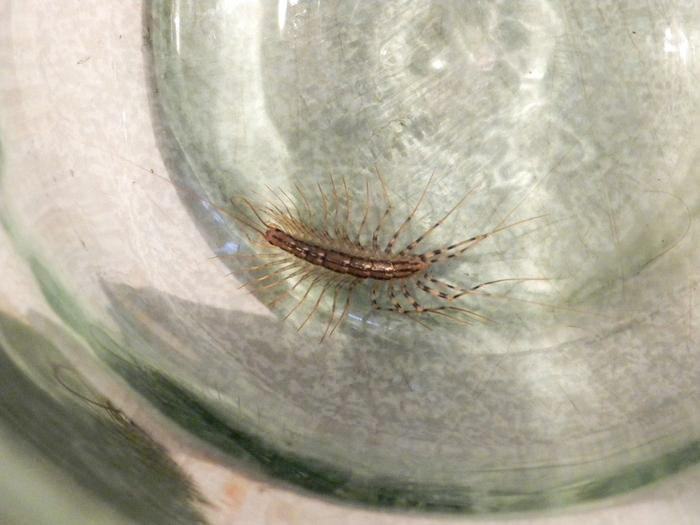
I woke up early today, sitting in the kitchen, fixing the primus stove and reading materials that my wonderful thesis students sent me. And then, out of the corner of my eye, I saw movement: across the kitchen, moving beautifully on long legs, came a scutigera. There was a glass on the table. I covered it with the glass, slid a sheet of paper underneath (carefully, so as not to pinch its legs), lifted it, and then transferred it into a jar (the glass still had some wine left in it, and I was afraid the scutigera might stick to it). So here it is. Scutigera coleoptrata (Linnaeus, 1758) - the house centipede. A Linnaean species, by the way (if it really is this one - and I wonder whether anyone seriously studies the systematics of scutigeras?).
In fact, the scutigera is a miracle of convergence, especially astonishing after insects began, based on genome analyses, to be grouped closer to crustaceans rather than to myriapods. Probably the scutigera is the pinnacle of myriapod evolution, independently acquiring many insect-like adaptations. What impresses me most are its complex compound eyes, efficient tracheal respiration, water-conserving integument, and fairly complex behavior. House centipedes can leap into the air and catch flying flies! In general, this is a Red Data Book animal with the status of "rare." Here, look at the page from the Red Data Book of Ukraine. The natural range of scutigeras in our country is the southern coast of Crimea.
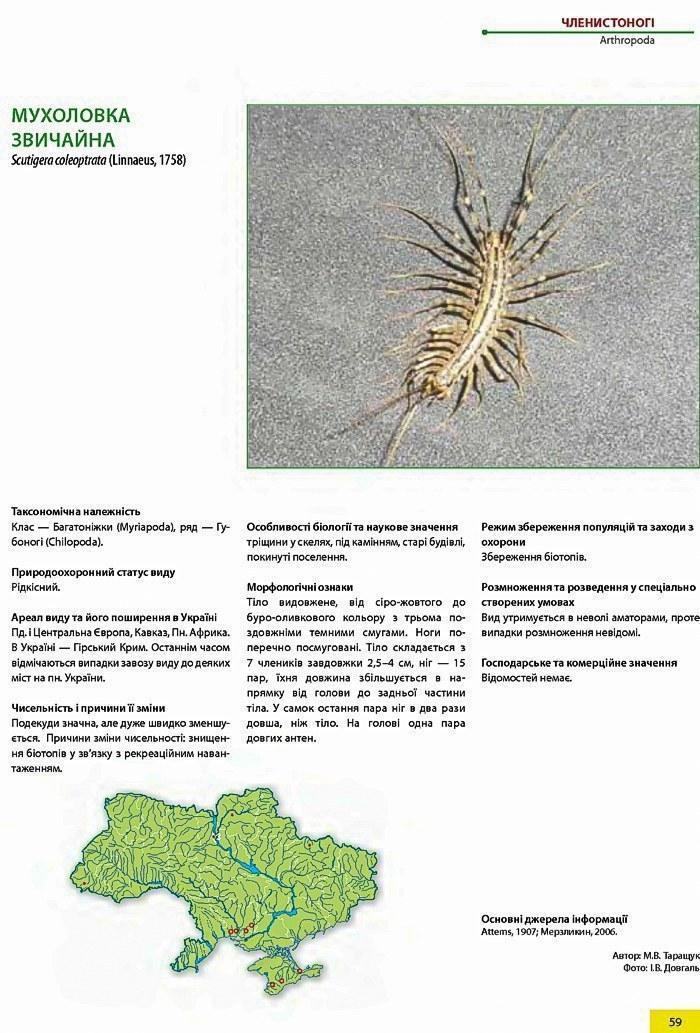
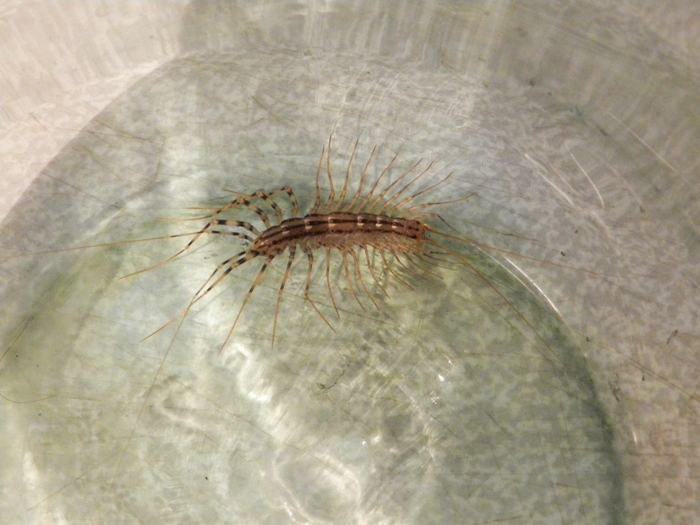
But apparently these animals are successfully colonizing many of our cities. The Red Data Book marks points corresponding to cities throughout Ukraine, including Kharkiv, without comment. There are plenty of them in Kharkiv - I have seen them myself no fewer than ten times, in different districts. These are not accidentally introduced individuals, but a successfully reproducing local population. By the way, since the scutigera is listed in the Red Data Book, a person who kills one in their home with a slipper is, in principle, supposed to pay a fine. Once I tried to catch Crimean and Kharkiv scutigeras, noticing some difference between the number of their segments and the size of their hind legs. Most likely these were young individuals differing by age. As they mature, the number of legs increases, and the hind legs, as I learned from the Red Data Book, differ between males and females. In the first photo in the jar, the head is pointing left; in the second, right.
Some time after I caught this animal, my wife and son woke up. I called them and showed it to them. I asked my wife to release the scutigera from the jar by first setting the jar down on a stool standing in the middle of the kitchen. When the scutigera reached the edge of the jar, it jumped, flew over the stool, ended up under the table, and immediately headed for the corner. Photographing it while it is moving is very difficult. Although it does not walk all that quickly, it still seems to be entirely in motion, shifting its many legs. My wife will be unhappy that I am showing the mess in the secluded corners of our apartment (well, not quite our own, since it is rented...).
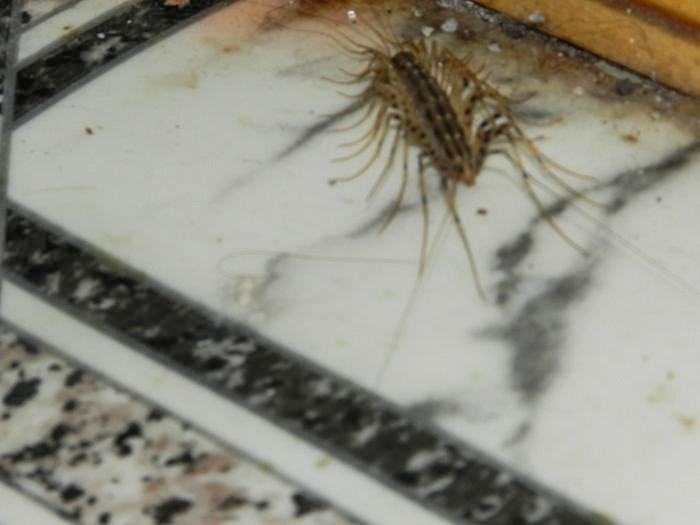
In any case, the scutigera ran to a secluded corner near the balcony door. I managed to switch on the flash. Look how it is rising up on its legs.
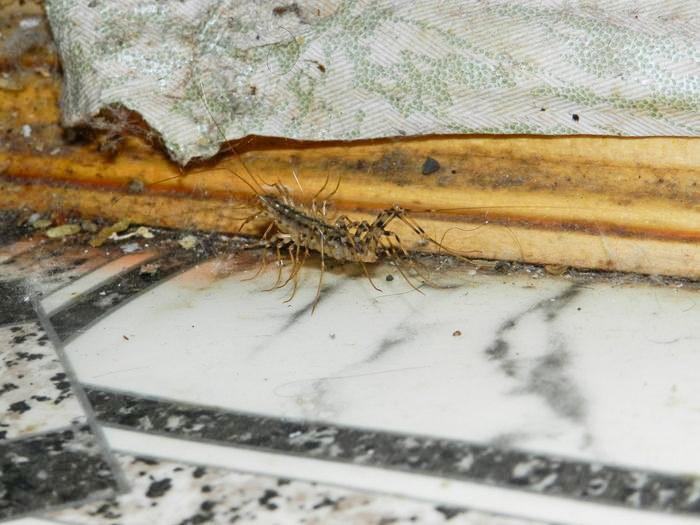
In the corner near the old refrigerator, which is used as a cabinet for home preserves, it is quite dusty and there is spiderwebbing (I also try to keep the spiders alive). The scutigera walks along the web very carefully, thoughtfully placing each leg. Thanks to that, I managed to catch it one last time with my flash.
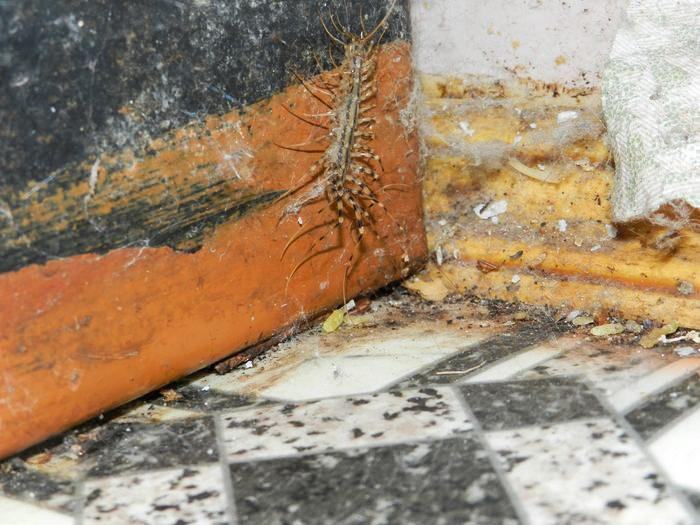
That’s all. So, you see, the scutigera has already left; I need to get back to my affairs, but I am left with a cheerful mood: what an amazing creature lives in our apartment!