

Ecology: biology of interaction. 4.17. (supplement) Intraspecific interaction strategies
It can be said that a significant portion of organisms lives in two fundamentally different environments: the external and the intra‑population ones. It might give the impression that a population — is an arena of struggle and uncompromising competition of all against all. Of course, this is not the case. Biology knows many examples of inter...
Ukrainian Language (latest version) / Russian Language (update stopped)
4.16. Population Size Regulation
D. Shabanov, M. Kravchenko. Ecology: The Biology of Interaction Chapter 4. Population Ecology
4.18. (addendum) How parasites 'frame' their hosts
4.17. (Addendum) Intrapopulation Interaction Strategies. It can be said that a significant portion of organisms live in two fundamentally different environments: the external and the intrapopulation. The intrapopulation environment is the totality of relationships between conspecifics, which is far from being exhausted by the examples below.
One of the most important mechanisms of intrapopulation population size regulation is territoriality – competition between individuals of a population for the use of space with all its resources. Usually, territoriality manifests itself in the defense of an individual territory. Most often, the area of this territory is larger than the minimum necessary for the survival of an individual or its family. In different organisms, territoriality manifests itself in different ways. Sometimes only males defend individual plots, sometimes pairs, and sometimes both males and females compete with each other for individual plots.
Have you ever wondered why songbirds sing? At the stage of pair formation, males sing to attract females. But when pairs are formed, nests are built, and chicks have hatched from eggs, the males continue to sing... At this stage, the males' singing indicates that the family territory is occupied. As strange as it may sound, in its biological essence, this behavior is quite close to the behavior of a domestic dog's male, who, during a walk with his owner on the other end of the leash, marks every corner of the house, pole, or tree with his urine. In most cases, territorial individuals know where their territory ends and where their neighbors' territories begin. The position of the border is the result of balancing the efforts of the owners of adjacent territories to expand their plots. Violation of a neighbor's territory causes clashes, and the outcome of these clashes usually depends on whose territory they occur on.
4.17. (supplement) Strategies of intra‑population interaction It can be said that a significant part of organisms lives in two fundamentally different environments: the external and the intra‑population one. The intra‑population environment is the set of relationships among conspecifics, which is far from being exhausted by the examples given below. One of the most important mechanisms of intra‑population regulation of numbers is territoriality—competition among individuals of a population for the use of space with all its resources. Often territoriality is manifested in the defense of an individual territory. Most often the area of this territory is larger than the minimum required for the survival of the individual or its family. In different organisms territoriality manifests in different ways. Sometimes only males guard individual patches, sometimes pairs, sometimes both males and females compete with each other for individual patches. Have you ever wondered why songbirds sing? At the pair‑formation stage, males sing to attract females. But once pairs are formed, nests built, chicks hatched, the males continue to sing… At this stage male singing indicates that the family patch is occupied. Strangely enough, biologically this behavior is quite similar to that of a domestic dog male, which during a walk with its owner marks every corner of the house, post or tree with urine at the far end of the leash. In most cases territorial individuals know where their patch ends and where the neighbors’ patches begin. The position of the border is the result of balancing the efforts of neighboring territory owners to expand their patches. Violation of another’s territory provokes clashes, and the outcome of these clashes usually depends on whose territory they occur in. “The complex of territorial behavior is by no means exhausted by direct attacks, fights, chases, etc. Moreover, such rigid forms of defense in their pure form are quite rare; almost always aggression is accompanied by ritualized behaviors: threat postures, specific acoustic signals, demonstration of attack without proceeding to physical contact, etc. The significance of the threat, for example, includes a certain horizontal tilt of the torso in a number of fish species, ‘raised’ postures of some tailless amphibians, head ‘nodding’, elevation and lowering of the anterior body part and spreading of the throat fold in iguanid lizards, diverse forms of display in various mammals. In the overwhelming majority of cases, threat displays are perceived by an individual that has entered a foreign patch as a signal to flee” (I.A. Shilov, 1998). Often in a territorial animal population not all individuals reproduce, but only those that possess an individual patch. “Wanderers” are forced to remain childless, awaiting the chance to occupy a territory that becomes available as a result of predator action or by taking over a patch from an aging territory owner. This behavior is an effective way to stabilize population size: at any moment as many individuals reproduce as there are individual patches on the given territory. Losses of patch owners are not critical: individuals from the “wanderer” pool, the population reserve, immediately take their place. Territoriality is not the only intra‑population mechanism limiting population growth. For example, in rodent mammals regulation of fecundity depending on density is carried out hormonally. At excessive population density, the number of contacts among conspecifics exceeds a certain threshold and triggers stress responses and hormonal rearrangements leading to reduced fecundity. The preceding exposition might give the impression that a population is an arena of struggle and uncompromising competition of all against all. Of course, this is not so. Biology knows many examples of mutual assistance and support within a population. It is especially interesting to understand the reasons for altruistic behavior, i.e., behavior in which one individual incurs some cost or even sacrifices its life for other individuals. The simplest way to grasp such behavior is, for example, a mother protecting her brood. Even if the mother dies, a situation is possible in which the total reproductive value (i.e., value for the future population) of the offspring is higher than the value of the mother herself. For instance, if a gene existed that compelled a mother to sacrifice her life for her children, such a gene could spread in the population thanks to the higher survival of the offspring of altruistic mothers. The foregoing reasoning aligns well with the spirit of sociobiology—the science that explains animal (and, in particular, human) behavior as the result of selection on genetically predetermined traits. The founder of sociobiology is considered to be the American insect‑behavior specialist Edward Wilson, who published in 1975 the book “Sociobiology: A New Synthesis”. The logic of this science is most easily illustrated by the example of kin selection described by one of the classics of sociobiology, William Hamilton. Hamilton was able to explain why altruistic behavior is most frequently observed in social Hymenoptera—bees, wasps and ants. The reason is that these insects have a rather unusual chromosomal sex‑determination system. A female of these insects can lay unfertilized eggs (with a single chromosome set), which develop into males, and fertilized eggs (with two sets), which develop into females. Usually the genetic similarity between parents and offspring, as well as among offspring themselves, is 1/2 (half the genes are identical, half are not). However, in Hymenoptera the situation is different. The similarity between a mother and her daughters is 1/2, but the similarity among sisters is 3/4 (because paternal inheritance consists of a single chromosome set, all daughters receive it completely). This means that a female will ensure better survival of her own genes if she cares for her sisters rather than for her own daughters! Apparently, these mechanisms are indeed the cause of the emergence of societies of social insects, where one female (queen) reproduces and the majority of individuals are sterile females that care for the queen’s offspring—i.e., their sisters. The described mechanism that underlies altruistic behavior operates only in females. And indeed, for example, in bees males (drones) do not participate in the collective activities of the family. Nevertheless, sociality in insects can arise not only on the basis of the described genetic mechanism. Evidence for this are termites. Their sociality likely has another cause—collective digestion, in which individuals must repeatedly consume each other’s feces to break down cellulose. By the way, in termites both females and males contribute equally to the “public” work. Sociobiology explains many astonishing features of insect behavior quite well, but it works somewhat less effectively when it comes to mammals. This may be due to several reasons, among them the fact that animals with flexible behavior apparently lack genes that rigidly predetermine a particular mode of action in a given situation. The applicability of sociobiological conclusions to human behavior remains a subject of fierce scientific and pseudo‑scientific debate. For example, practically all offspring in a baboon troop belong to several dominant individuals (matriarchs) who, by pooling their efforts, keep subordinate males in a submissive state (in particular, preventing them from mating with females). Periodically, as the matriarchs age, “revolutions” occur in the baboon group: subordinates jointly “overthrow” the old matriarchs and gain priority access to food and females. However, in the face of external danger (e.g., a leopard attack), both dominants and subordinates combine their defensive efforts and often sacrifice their lives to protect the group (see Fig. 4.17.1). From a sociobiological perspective, a young male who gives his life for the group before having produced offspring acts “incorrectly”. Yet if we consider this situation not from the viewpoint of selection on individual genes but from the perspective of the male’s psychology—both as a leader and as one who has not achieved dominant status—we can understand the willingness of a monkey to drive a predator away from the herd at any cost. [IMG_1] Fig. 4.17.1. In baboons, a capacity of barren males to self‑sacrifice to protect the troop has been recorded. The simplified marching order of baboons (A) and their formation during a predator attack (B) are shown.
Usually, in a territorial animal population, not all individuals reproduce, but only those who possess an individual territory. "Vagrants" are forced to remain childless, waiting for an opportunity to occupy a territory vacated due to the actions of a predator or taken from an aging owner. Such behavior is an effective way to stabilize population size: at any given moment, as many individuals reproduce as there are individual territories in a given area. Losses of territory owners are not critical: individuals from the "vagrant" population reserve immediately take their place. Territoriality is not the only intrapopulation mechanism that limits population growth. For example, in murid rodents, fertility regulation depending on density is carried out hormonally. At excessive population density, the number of contacts between conspecifics exceeds a certain limit and causes a stress reaction and hormonal changes that lead to a decrease in fertility.
From the above, it might seem that a population is an arena of struggle and uncompromising competition of all against all. Of course, this is not the case. Biology knows many examples of mutual aid and support within a population. It is especially interesting to understand the reasons for altruistic behavior, i.e., behavior where one individual causes harm or even sacrifices its life for the sake of other individuals. It is easiest to understand such behavior when, for example, it concerns a mother protecting her brood. Even if the mother dies, a situation is possible where the overall reproductive value (i.e., value for the future population) of the offspring is higher than the value of the mother herself. For example, if there were a gene that forced a mother to sacrifice her life for her children, such a gene could spread in the population due to the better survival of the children of altruistic mothers.
4.17. (supplement) Strategies of intra‑population interaction It can be said that a significant part of organisms lives in two fundamentally different environments: the external and the intra‑population one. The intra‑population environment is the set of relationships among conspecifics, which is far from being exhausted by the examples given below. One of the most important mechanisms of intra‑population regulation of numbers is territoriality—competition among individuals of a population for the use of space with all its resources. Often territoriality is manifested in the defense of an individual territory. Most often the area of this territory is larger than the minimum required for the survival of the individual or its family. In different organisms territoriality manifests in different ways. Sometimes only males guard individual patches, sometimes pairs, sometimes both males and females compete with each other for individual patches. Have you ever wondered why songbirds sing? At the pair‑formation stage, males sing to attract females. But once pairs are formed, nests built, chicks hatched, the males continue to sing… At this stage male singing indicates that the family patch is occupied. Strangely enough, biologically this behavior is quite similar to that of a domestic dog male, which during a walk with its owner marks every corner of the house, post or tree with urine at the far end of the leash. In most cases territorial individuals know where their patch ends and where the neighbors’ patches begin. The position of the border is the result of balancing the efforts of neighboring territory owners to expand their patches. Violation of another’s territory provokes clashes, and the outcome of these clashes usually depends on whose territory they occur in. “The complex of territorial behavior is by no means exhausted by direct attacks, fights, chases, etc. Moreover, such rigid forms of defense in their pure form are quite rare; almost always aggression is accompanied by ritualized behaviors: threat postures, specific acoustic signals, demonstration of attack without proceeding to physical contact, etc. The significance of the threat, for example, includes a certain horizontal tilt of the torso in a number of fish species, ‘raised’ postures of some tailless amphibians, head ‘nodding’, elevation and lowering of the anterior body part and spreading of the throat fold in iguanid lizards, diverse forms of display in various mammals. In the overwhelming majority of cases, threat displays are perceived by an individual that has entered a foreign patch as a signal to flee” (I.A. Shilov, 1998). Often in a territorial animal population not all individuals reproduce, but only those that possess an individual patch. “Wanderers” are forced to remain childless, awaiting the chance to occupy a territory that becomes available as a result of predator action or by taking over a patch from an aging territory owner. This behavior is an effective way to stabilize population size: at any moment as many individuals reproduce as there are individual patches on the given territory. Losses of patch owners are not critical: individuals from the “wanderer” pool, the population reserve, immediately take their place. Territoriality is not the only intra‑population mechanism limiting population growth. For example, in rodent mammals regulation of fecundity depending on density is carried out hormonally. At excessive population density, the number of contacts among conspecifics exceeds a certain threshold and triggers stress responses and hormonal rearrangements leading to reduced fecundity. The preceding exposition might give the impression that a population is an arena of struggle and uncompromising competition of all against all. Of course, this is not so. Biology knows many examples of mutual assistance and support within a population. It is especially interesting to understand the reasons for altruistic behavior, i.e., behavior in which one individual incurs some cost or even sacrifices its life for other individuals. The simplest way to grasp such behavior is, for example, a mother protecting her brood. Even if the mother dies, a situation is possible in which the total reproductive value (i.e., value for the future population) of the offspring is higher than the value of the mother herself. For instance, if a gene existed that compelled a mother to sacrifice her life for her children, such a gene could spread in the population thanks to the higher survival of the offspring of altruistic mothers. The foregoing reasoning aligns well with the spirit of sociobiology—the science that explains animal (and, in particular, human) behavior as the result of selection on genetically predetermined traits. The founder of sociobiology is considered to be the American insect‑behavior specialist Edward Wilson, who published in 1975 the book “Sociobiology: A New Synthesis”. The logic of this science is most easily illustrated by the example of kin selection described by one of the classics of sociobiology, William Hamilton. Hamilton was able to explain why altruistic behavior is most frequently observed in social Hymenoptera—bees, wasps and ants. The reason is that these insects have a rather unusual chromosomal sex‑determination system. A female of these insects can lay unfertilized eggs (with a single chromosome set), which develop into males, and fertilized eggs (with two sets), which develop into females. Usually the genetic similarity between parents and offspring, as well as among offspring themselves, is 1/2 (half the genes are identical, half are not). However, in Hymenoptera the situation is different. The similarity between a mother and her daughters is 1/2, but the similarity among sisters is 3/4 (because paternal inheritance consists of a single chromosome set, all daughters receive it completely). This means that a female will ensure better survival of her own genes if she cares for her sisters rather than for her own daughters! Apparently, these mechanisms are indeed the cause of the emergence of societies of social insects, where one female (queen) reproduces and the majority of individuals are sterile females that care for the queen’s offspring—i.e., their sisters. The described mechanism that underlies altruistic behavior operates only in females. And indeed, for example, in bees males (drones) do not participate in the collective activities of the family. Nevertheless, sociality in insects can arise not only on the basis of the described genetic mechanism. Evidence for this are termites. Their sociality likely has another cause—collective digestion, in which individuals must repeatedly consume each other’s feces to break down cellulose. By the way, in termites both females and males contribute equally to the “public” work. Sociobiology explains many astonishing features of insect behavior quite well, but it works somewhat less effectively when it comes to mammals. This may be due to several reasons, among them the fact that animals with flexible behavior apparently lack genes that rigidly predetermine a particular mode of action in a given situation. The applicability of sociobiological conclusions to human behavior remains a subject of fierce scientific and pseudo‑scientific debate. For example, practically all offspring in a baboon troop belong to several dominant individuals (matriarchs) who, by pooling their efforts, keep subordinate males in a submissive state (in particular, preventing them from mating with females). Periodically, as the matriarchs age, “revolutions” occur in the baboon group: subordinates jointly “overthrow” the old matriarchs and gain priority access to food and females. However, in the face of external danger (e.g., a leopard attack), both dominants and subordinates combine their defensive efforts and often sacrifice their lives to protect the group (see Fig. 4.17.1). From a sociobiological perspective, a young male who gives his life for the group before having produced offspring acts “incorrectly”. Yet if we consider this situation not from the viewpoint of selection on individual genes but from the perspective of the male’s psychology—both as a leader and as one who has not achieved dominant status—we can understand the willingness of a monkey to drive a predator away from the herd at any cost. [IMG_1] Fig. 4.17.1. In baboons, a capacity of barren males to self‑sacrifice to protect the troop has been recorded. The simplified marching order of baboons (A) and their formation during a predator attack (B) are shown.
However, sociality in insects is possible not only based on the described genetic mechanism. Termites are proof of this. Probably, the reason for their sociality is different – collective digestion, during which, to break down cellulose, individuals are forced to repeatedly eat each other's excrement. By the way, in termites, both females and males contribute equally to "public" work.
While excellently explaining many surprising features of insect behavior, sociobiology "works" somewhat worse when, for example, it comes to mammals. This can be due to many reasons, including the fact that animals with flexible behavior seem to lack genes that rigidly predetermine a particular course of action in a certain situation. The applicability of sociobiological conclusions to the description of human behavior remains a subject of fierce scientific and pseudo-scientific debate.
For example, practically all offspring in a troop of baboons belong to a few dominant males (leaders), who, by combining their efforts, keep subordinate males in a subordinate state (including forbidding them to mate with females). Periodically, as the leaders age, "revolutions" occur in the baboon group: subordinates jointly "overthrow" the old leaders and gain priority access to food and females. However, in case of external danger (e.g., a leopard attack), both dominant and subordinate males unite their defensive efforts and quite often sacrifice their lives protecting the group (Fig. 4.17.1). From the perspective of sociobiology, a young male who gives his life for the group before he has left offspring acts "incorrectly." However, if we consider this situation not from the perspective of individual gene selection, but from the perspective of the male's psyche, as a leader or one who has not yet achieved leadership status, it becomes "understandable" why a monkey is willing to drive away a predator from the pack at any cost.
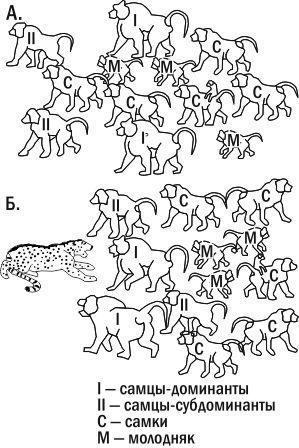
Fig. 4.17.1. In baboons, the ability of childless males to make self-sacrifices to protect the troop has been recorded. Here, the marching order of baboons (A.) and their formation during a predator attack (B.) are shown simplified.
4.16. Population Size Regulation
D. Shabanov, M. Kravchenko. Ecology: The Biology of Interaction Chapter 4. Population Ecology
4.18. (addendum) How parasites 'frame' their hosts